



Kostel svatého Bartoloměje v Kolíně Church
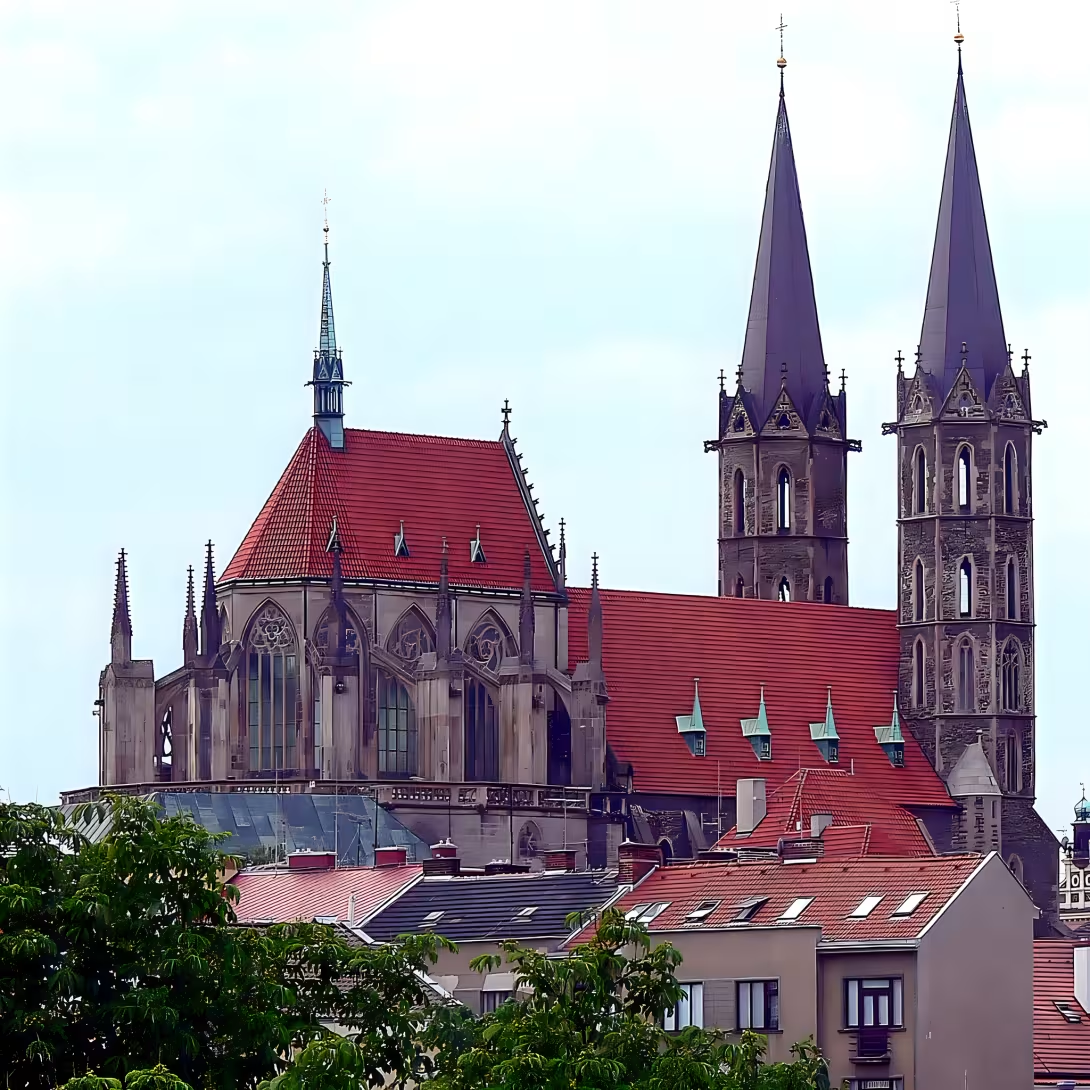
The Church of Saint Bartholomew in Kolín, also known as the Cathedral of Saint Bartholomew, is a prominent Roman Catholic parish church and the main church of the Kolín parish. Located in Kolín I within the Středočeský kraj region, this imposing Gothic structure dominates the cityscape and is recognized as a significant sacred building in Kolín.
Constructed initially in the second half of the 13th century, it features a three-nave layout with twin octagonal western towers from its original phase. The church underwent major renovations by architect Petr Parléř in the 14th century, adding a high 'cathedral' choir and surrounding chapels.
The origins of the Church of Saint Bartholomew trace back to shortly after Kolín became a royal city in the mid-13th century, likely founded by King Přemysl Otakar II. This period was marked by significant architectural and cultural development under his rule. The church's initial construction reflected contemporary Saxon, Thuringian, and Northern French architectural influences, characterized by early Gothic style with twin octagonal towers.
Architecturally, the church began as a simple early Gothic structure. In the 14th century, Petr Parléř significantly transformed it by constructing a high choir in place of the original presbytery. The northern tower faced structural issues and was reinforced with an independent bell tower in 1504. A major purist restoration led by architect Josef Mocker took place in the late 19th century, further enhancing its architectural significance.
Throughout its history, the church has seen various owners and administrators, including notable figures such as King Přemysl Otakar II and Emperor Charles IV, who directed Petr Parléř to restore the church after it burned down in 1349. The renovated church was consecrated in 1378. A large bell named Vužan, cast from a high silver content alloy and adorned with a gold hoop, hung on the southern tower until its destruction in a fire in 1796. An astronomical clock transferred to the bell tower's wall in 1728 had been mentioned as early as 1494.
Today, the Church of Saint Bartholomew remains a vital cultural and historical site. It is listed as a national cultural monument, reflecting its enduring significance. Visitors can explore its rich architectural details, including the original Gothic elements and later additions by Petr Parléř. The church's history and artistic features make it a worthwhile destination for those interested in exploring the heritage of Kolín.
The Church of Saint Bartholomew stands as a testament to the historical and cultural evolution of Kolín. Its architectural grandeur and storied past offer a unique glimpse into the region's rich heritage, making it an essential visit for anyone exploring this part of the Czech Republic.
Then and now
Drag the slider to compare how the landmark may have looked when it was built with the view today.
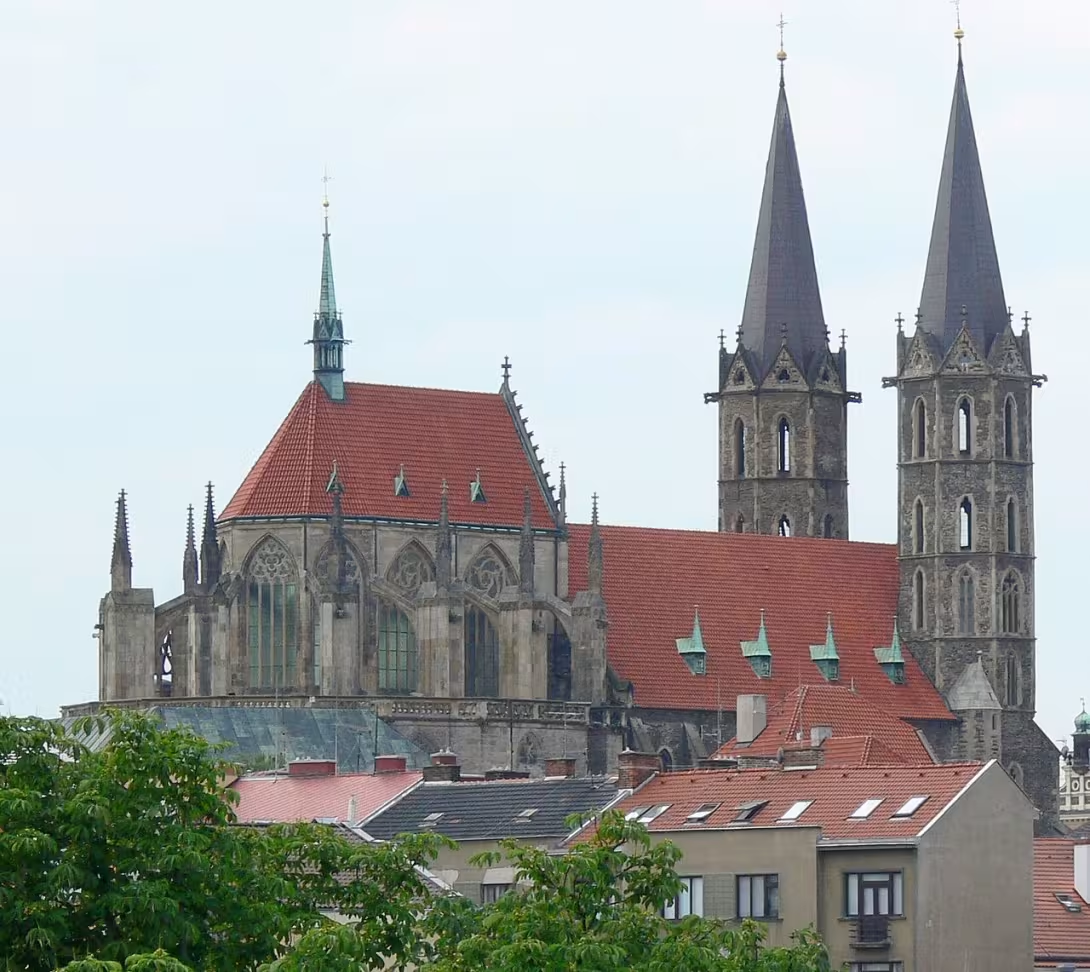

The historical appearance on the left is an AI-generated visualisation and serves as inspiration only.
Historical milestones
- 1300
- Construction of the church's original structure was completed.
- 1360
- Petr Parléř began restoration work after a fire destroyed the church.
- 1378
- The renovated church was consecrated.
- 1504
- An independent bell tower was added due to structural issues with the northern tower.
Architectural development
The Church of Saint Bartholomew began as a simple early Gothic structure with twin octagonal towers, reflecting contemporary Saxon, Thuringian, and Northern French architectural influences. In the 14th century, Petr Parléř significantly transformed it by constructing a high choir in place of the original presbytery. The church's northern tower was reinforced with an independent bell tower in 1504 due to structural issues. A major purist restoration led by architect Josef Mocker took place in the late 19th century, similar to renovations at Prague Cathedral and Karlštejn Castle.
Historical events
The church was likely founded shortly after Kolín became a royal city in the mid-13th century by King Přemysl Otakar II.
In 1349, the church burned down and was restored under the direction of Petr Parléř starting in 1360. The renovated church was consecrated in 1378.
Points of interest
- The Church of Saint Bartholomew's astronomical clock was mentioned as early as 1494, making it one of the oldest references to such a device in the region. This predates its installation on the bell tower wall by over two centuries.
- A large bell named Vužan, known for its high silver content alloy and gold hoop, hung in the southern tower until it was destroyed by fire in 1796. The loss of this bell marked a significant event in the church's history due to its unique composition and craftsmanship.
- Emperor Charles IV played a crucial role in the church’s restoration after it burned down in 1349, commissioning Petr Parléř for the task. This connection highlights the church's importance within the Holy Roman Empire during his reign.
- The northern tower of the Church of Saint Bartholomew faced structural issues and was reinforced with an independent bell tower in 1504. This adaptation reflects the ongoing architectural challenges and solutions throughout its history.
- Architect Josef Mocker conducted a major purist restoration in the late 19th century, enhancing the church's architectural significance by preserving its Gothic elements while updating it to contemporary standards of that era.
Guide
This guide is narrated by a synthetic voice generated by artificial intelligence.
Show guide text
This text was created by artificial intelligence and has not been editorially reviewed. It may contain inaccuracies.
The Church of Saint Bartholomew is the main parish church in Kolín and a powerful Gothic landmark of the city. Since 1995, its premises have been designated a national cultural monument.
The early Gothic church was built probably shortly after the royal city was founded in the middle of the 13th century. However, another church had stood here before, as archaeological finds show. The founder was most likely King Přemysl Otakar the Second. The construction was initially led by the Premyslid building workshop, which drew from Saxon, Thuringian, and North French models. Before the year 1300, two slender octagonal towers on the western façade were completed. They are 66 meters high and originally served as bell towers.
In 1349 the church burned down. Charles the Fourth then in 1360 summoned his court architect Peter Parléř to oversee the reconstruction, who was already directing the construction of the Cathedral of Saint Vitus in Prague at that time. On the site of the original presbytery, Parléř built a new, high choir of cathedral type with a ring of chapels. The restored church was consecrated in 1378.
By the end of the 15th century, the ringing of bells had compromised the structural integrity of the north tower. In 1504, an independent pyramidal bell tower was therefore created and the bells were moved into it. Until 1756 they hung with their opening facing upward. In 1728, the astronomical clock was also transferred here from the north tower. On the south tower hung the bell Vužan, with a high silver content and hoops made of pure gold. It was guarded as one of the city's greatest treasures. Both the bell and the astronomical clock were destroyed by a major city fire in 1796.
In the second half of the 19th century, architect Josef Mocker led an extensive purist reconstruction, completed in 1910. In 1945 the church was damaged by a bomb during an air raid. General reconstruction began in 1963 and continues to this day.
The lower western part is an early Gothic three-aisled basilica with an external buttress system. Above the original western entrance is a circular Gothic rose window. The tympanum of one of the two north portals is a copy. The original from the 13th century is now in the Lapidary of the National Museum in Prague. From the south is adjoined the Kokovská chapel with an altar of Our Lady of Sorrows.
Around Parléř's presbytery is the sacristy and six chapels, which were once maintained by city guilds: the Millers' Chapel, the Maltsters' Chapel, the Butchers' Chapel, the Sperlingovs' Chapel, the Saint John Chapel, and the Saint Wenceslaus Chapel. John the Second Žehrovský of Kolovrat is buried in the Maltsters' Chapel. He was a military captain of the city and participated in the peaceful expedition of King George of Poděbrady. The neo-Gothic main altar from the beginning of the 20th century was created by students of the sculptural school in Hořicích. Beneath the presbytery lies a crypt.
Tips for visitors
The best time to visit the Church of Saint Bartholomew in Kolín is during late spring or early fall when the weather is pleasant, allowing you to comfortably explore both the church and its surroundings. These seasons offer good natural lighting for photography and fewer crowds compared to summer months. Additionally, visiting on a weekday can provide a more tranquil experience, as weekends tend to attract larger groups of tourists.
For transportation, Kolín is accessible by car with parking available nearby, though it's advisable to check the current availability and any restrictions in advance. Public transport options are also convenient, including buses that connect Kolín with other parts of Středočeský kraj. For those using public transit, checking a reliable travel app or website for up-to-date schedules is recommended.
When planning your visit, consider bringing comfortable walking shoes and weather-appropriate clothing, as you may want to explore the area around the church. A camera or smartphone with a good camera can help capture the stunning Gothic architecture of the Church of Saint Bartholomew. Additionally, carrying a water bottle is advisable, especially during warmer months.
Photography enthusiasts will find several spots within and around the church that offer excellent views. The interior provides dramatic lighting conditions, particularly in the morning when sunlight streams through the stained glass windows. Outside, capturing the façade of the church against the backdrop of Kolín's skyline can be rewarding, especially during golden hour.
For families with children visiting the Church of Saint Bartholomew, consider extending your trip to include nearby attractions within a 30-minute drive. The Kolín Zoo offers an engaging experience for kids and is located not far from the city center. Additionally, exploring the local parks can provide a relaxing break and opportunities for outdoor play.
Frequently asked questions
Can the monument be visited?
Yes. We verified the opening hours or admission on the official website (29. 9. 2026); you will find them in the visitor information on this page. Please double-check with the operator before you travel. According to the heritage register restoration is under way, so access may be restricted.
What are the opening hours and admission?
Details verified on the official website (29. 9. 2026) are listed in the visitor information on this page. Official website: https://www.bartolomej-kolin.cz
Where is the monument?
Location: Brandlova, Kolín I, Kolín, Středočeský kraj. The map on this page shows the exact spot.
Why is the monument protected?
It is listed in the Central List of Cultural Monuments of the Czech Republic as a national cultural monument (register no. 184).
Businesses nearby
Do you run a restaurant, accommodation, shop, museum, rental, wellness or other visitor service near this monument? Show yourself directly to the people heading to it — this is how they will see you in the app and on the web:
Accommodation nearby
Trips and activities nearby
Guided tours, tickets and activities nearby from GetYourGuide
Affiliate link: if you buy from the partner, we may receive a commission. The price for you does not change.
Search tours and activities →Themed route
Thematic Walking Tour: Kolín I, Central Bohemian Region
1. Kostel svatého Bartoloměje (Church of Saint Bartholomew) - Type: Historical Church - Why Visit: This stunning example of Gothic architecture is the centerpiece of our tour. The church boasts intricate stone carvings and a rich history that dates back to the 13th century, making it a must-see for anyone interested in historical architecture and religious heritage.
2. Náměstí Svobody (Freedom Square) - Type: Public Square - Why Visit: Located just a short walk from the church, Freedom Square is an ideal spot to relax and soak in the local atmosphere. The square features beautiful landscaping and provides a peaceful setting for visitors to reflect on their experience at the church.
3. Kolínský zámek (Castle of Kolín) - Type: Historical Castle - Why Visit: Although not within walking distance, this castle is worth the brief journey from Freedom Square. The Kolínský zámek offers a glimpse into medieval life and architecture with its well-preserved structures and historical significance in the region.
4. Městské muzeum (City Museum) - Type: Museum - Why Visit: Situated near the castle, this museum provides an insightful look into the history of Kolín I. Exhibits cover a wide range of topics from local traditions to historical events, offering visitors a deeper understanding of the area's cultural heritage.
This tour offers a comprehensive exploration of Kolín I’s rich historical and cultural offerings, starting with its iconic church and extending through significant landmarks in close proximity.
Seasonal recommendations
Spring: Visiting the Church of St. Bartholomew during spring offers a unique experience as nature begins to awaken, with blooming flowers and fresh greenery surrounding the historic site. The soft morning light enhances the intricate details of the church's architecture, providing an ideal time for photography enthusiasts. This season often sees fewer tourists compared to summer, allowing for a more tranquil exploration. Visitors are advised to wear comfortable layers as temperatures can vary; mornings might be cool while afternoons warm up. Arriving early is recommended to enjoy the site with minimal crowds and to fully appreciate the serene atmosphere.
Summer: The Church of St. Bartholomew shines in summer, bathed in long daylight hours that illuminate its Gothic features beautifully. This season attracts more visitors due to favorable weather conditions, making it a popular time for sightseeing in Kolín. While the vibrant sunsets can offer breathtaking views, they also mean larger crowds and longer lines at peak times. To make the most of your visit, consider arriving early or later in the day when it's less crowded. Light clothing is advisable to stay comfortable during the warm days, but don't forget a hat and sunscreen for protection against the sun.
Autumn: Autumn provides a stunning backdrop for visiting the Church of St. Bartholomew, with its rich tapestry of reds, oranges, and yellows that contrast beautifully against the historic architecture. The cooler temperatures make it an ideal time to explore without the summer heat, while still enjoying plenty of daylight hours. This season often sees fewer tourists than summer, offering a more peaceful visit. Visitors should dress in layers to accommodate fluctuating temperatures throughout the day and consider bringing a light jacket for the crisp evenings.
Winter: Winter transforms the Church of St. Bartholomew into a picturesque scene with snow-covered surroundings that enhance its Gothic beauty. The shorter daylight hours mean visits need to be planned earlier in the day, but the early morning light can create magical photo opportunities. It's important to dress warmly, as temperatures can drop significantly, and check opening times which may vary during this season due to weather conditions. Despite potentially fewer visitors, it's advisable to prepare for longer waits on particularly cold days when access might be limited by weather-related closures.
Visualizations and artistic views


The visualisations are generated by artificial intelligence and serve as inspiration.
Photos from the area
Real photos taken near the monument


Zdroj a licence jsou uvedeny u každého snímku.
Atmosphere of the place
This atmospheric visualisation of the place and period was generated by artificial intelligence. It is not real footage of the location.
Tips from visitors
No tips yet. Be the first!
Log in and add your tip.
Sources and literature
Photos: Pajast / CC0, rozlišení zvýšeno umělou inteligencí — Wikimedia Commons. The author and licence also appear when you hover over the image.
Faktickým podkladem tohoto textu byl článek na Wikipedii, jehož autory jsou přispěvatelé Wikipedie. Článek je dostupný pod licencí CC BY-SA 4.0.
Location on the map
More monuments – Kolín I
Show all in the municipality

Příběhy a pověsti
Legendy, pověsti a příběhy spjaté s touto památkou

Fotografie návštěvníků
Zatím žádné fotografie. Buďte první, kdo přidá fotografii z návštěvy!
Log in a přidejte svou fotografii nebo hodnoťte.
Za ověřenou návštěvu v aplikaci získáte víc bodů — poznáme podle GPS, že jste na místě.
Reviews and comments