



Kostel svatého Jana Křtitele (Dolní Hbity) Church
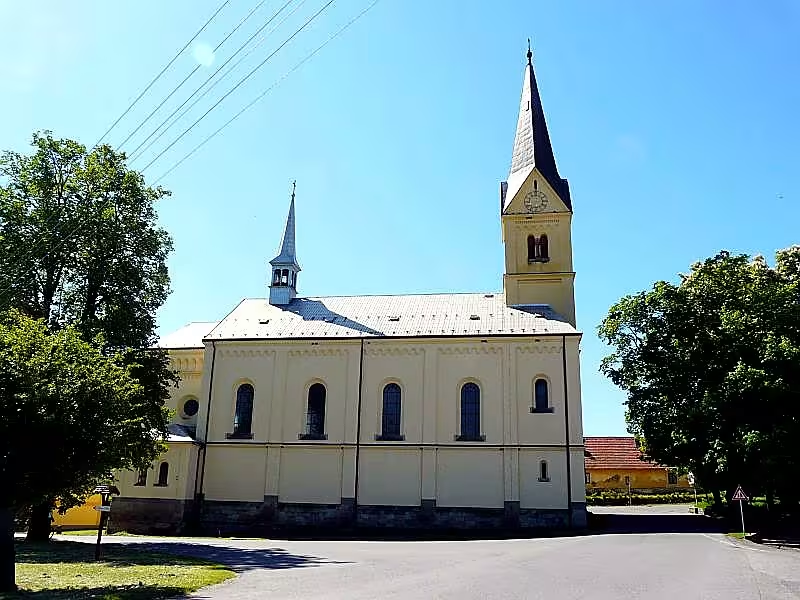
St. John the Baptist Church is a new Romanesque building in the village Dolní Hbity, district Příbram. The construction has become a dominant part of the village, which can be seen from all directions and which has a major influence on its character. Since 1998, the church has been protected as a cultural monument of the Czech Republic.
The church stands out for its precious size. The number and quality of the area belongs to the third largest temples in the district of Příbram, overcome only by churches in Příbrami and Bohtěna. This position shows the historical importance of the village and the attention given to the cult and architecture by the believers.
Special attention should be paid to the organ that was built in the church by the renowned Prague organist Karel Vocelka. Their quality manifests itself on both the level of the voice and the appearance - their appearance is appropriately involved in the perception of the church interior and its proportions. Their size is in proportion to the construction they decorate.
The organ went through a dramatic and enlightening history. The First World War was a threat to their existence. First, two copper drums had to be delivered to the state. The whistle itself became a threat, because it was tin, which was metal normally confiscated for war purposes. They were dismantled in February 1918. But then the vicar tried to help the organ and used his position to save it. He ordered that the whistles should not be processed immediately, and delayed many months of dispatch. In the end, however, they were crushed, but they managed to ensure that they remained in the Lower Hbits until the end of the war.
The sale of dismantled tin pipes brought CZK 9,600, which enabled the purchase of new ones. These new pipes were no longer tin - the choice fell on zinc, which was better available. Their price was CZK 3,500 and they were carefully tuned in 1920. In this way, the organ maintained its function in the liturgy of the church.
Another test was the damage they suffered in the tower fire in 1968. When they were extinguished, they were filled with water that caused the emergency. The repair came in 1969 when it was performed by the organist Miroslav Heger from nearby Horovice. So the organ was restored and returned to life.
Today, the church of St. John the Baptist remains a rare testimony not only about architecture and art, but also about how the MMMC was resisting the loss of their cultural heritage in difficult times. The organ represents a link between the tradition of the Czech organist and the history of the region.
Then and now
Drag the slider to compare how the landmark may have looked when it was built with the view today.
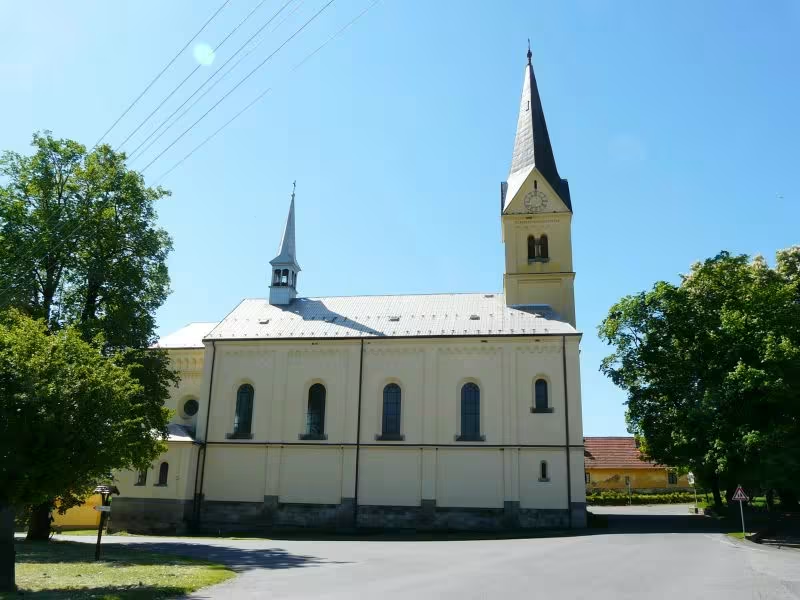

The historical appearance on the left is an AI-generated visualisation and serves as inspiration only.
Historical milestones
- 1868
- The decision to build a new church in the old place.
- 1872
- Finishing the construction of the New Romanesque church.
- 1918
- Dismantling of tin pipe organ for war purposes, subsequent purchase of new pipes in 1920.
- 1998
- Registration of the church in the list of cultural monuments of the Czech Republic.
Architectural development
The church was built in 1868-1872 as a monumental one-boat building with a half-circle priestry and a prism tower. The facade is significantly neo-Romanesque, with typical elements of historical architecture. The institutions of Charles Vocelka from 1920 are one of the most important parts of the interior. After the fire in 1968, the organ was repaired in 1969.
Historical events
- 1868
- The beginning of the construction of the New Romanesque church in the place of an older shrine.
- 1918
- Dismantling of tin pipe organ for the needs of World War I, subsequent purchase of new zinc pipes in 1920.
- 1968
- The fire of the church tower, in which water flowed into the organ and caused damage.
Points of interest
- The church of St. John the Baptist is the dominant part of the village Dolní Hbity and one of the largest buildings of its kind in the district Příbram, after the churches in Příbrami and Bohtěna.
- The organ in the church was made by renowned Prague organist Karel Vocelka, whose quality and appearance fit harmoniously into the interior.
- During World War I, the organ was threatened by confiscation of tin pipes that were confiscated for war purposes. But the priest tried to postpone their destruction.
- After crushing the original pipes, they were replaced by new zinc in 1920, which were tuned and reinserted into liturgical use.
- The organ suffered damage in the tower fire in 1968 when the water flowed into it. The organist Miroslav Heger of Hořovice did the repair in 1969.
Guide
This guide is narrated by a synthetic voice generated by artificial intelligence.
Show guide text
This text was created by artificial intelligence and has not been editorially reviewed. It may contain inaccuracies.
The Church of Saint John the Baptist in Dolní Hbity in the Příbram district is a Neo-Romanesque building. It is the dominant feature of the village no matter which direction you approach it from, and it gives the village its character. Since 1998 it has been protected as a cultural monument of the Czech Republic. It is also among the largest churches in the surrounding area. In the Příbram district, only the churches in Příbram and in Bohutín are larger.
The church's organs are proportionate to its size. They were made by Prague organ builder Karel Vocelka. They are excellent in sound and appearance and significantly influence the overall impression of the interior.
The organs went through difficult times during the First World War. First, two copper kettledrums had to be handed over. Then it was the turn of the pipes, because they were made of tin, and tin was being seized at that time for the benefit of the state. In February 1918 the organ pipes were dismantled. The parish priest at the time tried to save them. He insisted that they not be crushed immediately into boxes, and for months he delayed their dispatch. In the end, he did have to let them be crushed, but he managed to keep them in Dolní Hbity until the end of the war.
After the war, the crushed pipes were sold for 9,600 crowns. With this money, new pipes were purchased, this time made of zinc instead of tin. They cost 3,500 crowns and were installed and tuned in the organs in 1920.
Another disaster came in 1968 when the church tower caught fire. Water leaked into the organs during the firefighting efforts and damaged them. They were repaired in 1969 by Miroslav Heger from Hořovic.
Tips for visitors
The best time to visit the church of St. John the Baptist in Lower Hbits is during the morning hours of the week when it is quiet and you can see the interior without crowds. If you prefer a pleasant light for photography, come here in autumn or spring, when the sun rays illuminate the facade of the church from a pleasant angle. In winter there is a charm of snow and calm, but know that some roads can be difficult to access.
It is recommended to arrive by car because public transport to the village is not very common. The current connection and transport options can be found in the transport search engine.
When visiting the church, wear comfortable clothes and shoes as some parts of the church can be covered with paving or stone. The interior is cold, so bring a light sweater or coat. Children can take a small laptop or a book with you so that they can fill something out during the visit while adults are looking at the memory.
Photography in the church is allowed, but avoid flashing lightning that can damage sensitive paintings and frescoes. The best places for photos are the facade of the church with a prism tower and interior with new Romanesque elements. For the most beautiful light choose the time around the morning or afternoon hours when the sun illuminates the facade from the side.
In the vicinity of the Lower Hbit is worth visiting the city Příbram, which is only about 15 kilometers away. Příbram offers a rich history with significant cultural monuments such as the historical core of the city with city hall and churches. Another interesting thing is the village of Bohtún, which lies about ten kilometres from the Lower Hbit. Bohutun is famous for his larger church and picturesque environment, which lovers of peaceful walks will love.
For families with children, a visit to the church of St. John the Baptist in Lower Hbits is a great opportunity to learn about history and architecture. Children can see the tall tower and try to guess how tall it is. It is also possible to find small forest trails around the church where children can run and explore nature. It is also recommended to visit Příbram, where historical monuments and possibilities for active spending time are interesting for children.
Frequently asked questions
Can the monument be visited?
Religious buildings are usually open mainly during services; at other times a visit is normally arranged with the parish or the operator. We have not verified specific times.
Where is the monument?
Location: Dolní Hbity, Středočeský kraj. The map on this page shows the exact spot.
Why is the monument protected?
It is listed in the Central List of Cultural Monuments of the Czech Republic as a cultural monument (register no. 49612/2-4392).
For kids
Imagine going back to a time when our country was full of secrets and legends. And at that very time, there was a church of St. John the Baptist in Lower Hbits.
Is this what it looked like? The town was small and quiet, surrounded by fields and forests. People have lived here since ancient times, fed on agriculture and trade. And above this idyllic was the church of St. John the Baptist, which was the place of prayer and assembly.
Businesses nearby
Do you run a restaurant, accommodation, shop, museum, rental, wellness or other visitor service near this monument? Show yourself directly to the people heading to it — this is how they will see you in the app and on the web:
Nearby
- Near-lying city with historical core and significant cultural monuments.
- Another important village with a church that is bigger than the church in Lower Hbits.
- Protected land with rich nature and forest crops.
Accommodation nearby
Themed route
Thematic cruise route from Lower Hbit: Church of St. John the Baptist and the surroundings
1.Kostel svatého Jana Křtitele (Dolní Hbity) * Type: * Church * Why is it worth a visit: * This church is both architectural and historical proof of the rich past of Lower Hbit. Its simple but distinctive shape attracts the attention of lovers of history and architecture. It's the perfect place to start your trip.
2. Church in Bohutuna * Type: * Church * Why is it worth a visit: * On the way to Bohtěho you can enjoy a tour of the church which is bigger and historically more interesting than the one in the Lower Hbits. Its architecture and location offer a view of the landscape and the past of the village.
3. City Příbram * Type: * City * Why is it worth a visit: * Approximately 15 km from Lower Hbit is located the historic city of Příbram, known for its rich cultural heritage. Its historical core and significant monuments offer visitors the opportunity to explore Czech culture and history.
4. Natural Reservation Black Les * Type: * Natural reservation * Why is it worth a visit: * This reservation is an ideal place to relax and discover nature. Its proximity to the Lower Hbits (about 5 km) allows for an easy trip to the wild, where you can enjoy a quiet moment and explore various fauna and flora.
This route offers a combination of historical and natural experiences in the region of Central Bohemia.
Seasonal recommendations
Spring brings freshness and awakening nature around the church, when the surrounding vegetation turns bright green. The soft sunlight in this period highlights the shapes of the building and the details of its architecture. It is ideal to visit the morning when the air is the cleanest. Due to the variable weather, we recommend choosing layered clothes to prepare you for sudden temperature changes between cold morning and warmer day.
In the summer months there is the most light and the days are the longest, which allows to observe the construction in full brightness. The atmosphere is lively and the surrounding landscape is full of summer vegetation. In order not to attract too much heat, we recommend to arrive early in the morning or in late in the afternoon when the shadow is more pleasant. Dress lightly and don't forget enough fluids.
Autumn in the Lower Hbits creates a nostalgic and calm mood, complemented by morning fog and golden colours of leaves in the surroundings. Low sun creates interesting shadows that give the memory depth and intensity. The best time to visit is in the afternoon when the colors of the landscape most excel. Prepare stronger shoes in case of wet terrain and warmer layer of clothing to protect you from cooling wind.
Winter gives the church quiet and quiet, especially if the landscape is covered with snow, which gives the place a noble and clean look. The lighting is rather muted in this period, which underlines the historical seriousness of the monument. Due to the shorter day and possible frost, we recommend planning a visit in clear hours and not forgetting very warm clothes and quality shoes to protect against cold.
Visualizations and artistic views


The visualisations are generated by artificial intelligence and serve as inspiration.
Photos from the area
Real photos taken near the monument

Zdroj a licence jsou uvedeny u každého snímku.
Atmosphere of the place
This atmospheric visualisation of the place and period was generated by artificial intelligence. It is not real footage of the location.
Tips from visitors
No tips yet. Be the first!
Log in and add your tip.
Sources and literature
Photos: Jiří Velas / CC BY-SA 3.0 — Wikimedia Commons. The author and licence also appear when you hover over the image.
Faktickým podkladem tohoto textu byl článek na Wikipedii, jehož autory jsou přispěvatelé Wikipedie. Článek je dostupný pod licencí CC BY-SA 4.0.
Location on the map





Příběhy a pověsti
Legendy, pověsti a příběhy spjaté s touto památkou
Fotografie návštěvníků
Zatím žádné fotografie. Buďte první, kdo přidá fotografii z návštěvy!
Log in a přidejte svou fotografii nebo hodnoťte.
Za ověřenou návštěvu v aplikaci získáte víc bodů — poznáme podle GPS, že jste na místě.
Reviews and comments