



kostel svatého Jana Křtitele (Slavoňov) Church
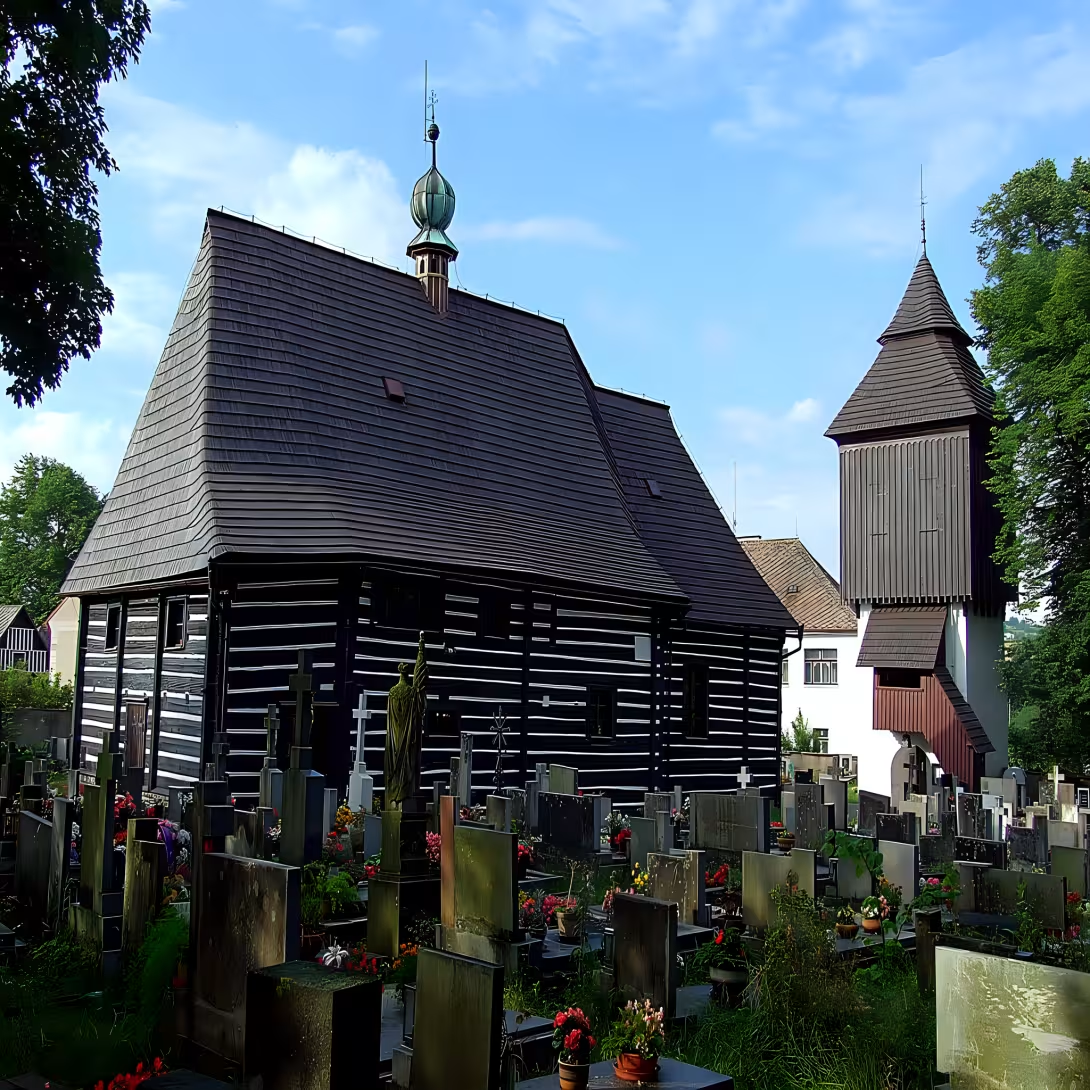
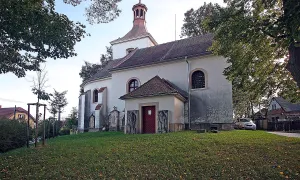
St. John the Baptist Church in Slavoňov is one of the few preserved examples of traditional wooden construction. It stands in a high place in the middle of the cemetery and forms together with the wooden morgue and bell tower of the fortification type a whole protected as a national cultural monument of the Czech Republic. This unique set represents a rare witness to the folk building tradition.
The history of the church goes deeper than its present form. The original Gothic church in this place is already mentioned in 1350. During the Hussite wars it probably disappeared - we only know its shape from the seal stored in the National Museum in Prague. The present church was built in 1553 on the initiative of Jan Kotček and his son Jan from Blazkov. In 1705 there was a substantial repair, during which a western hall with a reduced ceiling and a ring was added. It was originally dedicated to St. Martin, but during the reCatholicization of 1683, on the initiative of the Doberussian Dean Jiří Sidurg, it was rededicated to St. John the Baptist. Since 1683 he worked as a filial church to a church in Dobruška until he became a parish church in 1806.
The construction is a typical grafted construction on the ground plan of an irregular rectangle with an orthogonal closed eastern priesthood. The perimeter walls rest on a low-opal plinth. The roofs are valbic and covered with shingles; The only exception is an octave sandal growing from the ridge, whose onion is covered by copper-plated tinting. The construction dimensions are 19.65 metres long - presbyterium occupies 6.1 metres long, boat is 10 metres long and 9.8 metres wide, ring is 3 metres wide; internal height is 6 meters. A small sacristy is attached to the priesthood. The glazing consists of rectangular windows of different sizes, with only a window in the south side of the ship having a segmentally closed top.
The interior tells us about the tradivistic past and gradual changes. The ceiling of the ship is flat, supported by two longitudinal beams carried by wooden columns. The ship separates from the sacristy beams decorated with carved arcades with painting of the great chalice and Jesus bearing the cross; There are twelve apostles in the side arcades. Under the chalice lies the inscription mentioning the builders from 1553. The walls and the cassette ceiling are covered with painted plant ornaments from 1705. The interior was gradually enriched - the main altar with the painting of St. John the Baptist dates back to 1683, the side altar from the 19th century, the baptismal of the 18th century, and the statues of various saints including the works of the Prague workshop Mudroch and Svatánek. The organ from 1819 of the King's organist George Spanel's elders was replaced in 1909.
The church is a testament to long history, reflected in every layer of construction and decoration. It is a place where the traditions of different epochs meet - from medieval goth to tradivistic elements to baroque and newer adaptations of believers from different generations.
Then and now
Drag the slider to compare how the landmark may have looked when it was built with the view today.
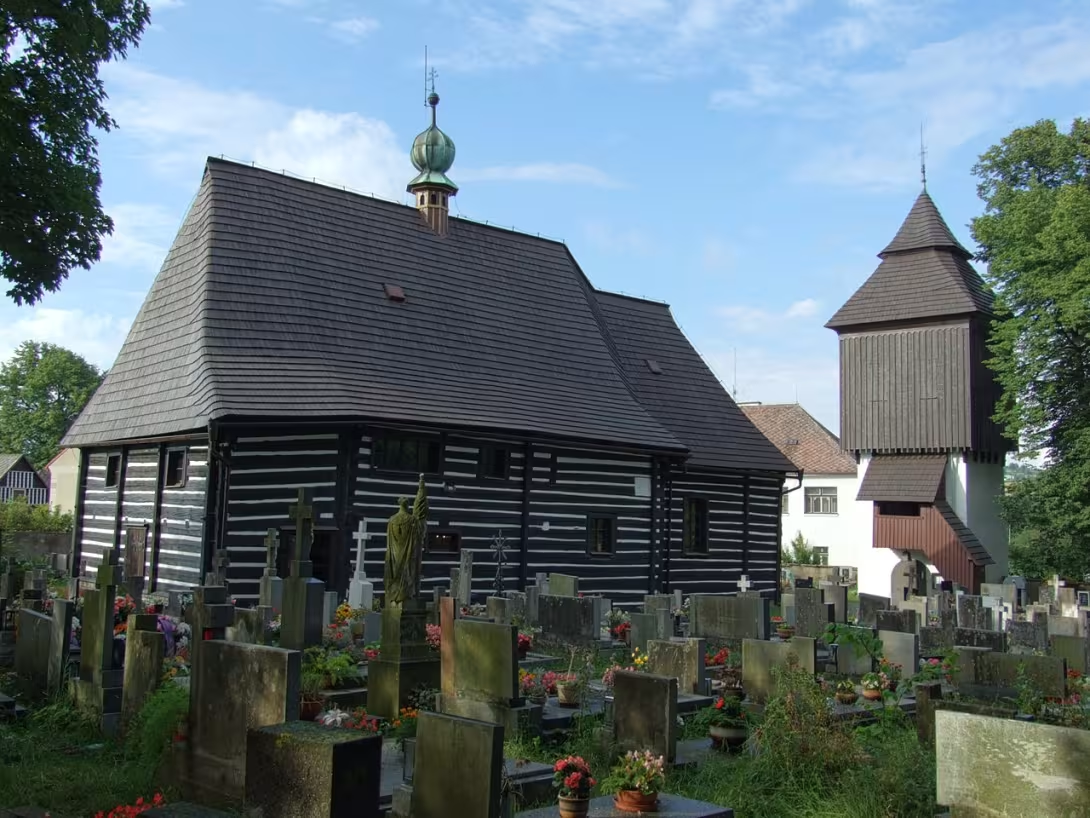
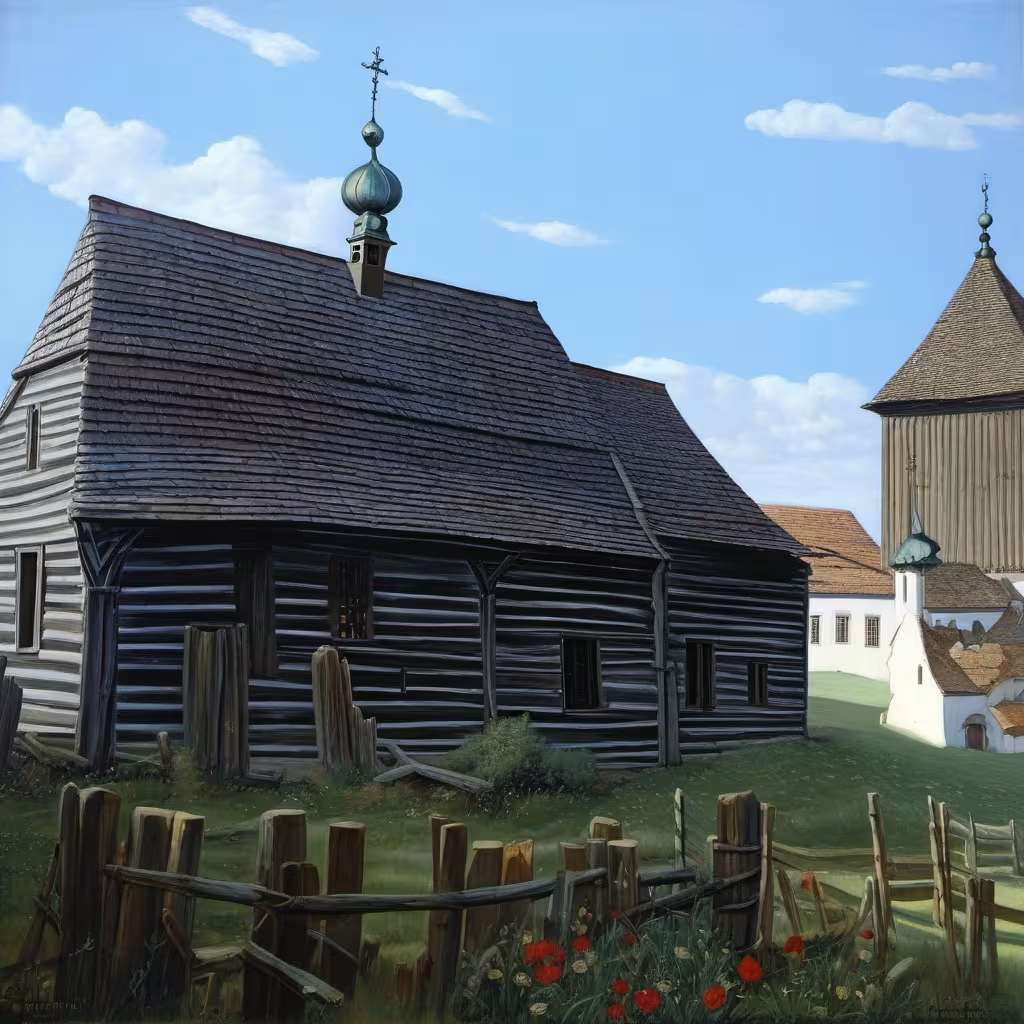
The historical appearance on the left is an AI-generated visualisation and serves as inspiration only.
Historical milestones
- 1350
- The first written mention of the church in Slavoňov, probably a wooden Gothic church dedicated to St. Martin.
- 1553
- Construction of a contemporary wooden church with Renaissance elements, financed by Jan Kotlačka and his son.
- 1705
- Repair of the church with an added hall and crust, contemporary painting decoration of arcades.
- 1806
- The church became parochial, separated from Dobruška.
Architectural development
The church was built from oak and fir tribes, with beam structures sealed with moss and mortar. In 1705, a western hall and a circle were added, during which the original paintings were repainted. The inner space is flat-ceiling, the ship is supported by wooden columns and arcades with Renaissance decoration. The church is illuminated by rectangular windows, except for one finished segment. In the 19th century, side altars and sculptures were added, and in the 20th century, statues and organ were added.
Historical events
- 1350
- First written mention of the church in Slavoňov, originally dedicated to St. Martin, in Gothic form.
- 1553
- Construction of the contemporary wooden Renaissance church with financial support of Jan Kotček and his son Jan from Blažkov.
- 1683
- Change the initiation of the church to St. John the Baptist during the reCatholisation, by order of Dean George Sidurg.
- 1806
- The church became parochial, originally a filial church in Dobruška.
Points of interest
- The Church of St. John the Baptist in Slavoňov is one of the few preserved examples of traditional wooden construction and together with the wooden morgue and bell tower form a protected collection of national cultural monuments.
- The original Gothic church in this place is documented already in 1350, but it was probably destroyed during Hussite wars.
- The current form of the church dates back to 1553, when it was built at the initiative of John Kotnik and his son John from Blazkov.
- The church was originally dedicated to St. Martin, but in 1683 it was rededicated to St. John the Baptist.
- The interior of the church contains paintings of plant ornaments from 1705 and carved arcades with the image of the chalice and Jesus bearing the cross from 1553.
Guide
This guide is narrated by a synthetic voice generated by artificial intelligence.
Show guide text
This text was created by artificial intelligence and has not been editorially reviewed. It may contain inaccuracies.
The Church of Saint John the Baptist in Slavoňov is a wooden Renaissance church situated on elevated ground in the middle of a cemetery. Together with a wooden mortuary chapel, a bell tower of fortification type with a boarded bell chamber, and a surrounding stone wall, it forms a uniquely preserved ensemble of wooden folk architecture, which is protected as a national cultural monument.
The church is documented here as early as 1350. The wooden Gothic structure from that period apparently perished during the Hussite Wars. We know its appearance from a seal in the collections of the National Museum in Prague. The present church was built in 1553 with the support of Jan Kotlačka and his son Jan of Blažkov. Originally it was dedicated to Saint Martin. The change of dedication occurred during the recatholization in 1683 at the initiative of the dean of Dobruška, Jiří Sidurga. At that time the church was a subsidiary chapel of the church in Dobruška. In 1786 it became a small parish church and it gained its own parish priest in 1806. During restoration in 1705 a western vestibule and a choir loft were added.
The church is built of timber with a rectangular presbytery oriented to the east. The logs from oak and fir trunks rest on a low limestone foundation. The joints between them were sealed with moss and mortar and whitewashed on the outside. The roofs are covered with shingles, except for the octagonal sanctus bell housing rising from the ridge, which has an onion dome covered with copper sheet metal. The building is just under twenty metres long and six metres high inside.
The flat ceiling of the nave is supported by two longitudinal beams on wooden pillars. A transverse beam with carved arcades separates the nave from the presbytery. Their paintings reveal that the church was originally Utraquist. In the two central arcades is a large chalice and Jesus carrying the cross, in the side arcades are twelve apostles. Below the chalice is an inscription with the year 1553 and the names of the builders. The walls and the coffered ceiling are decorated with painted floral ornaments from 1705, which covered older paintings, perhaps from the sixteenth century.
The main altar with a painting of Saint John the Baptist dated from 1683. It was removed in 1975, when a stage was installed in the presbytery. Of the other furnishings worth mentioning are a baptismal font decorated with figures from the eighteenth century, statues of Saint Cyril and Methodius from 1821, and a pulpit from 1833. In 1926 a painting of Saint Martin was stolen from the church. Four years later it was replaced by a copy of the painting by Škréta made by the painter Zikmund Rudolf. The organ from 1819 by the organ builder Georg Spanel the Elder from Králíky was replaced in 1909 with an instrument with one manual and seven stops.
Frequently asked questions
Can the monument be visited?
Religious buildings are usually open mainly during services; at other times a visit is normally arranged with the parish or the operator. We have not verified specific times.
Where is the monument?
Location: Slavoňov, Královéhradecký kraj. The map on this page shows the exact spot.
Why is the monument protected?
It is listed in the Central List of Cultural Monuments of the Czech Republic as a national cultural monument (register no. 389).
For kids
Imagine going back 476 years, until the church of St. John the Baptist in Slavoňov was new and full of life. At the time, the village was small, but amazingly closely connected to the surrounding area.
It was like a game where everyone played their roles. The villagers lived in fields, forests and rivers, and the church was their sanctuary. Who lived there? There lived farmers, merchants, shepherds and even nobles! They all came to church to pray, to celebrate their anniversary and to seek solace.
Businesses nearby
Do you run a restaurant, accommodation, shop, museum, rental, wellness or other visitor service near this monument? Show yourself directly to the people heading to it — this is how they will see you in the app and on the web:
Events nearby

Zdroj akcí: otevřená data měst a obcí ČR (Národní katalog otevřených dat) a kalendář akcí Národního památkového ústavu.
Accommodation nearby
Themed route
Thematic cruise route: Baroque spirit and rock secrets
1. Church of St. John the Baptist in Slavoňov * Baroque treasure with historical soul * - Visit this picturesque church with richly decorated interior where the elements of early Baroque architecture meet. The surrounding cemetery with memorable tombstones and a quiet atmosphere is also interesting, ideal for relaxation.
2. St. Martin's Church in Dobruška (5 km) * Gothic-Baroque contrast * - Originally a Gothic church, which has turned into a Baroque gem, offers an interesting view of the development of sacral architecture. The surroundings of the parish church are full of historic houses and picturesque streets that are worth a walk.
3. National Nature Reserve Stormy Mines (7 km) * Rock labyrinth and geological diva * - The final stop takes you to the fascinating rock area with the origin of limestone and dramatic rock formations. Ideal for nature lovers who appreciate the unique geology and calm natural scenery.
The route combines spiritual monuments with natural miracle, offering a harmonious experience of history and nature.
Seasonal recommendations
Spring In the church of St. John the Baptist in Slavoňov there is a special calm and quiet exciting atmosphere in which the walls of the church are filled with light from blooming trees around. From the outside nature is in its most beautiful condition - green meadows, flowering flowering shrubs and the first flowers on the willows create a romantic scenery. The inner lighting is often slightly warm to complement the natural light, and the church often holds mass with rich liturgical music, which is based on local traditions. It is advisable to visit the memory at an early morning time when fewer people are present and nature is most alive. It is recommended to wear light but warm clothes that are easily adapted to changing the weather, and shoes to a solid base, because the surrounding church is often wet.
Summer In the main summer season there is a church full of life and visitors who come here to seek rest from the hot sun. The inner spaces are often lit by light from outdoor vitrates that go from blue to yellow, creating a magical atmosphere. The outside area is warm and sunny, but the church is always cold, which is suitable for warm days. The best time to visit is in the morning when there are fewer crowds, and it is advisable to come up with light clothes that protect against sunlight but not overheating. It is also important to observe hygiene because it is often warm in the church on summer days.
Autumn Autumn at St. John the Baptist Church offers a fascinating combination of natural magic and light. The inner spaces are lit by warm light from ceramic candles, which give the place a delicate atmosphere, and the green color returns outside, which turns into brown and golden shades. The church often holds mass with musical accessories that express mental peace and reflection. Visiting the memory is suitable during the period when the weather is mild, and preferably in the morning when there are fewer visitors. It is recommended to wear clothes that protect against the cold wind, but at the same time it is comfortable, and shoes on a solid base because the surrounding church can be moist.
Winter In winter, the church of St. John the Baptist in Slavoňov is a special place where a quiet and mystical atmosphere returns. The inner spaces are lit by light from ceramic candles or small skylights, which create a cosy and peaceful atmosphere. Outside is light weak and cold, but in the church there is warmth and comfort, which is ideal for cold days. The best time to visit is in the morning when there are fewer visitors, and it is advisable to come up with warm clothes that protect against cold weather. It is also important to observe opening times that may be shorter in the winter months.
Visualizations and artistic views


The visualisations are generated by artificial intelligence and serve as inspiration.
Photos from the area
Real photos taken near the monument


Zdroj a licence jsou uvedeny u každého snímku.
View from the area
This animation was generated by artificial intelligence from a real photograph of the surroundings. The motion and details are not real footage of the location.
Atmosphere of the place
This atmospheric visualisation of the place and period was generated by artificial intelligence. It is not real footage of the location.
Tips from visitors
No tips yet. Be the first!
Log in and add your tip.
Sources and literature
Photos: Kozuch / CC BY-SA 3.0, rozlišení zvýšeno umělou inteligencí — Wikimedia Commons. The author and licence also appear when you hover over the image.
Faktickým podkladem tohoto textu byl článek na Wikipedii, jehož autory jsou přispěvatelé Wikipedie. Článek je dostupný pod licencí CC BY-SA 4.0.
Location on the map

Příběhy a pověsti
Legendy, pověsti a příběhy spjaté s touto památkou
Fotografie návštěvníků
Zatím žádné fotografie. Buďte první, kdo přidá fotografii z návštěvy!
Log in a přidejte svou fotografii nebo hodnoťte.
Za ověřenou návštěvu v aplikaci získáte víc bodů — poznáme podle GPS, že jste na místě.
Reviews and comments