



Kostel svatého Jana Nepomuckého s farou Church
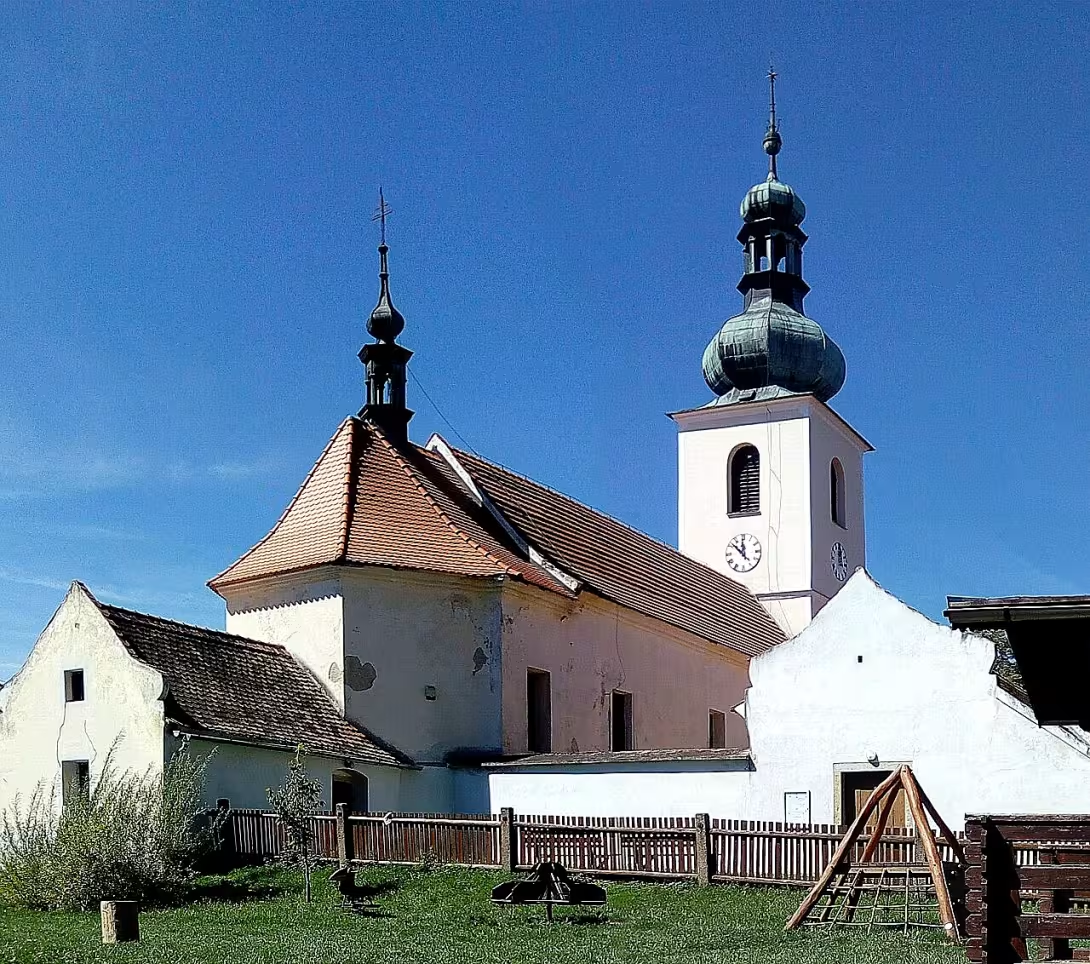
The Church of Saint John of Nepomuk in Svatý Jan nad Malší is a notable late Baroque church recognized as a cultural monument since 1958. Situated at an elevation of 614 meters, it offers spiritual significance and panoramic views of the surrounding area. Constructed between 1777 and 1782 on the site of an earlier pilgrimage chapel, this church holds historical importance as one of Bohemia's youngest pilgrimage sites.
The origins trace back to a pilgrimage chapel dedicated to Saint John of Nepomuk, consecrated in 1735. The inspiration for its construction came from five stars seen by Jan Bernard Rierenschopf, the then parish priest of Veleslavín, in 1732—three years after Saint John's canonization. This celestial vision led to the chapel's establishment and subsequent consecration, marking the beginning of a pilgrimage tradition that continues today.
Architecturally, the church is characterized by its Baroque style, evident in wooden floors, truss ceilings, vaults, and several historical doors adorned with handcrafted metalwork. The single-nave structure includes a sacristy and apse, with an imposing bell tower on the western side. Ambits flank both sides of the building, extending towards the east, while the northern section houses a separate entrance to the adjacent parish house. A school occupies the southern ambit wing.
Significant renovations occurred between 1823 and 1824, during which a bell tower was added with financial support from Count Jan Nepomuk Josef Buquoy z Nových Hradů. In 1906, bells were installed in this tower, enhancing its architectural prominence. The building's historical significance is marked by original elements such as a rococo-style carved main altar featuring an image of Saint John of Nepomuk from 1852 and a decorated cross with relics of the saint, donated by local priest A. Stropka in 1908.
Throughout its history, the church has been central to community events and traditions. An annual procession takes place on May 16th, the feast day of Saint John of Nepomuk, drawing pilgrims to this revered site. In front of the church stand two linden trees named Masaryk and Libuše, planted in 1919, with an additional tree added by President Václav Havel and his wife Dagmar in 2000. Nearby, a statue of Saint John of Nepomuk from 1873 stands as a testament to the enduring veneration of this saint.
Today, the Church of Saint John of Nepomuk remains accessible to visitors, offering insights into its rich history and architectural beauty. Its status as a cultural monument underscores its importance not only as a place of worship but also as a historical landmark. The church's blend of spiritual heritage and scenic location makes it a worthwhile destination for those interested in exploring the cultural tapestry of Bohemia. Visitors are invited to experience this unique site, where history and devotion converge amidst breathtaking views.
Then and now
Drag the slider to compare how the landmark may have looked when it was built with the view today.
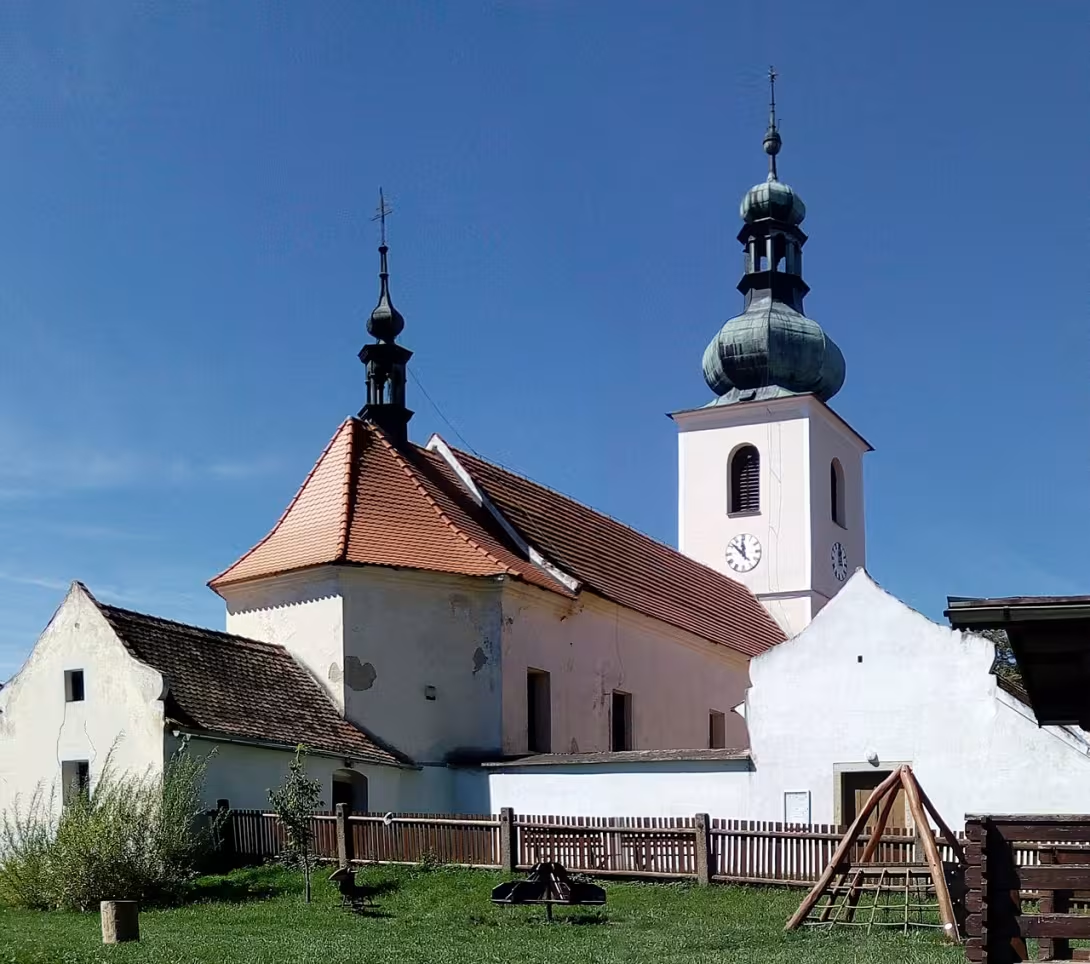

The historical appearance on the left is an AI-generated visualisation and serves as inspiration only.
Historical milestones
- 1735
- The original pilgrimage chapel was consecrated.
- 1782
- Construction of the church completed.
- 1824
- Renovations added a bell tower to the church.
- 1906
- Bells were installed in the tower.
- 2018
- Reconstruction of the building was completed.
Architectural development
The church's construction began in 1777 and concluded in 1782. It underwent renovations between 1823 and 1824, which included adding a bell tower. The architectural style is Baroque, characterized by its wooden floors, truss ceilings, and vaults.
Historical events
In 1735, the original pilgrimage chapel was consecrated after being inspired by five stars seen in 1732.
The church underwent significant renovations between 1823 and 1824, adding a bell tower supported by Count Jan Nepomuk Josef Buquoy z Nových Hradů.
In 1906, bells were added to the tower.
A reconstruction of the building was completed in 2018.
Points of interest
- The construction of the Church of Saint John of Nepomuk was inspired by a celestial vision: Jan Bernard Rierenschopf, the parish priest of Veleslavín, reportedly saw five stars in 1732, which led to the establishment of the pilgrimage chapel.
- A unique architectural feature is the church's single-nave structure with an imposing bell tower added between 1823 and 1824, funded by Count Jan Nepomuk Josef Buquoy z Nových Hradů, enhancing its prominence.
- The church houses a rococo-style carved main altar from 1852 featuring Saint John of Nepomuk, alongside a decorated cross containing relics donated in 1908 by local priest A. Stropka, reflecting the deep veneration for the saint.
- In front of the church stand two linden trees named Masaryk and Libuše, planted in 1919 to honor Czechoslovakia's founding fathers; an additional tree was added by President Václav Havel and his wife Dagmar in 2000.
- A statue of Saint John of Nepomuk from 1873 stands nearby the church, serving as a testament to the enduring veneration for the saint and highlighting the site’s importance as a pilgrimage destination.
Guide
This guide is narrated by a synthetic voice generated by artificial intelligence.
Show guide text
This text was created by artificial intelligence and has not been editorially reviewed. It may contain inaccuracies.
In Svatý Jan nad Malší near Českobudějovice stands a late Baroque parish church dedicated to Saint John of Nepomuk. It ranks among the youngest pilgrimage sites in Bohemia. Since nineteen fifty-eight it has been a cultural monument, and the rectory and church tower are also protected.
The origins of this place are tied to the year seventeen thirty-two. A vicar from Velešín named Jan Bernard Rierenschopl allegedly saw five stars appearing above the local hill, a symbol of Saint John of Nepomuck. This was merely three years after the saint's canonization. This vision apparently prompted him to build a pilgrimage chapel, which was consecrated in seventeen thirty-five.
The church we see today rose in place of the chapel between seventeen seventy-seven and seventeen eighty-two. A collection among residents of Ločenice also contributed to its construction. In seventeen eighty-five the church acquired a choir loft, and a year later a rectory was added. The tower was obtained only during renovations in eighteen twenty-three and eighteen twenty-four, which were significantly supported financially by Count Jan Nepomuk Josef Buquoy from Nové Hrady. The clock was added to it in nineteen hundred six. Around the church during the eighteenth century a settlement emerged, which took its name from the saint. Renovation of the building was completed in two thousand eighteen.
The church is a single-nave structure with a sacristy and chancel. The tower with stairs stands on the western side. On both sides it is surrounded by an ambulatory, which turns toward the east. To the north the rectory is attached to it with its own entrance to the courtyard, and the southern wing of the ambulatory is used by the neighbouring school. The cemetery lies to the east of the church. From a historical preservation perspective, the wooden floors, timber ceilings, vaults, and historical doors with handcrafted ironwork are valuable.
On the main carved Rococo altar hangs a painting of Saint John of Nepomuck from eighteen fifty-two. Among the Saint John monuments belongs a decorated cross containing relics of the saint, which the local vicar gave to the church in nineteen hundred eight. The original bells from the workshop of Jiří Václav Kohler were confiscated in nineteen seventeen for war purposes. The church received new ones in July nineteen twenty-three.
In front of the church grow two linden trees planted in nineteen nineteen, named Masaryk and Libuše. In the year two thousand a third was added, planted by President Václav Havel together with his wife Dagmar. The church lies at an elevation of six hundred fourteen metres, so there is a good view of the surrounding countryside from it. Every year on the sixteenth of May, on the feast day of Saint John of Nepomuck, a pilgrimage takes place to the church. In the village square stands also a statue of the saint from eighteen seventy-three by Jan Kadlec from Trhové Sviny.
Tips for visitors
The best time to visit the Church of Saint John of Nepomuk is during late spring or early autumn when the weather is mild, and the surrounding landscape is particularly beautiful. These seasons offer clear skies which enhance the view from the church's vantage point at a height of 614 meters. Additionally, visiting outside peak tourist season ensures a more tranquil experience.
The area can be accessed by car or public transport; however, it is advisable to check current routes and schedules via an online search tool before your visit.
When planning your visit, consider bringing comfortable walking shoes as you may want to explore the area around the church, including the statue of Saint John of Nepomuk from 1873 and the cemetery to the east. A camera is also recommended for capturing the stunning views and architectural details of this late Baroque church.
For photography enthusiasts, the best spots include the elevated position of the church itself which offers panoramic views of the surrounding area. Early morning or late afternoon light provides a soft glow that enhances the picturesque setting. The statue nearby can be an excellent subject for portraits with its historical significance and scenic backdrop.
Nearby attractions within a 30-minute drive include other historical sites in the Jihočeský kraj region, which offer additional cultural insights and natural beauty. These locations provide great opportunities to extend your exploration of this picturesque part of the Czech Republic.
Frequently asked questions
Can the monument be visited?
Religious buildings are usually open mainly during services; at other times a visit is normally arranged with the parish or the operator. We have not verified specific times.
Where is the monument?
Location: Svatý Jan nad Malší, Jihočeský kraj. The map on this page shows the exact spot.
Why is the monument protected?
It is listed in the Central List of Cultural Monuments of the Czech Republic as a cultural monument (register no. 27220/3-437).
Businesses nearby
Do you run a restaurant, accommodation, shop, museum, rental, wellness or other visitor service near this monument? Show yourself directly to the people heading to it — this is how they will see you in the app and on the web:
Nearby
The church is situated at a height of 614 meters, offering a good view of the surrounding area. Nearby features include a statue of Saint John of Nepomuk from 1873 and a cemetery to the east.
Accommodation nearby
Trips and activities nearby
Guided tours, tickets and activities nearby from GetYourGuide
Affiliate link: if you buy from the partner, we may receive a commission. The price for you does not change.
Search tours and activities →Themed route
Thematic Walking Tour: Svatý Jan nad Malší
1. Kostel svatého Jana Nepomuckého s farou (Church) - Begin your journey at the heart of Svatý Jan nad Malší with the stunning Kostel svatého Jana Nepomuckého. This church, perched at a height of 614 meters, offers not only spiritual solace but also breathtaking views of the surrounding landscape. Its architectural beauty and historical significance make it a must-visit for anyone interested in religious heritage or simply looking to enjoy panoramic vistas.
2. Statue of Saint John of Nepomuk (Statue) - A short walk from the church, you'll find the impressive statue of Saint John of Nepomuk dating back to 1873. This statue is a tribute to the patron saint of bridges and secrets, whose story resonates with themes of loyalty and martyrdom. It's an ideal spot for reflection or photography, capturing both history and art in one frame.
3. Cemetery (Cemetery) - To the east of the church lies the local cemetery, a serene place that offers insight into the community’s past generations. Walking through this quiet area provides a moment to appreciate the continuity of life and death, as well as an opportunity to explore the historical gravestones and memorials that tell stories of those who once called Svatý Jan nad Malší home.
This tour encapsulates the essence of Svatý Jan nad Malší by focusing on its spiritual and cultural landmarks. Each site is rich with history and significance, offering a comprehensive experience of this charming locale.
Seasonal recommendations
Spring: The arrival of spring brings a gentle awakening to the Church of Saint John Nepomucene, with its surrounding landscape blooming into vibrant colors. This season is characterized by mild temperatures and longer daylight hours, creating an inviting atmosphere for visitors seeking tranquility after winter's retreat. As nature renews itself around Svatý Jan nad Malší, the churchyard becomes a picturesque setting, offering serene views that enhance the historic charm of this site. Practical advice includes wearing comfortable layers to accommodate fluctuating spring weather and visiting in the morning or late afternoon when crowds are thinner, allowing for a more intimate experience with the architecture and peaceful surroundings.
Summer: Summer at the Church of Saint John Nepomucene is marked by lush greenery and warm, sunny days that highlight the intricate details of its baroque architecture. This season attracts numerous visitors drawn to the picturesque village of Svatý Jan nad Malší and its historical landmarks. The church often hosts various cultural events during this time, contributing to a lively atmosphere. To make the most of your visit, it is advisable to arrive early in the day or later in the afternoon to avoid peak tourist times. Light, breathable clothing is recommended for comfort, along with sun protection due to longer daylight hours.
Autumn: Autumn transforms the Church of Saint John Nepomucene into a stunning canvas of warm hues, as leaves turn golden and red around Svatý Jan nad Malší. The cooler temperatures create a crisp atmosphere that enhances the historical aura of the church, making it an ideal time for photography enthusiasts to capture its beauty in a new light. As visitor numbers generally decrease compared to summer, this season offers a quieter opportunity to explore the site at your own pace. Layered clothing is recommended to stay comfortable as days grow shorter and temperatures drop.
Winter: Winter envelops the Church of Saint John Nepomucene in a serene blanket of snow, casting an ethereal glow over its historic façade. The colder months bring a sense of quietude and reflection, with fewer visitors allowing for a more contemplative experience amidst the frosty landscape. Visitors are advised to dress warmly in layers and wear sturdy footwear suitable for potentially icy paths, ensuring a comfortable exploration of this enchanting winter wonderland.
Visualizations and artistic views


The visualisations are generated by artificial intelligence and serve as inspiration.
Photos from the area
Real photos taken near the monument


Zdroj a licence jsou uvedeny u každého snímku.
Atmosphere of the place
This atmospheric visualisation of the place and period was generated by artificial intelligence. It is not real footage of the location.
Tips from visitors
No tips yet. Be the first!
Log in and add your tip.
Sources and literature
Photos: Czeva / CC BY-SA 4.0 — Wikimedia Commons. The author and licence also appear when you hover over the image.
Faktickým podkladem tohoto textu byl článek na Wikipedii, jehož autory jsou přispěvatelé Wikipedie. Článek je dostupný pod licencí CC BY-SA 4.0.
Location on the map




Příběhy a pověsti
Legendy, pověsti a příběhy spjaté s touto památkou

Fotografie návštěvníků
Zatím žádné fotografie. Buďte první, kdo přidá fotografii z návštěvy!
Log in a přidejte svou fotografii nebo hodnoťte.
Za ověřenou návštěvu v aplikaci získáte víc bodů — poznáme podle GPS, že jste na místě.
Reviews and comments