






Kostel svatého Jiří (Jevany) Church
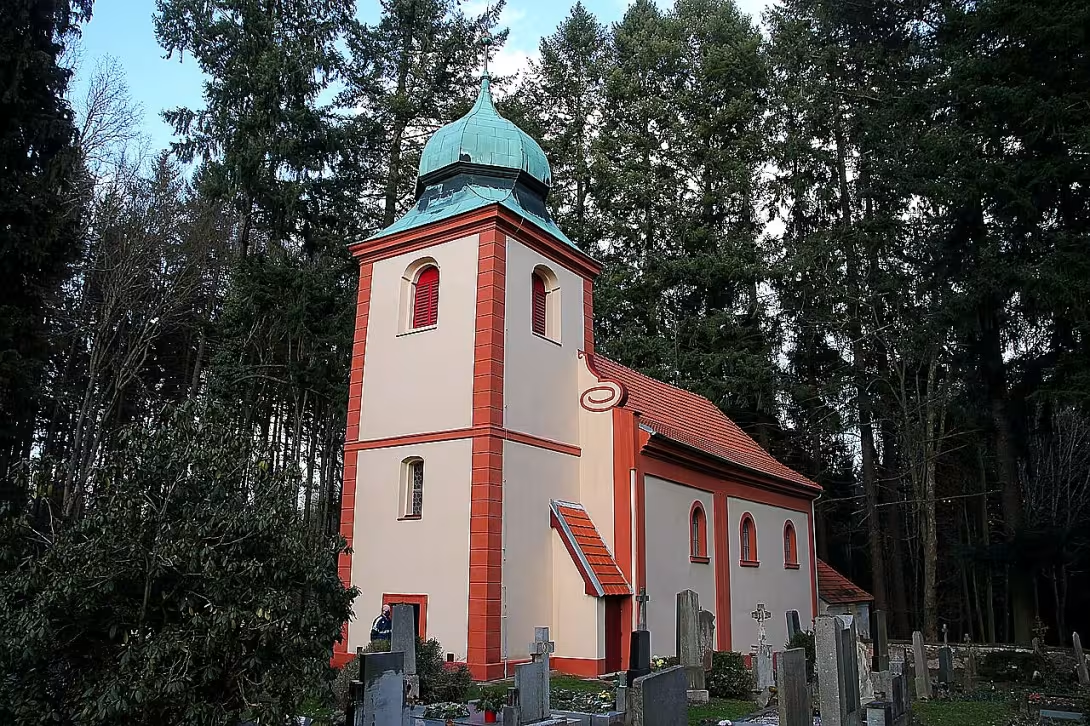
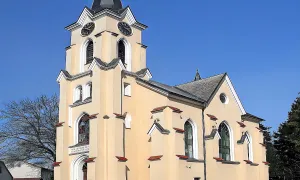
St. George's Church in Aldashín is the only building that remains of this desolate village. The Baroque temple and the cemetery are surrounded by spruce forest and belong to the parish Kostelec above the Black Forest. It is not only an architectural monument, but a living witness to the settlement and fall of the Czech countryside.
The history of the church begins at the turn of the 13th and 14th century, when archaeological surveys confirm the existence of a wooden church. In the 14th century it was replaced by a stone Gothic temple dedicated to St. Bartholomew. For the first time, Aldashin mentions himself in the written records of 1352 as plebania with a church. During the Hussite wars, the parish was abandoned, and after 1645, when the village was burned down in the Thirty Years' War, it was not restored by attempts to resettle.
But the church stayed. In 1729 it was rebuilt and baroque by the owner of the estate Marie Terezie z Lichtenštejna. In 1732 they changed his initiation - the painting of St. Bartholomew replaced St. George. In 1771, he was connected to a prism tower with an octave helmet. Other repairs were made: in 1782, the reconstruction of the altar, in 1884, a new altar painting from Josef Kandler and a pulpit decorated by evangelists, in 1907, a new crust and access from the sacristy to the cemetery, in 1934, the exchange of roofing for state cargo of 50,000 Kns. The latest modifications took place in the years 2008-2019.
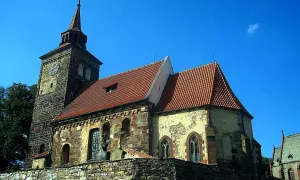
The building is a single stone Baroque church on an irregular rectangular plan with a flat ceiling, rectangular windows and a characteristic tower in the west.
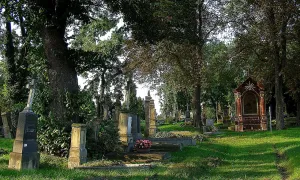
Thanks to the position in the woods, Aldashin evolved into a pilgrimage place. The tradition of pilgrimage ended in the 1950s after a communist coup. Today, church is held every other Sunday since 2: 00. The cemetery is functional with a crumbling morgue and is buried in it by important personalities: Bishop Jan Lebeda, documentarist Jan Špáta, composer Karel Svoboda and Major General Jiří Birula.
The church had two bells. The older shell in 1611 was hung in the tower by Jakub Mělnický from Mladá Bloslav. The younger bell of Bartholomew fell props in World War I. The older bell escaped and survived the second war and communism. In the 1970s, a recording of his sound was made, which was played in the Yevany at the funerals. In the 1990s he was transferred to St. Norbert's Church in Prague for Security. The bell was named Aldashin and it is expected to return to its original place.
Then and now
Drag the slider to compare how the landmark may have looked when it was built with the view today.
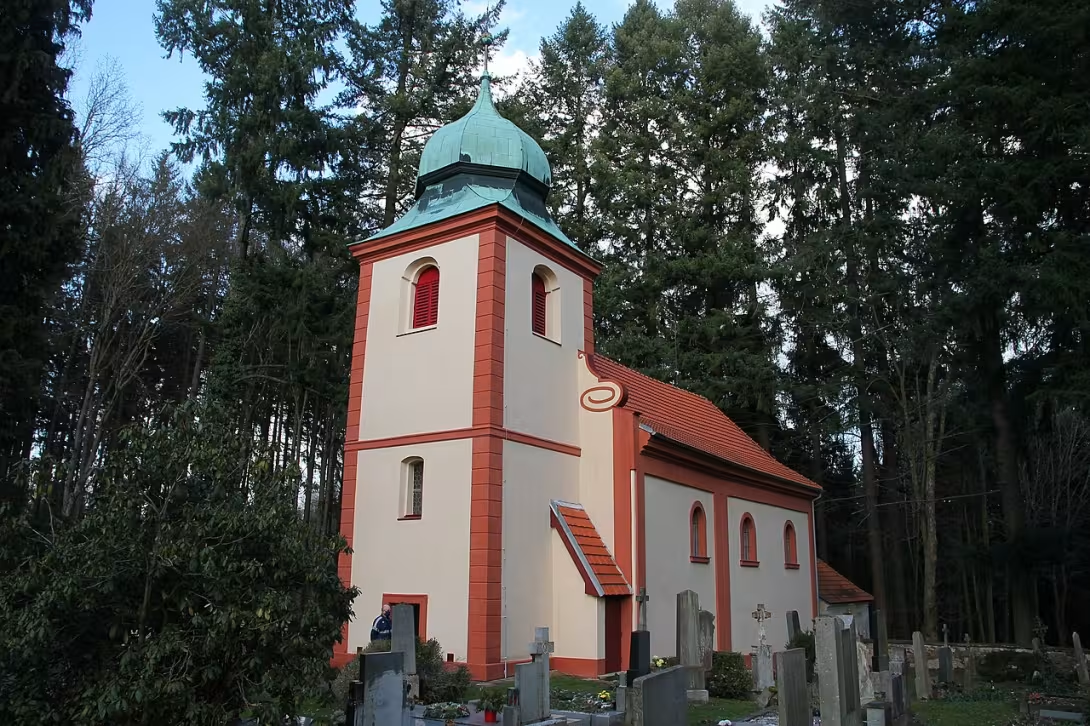
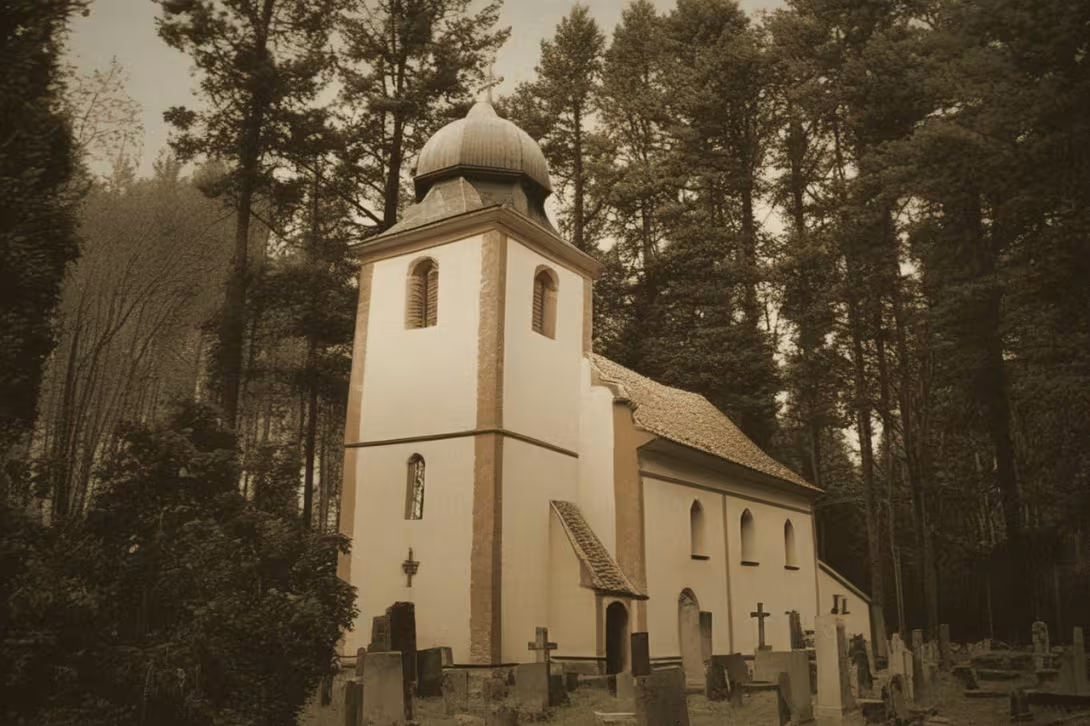
The historical appearance on the left is an AI-generated visualisation and serves as inspiration only.
Historical milestones
- zlom 13th and 14th century
- The creation of the first wooden church in Aldashín, supported by archaeological surveys.
- 1352
- The first written mention of a stone Gothic church dedicated to St. Bartholomew.
- 1645
- The destruction of Aldashin village after the fire during the Thirty Years War.
- 1729-1771
- Baroque church reconstruction and change of initiation to St. George.
- 1934
- Correction of the church and expansion of the cemetery for the state cost of 50,000 Kns.
- 2008-2019
- Long-term reconstruction of the church, including repairs of the outer mantle in 2018.
Architectural development
Originally a wooden church at the turn of the 13th and 14th century, replaced by a Gothic stone church dedicated to St. Bartholomew, documented since 1352. In 1729-1771 Baroque reconstruction, including construction of the tower in 1771. Other modifications in 19th century (altar, pulpit) and 20th century (repairs, reconstruction).
Historical events
The destruction of Aldashín village after a 30-year war and the definitive abandonment of the village after 1645; Baroque reconstruction of the church in 1729-1771 at the initiative of Marie Terezie z Lichtenštejna; The end of pilgrimage traditions after the communist coup in the 1950s.
Points of interest
- St. George's Church is the last remnant of the desolate village of Aldashín, which disappeared after the Thirty Years' War and was not restored.
- Originally the church was dedicated to St. Bartholomew, but in 1732 it was renamed St. George.
- The church preserved a bell from 1611, which survived both world wars and communism before being moved to Prague in the 1990s.
- The church served as a pilgrimage, but the tradition of pilgrimage ended after a communist coup in the 1950s.
- Major personalities are buried in the cemetery, such as Bishop Jan Lebeda, documentarist Jan Špáta or composer Karel Svoboda.
Guide
This guide is narrated by a synthetic voice generated by artificial intelligence.
Show guide text
This text was created by artificial intelligence and has not been editorially reviewed. It may contain inaccuracies.
Welcome to the place where time stopped and where the shadows of history whisper among the high spruce. You are standing in front of St. George's Church in Yevany, a building that is much more than a stone building. He is the silent, lonely guardian of memory who was the last to stand in a place where the life of an entire village once pulsed. Look around you. You see how the dense spruce forest touches the walls of the church and how the cemetery that is still being used surrounds this sacred place. Feel this atmosphere of peace and isolation. The church does not seem to be part of the modern world, but rather as if it had grown out of it, as if it were an inherent part of this country.
Let's go back deep into the past together to understand why this place is so special. This land was inhabited much before the walls of this church became real. Archaeological surveys tell us that the first wooden church stood here at the turn of the third and fourth century AD. That's when Aldashin was here, alive and busy. The first paper trail about the construction of the wood was from 1352. At that time the church was still Gothic and was dedicated to Saint Bartholomew. Imagine the medieval landscape, different from what you see today.
But fate has given Aldashin village and its church a difficult time. In 1645, during the devastating 30-year war, the village was burned down. That was the break that never came back. Aldashin disappeared and its inhabitants scattered, but the church remained. From the entire settlement of centuries, it was this one remnant, a silent witness to the human destiny. So the church is not just a religious sign; it is the last trace of human lives that once lived here, worked and believed.
Now pay attention to the architecture of the building itself, which stands right in front of you. Although the church has its deep roots in the gotics, what you see now is the result of a Baroque reconstruction that took place between 1729 and 1771. Notice his plan. The church is not built on perfect geometric squares, but has an irregular rectangular shape, giving it an organic, natural appearance. Look up at the tower. It is prismatic in shape and it culminates in an octagonal helmet that elegantly paints against the sky and crowns the entire building silhouette.
If you decide to enter later, pay attention to the interior. The church is single-storey, which means that space is open and uniform, creating a sense of both tonnage and intimacy at the same time. The ceiling is flat, which is a typical element that carries peace and moderation. The whole building has undergone a major transformation in recent years. Between 2008 and 2019, there was a large and long-term reconstruction aimed at saving this rare object for future generations. In 2018, the repair of the outer shell was also completed, so what you are now observing is the result of the efforts of many people who wanted to keep this historic jewel beautiful.
There are also names in the history of this place that help us better understand the context of the time. Among the personalities connected with this region and the period when the church was rebuilt baroque, for example Marie Terezie z Lichtenštejna. Although her name does not appear as the name of the builder in the history of the church, her presence in the historical records reminds us of how closely these rural monuments were linked to the great family lines and the political history of the country back then.
But now I want to invite you to think about something that may surprise you. Have you noticed that the church is called St. George? That's not the original initiation. As I mentioned, the church was originally dedicated to Saint Bartholomew. This change took place only in 1732, i.e. during the Baroque reconstruction. Why did this happen? It may have been a new spiritual need for the parish, perhaps the influence of the landowners at the time, but this change is a solid part of the identity of this place.
And if you're looking for a real mystery or a symbol of resilience, you need to know about one object that's hidden inside. The church preserved the bell from 1611. Try to realize the incredible weight of that year. This bell was here before the war burned down the village, before the baroque reconstruction took place, and before the world changed thousands of times. This metal voice survived both world wars. Though the world passed by him through the greatest storms of mankind, he remained silent and ready to ring again. It is a symbol of continuity that links the medieval village of Aldashin to today's world.
You're standing in a place where history doesn't just happen in books, but in every stone, every spruce, and every breath of this quiet place. The church of St. George is living proof that even if the village dies, even if people leave, what they left behind with respect and faith can last for centuries.
Thank you for spending this moment right here with us. Now that you know the story of this lonely church, we suggest you continue your tour of the area. Walk around the cemetery, feel the silence of the forest and just let yourself drift through the atmosphere of this extraordinary place for a while. It's the best way to truly understand what it means to be a witness to history. Goodbye.
Frequently asked questions
Is Kostel svatého Jiří (Jevany) open to the public?
Yes, the church is open to the public. The opening hours are 9: 00 to 5: 00.
How do I get to the place by car / public transport?
St. George's Church is located about 10 kilometres southeast of Prague. The nearest public transport stop is in the nearby village Jevany, from here you can walk or by bus.
How much is the entrance fee and is it paid on the spot?
Payment is made directly at the entrance to the church.
Is the tour suitable for children and seniors?
Yes, a church tour is suitable for all age groups. The church has accessible staircases and flat areas that allow easy walking.
How long does the tour take?
The church tour takes about 30-45 minutes, depending on the speed of the visitors.
What are the opening times and booking is required?
St. George's Church is open from 9: 00 a.m. to 5: 00 p.m. Reservation is not necessary, but it is recommended to contact the church administrator in advance when visiting larger groups.
What's interesting in the immediate vicinity?
The former village Jevany is located in the vicinity of the church, which was destroyed during World War II. There are also several historical monuments such as stone crosses and tombs.
For kids
Imagine going back to a time when Aldashinek village was full of life and energy. St. George's Church was the heart of the village where people gathered for Christian festivities and holidays.
How did it look here? The village was surrounded by forests and meadows where people fed on agriculture and animal breeding. The church stood in the middle of the village as if it were her heart. People came to church for worship and intentionally to bless their crops and protect them from danger.
Businesses nearby
Do you run a restaurant, accommodation, shop, museum, rental, wellness or other visitor service near this monument? Show yourself directly to the people heading to it — this is how they will see you in the app and on the web:
Events nearby
Zdroj akcí: otevřená data měst a obcí ČR (Národní katalog otevřených dat) a kalendář akcí Národního památkového ústavu.
Nearby
Around the church there is a functional cemetery with a crumbling morgue. In the vicinity (up to 5 km) there is a village Jevany and a woodland landscape with the predominance of spruce vegetation. There is a church over the Black Forest, which is the center of the parish.
Accommodation nearby
Themed route
Thematic cruise route around St. George's Church (Jevany)
1.Kostel svatého Jiří (Jevany) - * Type: * Historical landmark - * Why is it worth a visit: * This Baroque church is the main destination of the trip, offering beautiful architecture and a quiet environment for disconnection. It is an ideal place to explore the history and spiritual life of the village.
2. Functional cemetery with morgue - * Type: * Historical cemetery - * Why is it worth visiting: * The cemetery is part of the church area and has an interesting ancient morgue which represents the history of local families. It's a place of calm and reflection where you can see the details of the past.
3. Wooden landscape around Jevan - * Type: * Natural surroundings - * Why is it worth visiting: * Surrounded forests with the predominance of spruce stands offer a beautiful space for walks and relaxation in nature. It's an ideal place to observe wild flora and fauna or simply disconnect.
4. Church over the Black Forest - * Type: * Center of the parish - * Why is it worth a visit: * This place is an important part of the local community and offers other cultural and historical elements. Visit the parish, which represents the life and tradition of the area.
This route will guide you through quiet and historically rich places around Jevan, where you can explore both the architectural and natural beauty of the region.
Seasonal recommendations
Spring: In the spring season, St. George's Church in Yevany boasts the miracle of nature, when flowering shrubs and trees surrounding the monument tell of a new beginning. Sun rays illuminate the church facade in fine colours, which increases its historical beauty. Visiting during this period is ideal due to mild temperatures and slow crowds. We recommend a visit in the early afternoon, when nature most manifests itself in its fullness. Due to the alternating weather, it is advisable to carry clothes for various weather conditions.
Summer: Summer brings visitors to St. George's Church in Yevany seeking relief from urban life. The sunny days illuminate the church interior and from the outside there is a quiet park overlooking the surrounding countryside, providing an ideal environment for relaxation. In the main summer season it is recommended to visit the memory early or late in the afternoon to avoid heat and crowds. Don't forget to wear a sun guard and light clothes.
Autumn: In the autumn months, St. George's Church in Yevany has become melancholy atmosphere when tree leaves turn the surrounding area into a lively palette of colours. Sunshine days are an ideal time to visit because the sun illuminates the church and its surroundings in special colours. In advent time you can look forward to mild temperatures and lower traffic, which allows you to enjoy a quiet tour. We recommend wearing clothing suitable for conditions with the possibility to approach warm clothes.
Winter: The winter season offers the Church of St. George in Yevany a unique atmosphere where cold air emphasizes its historical character. The sunny days illuminate the church with a special light, creating views full of peace and beauty. The opening time is shorter in this period, so we recommend visiting the memory early in the morning or late in the afternoon. Don't forget to wear warm clothes and a suncoat because you can experience the surprisingly warm heat of the sun day.
Visualizations and artistic views


The visualisations are generated by artificial intelligence and serve as inspiration.
Photos from the area
Real photos taken near the monument


Zdroj a licence jsou uvedeny u každého snímku.
Atmosphere of the place
This atmospheric visualisation of the place and period was generated by artificial intelligence. It is not real footage of the location.
Tips from visitors
No tips yet. Be the first!
Log in and add your tip.
Sources and literature
Fotografie: Draceane / CC BY-SA 4.0 — Wikimedia Commons. The author and licence also appear when you hover over the image.
Faktickým podkladem tohoto textu byl článek na Wikipedii, jehož autory jsou přispěvatelé Wikipedie. Článek je dostupný pod licencí CC BY-SA 4.0.
Location on the map
Příběhy a pověsti
Legendy, pověsti a příběhy spjaté s touto památkou
Fotografie návštěvníků
Zatím žádné fotografie. Buďte první, kdo přidá fotografii z návštěvy!
Přihlaste se a přidejte svou fotografii nebo hodnoťte.
Za ověřenou návštěvu v aplikaci získáte víc bodů — poznáme podle GPS, že jste na místě.
Reviews and comments