



Kostel svatého Martina (Jámy) Church
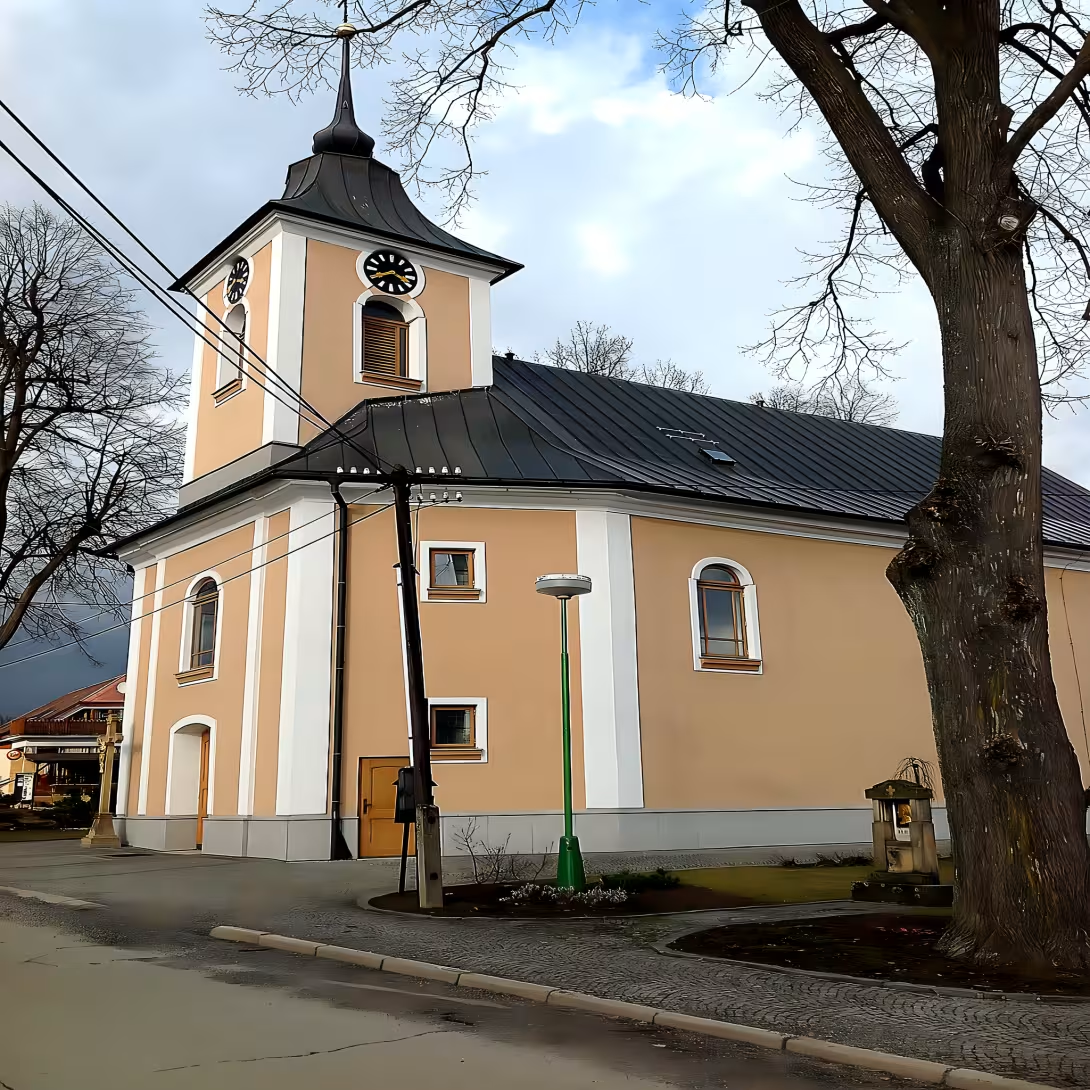
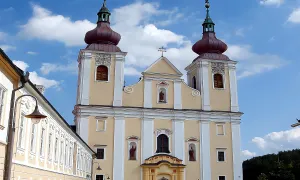
The Church of Saint Martin in Jámy is a notable historical monument located in the Vysočina region of the Czech Republic. Constructed in 1792, it stands on the site of an earlier church with origins dating back to before 1638. This classical-style building has served as a focal point for religious activities and reflects significant architectural and cultural developments over time.
The earliest documented history dates back to 1643 when a golden donation was recorded for the Jámy parish, owned by Jan Macák. The church's origins likely predate this record, constructed under the Ditrichštejn family before 1638. Historical sources suggest that services were held only every third Sunday in its early years. Once, thieves stole documents from the church, which were subsequently destroyed by rain.
The current structure was built in 1792 on the site of an older church, following the establishment of a local parish by the Náboženský fond in 1784. Florián Málek served as chaplain at this time, leading to the construction of the new building. The architectural style is classical, featuring a single-nave structure with a vaulted chancel and one altar. A bell tower was added above the entrance, enhancing its prominence in the village.
Throughout its history, the Church of Saint Martin has undergone various renovations and enhancements. In 1812, it was repaired and re-roofed using donations. By 1847, the church had acquired a significant painting of Saint Martin by Jan Dvořák from Vienna, installed on the altar that October. The church's organ, originally dating back to 1760, was notably repaired in 1851 by self-taught teacher Jan Hron for a modest fee.
The church experienced further development when it was elevated to parish status in 1868. This change prompted significant renovations and improvements under Farář Václav Bezděk, who served from 1878 onwards. The church's bells have an interesting history, with one dating back to 1530 and another inscribed for Saint Michael in 1536.
Today, the Church of Saint Martin remains a significant cultural and historical site. Its classical architecture and rich history make it a worthwhile visit for those interested in exploring the religious heritage of the Vysočina region. Visitors can appreciate its architectural beauty and learn about its storied past, making it an enduring symbol of the community's spiritual life.
Then and now
Drag the slider to compare how the landmark may have looked when it was built with the view today.
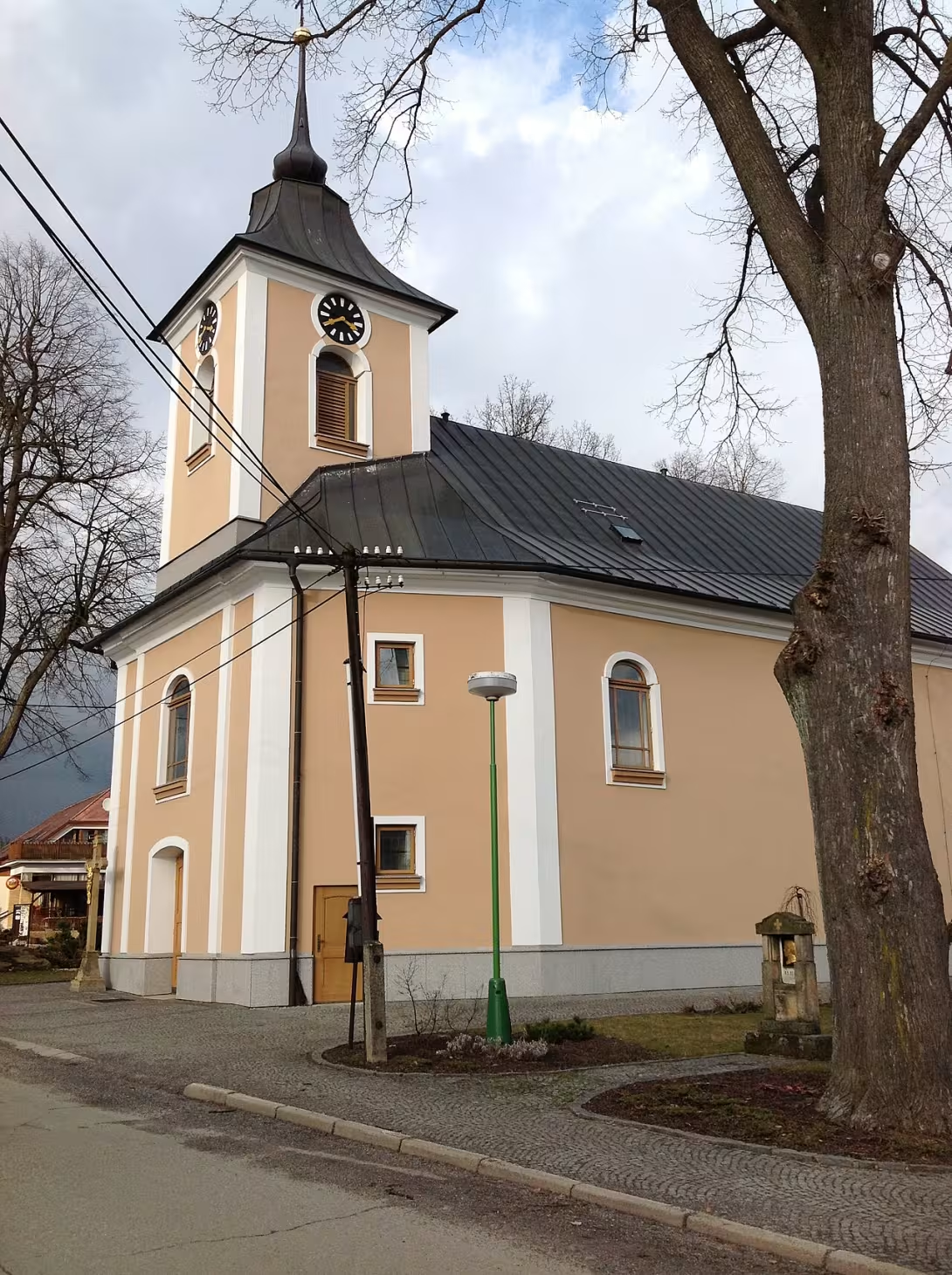
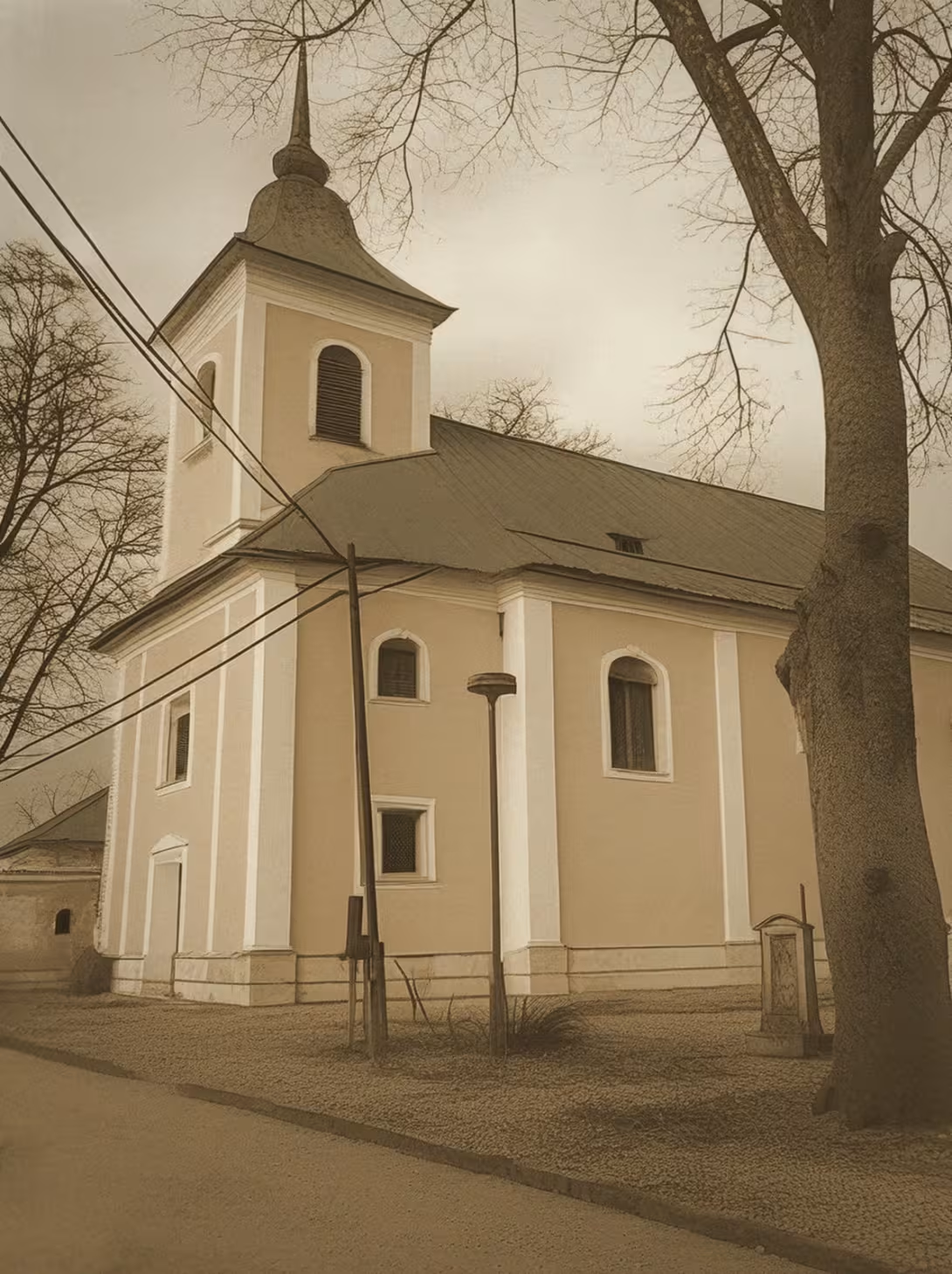
The historical appearance on the left is an AI-generated visualisation and serves as inspiration only.
Historical milestones
- 1784
- Establishment of a local parish in Jámy by the Náboženský fond.
- 1792
- Construction of the new church building began.
- 1812
- The church was repaired and re-roofed using donations.
- 1847
- Acquisition of a painting of Saint Martin by Jan Dvořák from Vienna.
Architectural development
Originally built on the site of an older structure, the Church of Saint Martin underwent several phases of development. The current building, constructed in 1792, is a single-nave oriented structure with a vaulted chancel and one altar. A bell tower was added above the entrance, and over time, various elements such as altars, bells, and organ pipes were renovated or replaced.
Historical events
In 1784, the Náboženský fond established a local parish in Jámy with Florián Málek as the chaplain, leading to the construction of the new church in 1792.
The church was elevated to a parish status in 1868, prompting significant renovations and improvements.
Owners
The church's ownership transitioned from being under the Ditrichštejn family to the Náboženský fond in 1784, which facilitated its development into a parish. Subsequent changes in patronage occurred following the death of Prince František z Ditrichštejna.
Points of interest
- The Church of Saint Martin has a mysterious history involving stolen documents that were ultimately destroyed by rain, adding an element of intrigue to its past.
- In 1812, the church underwent repairs and re-roofing funded entirely through donations, highlighting the community's dedication to preserving their place of worship.
- A unique aspect of the church is its organ repair in 1851 by Jan Hron, a self-taught teacher who undertook this task for just a modest fee, showcasing local talent and resourcefulness.
- The church bells have an intriguing history; one dates back to 1530, while another was inscribed for Saint Michael in 1536, reflecting the long-standing tradition of bell-making in the region.
- In 1847, the church acquired a significant painting of Saint Martin by Jan Dvořák from Vienna, which was installed on the altar that October, indicating connections beyond local borders and enriching its cultural heritage.
Guide
This guide is narrated by a synthetic voice generated by artificial intelligence.
Show guide text
This text was created by artificial intelligence and has not been editorially reviewed. It may contain inaccuracies.
The Church of Saint Martin in Jámy dates from 1792. It stands on the site of an older church, whose origins go back before 1638.
The oldest written record about the church in Jámy is probably a mention of one gold coin left as a bequest for the local poor in 1643. The monastery annals contain nothing about the construction, so it is believed that the church was built while the Ditrichsteins still ruled. The exact date remained unknown. The founder of the parish chronicle discovered that the church had once been robbed. The thieves found no valuables, only documents, which they tore apart and scattered across the cemetery. Rain finished their destruction. Therefore, in 1784 it was no longer possible to establish the date of construction.
The original church was simple. It had a brick sacristy, one altar, a wooden priest's choir, a pulpit, and three bells. It was a branch church and Mass was celebrated by a chaplain from Žďár only every third Sunday. Until 1691, parishioners were apparently allowed to bury their dead themselves. The coffin was lowered and partially covered, and the church ceremony took place only when the priest returned to Jámy.
After the monastery was dissolved, a religious foundation established a small parish in Jámy in 1784, where a chaplain named Florián Málek provided the services. This led to the construction of a new church from solid materials in 1792. It is a single-nave church, 30 meters long, 10 meters wide, and 17 meters high, with a vaulted chancel. A 22-meter high tower was added above the entrance. Wooden pews and an organ were brought here from the church in Zelená Hůrka. The old cemetery near the church was closed and a new one was created at the upper end of the village.
In 1847, the church received a painting of Saint Martin from the Viennese painter Töpel from Prince František of Ditrichstein, valued at 400 gold coins. Jan Dvořák brought it from Vienna without a frame. On October 19th it was placed on the altar and on October 24th it was blessed. In 1851, a painted Stations of the Cross was added. At that time, four bells hung on the tower. The oldest bore the date 1530 and another 1536. The large bell apparently originally belonged to the church at Žďár Castle.
Priest František Šrámek found both the rectory and the church in poor condition. In 1863, a village teacher and autodidact named Jan Hron from Nové Veselí repaired the organ for 50 gold coins. According to the priest, he repaired it so well that a professional would have charged at least four times as much. In 1868, the small parish was elevated to the status of a full parish. Extensive renovations of the church followed, overseen by priest Václav Bezděk, who worked in Jámy from 1878 onwards.
Frequently asked questions
Can the monument be visited?
Religious buildings are usually open mainly during services; at other times a visit is normally arranged with the parish or the operator. We have not verified specific times.
Where is the monument?
Location: Jámy, Kraj Vysočina. The map on this page shows the exact spot.
Businesses nearby
Do you run a restaurant, accommodation, shop, museum, rental, wellness or other visitor service near this monument? Show yourself directly to the people heading to it — this is how they will see you in the app and on the web:
Events nearby
Zdroj akcí: otevřená data měst a obcí ČR (Národní katalog otevřených dat) a kalendář akcí Národního památkového ústavu.
Nearby
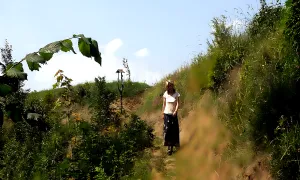
The Church of Saint Martin is situated in Jámy within the Vysočina Region. The surrounding landscape includes rolling hills typical of the area, and nearby natural features contribute to its serene setting.
Accommodation nearby
Themed route
Tematická výletní trasa: Kostel svatého Martina (Jámy)
1. Kostel svatého Martina (Jámy) - Hlavní cíl
- Typ: Historický kostel
- Proč stojí za návštěvu: Tento barokní kostel je architektonickou perli obce Jámy. Jeho bohaté historie a jedinečná vnitřní dekorace nabízejí pohled na minulost této části Čech.
2. Nádvoří kostela svatého Martina
- Typ: Historický areál
- Proč stojí za návštěvu: Nádvoří je klidným místem, kde si můžete užít pohledu na kostel a jeho okolí. Je to ideální místo pro odpočinek nebo krátkou meditaci po prozkoumání vnitřních prostor.
3. Kaple svatého Jana Nepomuckého
- Typ: Kaple
- Proč stojí za návštěvu: Tato kaple je součástí kostelního areálu a nabízí jednoduchý, ale výrazný pohled do minulosti. Je to místo pro klidné modlitby nebo krátké zastavení během návštěvy.
4. Obecní úřad Jámy
- Typ: Místní instituce
- Proč stojí za návštěvu: Zajímavostí je možnost se dozvědět více o historii a současném životě obce. Je to také místo, kde můžete získat doporučení pro další aktivity nebo informace o místních událostech.
5. Místní tržiště
- Typ: Tržiště
- Proč stojí za návštěvu: Navštívte místní trh pro poznání obyvatelstva a koupi regionálních produktů. Je to skvělý způsob, jak se ponořit do každodenního života v Jámách a podpořit místní hospodyňky a farmáře.
Tato trasa nabízí kombinaci historických, kulturních a každodenních zkušeností, které vás ponoří do atmosféry obce Jámy.
Seasonal recommendations
Jaro: During the spring season, Church of Saint Martin in Jamné transforms into a wonder of blooming nature as surrounding forests and fields begin to flourish. Sunny days offer ideal lighting for photographing architectural details of the church, while mild temperatures allow for a comfortable visit. This period often sees the site open with blossoming flowers and fresh foliage, adding an atmosphere of renewal. It is recommended to visit in the early afternoon or late evenings to avoid initial tourist crowds, and wear comfortable shoes for potentially damp ground.
Léto: A summer visit to Church of Saint Martin offers long sunny days ideal for exploring its historic interiors and surrounding gardens. During this season, site accessibility often aligns with peak tourist times, leading to a higher number of visitors. Sunny days provide perfect lighting for photography but also necessitate sun protection. It is recommended to visit in the early afternoon or late evenings to avoid initial tourist crowds, and wear light clothing with a hat and sunscreen. Humidity can be more pronounced, so bring along some refreshments.
Podzim: Autumn offers Church of Saint Martin unique lighting and atmosphere as leaves turn into vibrant shades of red-brown and gold. This season is ideal for visitors seeking milder temperatures and fewer crowds as autumn holidays approach. Sunny afternoons are still long enough to explore the site, while cooler evenings offer a more tranquil visit. It is recommended to wear layered clothing and quality shoes, as temperatures can be variable and fallen leaves may make walking difficult.
Zima: A winter visit to Church of Saint Martin offers a quiet and serene impression when the surrounding landscape is covered in snow or has little foliage. Shorter and colder sunny days require warm clothing and wind protection. Winter light can add a melancholic and mystical touch to the church, ideal for photography or peaceful strolls. It is recommended to visit in the morning when site accessibility is usually shorter, and bring along warm boots and protective cream against the cold.
Visualizations and artistic views


The visualisations are generated by artificial intelligence and serve as inspiration.
Photos from the area
Real photos taken near the monument


Zdroj a licence jsou uvedeny u každého snímku.
Atmosphere of the place
This atmospheric visualisation of the place and period was generated by artificial intelligence. It is not real footage of the location.
Tips from visitors
No tips yet. Be the first!
Log in and add your tip.
Sources and literature
Photos: PAJUPAJU / CC BY-SA 3.0, rozlišení zvýšeno umělou inteligencí — Wikimedia Commons. The author and licence also appear when you hover over the image.
Faktickým podkladem tohoto textu byl článek na Wikipedii, jehož autory jsou přispěvatelé Wikipedie. Článek je dostupný pod licencí CC BY-SA 4.0.
Location on the map


Příběhy a pověsti
Legendy, pověsti a příběhy spjaté s touto památkou

Fotografie návštěvníků
Zatím žádné fotografie. Buďte první, kdo přidá fotografii z návštěvy!
Log in a přidejte svou fotografii nebo hodnoťte.
Za ověřenou návštěvu v aplikaci získáte víc bodů — poznáme podle GPS, že jste na místě.
Reviews and comments