






Kostel svatého Michaela archanděla v Praze-Starém Městě Church
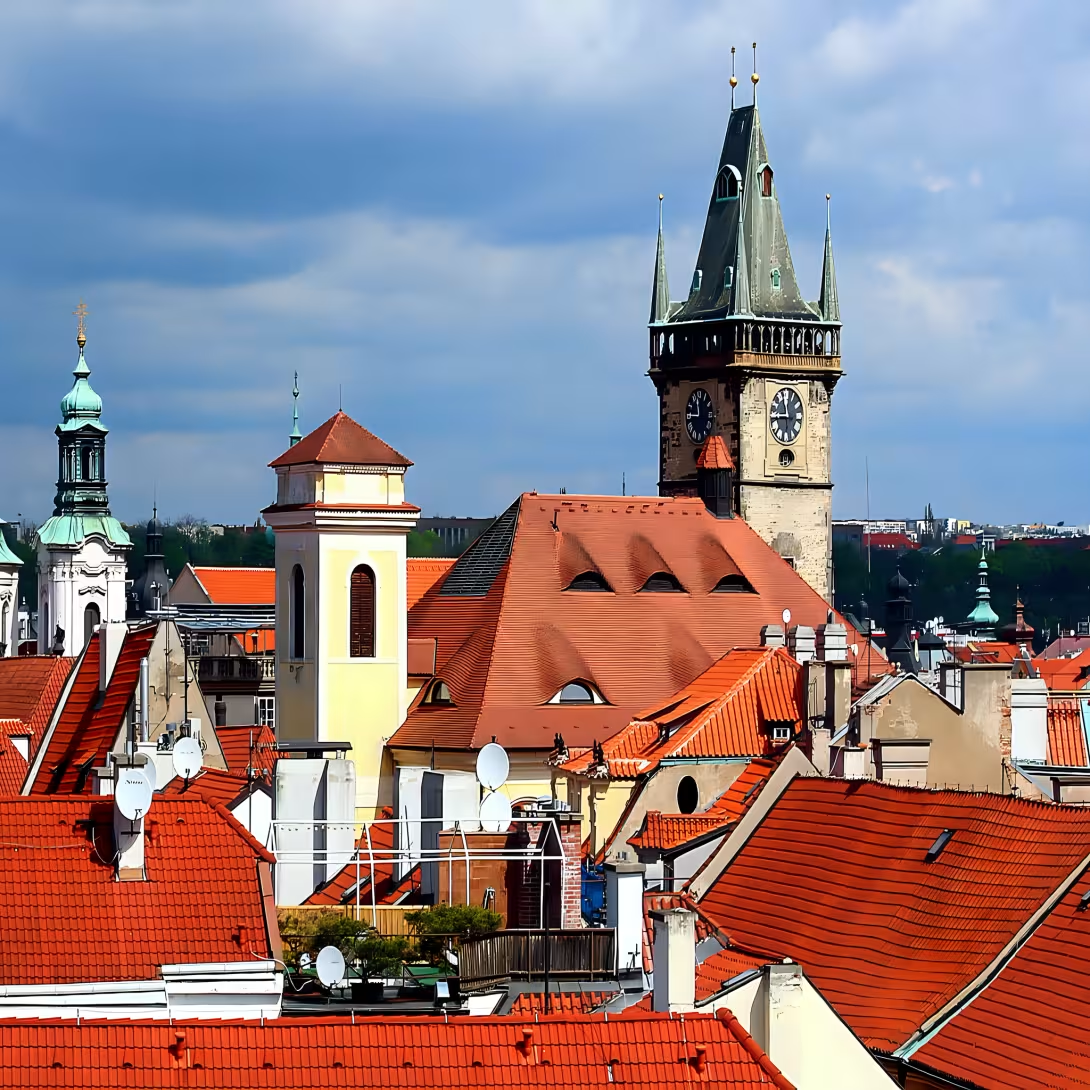
St. Michael's Archangel Church in Prague's Old Town stands as evidence of architectural evolution and religious history. Located in the centre of Prague, it is remarkable for the transition from Romanesque to Gothic architecture and plays an important role during the Hussite movement. Originally built between 1150 and 1200, it was one of the largest medieval churches in Prague. The historical significance of the church underlines its connection with Jan Hus, a key figure in religious reform.
The origin of St. Michael's church dates back to when Czechs experienced significant cultural and religious changes. Initially built as a Romanesque structure at the end of the 12th century, later evolved into a Gothic basilica through large renovation in the 13th century. These changes included the addition of the west tower and side streets which reflected the architectural trends of this time. The development of the church coincided with the rise of the Hussite movement, which sought to reform the Catholic Church and deeply influence European history.
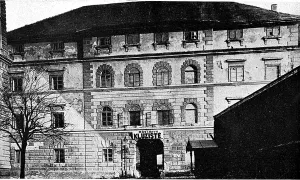
The church of St. Michael features a mixture of Romanesque and Gothic elements. The original Romanesque structure was extended in the 13th century into the basilica-style layout, featuring the west tower and side alleys. This transformation meant a significant shift towards Gothic architecture. Later modifications included regotization in 1914-1915 under builder Stephen Koloschek, introduction of an oblong ship with a flat ceiling and a prism tower in the west. Exterior unifies Baroque main cornice, its interior boasts a decorative vault in the presbytery.
Throughout his history, the Church of St. Michael saw various owners and administrators, reflecting wider religious and political shifts. Originally associated with the Hussites during the Hussite Wars (1419), later became Lutheran property in 1524 before returning to Catholic hands after the Battle of White Mountain in 1621. In 1790 the church was acquired by the German Lutheran Church after leaving. After World War II he was transferred to the Prague congregation of the Slovak Evangelical Church.
The key events at St. Michael's Church highlight his role as a centre of religious discourse and reform. From 1390 to 1406 Bernard, progressive Zderaz Crusader, served as a parish priest and hosted university discreditations attended by Jan Hus. By 1380 the church had 11 priests who also taught at one of the oldest Prague schools. These events highlighted the importance of the church as an intellectual and spiritual centre during major religious upheaval.
The Church of St. Michael remains open to visitors today and offers a view of the rich historical tapestry. the church is remarkable not only for its architectural beauty, but also for its role in shaping religious thinking in Europe. Visitors can explore its crypt where rectors of Prague University are buried, and appreciate the mixture of Romanesque and Gothic elements that define its structure. This monument is a testament to the permanent heritage of religious reform and architectural innovation.
The Church of St. Michael Archangel is more than an architectural miracle, symbolizing historical resilience and spiritual evolution. Its walls reflect the voices of reformers such as Jan Hus, making it a mandatory visit for anyone interested in history, architecture and religious intersections. Visitors are encouraged to enter this remarkable space and experience its profound first-hand legacy.
Then and now
Drag the slider to compare how the landmark may have looked when it was built with the view today.
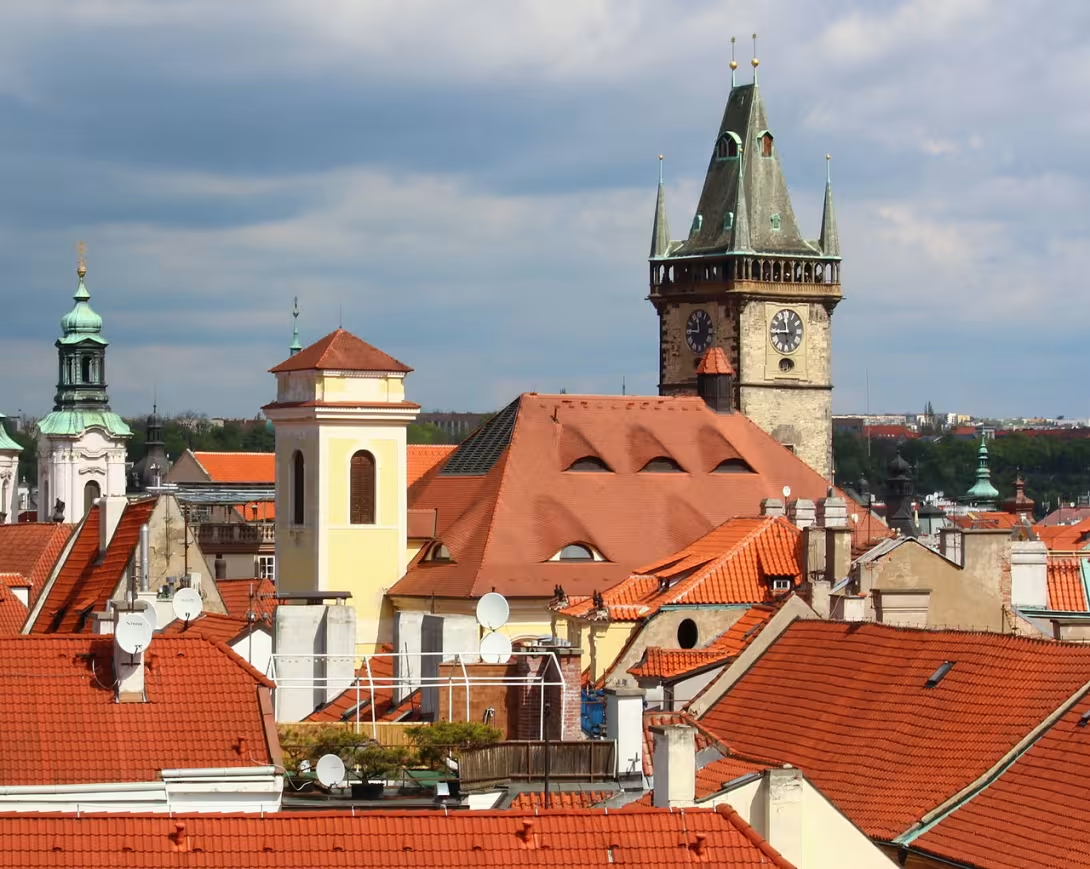

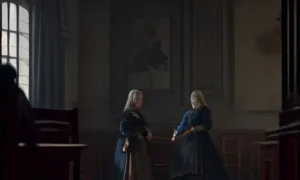
The historical appearance on the left is an AI-generated visualisation and serves as inspiration only.
Historical milestones
- 1380
- the church had 11 priests who also served as teachers at the local school.
- 1390
- Bernard, the progressive Zderaz Crusader, became a parish priest and hosted university discreditations attended by Jan Hus.
Architectural development
St. Michael's church began as a Romanesque structure in the late 12th century, developing into a Gothic basilica with significant renovation in the 13th century. These changes included the addition of the west tower and side streets which reflected the architectural transition of the era.
Historical events
In the 13th century, the church was extended to the west tower and side streets that adopted the Gothic basilica.
By 1380 the church had 11 priests who also acted as teachers at a local school, one of the oldest Prague schools.
From 1390 to 1406, Bernard, progressive Zderaz Crusader, was a parish priest and hosted university discreditation attended by Jan Hus.
Owners
- 1335
Points of interest
- The Church of Saint Michael was once an important place for intellectual debates because he hosted university discredit attended Jan Hus from 1390 to 1406. These discussions played a key role in the early stages of the Hussite movement.
- In an interesting turn of ownership of history, the church became Lutheran property in 1524 and later returned to Catholic control after the Battle of White Mountain in 1621. This past reflects the stormy religious shifts in the Czech Republic during this time.
- The architecturally unique church underwent a regotissing process between 1914 and 1915 under builder Stephen Koloschek. This renovation introduced an elongated ship with a flat ceiling and a prism tower in the west that blends historical styles in its design.
- St. Michael's church had 11 priests in 1380 who also taught at one of the oldest schools in Prague. This dual role underlines the function of the church as a religious and educational centre in the Middle Ages.
- After World War II, the church was transferred to the Prague congregation of the Slovak Evangelical Church, which shows its lasting importance in the meziminational religious communities long after its initial construction.
Guide
This guide is narrated by a synthetic voice generated by artificial intelligence.
Show guide text
This text was created by artificial intelligence and has not been editorially reviewed. It may contain inaccuracies.
The former Church of Saint Michael the Archangel is located in Prague's Old Town near Old Town Square, between Michalska and Melantrichova streets. It was an important center of the Hussite movement. During the reforms of Joseph II, it was abolished, and from that time the building served various civilian purposes.
The site was significant already in the time of the Premyslid princes. A road passed through here, which the chronicler Cosmas called the Vyšehrad road. It connected Vyšehrad with Prague Castle via a ford and a wooden bridge, the predecessor of Judith Bridge and Charles Bridge. Apparently, a wooden structure, possibly of a sacred nature, already stood here in the pre-Romanesque period.
A stone Romanesque single-nave church was built between 1150 and 1200, when the neighboring Rynek, the future Old Town Square, was flourishing. It was among the largest Prague churches of its time. According to one hypothesis, it stood in the center of a settlement of Venetian merchants. Another theory attributes it to the German community, because Saint Michael is considered the patron of Germania. The church had a cemetery, and Michalska Street was called Behind Saint Michael in the Middle Ages.
In the thirteenth century, a western tower and side aisles were added. The patronage rights were held by Czech kings, later by Queen Elisabeth of Bohemia, the wife of John of Luxembourg. After her death, the king donated it to the Zderaz monastery in 1335. In the second half of the fourteenth century, a Gothic reconstruction began, during which the older church was almost entirely replaced by a hall church with three aisles. From that period, a remnant of a Gothic chapel remained on the facade.
In 1380, eleven priests worked here. At the same time, they taught in the parish school, one of the oldest in Prague, and at the theological faculty of the university. From 1390 onwards, the parish priest was the Zderaz Crossbearer Bernard. Theological disputations of university masters were held at the parsonage, and a theology student Jan Hus participated in them. After his ordination as a priest in 1400, Hus preached here.
In 1406, Bernard's successor became Kristian of Prachatice. He was a physician, botanist, astronomer, and mathematician, four times rector of the university, and both Hus's countryman and supporter. Both were among the initiators of the Kutná Hora Decree. The church was, besides the Bethlehem Chapel, one of the main reform sanctuaries. It was among the few churches where an anathema against Hus was not proclaimed on March 15, 1411. From 1414, communion in both kinds was administered here. In 1415, Kristian traveled to Konstanz after Hus and visited him in prison. For this, he was arrested and released only through the intercession of Sigismund of Luxembourg.
Tips for visitors
The best time to visit St. Michael's archangel church is late in the spring or early in the autumn when the weather is pleasant for exploring both inside and outside. These seasons offer mild temperatures and fewer crowds compared to summer, allowing you to better appreciate architectural details. In addition, a visit in the morning can provide smoother lighting ideal for photography and a quieter atmosphere before the day's peak tourist hours.
Parking near the church can be difficult due to its central location in the Old Town of Prague. Public transport is recommended because it provides convenient access with options such as trams and buses that stop close by. For those who drive are parking garages nearby, but availability may vary, so checking the online for up-to-date information before your visit is appropriate.
When visiting the church, consider bringing comfortable walking shoes because you will probably explore other Prague Old Town. A camera or smartphone with a good camera will help capture the complicated details of the architecture church and stained windows. In addition, carrying a small umbrella or raincoat can be useful if the weather changes unexpectedly.
Photographers enthusiasts should focus on capturing the western facade church early in the morning when the light is soft and scattered. The interior offers excellent opportunities to photograph gothic elements, especially during services when natural light filters through windows of coloured glass. Keep in mind the limitations of the photograph inside the church and always ask for permission if not sure.
Near attractions within a 30-minute walk include Prague Chateau, which has several museums and magnificent city views. The Old Town Square also contains historical buildings such as astronomical clocks and the Gothic Church of the Virgin Mary before Tyn. For families with children, consider visiting the nearby Petřín Lookout Tower, which offers fun rides and picturesque views of Prague.
Frequently asked questions
Can the monument be visited?
Yes. We verified the opening hours or admission on the official website (21. 9. 2026); you will find them in the visitor information on this page. Please double-check with the operator before you travel.
What are the opening hours and admission?
Details verified on the official website (21. 9. 2026) are listed in the visitor information on this page. Official website: https://www.sexmachinesmuseum.com/
Where is the monument?
Location: Praha, Hlavní město Praha. The map on this page shows the exact spot.
Why is the monument protected?
It is listed in the Central List of Cultural Monuments of the Czech Republic as a cultural monument. It is protected as part of a larger listed ensemble.
For kids
Imagine going back to the past to the Old Town in Prague and finding yourself in front of the wonderful church of St. Michael the Archangel. It's like you're in a book full of adventure where every wall has its own history and secrets.
Businesses nearby
Do you run a restaurant, accommodation, shop, museum, rental, wellness or other visitor service near this monument? Show yourself directly to the people heading to it — this is how they will see you in the app and on the web:
Events nearby

Zdroj akcí: otevřená data měst a obcí ČR (Národní katalog otevřených dat) a kalendář akcí Národního památkového ústavu.
Nearby
Old Town Square
Coal market
Accommodation nearby
Trips and activities nearby
Guided tours, tickets and activities nearby from GetYourGuide
Affiliate link: if you buy from the partner, we may receive a commission. The price for you does not change.
Search tours and activities →Themed route
Thematic cruise route: Church of St. Michael the Archangel
1. Church of St. Michael the Archangel * Type: * Historical church * Why is it worth a visit: * This baroque church is one of the most beautiful sacral buildings in Prague. Its rich interiors and fascinating history, which dates back to the 14th century, China is essential to every lover of history and architecture.
2. The Old Town Square * Type: * Historical mission * Why is it worth a visit: * Located only a few minutes of poverty from the church and is known for its history, its own tragedy of Hussite year. It is the lively center of Old Town with beautiful Gothic houses and a monument protected from.
3. Church of St. Nicholas * Type: * Historical church * Why is it worth visiting: * This Gothic church is often referred to as "small dome" meaning its meaning and beautiful architecture. It is a location in the Old Town Square of the acquisition of one lodged in small pieces of Prague.
4. Church of St. Gilji * Type: * Historical church * Why is it worth a visit: * Located on the Jihu of Old Town Square and is determined by its own Gothic architecture and history, which deepens the legends of St. George. It is an ideal place for those who need to ensure that there is a spiritual and cultural department of the Old Town.
5. Church of the Virgin Mary Snow * Type: * Historical church * Why is it worth a visit: * This Baroque church is famous for its own rich history and architecture. It is of the opinion that in the Old Town it is necessary to acquire suitable prosthetics between other monuments, which for other reasons can affect the routes.
This route guides you to the beautiful Old Town of Prague, offering its rich history and architecture.
Seasonal recommendations
Spring: The church of St. Michael Archangel offers in the spring business a valid green and a celestial which is determined by the circumstances of the Old Town. Sun light sources of recalculated values, which have historical architecture of the skeleton and are details. This solution is ideal for determination, because the crowd with the zat is extracting the tourist that is necessary to achieve these goals. The Commission considers that the AGL does not apply to aggregate aggregates. The best time to visit is in the afternoon when the sun lights the church in the most beautiful light.
Summer: During the summer trade the Old Town mutates in favour of the center where crowds of tourists and media meet. The sunny echo concerns the common cube of St. Michael's Archangel and its surroundings, which means they are to be fulfilled. Inventories should be made available on a daily basis to avoid the unknown crowd, in the name of having significant summer services. The warm round is recommended, the same as wearing a protective sunlight and plenty of drinking water. In addition, they could determine whether a plan does not require, when the temperature is to be carried out and the church calls for liquid products.
Autumn: Autumn Transferring a quiet and less challenging atmosphere to the Old Town Square, where the leaves will grow into forest colours. Sunny days in relation to the environment, which has the historical architecture of St. Michael's Church and its surroundings. The entrants may expect a small volume of tourists who have been exposed to normal trade but have determined that further adjustments cannot be made in 2005. Hot round and umbrella are supplied products that are not intended for use. The best time to visit is when the sun lights up the church in the most beautiful light and the crowd is covered with zat.
Winter: During winter offers Old Town is one of them. Significant and significant increase in romantic values that have historical architecture of the cube and its surroundings. Vstavy should be converted to cold temperatures and shorter opening times, especially in the Advent course. The round, protective gloves and shoes are essential for the use of these activities. In addition, they could announce that in quiet hours, such as auxiliary mode, it is mild temperature and the church offers liquid products.
Visualizations and artistic views


The visualisations are generated by artificial intelligence and serve as inspiration.
Photos from the area
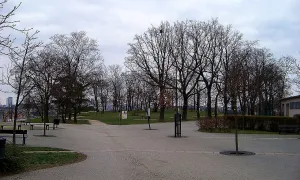
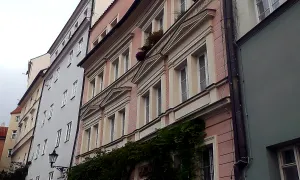
Real photos taken near the monument


Zdroj a licence jsou uvedeny u každého snímku.
Tips from visitors
No tips yet. Be the first!
Log in and add your tip.
Sources and literature
Photos: Gampe / CC BY-SA 3.0, rozlišení zvýšeno umělou inteligencí — Wikimedia Commons. The author and licence also appear when you hover over the image.
Location on the map
Příběhy a pověsti
Legendy, pověsti a příběhy spjaté s touto památkou
Fotografie návštěvníků
Zatím žádné fotografie. Buďte první, kdo přidá fotografii z návštěvy!
Log in a přidejte svou fotografii nebo hodnoťte.
Za ověřenou návštěvu v aplikaci získáte víc bodů — poznáme podle GPS, že jste na místě.
Reviews and comments