



kostel svatého Václava (Branišov) Church
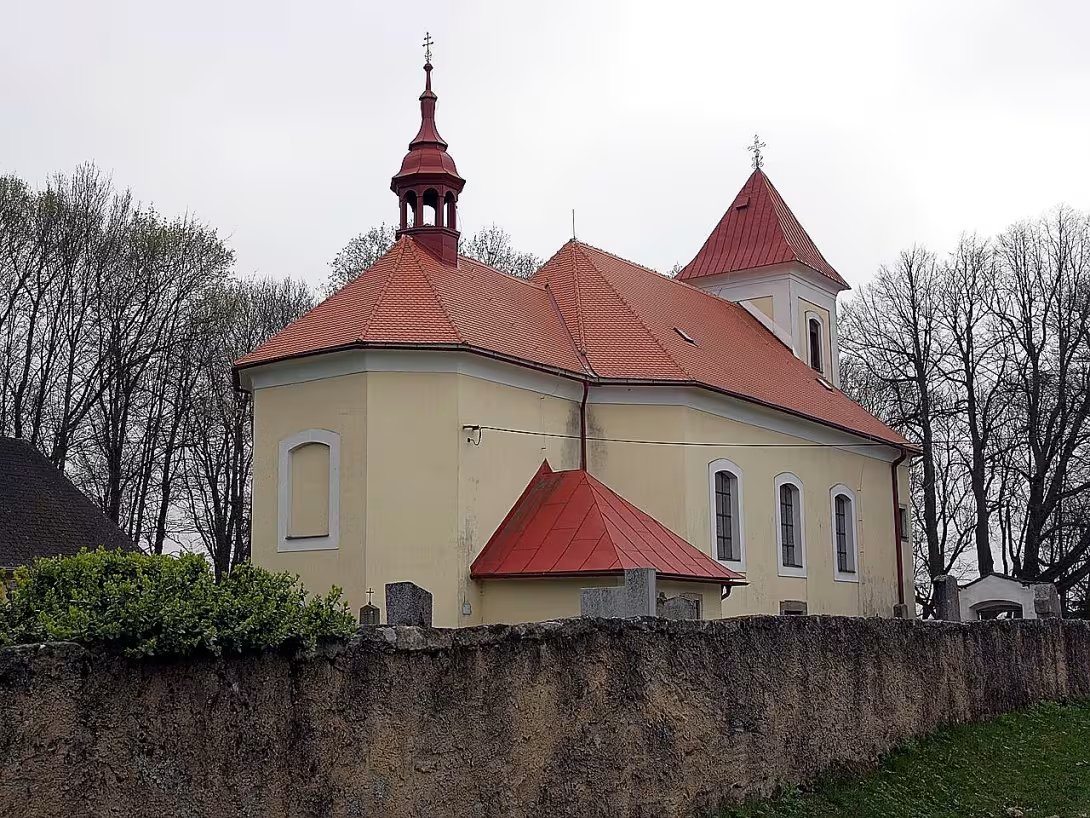
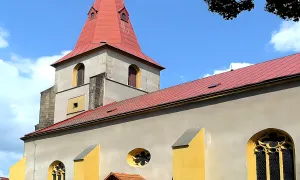
St. Wenceslas Church is located on the eastern edge of Branišova in the cemetery area. It is a Baroque building from 1749- 1751, which is protected as a cultural monument of the Czech Republic - along with a cemetery, morgue, fenced wall and gates. It serves as a filial church of the parish Branišov- Windy Jeníkov.
The tradition of the church in Branišov is of older origin. Written mention of it dates back to 1352, when the parish guarded it under the patronage of the Geliv monastery. During the Hussite wars, the parish and the chapel became part of the Sýbí parish. Restoration came in the 18th century. From 1749 to 1751 the builder Anselm Martin Lurago built a new Baroque church according to the imagination of the vicar František Felix Walk. The temple was ordained September 20, 1751.
Architecturally, the church is a one-ship building with baroque features - a triangular conclusion and a tower on the front. This characteristic look remains to this day.
For centuries, she took her toll. Lightning struck the tower on May 15, 1827, causing a fire that destroyed the roof, organ and altar and melted the bells. The new bells of Václav and Michael were taken on 17 November 1834. In World War I, bells were recited, later replaced with new ones with the same names. World War II took the bell of Wenceslas, which never returned to the tower.
Modern church care began in 1951 in exchange for roof coverings. Further repairs followed - new sheet metal cover in 1971, facade repair in 1994, organ reconstruction in 2009 and wooden parts of the circle in 2010. A special historical contribution was made by an archaeological survey in 2013, which uncovered 28 skeletal remains and an interesting find: a grinding stone from the 13th century, once used to grind iron ore or silver. The 2008 Petitions of Branish Citizens initiated a series of rescue works that continue to ensure the future of this historically valuable temple.
Then and now
Drag the slider to compare how the landmark may have looked when it was built with the view today.
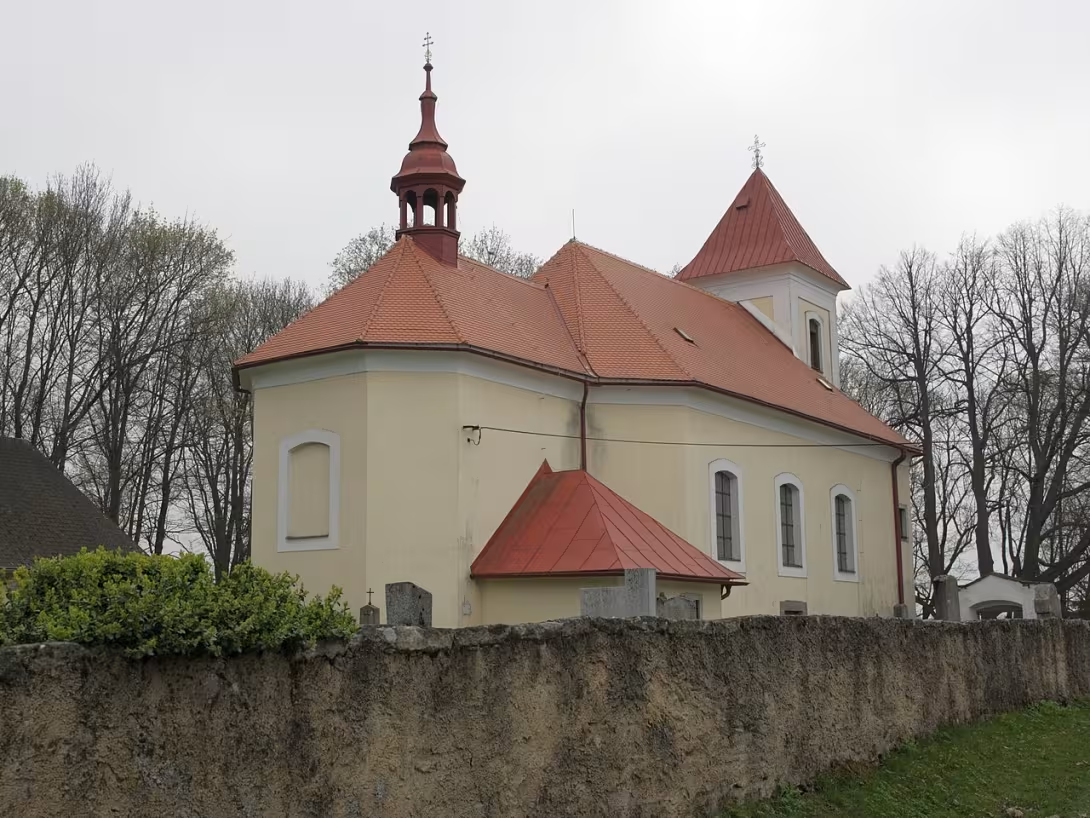

The historical appearance on the left is an AI-generated visualisation and serves as inspiration only.
Historical milestones
- 1352
- The first written mention of the chapel at the site of the present church, which was part of the parish Sýbí and under the patronage of the Geliv monastery.
- 1749-1751
- The position of the Baroque Church of St. Wenceslas according to the project of Anselm Martin Luraga, consecrated on 20 September 1751.
- 1827
- A church fire caused by a lightning strike that burned down the roof, the organ, the altar and melted down the bells.
- 1951
- Significant repair of the church, including replacement of roof and other building modifications.
Architectural development
The church was built in 1749-1751 as a Baroque building on the site of an older chapel. In the 19th century he went through minor repairs after the fire and other maintenance interventions. In the 20th century reconstruction of the roof (1951, 1971), repair of the fenced wall of the cemetery (1983) and minor modifications of the facade (1994) were carried out. A reconstruction of the plaster of the morgue and cemetery wall took place in 2008, after which organ and ring were restored in 2009-2010.
Historical events
1352 - The first written mention of the chapel at the site of the present church, which was part of the parish Sýbí.
1751 - The consecration of the newly built Baroque Church of St. Wenceslas.
1827 - The fire of the church caused by a lightning strike, in which the roof, organ and altar burned.
1951 - Significant repair of the church, including roof replacement.
Points of interest
- The church of St. Wenceslas was built in 1749-1751 according to the design of the priest František Felix Walk, the builder was Anselm Martin Lurago.
- Lightning destroyed the church tower in 1827, causing a fire that damaged the roof, the organ, the altar, and melted down the original bells.
- In 1834, new bells named Václav and Michael were made, which were later recited and replaced during the First World War.
- The 2013 archaeological survey revealed 28 skeletal remains and a grinding stone from the 13th century which served to grind iron ore or silver.
- The church is protected as a cultural monument of the Czech Republic together with cemetery, morgue, wall and gates.
Guide
This guide is narrated by a synthetic voice generated by artificial intelligence.
Show guide text
This text was created by artificial intelligence and has not been editorially reviewed. It may contain inaccuracies.
The Church of Saint Václav stands on the eastern edge of the village of Branišov, in the middle of the cemetery. It is a subsidiary church of the Roman Catholic parish of Branišov – Větrný Jeníkov. It is a single-nave baroque structure with a three-sided choir and a tower on the front side. The entire complex is a cultural monument. Besides the church, it includes the cemetery grounds, a mortuary chapel, a perimeter wall, and a pair of cemetery gates.
The church in Branišov is first documented in writing in the year 1352. The local parish then fell under the patronage of the Želiv monastery. During the Hussite Wars, the parish and the chapel that stood on the site of the present church became part of the parish of Úsobí.
The new baroque church was built between 1749 and 1751. Its builder was supposed to be Anselm Martin Lurago. The parish was then restored, and František Felix Procházka became the parish priest. The church was consecrated on September 20, 1751. Until the year 1865, it underwent only minor repairs and maintenance.
The exception was the repair after a fire on May 15, 1827. Lightning then struck the tower and fire destroyed the roof, the organ, and the altar. The bells melted in the flames. The roof was given new shingles, and on November 17, 1834, new bells were added, named Václav and Michael.
During the First World War, both bells were confiscated. After the war, they were replaced with new bells bearing the same names. During the Second World War, only the bell named Václav was removed and never returned to the tower.
A major repair took place in 1951, when the roof covering was replaced. In 1971, it was replaced with metal roofing. In 1983, the cemetery wall was repaired, in 1994 the external façade of the church received a fresh coat of paint, and in 2002 the gates were repaired. In 2008, Branišov citizens drafted a petition for the preservation of the parish monuments. That same year, the plaster on the mortuary chapel and cemetery walls was repaired and the foundations were stabilized. In 2009, the organ underwent reconstruction, and in 2010, the wooden parts of the choir gallery.
In 2013, an archaeological survey took place in the church and cemetery. Twenty-eight skeletal remains were found in the church. Archaeologists also discovered a millstone from the 13th century, on which iron ore or silver was ground.
Tips for visitors
The best time to visit the church of St. Wenceslas in Branišov is during the spring and summer months when the outdoor light is favourable and nature around the monument is in full glory. The ideal morning is when the church is quiet and you can see the interior without disturbing crowd. The Baroque architecture of the church is best presented in sunny weather, where shadows and light are played on the facade and interior details.
It is recommended to use public transport if you travel from larger cities. Find out the current connection in the traffic search engine.
When visiting, wear comfortable clothes and shoes as the church is located in the cemetery area where the pavement is often uneven. Children can take a small notebook and pencil so that we can draw together or record the interesting things you find in the church. Also remember the sunglasses or hat if the sun is too strong.
For photography is the most suitable eastern and western side of the church where natural light is pleasant. The interior is also beautiful, but watch out for the flashing lens that may disturb other visitors. The best time for photography is early morning or late afternoon when the light is softer and the church looks best.
In the vicinity of St. Wenceslas' church in Branišov is worth visiting the Želivský monastery, which is located about ten kilometres from the village. This tanker complex is a great choice for another tour as it offers rich history and beautiful medieval architecture. Another interesting thing is the Chateau of Windy Jeníkov, only five kilometers away, with its Baroque chateau and surrounding park, which is ideal for a family trip.
For families with children, a visit to St. Wenceslas' church in Branišov is interesting thanks to the possibility of exploring the surrounding cemetery and its history. Children can talk about the old tombstones and monuments found here. In the vicinity you can visit the Želiv monastery where children can learn about the life of monks and their daily activities. Wind Castle Jeníkov offers spacious spaces where children can move freely and explore nature in the park.
Frequently asked questions
Can the monument be visited?
Religious buildings are usually open mainly during services; at other times a visit is normally arranged with the parish or the operator. We have not verified specific times.
Where is the monument?
Location: Branišov, Kraj Vysočina. The map on this page shows the exact spot.
Why is the monument protected?
It is listed in the Central List of Cultural Monuments of the Czech Republic as a cultural monument (register no. 26583/7-4715).
For kids
Imagine going back to when St. Wenceslas's Church in Branišov was still young and full of life. The village of Branišov was a small town where people lived for a living in agriculture and trade.
How did it look here? Who lived here? What happened here? There were people here who prayed at St. Wenceslas's Church. They were peasants who tried to give birth to their fields and live with their family. They were merchants who tried to sell their products on the market.
Businesses nearby
Do you run a restaurant, accommodation, shop, museum, rental, wellness or other visitor service near this monument? Show yourself directly to the people heading to it — this is how they will see you in the app and on the web:
Nearby
- The Cistercian monastery founded in 1144, an important medieval complex with Gothic and Baroque architecture.
- Baroque chateau from the 18th century with park, located in the neighbouring village.
- Geological formations overlooking the surroundings, protected areas with rich flora and fauna.
Accommodation nearby
Themed route
Thematic cruise route: Branišov and surroundings - medieval, Baroque and nature
1. Church of St. Wenceslas (Branišov) * Type: * Sacral monument, Romanesque-Gothic church from the 13th century. * Why visit? * A unique example of medieval sacral architecture with preserved fresco and historical equipment, typical of South Bohemian and Highlands regions.
2. Castle Windy Jeníkov * Type: * Baroque chateau with park, about 5 km from Branišova. * Why visit? * An impressive Baroque building with rich interior decoration and large English park, ideal for walking on historical roads.
3. Želiv monastery * Type: * Cistercian monastery, about 10 km from Branišova. * Why visit? * The most important medieval monastery complex in the Czech Republic with Gothic and Baroque elements, connected with legend of foundation and rich history.
4. Natural Reserve Black Rock * Type: * Geological and botanical reservation, about 7 km from Branišova. * Why visit? * Stupendous rock formations and a rare flower on the edge of Žďárské vršky, suitable for short hiking and nature observation.
* Tip: * The route combines spiritual and historical monuments with natural experience, ideal for cyclists and pedestrians.
Seasonal recommendations
Spring: In the spring season, St. Wenceslas Church in Branišov boasts a wonderful flowering of surrounding fields and meadows, bringing a mild temperature and sweet smell of flowering plants into the atmosphere. This time of year is ideal for short walks around the monument where you can relax and look at nature in full bloom. Visitors are advised to wear comfortable shoes and a short jacket for temperature changes during the day. The best time to visit is afternoon when the sun lights up the church and its surroundings in the most beautiful light.
Summer: In the summer season, historical monuments of new life are acquired. The Church of St. Wenceslas boasts long days and sunny lighting, which highlights its architectural details. The atmosphere is full of life, often there can be various events or exhibitions of art. Visitors should be prepared for possible crowds, especially in the high summer season, and it is recommended to bring sunflower and clothing suitable for warm day. The best time to visit is in the morning or evening when fewer people and the temperature is more pleasant.
Autumn: Autumn atmosphere around St. Wenceslas church in Branišov is gaining melancholy beauty. The forest areas around them are colored in pink, yellow and orange shades, which brings unique aesthetics. This time of year is ideal for peaceful walks and reflective visits to the sights. Visitors are advised to wear warm clothes because autumn can be cold, especially in the concept. The best time for a tour is in the afternoon when the sun hides behind the sky and the trees color their leaves.
Winter: In winter, historical monuments of quiet peace are acquired. The Church of St. Wenceslas in Branišov boasts a snow blanket and cool, clean air, which brings a feeling of relaxation even in the most busy times. The atmosphere is calm and almost magical, especially when the sun is wrapped in clouds. Visitors are advised to wear a warm suit and shoes suitable for snow or cold flooring. The best time to visit is in the afternoon when the sun's rays intersect with the cloud and illuminate the church in its winter beautifully.
Visualizations and artistic views


The visualisations are generated by artificial intelligence and serve as inspiration.
Photos from the area
Real photos taken near the monument


Zdroj a licence jsou uvedeny u každého snímku.
Atmosphere of the place
This atmospheric visualisation of the place and period was generated by artificial intelligence. It is not real footage of the location.
Tips from visitors
No tips yet. Be the first!
Log in and add your tip.
Sources and literature
Photos: RomanM82 / CC BY-SA 4.0 — Wikimedia Commons. The author and licence also appear when you hover over the image.
Faktickým podkladem tohoto textu byl článek na Wikipedii, jehož autory jsou přispěvatelé Wikipedie. Článek je dostupný pod licencí CC BY-SA 4.0.
Location on the map

Příběhy a pověsti
Legendy, pověsti a příběhy spjaté s touto památkou
Fotografie návštěvníků
Zatím žádné fotografie. Buďte první, kdo přidá fotografii z návštěvy!
Log in a přidejte svou fotografii nebo hodnoťte.
Za ověřenou návštěvu v aplikaci získáte víc bodů — poznáme podle GPS, že jste na místě.
Reviews and comments