



kostel svatého Václava (Jezbořice) Church
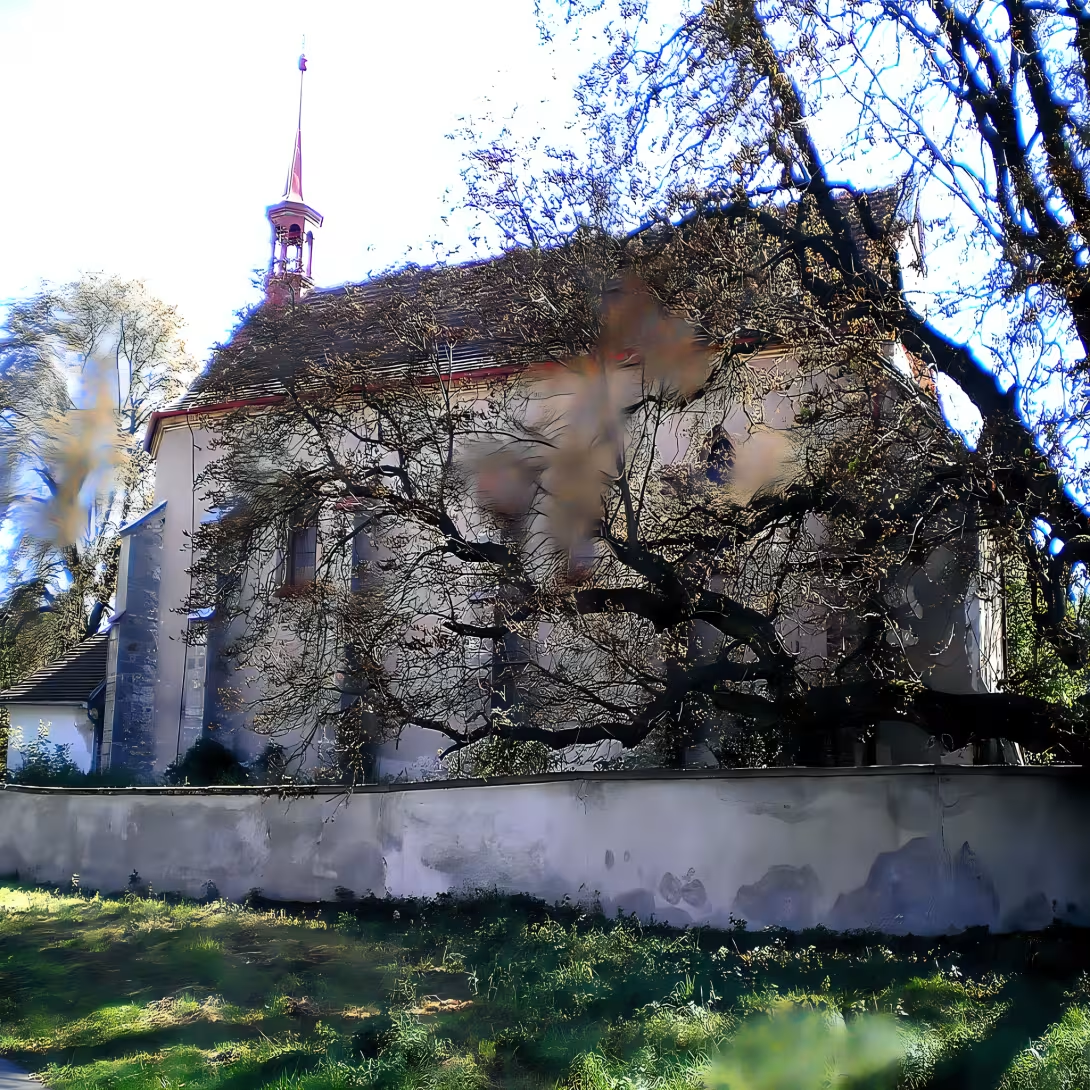
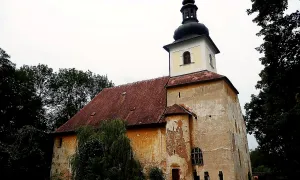
On the edge of a steep design in the centre of the village Jezbořice in the district of Pardubice stands the Gothic filial church of St. Wenceslas. Its dominant position is underlined by the wooden bell tower and cemetery, which form a protected area with the church. The National Heritage Institute records it under the register number ÚSCP 21021 / 6-2092.
The original construction is highly likely to date for the period after 1055; It was a small wooden chapel at the chateau. Today's appearance is the result of successive extensions and reconstructions, especially since the end of the 15th century, when a flat-ceiling ship with a late Gothic profile of the saddle portal was built from the west. At the same time, there were significant modifications to the interior - sediums, sanctuarium and new vaults were created. In the second half of the 16th century the ship acquired a Renaissance vault and in front of the west facade added an annex with a staircase to the circle. The northern sacristy was demolished in the late Baroque and replaced by a new one following the presbytery.
The Thirty Years' War interrupted religious life - the rectory died. Only in the 18th century did the priest return, initially alternately in Jebořice and Mikulovice. In 1769 the locale was established and in 1871 it became a parish church. Today it is administered by the parish of Høman's Town.
The construction represents a Gothic oriented brick church with an interesting building history. The original Renaissance vault fell partially in the fire of 1791; the remainder was removed in 1815. The current ceiling is flat reed. The ship measures 19.85 metres in length and 6.90 metres in width, the presbytery then 6.90 metres in length and 5.80 metres in width.
Interior equipment is rich. The main altar of the 18th century bears the monumental picture of St. Wenceslas serving Christ the crown (4 × 2.50 m). The local landowner Josef Kolínský gave it to the church, painted by Karel Záhorský in 1897. The altar is accompanied by two statues of Saint Peter and Paul. There's a gothic penitentiary on the left of the altar. The equipment includes a baroque chalice with six miniature ground patrons and a patent to provide the patients from 1730. The ecclesiastical of 1600 bears the coat of arms of the Lippanski knight of Lipan. The Chinese candlesticks came from 1674.
We walk through the church among valuable paintings. Particularly interesting is the picture of Jan Nepomucký from 1595 (73 × 45 cm), painted on wood by the chrudim painter Matthew Radoš God. He's talking about a young Ozama, the daughter of a Master of Lipan who died only four years old. The epitaphs on the walls document the influence of the local noble families that have owned Jezbořice for centuries.
At the end of the 19th century, the architect Bohumil Dvořák was able to uncover the remains of the Gothic tomb. Today the church is an important part of the cultural heritage of the Pardubice district and with its wooden bell tower it is far from visible in the landscape.
Then and now
Drag the slider to compare how the landmark may have looked when it was built with the view today.
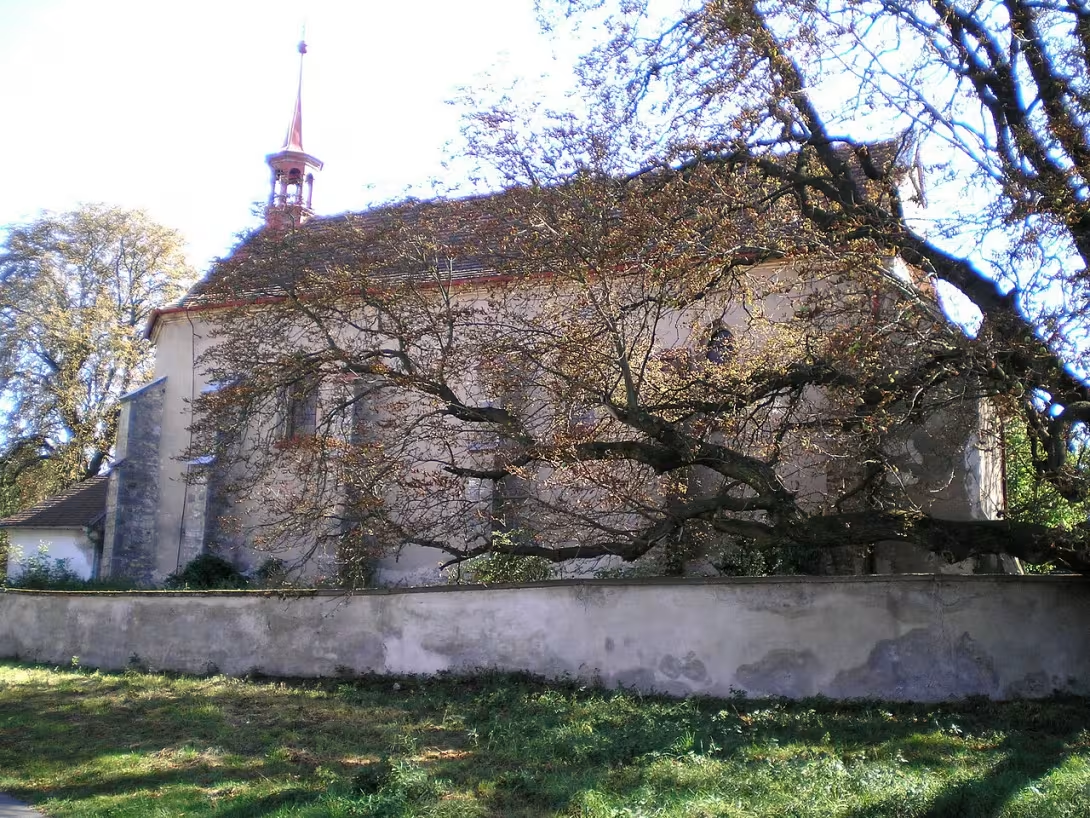
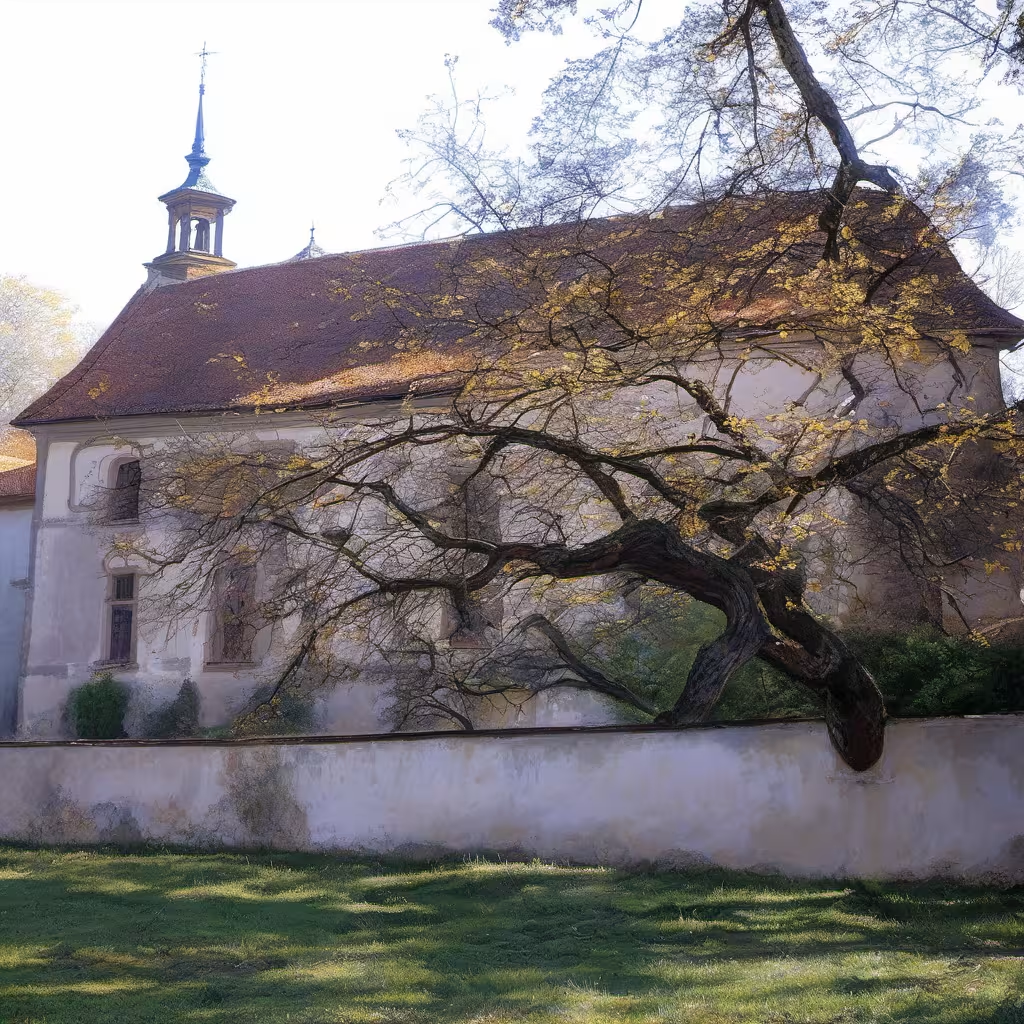
The historical appearance on the left is an AI-generated visualisation and serves as inspiration only.
Historical milestones
- po 1055
- The establishment of the wooden church of St. Wenceslas at the fort.
- End of 15th Century
- Gothic reconstruction of the church with the addition of the boat and the sanctuarium, the creation of the Gothic sanctuarium.
- 1595
- Painting of the painting of John Nepomuk in memory of the daughter of Jetrich Lipanski of Lipan.
- 1791
- Church fire, destruction of the Renaissance vault.
- 1871
- Establishing a parish in Jesurice.
Architectural development
Originally a smaller chapel was gradually expanded during the fort. The ship of the church (19,85 × 6,90 m) and the presbytery (6,90 × 5,80 m) were created in a Gothic style at the end of the 15th century. The Renaissance vault was replaced by a flat reed ceiling after the fire in 1791. In the 18th century the original sacristy was demolished and replaced by baroque. The bell tower is baroque and is part of the complex. The church was renovated in the 19th century, where a fragment of the Gothic tomb was uncovered.
Historical events
- After 1055
- The creation of the first wooden church of St. Wenceslas at the fortress in Jeshorice.
- End of 15th Century
- Gothic reconstruction of the church with the addition of the boat and the sanctuarium, the creation of the Gothic sanctuarium.
- 1791
- The church fire that brought down the Renaissance vault.
- 1871
- Transforming the locale into a rectory.
Owners
The sequence of owners with years if available, otherwise zero.
Points of interest
- The church of St. Wenceslas in Jebořice stands on the edge of a steep hill and forms a protected area with a wooden bell tower and cemetery.
- The original building probably dates back to the year 1055 and it was a small wooden chapel at the chateau.
- Today's church appearance was created by successive reconstructions, especially since the end of the 15th century, when a ship with a late Gothic portal was built and sedile, sanctuarium and new vaults were created.
- The interior equipment includes a monumental painting of St. Wenceslas by painter Karl Záhorský from 1897, dedicated to local landowner Josef Cologne.
- An interesting painting is the work of Matthew Radoš in 1595, depicting young Ozama, the daughter of the lord of Lipan, who died at the age of four.
Guide
This guide is narrated by a synthetic voice generated by artificial intelligence.
Show guide text
This text was created by artificial intelligence and has not been editorially reviewed. It may contain inaccuracies.
The Church of Saint Václav in Jezbořice stands on the edge of a steep hillside in the middle of the village. Thanks to this location, it is visible from afar together with a wooden bell tower standing nearby. The Gothic church, along with the adjacent cemetery and bell tower, is protected as a cultural monument.
A wooden church dedicated to Saint Václav probably stood at the highest point of the village already after the year 1055. The original structure was a smaller chapel at the local stronghold and had five windows. The church acquired its present appearance only at the end of the fifteenth century. Then a nave with a flat ceiling was added to it from the west, which was entered through a late Gothic portal. In the second half of the sixteenth century, the nave received a Renaissance vault, and a small building with stairs to the gallery was added in front of the western façade. The vault partially collapsed during a fire in the year 1791, and the rest was removed in 1815. Since then, the nave has had a flat reed ceiling.
During the Thirty Years' War, the local parsonage ceased to exist. Only in the eighteenth century did a priest live here again, alternating with Mikulovice. In 1769, a curate position was established here, which changed into a parish in 1871. Today the church is administered by the parish of Heřmanův Městec. A number of epitaphs on the walls of the church tell of the former owners of Jezbořice.
The Baroque main altar dates from the eighteenth century. Its painting of Saint Václav, who presents a crown to Christ, was painted in 1897 by Karel Záhorský. A local man, the farmer Josef Kolínský, donated it to the church. Statues of Saint Peter and Saint Paul stand on either side of the altar. To the left of the altar is a Gothic sanctuary.
Among the rarities is a baptismal font from 1600 with the coat of arms of the knight Lipanský of Lipany and with an inscription from the Gospel of Mark. Pewter candlesticks from 1674 stand on the christening table. The same coat of arms, a monk rowing in a green field with a white helmet above, is also borne by a painting on wood that hangs behind the altar. Its inscription commemorates four-year-old Ozama, daughter of Jetřích Lipanský of Lipany, who died in 1595 and was buried in this church. The painting was created by Matouš Radouš Bohemus, a citizen of Chrudim.
From the liturgical furnishings, a Baroque chalice with six silver miniatures of the patron saints of the lands and a paten from 1730 with engravings of Saint Václav have been preserved. During renovations at the end of the nineteenth century, architect Bohumil Dvořák uncovered part of a Gothic tomb.
Tips for visitors
Best time to visit
Church of St. Wenceslas is the most pleasant to visit in the morning when there is a quiet and pleasant light for photography. The ideal period for visiting is in spring or autumn when nature is around beautifully coloured and temperatures are pleasant. In summer it is advisable to visit to choose the days off the main weekends when the church can be visited by a large number of people. A sunny afternoon with mild shade from surrounding trees is also excellent for viewing and photographing the inner spaces.
The stop is usually near or around the church. It is recommended to remember that there is no tram stop in the village.
What to take with you
When visiting the church take on comfortable shoes because it is a historic construction with possible inequalities and stairs. In the summer months it is advisable to take light clothes and sunglasses as the surrounding church can be intense. If you are planning to take pictures, it is recommended to have a lens for wide-angle images with you to capture the overall view of the church and its surroundings. In winter it is advisable to pack warm clothes because the rural environment can be colder than cities.
Photography - best places and light
Best places for photography are around the church, especially from the south side, where there is a good view of the overall view of the building and surrounding landscape. The inner spaces of the church are also very photogenic, especially gothic windows and altar. The best light is in the morning or in the afternoon when the light is softer and not as intense as at noon. In winter it is advisable to photograph in clear weather when the snow cover highlights the beauty of the church.
What to visit in the vicinity (within 30 minutes drive)
In the vicinity of St. Wenceslas Church is worth visiting Mikulovice Chateau, located just three kilometers from Jesburice. It is a Baroque chateau with a beautiful park where you can see historical buildings and nature. Another interesting thing is Pardubice Chateau, 15 kilometers away, where there is a chateau area with a rich history and museum. Both of these places offer rich possibilities for exploring history and nature.
Tips for families with children
For families with children, a visit to St. Wenceslas church is a great opportunity to explore history and architecture. Children can explore the Gothic elements of the church and learn more about its history. There is also enough space around the church for walks and games, allowing families to spend time outside. When visiting the Castle Park in Mikulovice, children can discover the nature and animals that live there. If you go to Pardubice Chateau, children can visit the chateau area and participate in possible interactive activities that often take place here.
Frequently asked questions
Can the monument be visited?
Religious buildings are usually open mainly during services; at other times a visit is normally arranged with the parish or the operator. We have not verified specific times.
Where is the monument?
Location: Jezbořice, Pardubický kraj. The map on this page shows the exact spot.
Why is the monument protected?
It is listed in the Central List of Cultural Monuments of the Czech Republic as a cultural monument (register no. 21021/6-2092).
For kids
One day, when the first stars appeared in the blue sky and everything around it began to be quiet, the little church of St. Wenceslas stood on the edge of the top as a guardian of time. It was a place full of stories and sounds of the past trying to penetrate the present.
Businesses nearby
Do you run a restaurant, accommodation, shop, museum, rental, wellness or other visitor service near this monument? Show yourself directly to the people heading to it — this is how they will see you in the app and on the web:
Events nearby
Zdroj akcí: otevřená data měst a obcí ČR (Národní katalog otevřených dat) a kalendář akcí Národního památkového ústavu.
Accommodation nearby
Themed route
Thematic cruise route from the village Jezbořice
1. Church of St. Wenceslas (Jezbořice) * Type: * Historical landmark * Why is it worth visiting: * The Church of St. Wenceslas is an architectural work which represents the rich history of the village. Its simple but distinctive position offers a view of the traditions and heritage of the local community.
2. Mikulovice Chateau * Type: * Baroque chateau with park * Why is it worth a visit: * This chateau, located just 3 km from Jebořice, is a former estate of noble families. Its beautiful park and Baroque architecture provide a view of the lifestyle of the past.
3. Pardubice Chateau * Type: * Chateau area with historical buildings and museum * Why is it worth a visit: * Although it is approximately 15 km away, Pardubice Chateau offers a fascinating view of the history of the region. Its area with museum and historical buildings allows a deeper understanding of cultural heritage.
4. Pardubice Landscape * Type: * Natural elements * Why is it worth a visit: * Near forest trees and river Chrudimka add a relaxing element to the route. This landscape offers beautiful walks in peace, an ideal way to close a day full of historical discoveries.
This route combines history and nature, providing travelers with a comprehensive view of Pardubický kraj.
Seasonal recommendations
Spring: In the spring, the church of St. Wenceslas in Jesurice is transformed into a noble space where the sun's rays revive the green nature around it. They bloom many flowers and trees are provided with new leaves, creating a harmonious environment for visiting. In this period the atmosphere is calm and welcoming, ideal for relaxing and enjoying the beauty of nature. It is recommended to visit the church in the early spring season when opening is long and crowds are usually less. Make sure to wear proper clothes for mild temperatures that can change quickly.
Summer: Summer brings a lively and full of energy character to the church of St. Wenceslas. Sun rays illuminate architectural details, which increases their beauty. This is the perfect time to take a photo and explore the surrounding natural parks. In the main summer season it is recommended to visit the church at the beginning of the day to avoid strong crowds of tourists. Remember the sun protection and plenty of drinking water because temperatures can be high.
Autumn: In the autumn, the church of St. Wenceslas offers a melancholy view when tree leaves are transformed into golden and red shades. The atmosphere is calm and quiet, which creates ideal conditions for using the beauty of changing seasons. This is also the time when various adventure events can take place that add another layer of atmosphere to the visit. It is recommended to visit the church in the early afternoon and to make sure suitable clothes for cooler temperatures.
Winter: Winter visit to St. Wenceslas Church offers a unique view, where everything around is covered with snow and trees are without leaves. Sun rays are projected on a snowy surface, creating magical light. It is recommended to visit the church in warm clothes, with protection against cold and snow, and to ensure sufficient light provision for safe movements.
Visualizations and artistic views


The visualisations are generated by artificial intelligence and serve as inspiration.
Photos from the area
Real photos taken near the monument


Zdroj a licence jsou uvedeny u každého snímku.
View from the area
This animation was generated by artificial intelligence from a real photograph of the surroundings. The motion and details are not real footage of the location.
Atmosphere of the place
This atmospheric visualisation of the place and period was generated by artificial intelligence. It is not real footage of the location.
Tips from visitors
No tips yet. Be the first!
Log in and add your tip.
Sources and literature
Photos: Josef Hron / Public domain, rozlišení zvýšeno umělou inteligencí — Wikimedia Commons. The author and licence also appear when you hover over the image.
Faktickým podkladem tohoto textu byl článek na Wikipedii, jehož autory jsou přispěvatelé Wikipedie. Článek je dostupný pod licencí CC BY-SA 4.0.
Location on the map

Příběhy a pověsti
Legendy, pověsti a příběhy spjaté s touto památkou
Fotografie návštěvníků
Zatím žádné fotografie. Buďte první, kdo přidá fotografii z návštěvy!
Log in a přidejte svou fotografii nebo hodnoťte.
Za ověřenou návštěvu v aplikaci získáte víc bodů — poznáme podle GPS, že jste na místě.
Reviews and comments