



Kostel svatého Václava a svatého Víta a Panny Marie Church
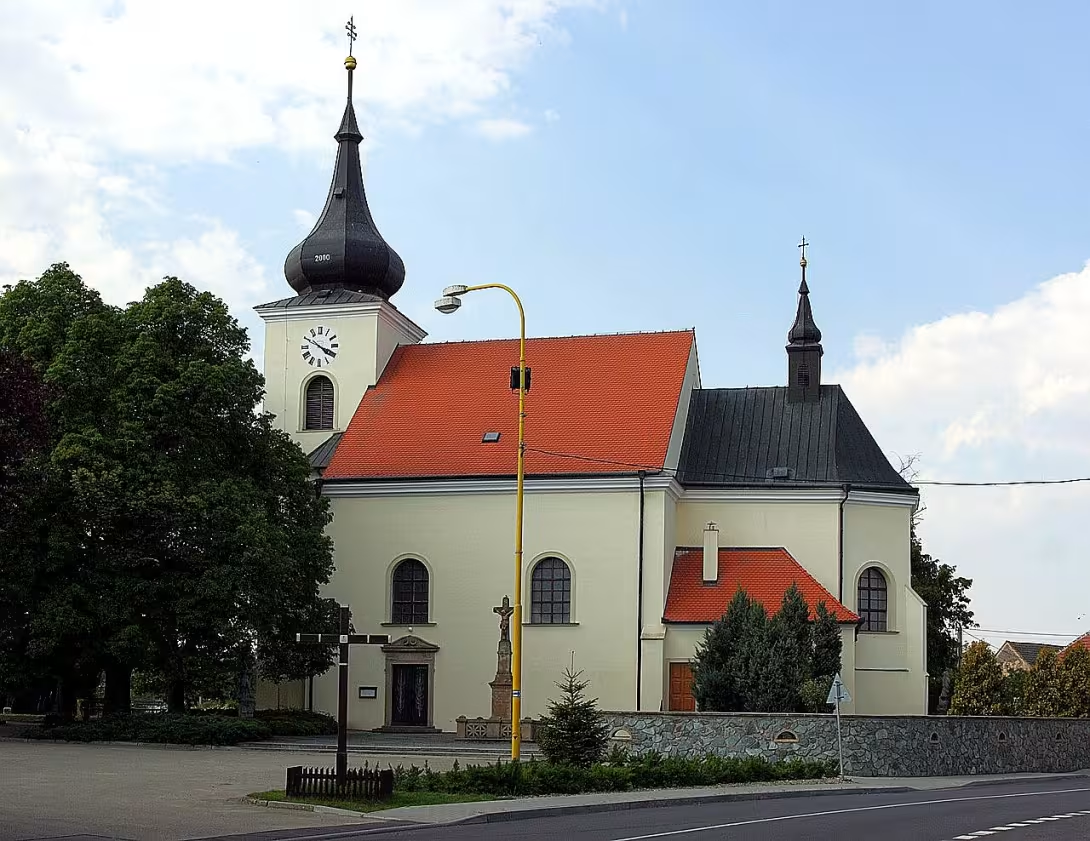
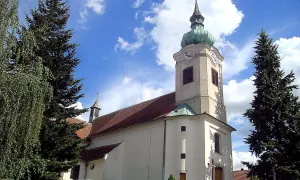
Kostel svatého Václava a svatého Víta a Panny Marie in the Great Germans, district Břeclav, is a parish temple protected as a cultural monument. It is an early baroque one-boat building with a distinctive four-sided tower in the western facade and a polygonal conclusion of the priesthood, which determines the character of the village.
It is believed that the temple dedicated to the Virgin Mary stood in this place in the middle of the 13th century. For the first time, it is mentioned in written sources of 1392. Originally a Romanesque building was rebuilt into a Gothic style in the 15th century, which formed it until its destructive experience in the 17th century. First it was hit by Stephen Bochkaye's campaign in 1605, later by the fury of the Thirty Years' War. The old building probably left only the foundations and remains of the masonry.
The restoration of the church and the rectory was due to the patron Jan Montrochier and his wife Vorshila. The temple was practically rebuilt in the early Baroque style and festively consecrated in 1652. The new main altar was dedicated to the Virgin Mary. In 1672, two side altars were added, dedicated to St. Vít and the faithful dead. In 1695, the biggest bell of the church was cast, weighing approximately 840 kilograms. During the 17th century the church was probably dedicated to St. Wenceslas, which gave him today's title.
In the following century, there were successive repairs and modifications. In 1733 Olomouc Bishop Wolfgang Hannibal of Schrattenbach founded the brotherhood of St. John Nepomuk, who was involved in the uplifting of the church until 1770 when the patent of Josef II cancelled it. In the 1960s and 1970s, the interior was renovated in the late Baroque style. During the 19th and early 20th centuries, roofs, windows, facades and altars were gradually repaired; In 1895 a new main altar was established.
The 20th century brought serious trials. In 1917, three bells were recited for military purposes, including the famous bell from 1695. During World War II, the church was once again in danger - in 1942, three more bells were collected from the five which the church had. When liberating the Great German on April 15-18, 1945 he was hit by artillery shelling, which destroyed the clock machine and damaged parts of walls and windows, although the interior remained relatively intact. New bells were cast and consecrated in 1949.
Since the second half of the 20th century, the renewal continued. In 1978, an underground crypt was discovered under the priesthood. A major reconstruction in the years 1991- 1992 brought new roof binding, copper sheet, new plaster and double windows, while gas central heating replaced the original storage heaters. The roof of the tower was given a new copper coating in 2000, the roof cover on the ship was replaced in 2004.
Architecturally, the church is a pattern of an early Baroque - a single-boat oriented building with half-circle arched windows and an onion roof of the tower on which are visible clock dials. The tower in the west front dominates the composition. The church today serves as a parish temple and a cultural monument that shows centuries of history - from the Middle Ages to the Baroque to modernity.
Then and now
Drag the slider to compare how the landmark may have looked when it was built with the view today.
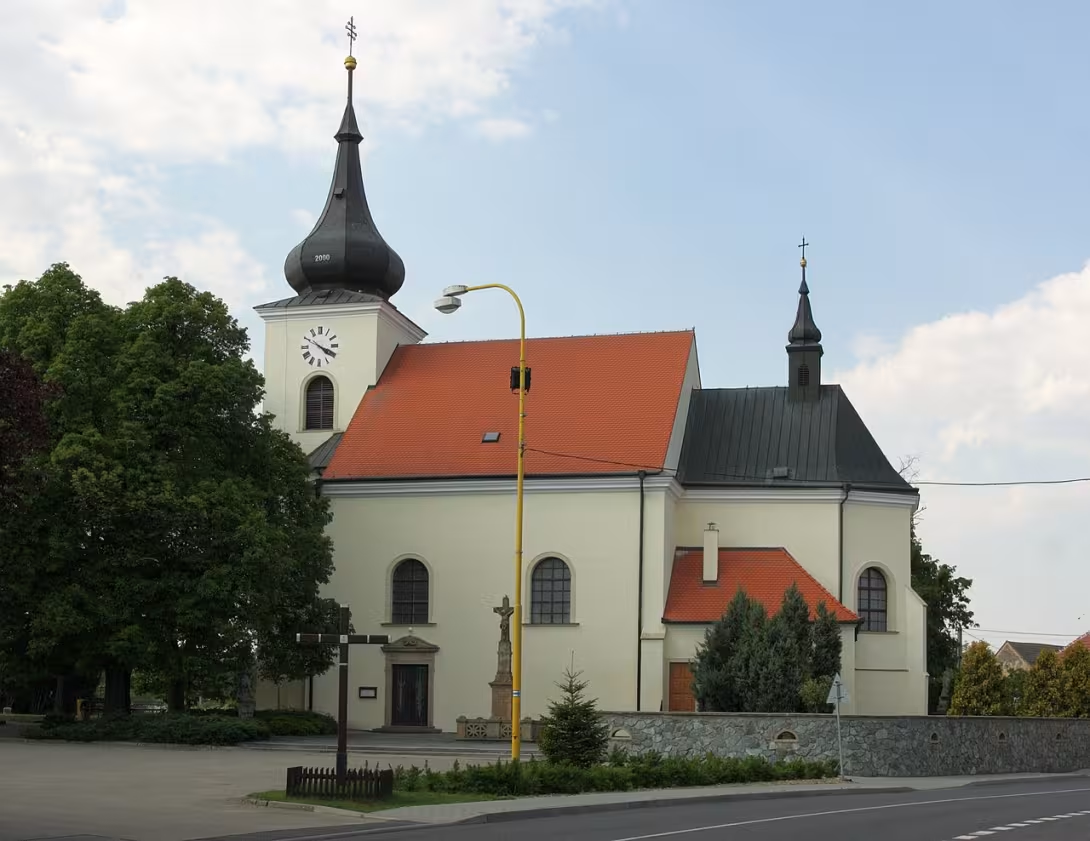

The historical appearance on the left is an AI-generated visualisation and serves as inspiration only.
Historical milestones
- 1392
- First written mention of the church dedicated to the Virgin Mary
- 1605
- Damage to the church during Stephen Bočkaj's invasion
- 1652
- The ordination of a newly built early Baroque church
- 1695
- Spilling the biggest bell of the church weighing about 840 kg
- 1945
- Damage to the church by artillery sniper during liberation fighting
- 1978
- Replacing the main altar and uncovering the underground crypt under the priesthood
Architectural development
The church was built on the foundations of a destroyed Gothic temple with a Romanesque core. The early Baroque form of 1652 is characterized by a single-boat layout with a polygonal priesthood and a tower in the western facade. In the 18th century there were late Baroque modifications of the interior, in the 19th century classical and historical changes. In the 20th century, repairs were made after war damage and modernization of technical equipment.
Historical events
Destruction of the original Gothic church during the 30-year war (17th century)
The consecration of the newly built early Baroque church in 1652
Damage to the church during liberation struggles in April 1945
Large reconstruction in 1991- 1992 with modernization of the interior
Owners
Prague Chateau
Points of interest
- The church was originally dedicated only to the Virgin Mary, the first written mention of it dates back to 1392.
- The original Romanesque building was rebuilt into a Gothic temple in the 15th century, which was destroyed during the campaign of Stephen Bočkaye in 1605 and then the Thirty Years' War.
- In the 17th century the church was rebuilt in the early Baroque style, ceremonially consecrated in 1652 and also dedicated to St. Wenceslas.
- The largest bell of the church, cast in 1695 and weighing about 840 kilograms, was recited in 1917 for military purposes.
- During World War II, the church was shot at liberation in April 1945 while suffering damage to the clock machine and parts of the walls.
Guide
This guide is narrated by a synthetic voice generated by artificial intelligence.
Show guide text
This text was created by artificial intelligence and has not been editorially reviewed. It may contain inaccuracies.
The parish church in Velkých Němčicích in the Břeclav region is an early Baroque single-nave building with a tower. It was consecrated in 1652 and is protected as a cultural monument.
The church dedicated to the Virgin Mary stood in the middle of the village probably already in the middle of the thirteenth century. It is first mentioned in writing in 1392. The originally Romanesque building was rebuilt in the Gothic style in the fifteenth century. In the first half of the seventeenth century, the church was severely damaged, first during the invasion of Stephanus Bocskay in 1605 and then during the Thirty Years' War. Apparently only the foundations and remnants of the walls remained. The patron Jan Montrochier and his wife Voršila were instrumental in the restoration of the church and rectory. The church thus rose practically anew in an early Baroque style. The main altar was again dedicated to the Virgin Mary. Probably still in the seventeenth century, dedications to Saint Wenceslaus and Saint Vitus were added.
In 1695, the largest bell, weighing approximately 840 kilograms, was cast. In 1733, the Olomouc bishop Wolfgang Hannibal von Schrattenbach founded the confraternity of Saint John of Nepomuk. It cared for the church until 1770, when it was dissolved by a patent of Joseph the Second. In the sixties and seventies of the eighteenth century, the interior acquired a Late Baroque appearance.
In the nineteenth century, the church underwent a series of repairs. It received a new roof of the presbytery with a sanctus tower, new windows and plaster. In 1895, a new main altar was created. Both world wars deprived the church of its bells. In 1917, three bells were confiscated, including the largest one from 1695, and in 1942 three of the five again. During heavy fighting for Velkých Němčicích in April 1945, the church was hit by artillery. It destroyed the clock mechanism, collapsed part of the walls and broke out windows, but the interior suffered no major damage. Repairs took place in 1947 and 1948, and in 1949 it was possible to cast new bells.
In 1978, a new main altar replaced the dilapidated one. In doing so, an underground crypt was revealed beneath the presbytery. A major reconstruction in 1991 and 1992 brought a copper roof covering over the presbytery, new plaster and central heating. Later, the organ, tower and nave roof were repaired.
The presbytery of the building is polygonally enclosed. From the western façade, a four-sided tower with a clock in the bell tower storey rises. The windows are topped with a semicircular arch. An oratory adjoins the presbytery from the south and a sacristy from the north.
Tips for visitors
The best time to visit the church of St. Wenceslas, St. Vitus and the Virgin Mary in the Great Germans is during the spring and summer months when the outdoor environment is pleasant and sunlight creates ideal conditions for photography. In summer you can also enjoy a quiet atmosphere around the church, which is less busy at this time. The morning hours in the morning or afternoon after the 15th are suitable for those who want to escape the crowds of tourists.
It is recommended to use public transport if you drive from larger cities. You can find the current connection and schedule in the search engine or on the website of the transport company.
When visiting, wear comfortable clothes and shoes because the church and its surroundings offer several places with uneven terrain. It is also convenient to wear comfortable shoes if you are planning a tour around. If you want to photograph, do not forget the camera or mobile phone with a high-quality lens. For photography of the church interior it is advisable to have a small reflector or lamp with you because the lighting inside may be limited.
The best places for photography are the exterior facade of the church with its early Baroque elements and polygonal priesthood. The inner spaces offer beautiful frescoes and historical details, which are ideal for shooting in the light. It is recommended to photograph in natural light from window openings. The church tower is another interesting place worth capturing in the photograph.
It is worth visiting Castle Velké Němčice, which is only a few minutes' walk away. The natural park Pálava is also suitable for families with children who can discover nature and historical monuments in a safe environment.
For families with children a visit to the church is interesting due to its historical importance and the possibility to explore its inner spaces. Children can see frescoes and sculptures that are often told stories from history. In the vicinity of the church you can find also small trails that are suitable for family trips. The Velké Němčice Chateau also offers a tour of the interior where children can see historical furniture and works of art.
Frequently asked questions
Can the monument be visited?
Religious buildings are usually open mainly during services; at other times a visit is normally arranged with the parish or the operator. We have not verified specific times.
Where is the monument?
Location: Velké Němčice, Jihomoravský kraj. The map on this page shows the exact spot.
Why is the monument protected?
It is listed in the Central List of Cultural Monuments of the Czech Republic as a cultural monument (register no. 27275/7-1791).
For kids
Imagine going back to the past to Prague, where the new church of St. Wenceslas and St. Vitus and the Virgin Mary is being built. The place where today stands a beautiful Gothic church was once a Romanesque temple.
It was like a game where people imagined what their city would look like in the future. And right here, in this place, it was beginning to build something truly astonishing - a new church! Imagine you're a small construction man and you have a job to build a new building. How would you do that?
Businesses nearby
Do you run a restaurant, accommodation, shop, museum, rental, wellness or other visitor service near this monument? Show yourself directly to the people heading to it — this is how they will see you in the app and on the web:
Nearby
Prague Chateau, Old Town Square
Accommodation nearby
Trips and activities nearby
Guided tours, tickets and activities nearby from GetYourGuide
Affiliate link: if you buy from the partner, we may receive a commission. The price for you does not change.
Search tours and activities →Themed route
Thematic cruise route from the Great Germans
1.Kostel svatého Václava a svatého Víta a Panny Marie _ Type _: Church This Baroque church is our main destination. Its rich history and architectural appearance attract visitors who wish to explore the spiritual and cultural heritage of the village Velké Němčice. The church is the perfect place to start your trip.
2. Castle Velké Němčice _ Type _: Castle There is a chateau about 1 km from the church, which is an important historical monument to the village. Its beautiful architectural features and charming park offer an ideal break for relaxation and a tour after a visit to the church.
3. Pálava National Nature Reserve _ Type _: Natural Reservations After the chateau, travel to the Pálava National Nature Reserve, which is known for its unique flora and fauna. This reservation offers beautiful views and the opportunity to explore wild nature in peace.
4. Pálava Natural Park Type _: Park After visiting the reservation it is advisable to visit the Pálava Natural Park, located nearby. This park provides a beautiful opportunity for a picnic or a long walk in green and is an ideal place to close your trip.
This route offers a combination of cultural, historical and natural adventures that allow visitors to explore the Great Germans area in general.
Seasonal recommendations
Spring: In the spring period Kostel svatého Václava a svatého Víta a Panny Marie in the Great Germans is transformed into a special place where the sun illuminates historical architecture with new light. The green surrounding nature gives the church life and makes it a quieter atmosphere. Visitors can expect mild temperatures, so it is advisable to bring light clothes for transitions between solar and cold moments. The best time to visit is at noon, when lighting is best suited for photo and viewing.
Summer: Summer brings long sunny days and warmer air around the Church of St. Wenceslas and Saint Vitus and the Virgin Mary. This time of year is ideal for visiting because nature in full bloom offers a beautiful background. However, you can meet with a higher frequency of visitors, especially in the main summer season. We recommend to come earlier on the day and wear sun cream together with light clothes to handle heat. Don't forget to bring water to make the visit comfortable.
Autumn: In the autumn months, the surrounding area of St. Wenceslas and St. Vitus and the Virgin Mary grows special colours when tree leaves pass into yellow and red shades. This seasonal change creates a unique atmosphere of calm and relief from the summer flood of visitors. The temperature is usually pleasant, so light clothes will be sufficient, but you can bring a backpack for an umbrella or a warm sweater for cooler evenings. The best time to visit is early afternoon when the sun is still warm and surrounding nature offers beautiful colors.
Winter: Winter brings the Church of St. Wenceslas and St. Vitus and Virgin Mary a peaceful atmosphere where the surrounding area is covered with snow or green leaves. This time of year offers unique lighting of the church in cool light and fewer visitors. It is important to prepare for lower temperatures, so we recommend wearing warm clothes and shoes suitable for snow.
Visualizations and artistic views


The visualisations are generated by artificial intelligence and serve as inspiration.
Photos from the area
Real photos taken near the monument


Zdroj a licence jsou uvedeny u každého snímku.
Atmosphere of the place
This atmospheric visualisation of the place and period was generated by artificial intelligence. It is not real footage of the location.
Tips from visitors
No tips yet. Be the first!
Log in and add your tip.
Sources and literature
Photos: RomanM82 / CC BY-SA 3.0 — Wikimedia Commons. The author and licence also appear when you hover over the image.
Faktickým podkladem tohoto textu byl článek na Wikipedii, jehož autory jsou přispěvatelé Wikipedie. Článek je dostupný pod licencí CC BY-SA 4.0.
Location on the map


Příběhy a pověsti
Legendy, pověsti a příběhy spjaté s touto památkou
Fotografie návštěvníků
Zatím žádné fotografie. Buďte první, kdo přidá fotografii z návštěvy!
Log in a přidejte svou fotografii nebo hodnoťte.
Za ověřenou návštěvu v aplikaci získáte víc bodů — poznáme podle GPS, že jste na místě.
Reviews and comments