



kostel svatého Víta s farou Church
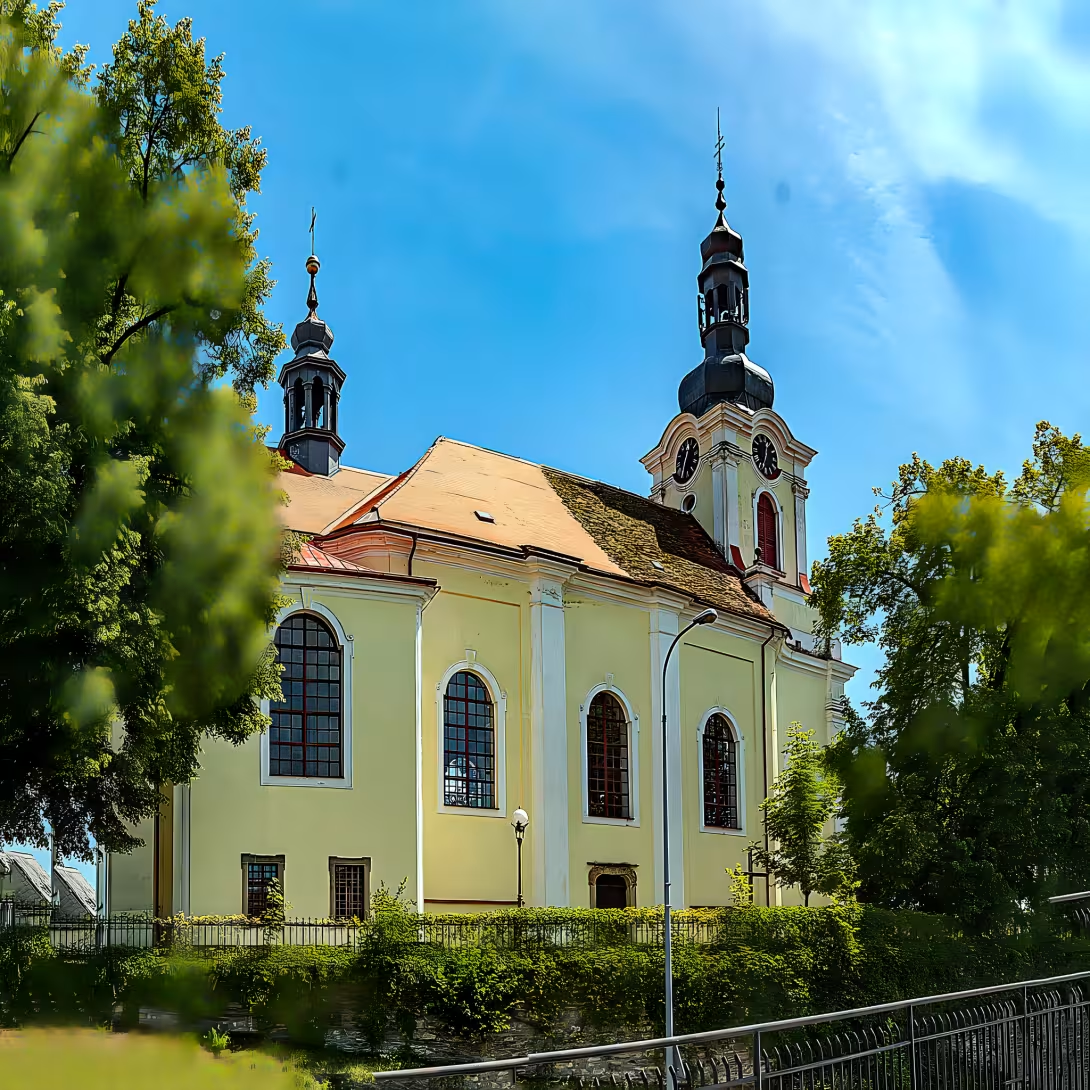
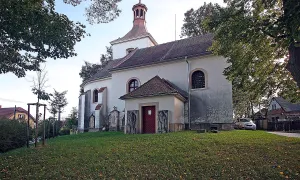
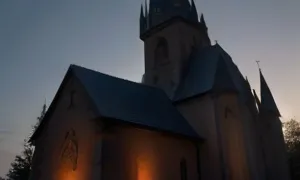
The Church of St. Vitus in Chastolovice represents the ultimate Baroque style with elements of Rococo. The monument is protected by the state along with the rectory (house No. 82) and the corresponding supporting wall, which is decorated with valuable fencing.
The original original was supposed to be the Gothic church of St. Catherine, the first mention of it dates back to 1356. Over time, the building was in a very bad state, which is why it was demolished in the 18th century to free up the site of a new construction. Several valuable artifacts were preserved from the original church: the tin baptiser from 1571 with Czech inscription made by Jan Bassti Convařář from Hradec Králové and three bells - the bell Orlík from 1564 from the convaler Adam Taraby, the bell from 1612 from Fridrich from Oppersdorf and the bell from 1509 without dedication.
The decision to build a new church was taken by František Filip Šternberk. The construction was entrusted to František Kermer, the royal hradec architect and builder who was a pupil of the leading builders of his time. The base stone was placed behind the main altar in 1772 with the inscription entered. The construction lasted longer than expected, because it was interrupted by peasant riots. The church was ceremoniously consecrated on 24 September 1775, after three years of construction. The outer wall of the priesthood was attached to the Renaissance tombstones of the children of the superintendent Jan Matiegka from 1590 to 1607.
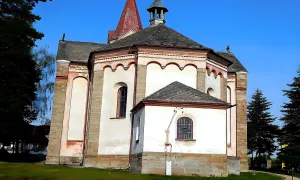
The construction is a single boat with a rectangular priesthood, which has a closed form inside the circular plan and from the outside triangle. The western facade is decorated with a prism tower. The outside plaster is smooth, decorated with lizene frames around the casual windows. The walls divide the pilasters both inside and outside. The interior is arched by rolling with sections. On the south side there is a hall, on the opposite side the boat closes a winning arch with an elevated priesthood. Interesting is the unusual orientation of the main altar to the north side. The sacristy with a separate entrance extends west of the priesthood. Both oratoriums, which are located above it and symmetrically on the opposite side of the priesthood, reflect the baroque pursuit of symmetry. Eight windows illuminate the interior - six falls to the ship and two priesthood. The decoration of the church is based on rococo style with elegant gilded elements and stucco year, although part of the decoration is characterized by pseudorococo conception.
The organ played an interesting role. Two decades after the church was consecrated, there were no organ. It was only in 1794 that the local vicar agreed with the director of the estate Josef Pospíšil to obtain the funds for their acquisition. The money for the organ was extracted by selling the church tin, honey and wax - 400 gold and 35 tailors in total, but that was not enough. Director Pospíšil turned to the patron saint of the church Count Christian Šternberk, who helped financially while having two supporting pillars under the bark to ensure safety. The production of the organ was entrusted to Jan Jiří Spanel from Rokytnice in the Orlicke Mountains, an experienced carpenter and organist. He received 500 gold pieces for his work. Construction and production lasted for a year and a half, and installation took six weeks. During the assembly, Pastor Ježek provided all workers with free food.
The remains of former chaplain, Father Martin Čeňek and brewer Vojtěv Kobeš, are stored in the crypt under the bark. A skeleton was set up near the church. The church thus represents not only rich Baroque architecture, but also a living link with Czech history of the local place.
Then and now
Drag the slider to compare how the landmark may have looked when it was built with the view today.
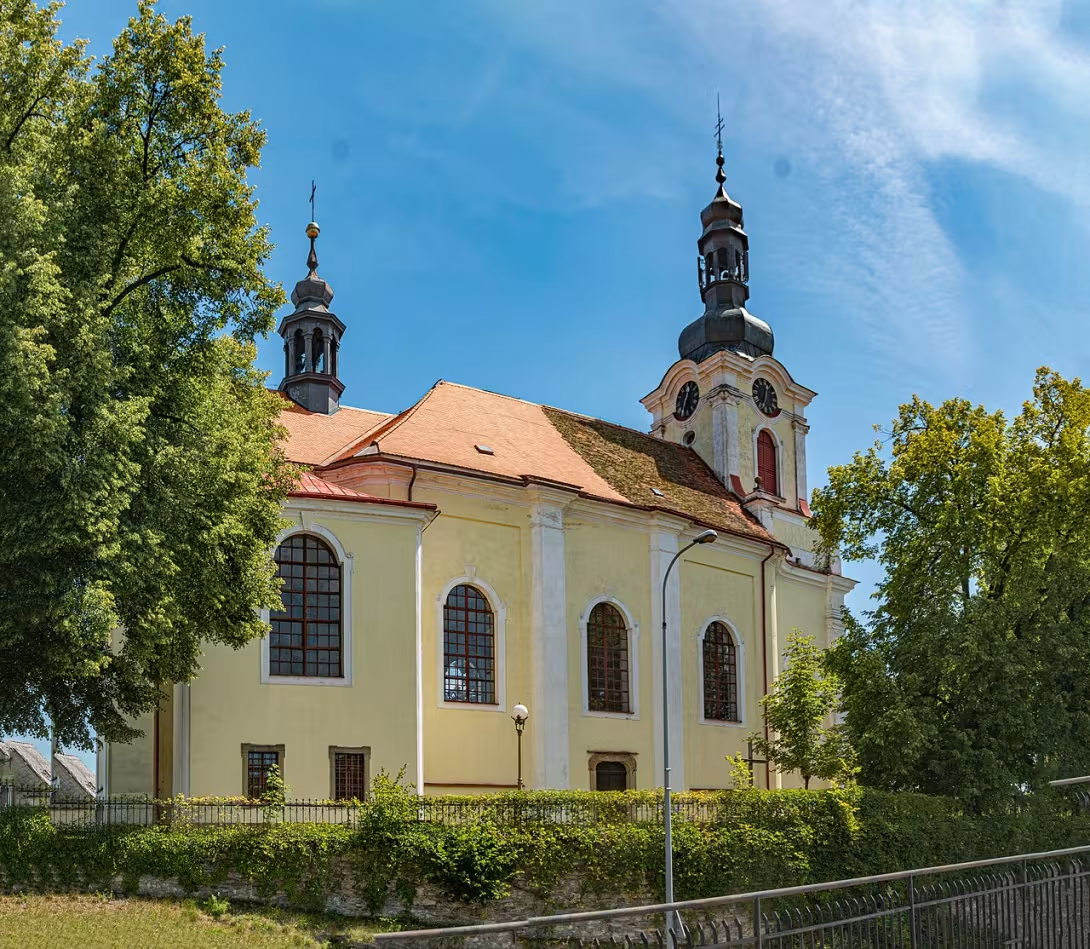
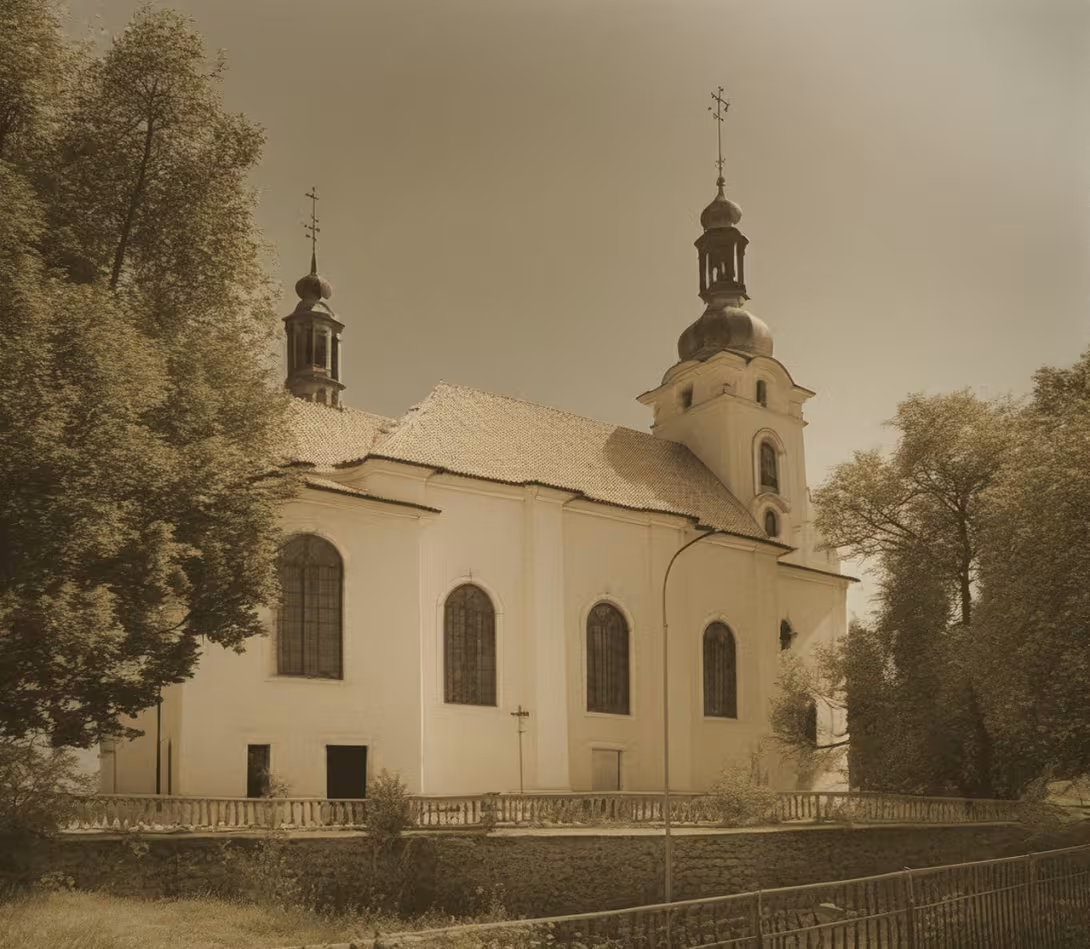
The historical appearance on the left is an AI-generated visualisation and serves as inspiration only.
Historical milestones
- 1356
- First mention of St. Catherine's original Gothic church.
- 1772
- The laying of the cornerstone of the new Baroque church.
- 1775
- The ceremonial consecration of the church after three years of construction.
Architectural development
A new Baroque building was built on the site of the extinct Gothic church. The church is single-storey with a rectangular priesthood and a prism tower in the western facade. The interior is characterized by a vaulted vault and rococo decoration.
Historical events
The first mention of the original Gothic church of St. Catherine in 1356, the laying of the foundation stone of the new church in 1772 and the ceremonial consecration of the building in 1775.
Owners
František Filip Šternberk
Points of interest
- The church represents the ultimate Baroque style with elements of Rococo. - The original Gothic church preserved valuable artifacts like the Chinese Baptist of 1571 and three bells. - The construction of the new church has been interrupted by peasant riots. - Interesting is the unusual orientation of the main altar to the north side. - The purchase of the organ was made by selling the church tin, honey and wax.
Guide
This guide is narrated by a synthetic voice generated by artificial intelligence.
Show guide text
This text was created by artificial intelligence and has not been editorially reviewed. It may contain inaccuracies.
The Church of Saint Vitus in Častolovice is a Late Baroque parish church. It was commissioned by František Filip, Count of Šternberk. The heritage protection applies not only to the church itself, but also to the rectory, the house with descriptive number 82, and a section of the retaining wall with valuable fencing.
A Gothic Church of Saint Catherine stood on this site previously, first mentioned in 1356. In the eighteenth century it was in poor condition, and so it was demolished. From the original church a tin baptismal font from 1571 has been preserved, bearing a Czech inscription. It states that it was made for the town of Častolovice under the priest Jan Hradecký by Jan Bassti, a bell founder in Hradec. Three bells have also survived: the bell called Orlík by bell founder Adam Taraby from 1564, a bell from 1612 by Friedrich of Oppersdorf, and a bell from 1509 without dedication. This one was later placed on the tower of the new church.
The new church was designed by František Kermer, a royal Hradec Králové architect and builder and student of Kilián Ignác Dientzenhoper. The foundation stone with a record was laid in 1772 in front of the main altar. The construction was interrupted by peasant uprisings, and so the church was solemnly consecrated only on September 24, 1775. Renaissance tombstones of children of the seigneurial official Jan Matiegka from 1590 to 1607 were transferred to the outer wall of the chancel. The largest of them belonged to twins Jan and Magdalena. A bone house was also established near the church.
The church is single-aisled with a rectangular chancel and a prismatic tower in the western façade. It is unusual that the main altar faces north. On both sides of the chancel, oratories are symmetrically placed, one of them above the sacristy. In this way the building respects the Baroque striving for symmetry. The nave is vaulted with a barrel vault and is illuminated by six windows, the chancel has two more windows. The interior decoration is already in the Rococo style, with curved shapes and gilded rocaille.
The church lacked an organ for the first two decades. In 1794, the local priest therefore arranged with the estate director Joseph Pospíšil that he would raise money for one. They sold church tin, honey and wax and obtained over 400 gulden. This was not enough, and so Pospíšil wrote to the church's patron, Count Christian Šternberk. He paid the remainder and, for safety reasons, had two load-bearing pillars built under the gallery. The organ, which cost 500 gulden, was made by carpenter and organist Jan Jiří Spanel from Rokytnice in the Eagle Mountains. It has two manuals and is built into a richly articulated case.
Tips for visitors
The best time to visit the church of St. Vitus in Častolovice is during spring or autumn when the weather is quiet and pleasant. Baroque architecture is particularly beautiful in these months against the background of living vegetation or ironed leaves.
Check current route and time options in previous visiting planning.
When you visit, bring a suitable suit because the church can be cold. Also remember the photographic equipment if you are interested in capturing the beauty of baroque interior and architecture.
The photography at the church offers the best light during noon, when the sun's rays penetrate through the windows and highlight the baroque details. Don't forget to also view the fenced zone around the church, which is exceptionally beautiful.
The church is surrounded by a rectory with historical house No. 82 and a section of supporting wall, which are interesting for visiting. For those who travel by family with children, the surrounding nature is a suitable place for short walks and relaxation.
Frequently asked questions
Can the monument be visited?
Religious buildings are usually open mainly during services; at other times a visit is normally arranged with the parish or the operator. We have not verified specific times.
Where is the monument?
Location: Komenského, Častolovice, Královéhradecký kraj. The map on this page shows the exact spot.
Why is the monument protected?
It is listed in the Central List of Cultural Monuments of the Czech Republic as a cultural monument (register no. 27731/6-2236).
For kids
Imagine being a little adventurer and discovering a mysterious land full of old stories and hidden treasures. How about we take a look at one of those legendary memorials? Church of St. Vitus in Chastolovice! It's like an ancient chateau, but of wood and stone. He's been standing there since your great-great-grandmothers and grandfathers introduced what would happen in the future.
Businesses nearby
Do you run a restaurant, accommodation, shop, museum, rental, wellness or other visitor service near this monument? Show yourself directly to the people heading to it — this is how they will see you in the app and on the web:
Nearby
Fara (house No. 82) and section of supporting wall with valuable fencing.
Accommodation nearby
Themed route
1. A section of supporting wall with valuable fencing (Architectural element) - Historical detail that borders space and represents an interesting element for observation. 2. Church of St. Vitus (Sacral Monument) - The main objective of the tour, which represents the centre of the whole area by its important construction. 3. Fara (Historical building) - Building No. 82, which forms an integral part of the religious complex.
Seasonal recommendations
Spring: In the spring period, the church of St. Vitus in Chastolovice is transformed into a place full of life, when newly blooming trees and bushes revive the surrounding countryside. The sun rays illuminate the masonry of the church with their fine light, creating an extremely attractive atmosphere. Visitors can expect milder crowds compared to winter frost and summer temperatures, which is an ideal time to explore the sights without excessive pressure. It is recommended to wear comfortable clothes suitable for mild weather and bring with you sunglasses because the spring sun can be very strong.
Summer: Summer in Chastolovice brings full flowering nature around the church of St. Vitus and rectory becomes a popular place for relaxation in the sun. The atmosphere is revived by the tones of flowering bushes, which creates a beautiful background for photographs. The main summer season increases the number of visitors, so it is advisable to come early in the morning or evening to enjoy a quiet moment without long queues. Early arrival is especially recommended for those who want to photograph the church in the best light. Wearing light clothes and sun protection, such as sunglasses and a hat, is crucial for the comfort of a visit.
Autumn: In the autumn, the church of St. Vitus in Chastolovice offers a cozy atmosphere when tree leaves turn red and yellow into different shades. This color spectrum celebrates nature around the monument and creates a unique background for visiting. The crowds are usually smaller than in the summer months, allowing a more relaxed experience. It is recommended to wear warmer clothes and perhaps an umbrella for the sudden rainfall that are common this season. The best time to visit is usually the afternoon when autumn sun becomes less intense.
Winter: Winter brings a cosy and quiet atmosphere to the Church of St. Vitus in Chastolovice. The church, illuminated by ice rays or evening light, offers a quiet and reflective environment. Visitors should wear warm clothes, including hats and gloves to protect themselves from cold weather. Winter visit is ideal for those looking for quiet moments at the church without unnecessary crowds.
Visualizations and artistic views


The visualisations are generated by artificial intelligence and serve as inspiration.
Photos from the area
Real photos taken near the monument


Zdroj a licence jsou uvedeny u každého snímku.
Atmosphere of the place
This atmospheric visualisation of the place and period was generated by artificial intelligence. It is not real footage of the location.
Tips from visitors
No tips yet. Be the first!
Log in and add your tip.
Sources and literature
Photos: Petr1888 / CC BY-SA 4.0, rozlišení zvýšeno umělou inteligencí — Wikimedia Commons. The author and licence also appear when you hover over the image.
Faktickým podkladem tohoto textu byl článek na Wikipedii, jehož autory jsou přispěvatelé Wikipedie. Článek je dostupný pod licencí CC BY-SA 4.0.
Location on the map

Příběhy a pověsti
Legendy, pověsti a příběhy spjaté s touto památkou
Fotografie návštěvníků
Zatím žádné fotografie. Buďte první, kdo přidá fotografii z návštěvy!
Log in a přidejte svou fotografii nebo hodnoťte.
Za ověřenou návštěvu v aplikaci získáte víc bodů — poznáme podle GPS, že jste na místě.
Reviews and comments