



Křížová cesta (Nová Říše) Way of the cross
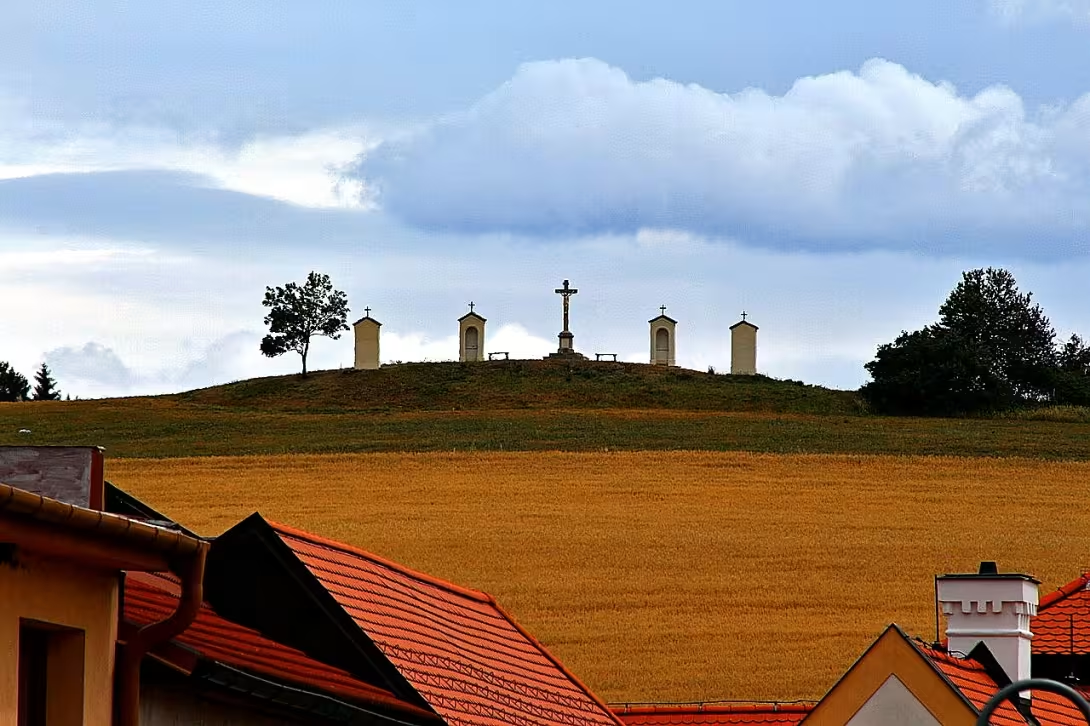
The cross road in the New Reich in Jihlava is a historic sacral object from the second half of the 19th century, located on the hill Justice east of the village. This complex consists of a granite cross and a brick chapel of the same architectural shape. The whole complex is protected as a real-estate cultural monument of the Czech Republic and represents an important proof of religious development and the care of church rules for cultural landscape in the region.
The creation of this pilgrimage site is closely linked to the activities of the premonstrate monastery in the New Reich, which was behind the initiative to build a cross road. The historical context of the second half of the 19th century was carried in the spirit of reviving religious life, caring for pilgrimage places and reminiscing of the Cyrilomethodean tradition in Czech countries. The first element on the hill Justice became the granite cross erected in 1863 on the occasion of the thousand anniversary of the arrival of Cyrila and Metoděje in Moravia. Ten years later, in 1873, the cross road itself arose.
The architectural essence of the monument is made up of a wall niche chapel of uniform textures originating in the second half of the 19th century. Originally, it consisted of thirteen chapels, with the granite cross at the end of the journey being the fourteenth stop. Ten objects were preserved from the original file. During the modern restoration, it was subsequently decided to complete three missing chapel.
The premonstrate monastery in the New Reich is the owner and administrator of the monument, on whose initiative the pilgrimage site was created in the past and in modern times it also underwent extensive monument renewal. These historical destinies were marked by a major overhaul launched in 2010.
Among the key events of modern history are the overall renewal of the pilgrimage site launched in 2010. At that time, the flywood and terrain inequalities were removed and the surrounding area was supplemented with new trees and shrubs. Copies of cast iron paintings previously safely stored in the Neo-Reich monastery were placed in the capitals. In 2012, the general repair of the granite cross was passed, which recovered the cast iron body of Christ and a copy of the memorial plate, from which only the torso was preserved. In 2013, the restoration of four chapels on top of the cross and three chapels on the road towards Zdenkov followed, and the decision was made on the completion of the remaining unpreserved objects.
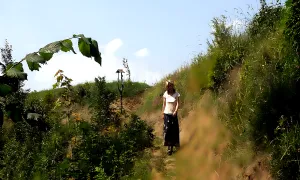
Today the cross road is located in a modified natural environment east of the village Nová Říše near the road towards Zdenkov. The area is freely accessible and offers visitors a view of the sensitively repaired sacral architecture linked to the link of the premonstrate order. Visiting this place on the hill Justice provides an opportunity to discover the material heritage of the 19th century in the authentic environment of Moravian countryside.
Then and now
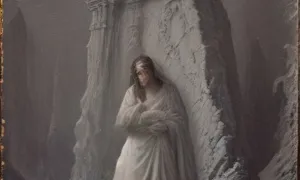
Drag the slider to compare how the landmark may have looked when it was built with the view today.
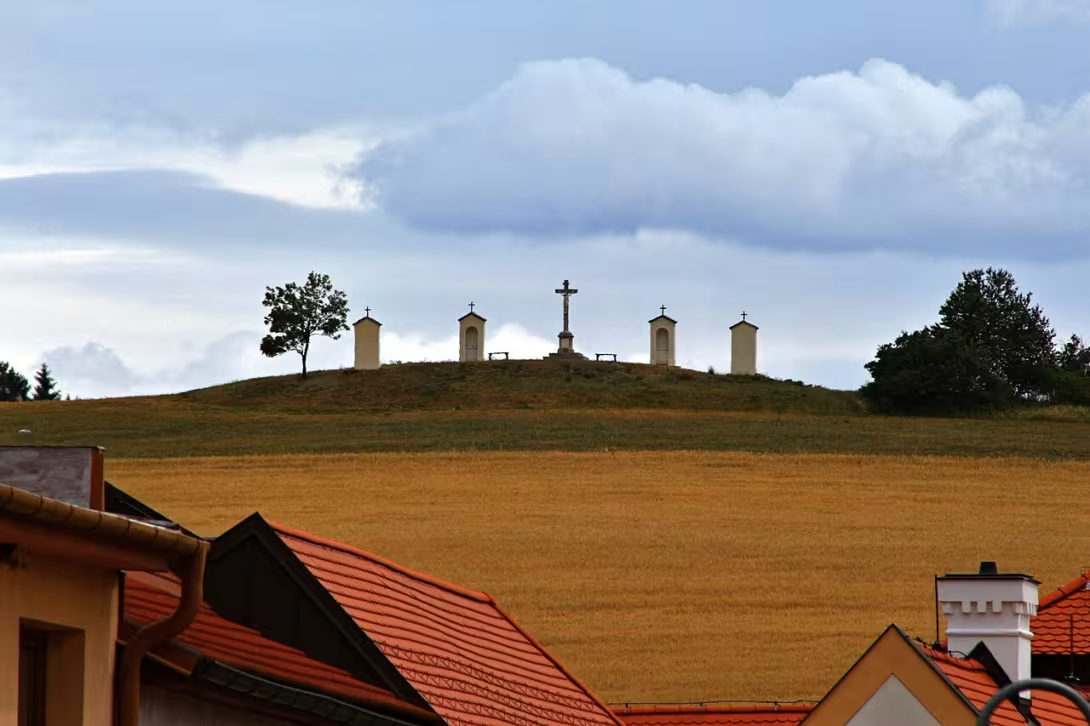
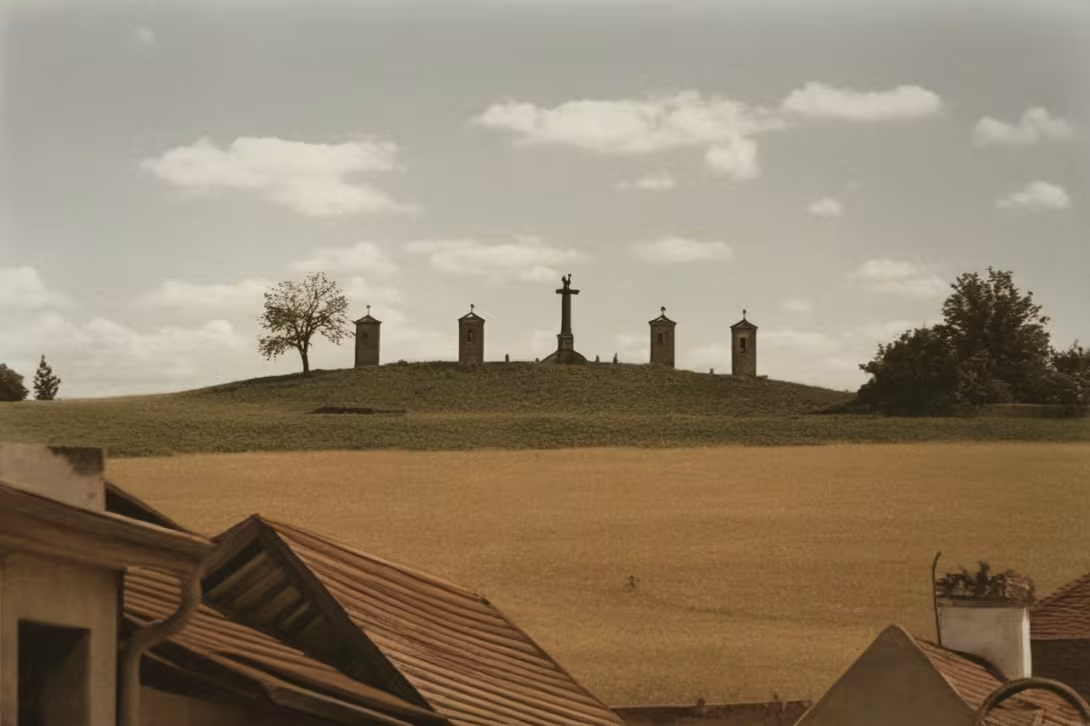
The historical appearance on the left is an AI-generated visualisation and serves as inspiration only.
Historical milestones
- 1863
- At the summit of Justice was built the granite cross on the occasion of the thousand anniversary of the arrival of Cyrila and Metoděje in Moravia.
- 1873
- On the initiative of the premonstrate monastery, a cross road formed by thirteen walled niche chapels.
- 2010
- The restoration of the pilgrimage site began, the removal of the jet wood and the modification of the surroundings.
- 2012
- The granite cross was restored, underwent a general repair, he got a cast-iron body of Christ and a copy of the memorial plate.
- 2013
- The restaurants repaired four chapels on top of the cross and three chapels on the road towards Zdenkov.
Architectural development
The cross road consists of a granite cross and thirteen gimped enchantment chapels of the same architectural curds from the second half of the 19th century. Originally, it counted thirteen chapels, and the 14th stop was the granite cross, with three chapels not preserved and later decided on their completion. During the reconstruction between 2010 and 2013, overhaul of the cross took place, restoration of the chapel and installation of copies of cast iron paintings and commemorative plates.
Historical events
In 1863 the granite cross was built on the occasion of the thousand anniversary of the arrival of Cyrila and Metoděje in Moravia. In 1873 the cross road itself was created from the initiative of the premonstrate monastery. In 2010, the total renewal of the pilgrimage site started, including modifications to the surroundings and restoration of individual chapel.
Owners
premonstrate monastery in the New Reich
Points of interest
- The cross road is located on the hill Justice east of the village Nová Říše and was created on the initiative of the premonstrant monastery. - The first element on the hill in 1863 was the erected granite cross to commemorate the thousand anniversary of the arrival of Cyrila and Metoděje, with the cross road itself established in 1873. - The original set consisted of thirteen chapels and the 14th stop was the granite cross, with ten objects preserved and a decision was made to complete three missing chapels in the context of the modern renewal. - The general repair of the monument started in 2010, during which the funnel trees were removed, new trees were planted and copies of cast iron paintings from the monastery were placed in the chapel nouvels. - In 2012, the repaired granite cross went through the return of the cast iron corpus of Christ and a copy of the commemorative plate, followed by the restoration of four chapel by the cross and three chapel by the road to Zdenkov in 2013.
Guide
Show guide text
This text was created by artificial intelligence and has not been editorially reviewed. It may contain inaccuracies.
Welcome to the New Reich, a place where history encounters nature and silence. Right now, you're standing on a hill of Justice, a place with a very strange and deep atmosphere. If you look around you, you'll see elements that make up one of the most important local monuments. There is a granite cross in front of you and it is accompanied by a number of brick chapels in the surrounding area. Feel the serenity surrounding this place, and let yourself for a moment forget the hustle and bustle of the day. You stand in a space that has been reserved for centuries by prayer, contemplation and spiritual journey. The whole area is today protected as a real-estate cultural monument of the Czech Republic, which shows its value not only for local residents but for our whole culture.
Let us now look together at how this place was created and who was its creator. The history of this pilgrimage takes us to the second half of the nineteenth century. It all began in 1863 when the granite cross was erected on the very top of the hill. But it wasn't a random act. The cross was built to commemorate a very important event, namely the thousand anniversary of the arrival of the saints Cyrila and Metoděje on Moravian soil. Imagine what time it was and how strong the sense of belonging with its own roots and the faith that drove people to such a construction. Ten years later, in 1873, this place grew further. On the initiative of the premonstrate monastery, the cross road itself was created. It was made up of thirteen walled orchid chapels, which were to assist pilgrims in their spiritual pilgrimage and meditation over the suffering of Christ.
Now pay attention to the architecture before you. Note the material from which the cross is made. It is granite, a stone known for its hardness and resistance, which symbolizes eternity and bitterness. Look at the chapel. They are walled and have a very specific architectural shape. Notice that all the chapels have identical shapes, which creates a harmonious and rhythmic whole. It is this uniformity of style that leads the visitor to a sense of order and peace. The chapels are made up of niche, which served as a space for a painting or a statue, and are distributed so as to form a path that man slowly passes through.
If you look closer at the granite cross, you'll see the cast iron body of Christ on it. It is important to know that what you see today is the result of careful care and recovery. In modern times, specifically between 2010 and 2013, the whole pilgrimage site underwent an extensive general repair. In 2010, the removal of funnel trees and the modification of the surroundings began to become visible and accessible again. In 2012, the cross was completely restored, it was this cast iron corpus, and a copy of the commemorative plate was attached to it, which reminds us of the original sacred intention. One year later, in 2013, the restoration staff focused on the chapel itself. They repaired four of them at the very top of the cross and three others which are located on the road towards Zdenkov. Thanks to this work we can admire these buildings today in such good condition.
When we think about this place, we can't ignore the personalities associated with it. Even though we do not know the chapel architects, spiritually, Cyril and Metoděj are connected to this hill. These two brothers, the apostles of the Slavs, brought baptism to Moravia, and with it the scriptures, which fundamentally affected the development of our languages and culture. It is their legacy that is here, on the hill of Justice, tangible. It's fascinating to think that the cross you see was built precisely to remind them of their arrival thousands of years ago. It's where the ancient faith meets the nineteenth century and the present.
You might find one interesting thing that makes this place special. The cross road isn't just a set of buildings, it's a sophisticated space. Note how it is located east of the village Nová Říše. The hills in this area often served as landmarks, but also as places of deep silence and prayer. The fact that it was created on the initiative of the premonstrate monastery shows the strong influence of ordinary communities in the organization of spiritual life in the region. The mystery remains the names of the particular craftsmen who created these granite and masonry elements, but their work has lasted more than a century and still tells their story to anyone who rises here.
Now that you know the history and meaning of this place, I invite you to further explore. I suggest you slowly go through the whole cross road, stop at each of the chapel and perceive the silence of the surrounding countryside. Try to imagine the pilgrims from the nineteenth century who walked here with hope and faith in their hearts. Look down the hill at the New Reich and feel the space surrounding you. Let yourself be guided by the path that the monks once designed and built by craftsmen, and take a moment of peace in the arms of nature and history.
Thank you for spending this short time with us at the Cross Road in the New Reich. We hope this recording has helped you better understand the beauty and importance of this pilgrimage place. We wish you a pleasant further journey and many inspiring experiences in discovering our cultural monuments. Goodbye.
Tips for visitors
To visit the Cross Road in the New Reich in Jihlava, the best time is early morning or late afternoon, when sunlight supplies the whole route and surrounding nature on the hill Justice an impressive atmosphere and peace of mind.
Take your fixed shoes with you on the road, because the terrain on the hill of Justice can be uneven, as well as plenty of drinking water, as you will not find refreshments directly on the route.
For photography lovers, this real-estate cultural monument, consisting of a granite cross and walled enchantage chapel of the same architecture, offers great compositional possibilities especially at sunset, when the side light beautifully highlights the details of historical buildings.
Families with children appreciate the peaceful natural environment around the village Nová Říše, which is ideal for a light walk connected with the discovery of local history and surrounding landscape in Jihlava.
Frequently asked questions
Can the monument be visited?
This is a structure in a public space that can usually be seen from outside free of charge. We have not verified that this particular one is freely accessible.
Where is the monument?
Location: Nová Říše, Kraj Vysočina. The map on this page shows the exact spot.
Why is the monument protected?
It is listed in the Central List of Cultural Monuments of the Czech Republic as a cultural monument (register no. 1000139427).
Businesses nearby
Do you run a restaurant, accommodation, shop, museum, rental, wellness or other visitor service near this monument? Show yourself directly to the people heading to it — this is how they will see you in the app and on the web:
Events nearby
Zdroj akcí: otevřená data měst a obcí ČR (Národní katalog otevřených dat) a kalendář akcí Národního památkového ústavu.
Nearby
The cross road is located on the hill Justice east of the village Nová Říše in Jihlava, near the road towards Zdenkov.
Accommodation nearby
Trips and activities nearby
Guided tours, tickets and activities nearby from GetYourGuide
Affiliate link: if you buy from the partner, we may receive a commission. The price for you does not change.
Search tours and activities →Themed route
Nová Říše Municipality This picturesque village serves as a starting point for the whole trip and offers a place to start the trip to selected places in the surroundings.
Cross travel (Nová Říše) Monuments The main destination of the trip is located on the hill Justice east of the village Nová Říše in Jihlava. The place is worth visiting for its spiritual atmosphere and an interesting surrounding landscape.
Road towards Zdeněkov Ambient communication This route passes in the immediate vicinity of the main monument and defines the space for a pleasant walk east of the village.
Seasonal recommendations
Spring in the New Reich awakens the cross path to a new life, when the landscape around it begins to bloom and awaken after winter sleep. The sun radiates individual stops along the road with freshly green grass and first field flowers, creating an atmosphere of hope and quiet contemplation. In this period you will meet only a few tourists, so you will enjoy complete peace. The practical advice is to choose fixed and waterproof shoes, because the field roads are wet and muddy on the tidal and spring rains. The ideal time for visiting is in the morning, when the morning fog slowly retreats and the spring sun warms pleasantly without heating too strongly.
Summer brings full, rich green forests and meadows around the New Reich, which provide a welcome shadow under the crowns of grown trees. The lighting is sharp during sunny days but penetrating rays through thick leaves create an interesting game of light and shadow on individual stops. The atmosphere is more lively thanks to tourists in the main summer season, but the monument remains an oasis of peace compared to overpopulated castles. We recommend to leave early in the morning or on the contrary in the late afternoon to avoid the biggest midday heat. Don't forget to bring enough fluids, headgear and insect repellent.
Autumn transforms the surrounding nature into a colorful palette of shades from yellow to orange to dark red, which adds an extremely melancholy and romantic character to the whole cross road. The low autumn sun creates long shadows and magical, soft lighting, which is absolutely ideal for landscape photography and details of niche chapel. The crowds are minimal at this time of year, recording deep concentration. Dress in layers because the morning cold can quickly turn into a pleasant afternoon, and count on the falling leaves to occasionally slip a leg, so you can use a tourist stick.
Winter covers the cross path in the New Reich into deep silence and often snow whiteness, which underlines the monumental and spiritual dimension of the monument in good condition. The lighting is usually short, but the winter sun reflects off the snow creates a clean and sharply bounded scenery, while in advent time you will be breathed by an unrepeatable serious atmosphere. As the crowds fall completely in winter, you will experience absolute loneliness. The key to a successful visit is high-quality winter shoes with anti-slip soles and very warm, non-inflatable clothes, because in open spaces it can blow unpleasantly. The best time is noon, when it is the hottest out and daylight reaches its maximum.
Visualizations and artistic views


The visualisations are generated by artificial intelligence and serve as inspiration.
Photos from the area
Real photos taken near the monument

Zdroj a licence jsou uvedeny u každého snímku.
Tips from visitors
No tips yet. Be the first!
Log in and add your tip.
Sources and literature
Photos: VitVit / CC BY-SA 4.0 — Wikimedia Commons. The author and licence also appear when you hover over the image.
Faktickým podkladem tohoto textu byl článek na Wikipedii, jehož autory jsou přispěvatelé Wikipedie. Článek je dostupný pod licencí CC BY-SA 4.0.
Location on the map

Příběhy a pověsti
Legendy, pověsti a příběhy spjaté s touto památkou
Fotografie návštěvníků
Zatím žádné fotografie. Buďte první, kdo přidá fotografii z návštěvy!
Log in a přidejte svou fotografii nebo hodnoťte.
Za ověřenou návštěvu v aplikaci získáte víc bodů — poznáme podle GPS, že jste na místě.
Reviews and comments