



Labský jez Water structure
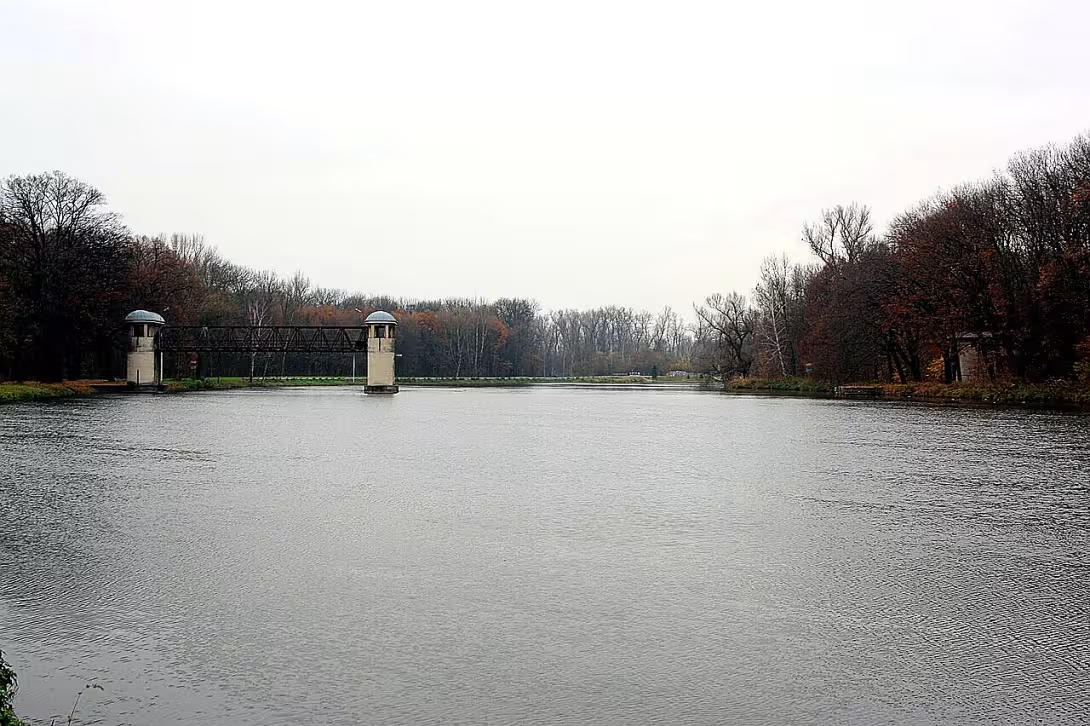
Labský jez is a water work and cultural monument of the Czech Republic. It is located in the cadastral territory of the municipality Kly in the district of Mělík, namely in the river kilometre 6,559 under the castle of the Giant. The construction of the early 20th century was used to regulate the middle flow of the Elbe and to ensure the shipping through the air level of the river.
The building was built in 1908-1911 along with the shallow wall Hadek on the northern edge of the village of Giant. The design was developed by architect Pavel Janák and the implementation was carried out by company Lanna. The whole complex was designed as a combination of a poison and a navigational canal with a sluice chamber.
The construction consisted of a bridge moving eating in two fields with concrete bottom covered blocks. The wider right field of 62,18 m long was used by seventeen Schwarzer slices connected by the footbridge. Above them were inserted three wooden boards with a covered height of 2.65 m. The lower left field of 30,18 m was used by the Liebisch bridge construction with eighteen steel frames. Also here were inserted three board slugs with a charged height of 3.8 m. The moving parts with electric drive were produced by Breitfeld, Danek & Co. The total weight of the paid structures was 116 tonnes, of which 30 tonnes were moving parts.
The sailing channel ends with a chamber of dimensions of 73 × 11 m and a depth of 3,5 m This allowed for the passage of ships with a capacity between 600 and 800 tonnes. The Jez held 1.38 million cubic meters of water and created a flooded area of 53.8 hectares with a rise of 6,431 km. The key difference between the upper level at 159,30 m and the lower level at 157,10 m above was for navigation operations.
The jez operation ended in 1974. The reason for this was the construction of the new site of the Giant in 1972- 1974. This arose 400 metres below between the old and Hadek to ensure the transport of coal to the Chvaletice power plant. In the early 1980s, the old eatery was abolished and most of the structures were dismantled. Schwarzer's husks tilted to the bottom of the river and Liebisch's structure was removed.
At present, the original work has preserved offshore pillars, central pillar and raised bridge. The building remains a technical witness to the modernization of waterways from the early 20th century.
Visiting this place offers the opportunity to see the remains of a unique water work near the Giant Castle. This is an important example of industrial architecture, which in the past has had a major impact on the navigation operation on the Elbe.
Historical milestones
- 1908
- Start of construction of water works and navigation channel
- 1911
- Completion of construction and launch of Elbe flow control
- 1974
- Termination due to construction of a new lock
- 1980
- Deterioration and dismantling of most steel structures
Architectural development
The concrete bottom structure was lined with blocks. The construction consisted of two fields, one of which was used by Schwarzer's shell and the other by Liebisch system. The moving parts with electric drive were produced by Breitfeld, Danek & Co.
Historical events
1972- 1974 construction of the new site of the Giant, the beginning of the 1980s the abolition of the old venom and dismantling of the structures.
Points of interest
- Construction from the beginning of the 20th century was used to regulate the flow of the Elbe and ensure the sailing of ships. - The building was built in 1908-1911 according to the design of architect Pavel Janák. - The total weight of the paid structures was 116 tonnes, of which 30 tonnes were moving parts. - Jez held 1.38 million cubic meters of water and created a flooded area of 53.8 hectares. - The operation ended in 1974 because of the construction of a new furnace for the transport of coal to the power plant Chvaletice.
Guide
Show guide text
This text was created by artificial intelligence and has not been editorially reviewed. It may contain inaccuracies.
Welcome to the village Kly. Right now, you're standing in front of a place that once fundamentally affected the current of one of our largest rivers. In front of you is Labský jez, a water work that, although no longer fulfils its original function, has still left its necessary trail in the landscape. Now, if you look around, you won't see a massive dam in the full force it had a century ago, but your eyes will surely pick up the most important remains. Note above all the massive pillars that protrude from the water and the shores. These concrete and stone supports, both central and coastal, are the silent witnesses of the era when mankind tried to tame nature in order to make trade and transport more efficient by water.
Let us now return together in time more than a hundred years back to the time when the building began. It was one thousand nine hundred eight. At that time it was necessary to resolve the problem of sailing ships in the middle of the Elbe. While the river offered a great route for the transport of goods, its level was not always high enough and stable enough for the safe passage of larger vessels. That is why a plan has been made to build this phenomenon. The construction was not an isolated project, but it was closely connected to the Shallow Hadík. The whole complex was aimed at air water, thus increasing its level so that ships could flow smoothly towards the target. The work was challenging and lasted three years, until in the year one thousand nine hundred eleven the work was completed and the regulation of the Elbe flow was fully exploited.
Now pay attention to the very form of the construction. Even if you eat them today in the bulk of it, you can still perceive the brilliant planning behind this work. The author of the project was the renowned architect Pavel Janák. Janák was the master of his craft and put his experience of space and functionality into this technical work. When you look at the remaining pillars, imagine how the water flowed between them and how the steel structure attached to them. The whole system was designed to be as effective as possible. Apart from the actual lake there was a navigational channel with a sluice chamber. It was this chamber that served as a sort of water lift that allowed ships to overcome the difference in the water level that you created. Imagine the noise of water, the movement of heavy vessels and the work of the people who were operating this system.
It's fascinating to think how much effort and material has been put into the building. Let's stop at some specific data to help you see the dimensions of this project. The total weight of the paid structures, namely those parts that held water directly and formed the body of the poison, was an incredible hundred and sixteen tons. Of this weight, the moving parts consisted of 30 tonnes. These moving elements were key because they allowed to regulate water flow according to current needs or river condition. Imagine the massive steel and concrete that had to withstand the constant pressure of water and eventual Christmas during spring thaw. He was able to contain the amount of water corresponding to one and three thousand cubic metres. It's a quantity we find difficult to imagine these days, but at that time, it was a huge shift in the possibility of using the Elbe for transport.
If we think about the fate of this place now, we'll find that even the strongest buildings have their end. Jez served faithfully for many decades, became a natural part of the landscape in Klych and helped develop the region. However, time was changing and technology was moving forward. In the year one thousand nine hundred seventy-four came the moment when the work of the lake was completed. The reason for this was the construction of a new, more modern lock, which performed its functions more efficiently and safely. After several years, namely in the year one thousand nine hundred and eighty, the eatery was officially cancelled. At that time, most of the steel structures were dismantled, which you had just thought through the construction. Only the most resilient parts that you see before you today remain.
Here we come to the part that may interest you. It's a strange feeling for a building that was once the peak of technology, and now it's just a silent reminder of the past. The mystery remains how powerful this project affected the lives of the local population in Klych in times of its greatest fame. Imagine how the landscape around the river was changing, how people moved around here and how eating affected the rhythm of the whole neighborhood. It's a reminder that one constantly looks for ways to control nature, but in the end, nature always finds its way back. Today, the water flows more freely, but the pillars still stand as a monument to human engineering and the ambitions of the early twentieth century.
Notice how this monument is currently written into the surrounding nature. The concrete and the stone of the pillars are gradually wrapped in time, giving them some melancholy charm. It is a place where the history of transport meets, the architecture of Pavel Janák and the natural flow of the Elbe. Even though the ships no longer sail through the sluice chamber and the steel parts are long gone, the spirit of this place remains. It is proof of how important the regulation of rivers for the development of our cities and trade routes was.
Now that you've learned the story of the Elbe Jez, I suggest you observe the stream of the river in silence for a moment and try to imagine the contrast between today's calm and the dynamic that ruled here centuries ago. Walk slowly around the remaining pillars and perceive the atmosphere of this unique water work, which is today registered as a cultural monument of the Czech Republic.
Thank you for spending time with us on this fascinating piece of history. We hope that you are interested in the story of the Elbe Jez in Klych and that you have gained a new perspective on what you see before you. You can now continue your journey and explore other beautiful corners of the region. We wish you a pleasant rest of the day and a pleasant journey.
Tips for visitors
The best time to visit is late spring or autumn, when the colors of nature around the river are the most pronounced and the stream of water is calmer. Kly can be reached by car or public transport; Check the specific connection in the current search engine.
For your journey, wear suitable shoes in the field because it is a ruin near the water where it can be wet and slippery. We also recommend insect repellent due to the proximity of the river and surrounding vegetation.
For the best photos I recommend to come in the morning or late afternoon lights that highlight the structure of old concrete and stone. The most interesting shots are taken from an angle that captures a broken structure in contrast to the natural flow of the Elbe.
In the immediate vicinity you can visit the Mansion of the Giant and the Hadík, which makes the visit a complex trip to the history of water management and noble settlements.
Families with children appreciate the nature walk and the possibility to observe the remains of the old water work, which may be a great way to bring children closer to the function of regulation of the river in practice.
Frequently asked questions
Can the monument be visited?
This is a structure in a public space that can usually be seen from outside free of charge. We have not verified that this particular one is freely accessible.
Where is the monument?
Location: Kly. The map on this page shows the exact spot.
Why is the monument protected?
It is listed in the Central List of Cultural Monuments of the Czech Republic as a cultural monument (register no. 1000135627).
Businesses nearby
Do you run a restaurant, accommodation, shop, museum, rental, wellness or other visitor service near this monument? Show yourself directly to the people heading to it — this is how they will see you in the app and on the web:
Nearby
V bezprostřední blízkosti se nachází zámek Obříství a zdymadlo Hadík.
Accommodation nearby
Trips and activities nearby
Guided tours, tickets and activities nearby from GetYourGuide
Affiliate link: if you buy from the partner, we may receive a commission. The price for you does not change.
Search tours and activities →Themed route
1st castle of the Giant, historical building. This building offers a view of the old architecture. 2. Hatch lock, water technique. This object shows an interesting way to regulate water levels. 3. Labský jez, water work. The main destination of the trip, which is a large water area.
Seasonal recommendations
In spring, the surrounding area of the demolished water works awakens to life, and the young greenery begin to cover the remains of theatres. The air is fresh and light soft, which creates a sense of hope even in ruins. We recommend moisture resistant shoes because the terrain can be muddy after melting snow. It's best to set off in the morning when dew is still visible on the grass.
In the summer months, the scene is dominated by thick crowns of trees and heat from asphalt and stone. The atmosphere is sleepy and calm, while the sun creates sharp shadows in empty ruins. It is advisable to choose light clothes and hat on your head. The ideal time for visiting is early morning or late evening to avoid the greatest temperatures.
Autumn brings to the landscape around Kly colorful leaves that contradict the grey stone of the building. Fogs often roll over the water, giving the place a mysterious and melancholy touch. It's practical to wear layered clothes and a waterproof jacket. The most striking experiences offer a decadent time when the low sun beautifully underlights colored trees.
Zimą is a ruin of the wood and wasteland, stripped of all leaves. When snow comes to the place, the white blanket unites the landscape and reduces all sounds, which deepens the sense of isolation. Hot shoes with anti-slip soles and gloves are essential. The most suitable visit is on clear winter days, when the freezing air makes the views clear.
Visualizations and artistic views

The visualisations are generated by artificial intelligence and serve as inspiration.
Photos from the area
Real photos taken near the monument


Zdroj a licence jsou uvedeny u každého snímku.
Tips from visitors
No tips yet. Be the first!
Log in and add your tip.
Sources and literature
Photos: Jan Polák / CC BY-SA 3.0 — Wikimedia Commons. The author and licence also appear when you hover over the image.
Faktickým podkladem tohoto textu byl článek na Wikipedii, jehož autory jsou přispěvatelé Wikipedie. Článek je dostupný pod licencí CC BY-SA 4.0.
Location on the map
More monuments – Kly
Show all in the municipality
Příběhy a pověsti
Legendy, pověsti a příběhy spjaté s touto památkou
Fotografie návštěvníků
Zatím žádné fotografie. Buďte první, kdo přidá fotografii z návštěvy!
Log in a přidejte svou fotografii nebo hodnoťte.
Za ověřenou návštěvu v aplikaci získáte víc bodů — poznáme podle GPS, že jste na místě.
Reviews and comments