



Štěpánský most Bridge
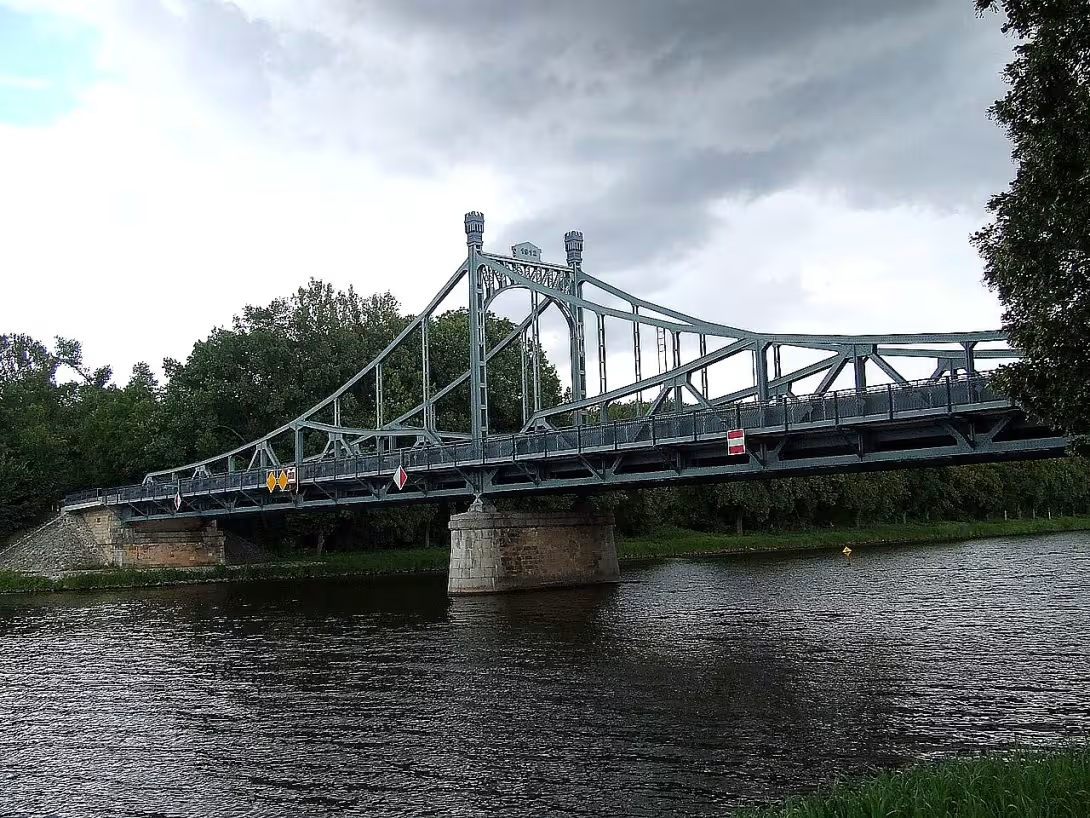
The Štěpánský most at the Giant in the Mělnický district is a steel road bridge built over the Elbe River in 1912. Today, I / 9 Praha-Mělník is the road and the building is one of the most interesting works of Czech infrastructure of its time.
The name comes from the then ferry "Na Štěpán" near the Giant. Since the construction was originally intended for Croatia, the former part of Austria-Hungary, it was decided to install it in Mělnick in the middle of the production. The project was developed by engineer Karel Šimek, who later became Professor of Technical University in Brno.
The bridge is designed by a continuous three-band console with joints - a design solution that was applied in Austria-Hungary only in this and one other case, via the Tisu bridge at Tokaja. The construction was supplied by Prague Mostárna, the first Czech Moravian machinery factory in Prague. Architecturally dominates the construction of a portal on the central pillar with pseudo-gothic towers ending in the battlements.
A special feature was the establishment of the middle pillar by means of a reinforced concrete cason. It was the first application of this solution in Czech countries according to the project of engineer Vojtěv Kapsy. Keson with dimensions 14.28 × 4.80 meters was embedded eight and a half meters below Elbe. Due to the expected high maintenance costs, the construction was blown and metallized with zinc for CZK 3.2 million, which was assumed to last 20 years.
The bridge measures 95.55 meters in length in two equal fields. The peak of the middle pillar reaches 13 meters above the ground, the passable arch stands eight meters high. The original width was 6.6 metres with the road width 4.6 metres and pavements located inside. In the years 1957- 1958 the bridge underwent an adjustment, during which walkways of a width of 1.2 metres were moved outside where they are today.
In 2003 he completed a total reconstruction for CZK 28 million. The original road has been removed, new hydroinsulation and drainage have been carried out, new surface laid and the whole structure treated. The investor was the Road and Motorway Directorate.
The bridge remained in public awareness as a place to shoot the TV series "30 Major Zeman cases" in the episode "Big Chance End." On the left pillar is a visible flood sign resembling the August 2002 flood.
Then and now
Drag the slider to compare how the landmark may have looked when it was built with the view today.
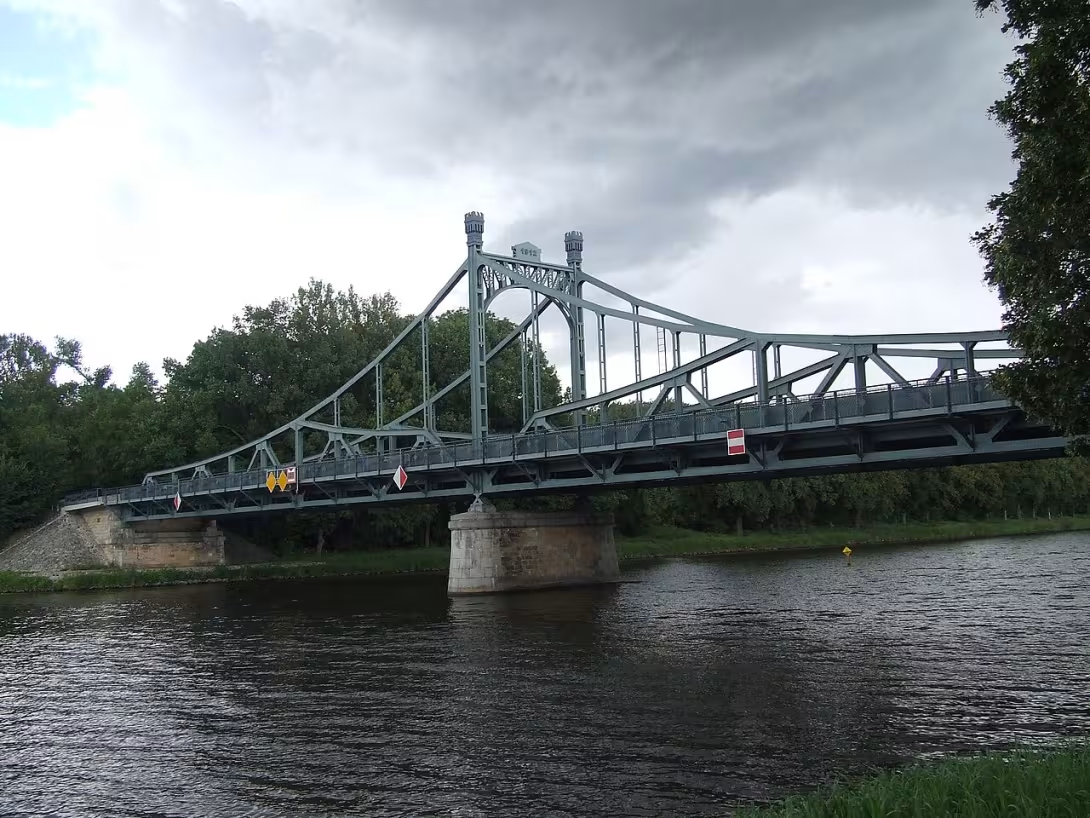
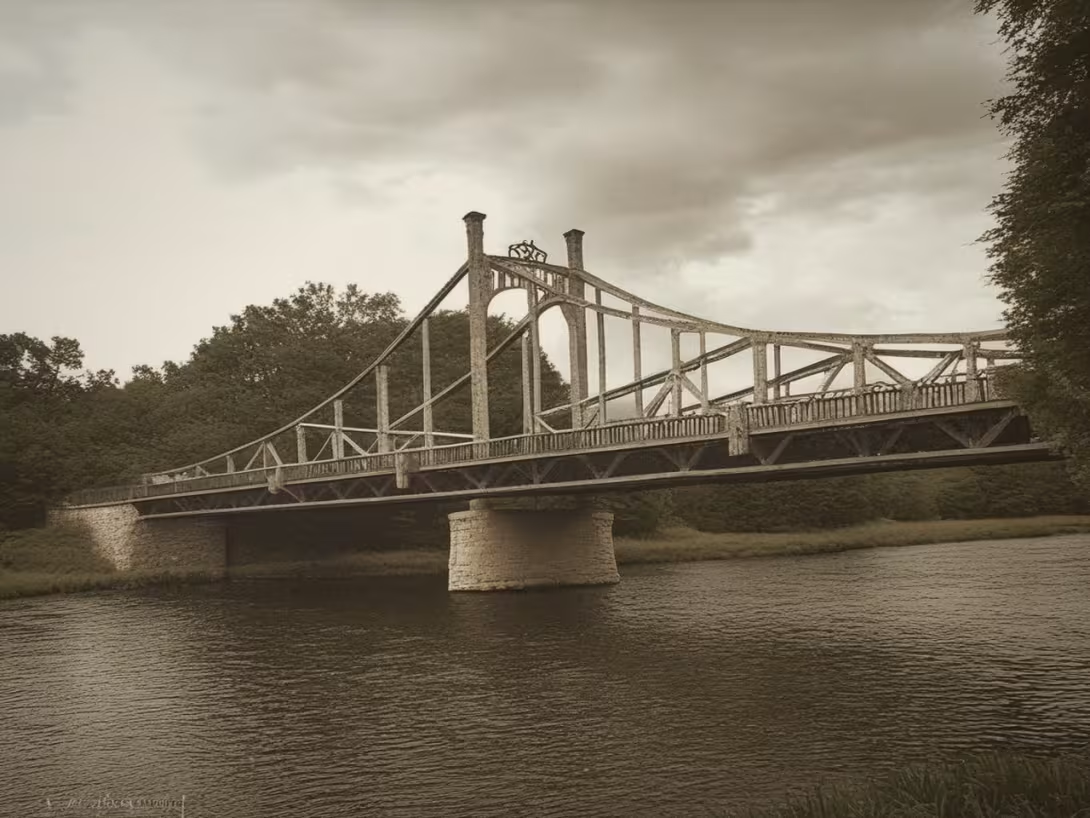
The historical appearance on the left is an AI-generated visualisation and serves as inspiration only.
Historical milestones
- 1912
- The opening of the bridge as the first Czech construction with a reinforced concrete keson and a continuous console beam with joints.
- 1957
- The beginning of the bridge reconstruction, when the pavements were moved out of the bridge construction.
- 2003
- Reconstruction of the bridge including waterproofing, drainage and surface treatment.
Architectural development
The bridge was built of steel with a reinforced concrete keson for the middle pillar, which was embedded in a depth of 8,85 meters. The construction consists of a continuous console beam with joints and a portal with pseudo-gothic turrets. The original width of the road was 4.6 metres, later extended to 6.6 metres including pavements. Reconstruction in 2003 included new hydroinsulation and surface treatment.
Historical events
1912 - The opening of the bridge as the first Czech building with iron-concrete kesson for the creation of pillars.
1957-1958 - Reconstruction of the bridge during which the pavements were moved from the interior of the bridge out.
2003 - Reconstruction of the bridge under the Road and Motorway Directorate project.
Points of interest
- The bridge was built in 1912 as a steel construction over the Elbe River near the Giant.
- Originally intended for Croatia, but was eventually installed on Mělnice.
- Its construction uses a continuous three-belt console with joints, which was used only here and on one other bridge in Austria.
- The middle pillar was founded by means of a reinforced concrete cason, which was the first application of this solution in Czech countries.
- The bridge underwent modifications in 1957- 1958, during which the pavement was extended and moved out of the road.
Guide
This guide is narrated by a synthetic voice generated by artificial intelligence.
Show guide text
This text was created by artificial intelligence and has not been editorially reviewed. It may contain inaccuracies.
Štěpánský most is a steel road bridge across the Elbe near the town of Obříství in the Mělník district. It was built in 1912 and today the first class road number 9 from Prague to Mělník runs across it. As a cultural monument it is registered under the name Silniční most Štěpánský. It got its name from the ferry Na Štěpáně that operated nearby and was one of the reasons the bridge was built there.
The arched upper part of the structure resembles chain or cable-stayed bridges. However, the bridge actually carries a continuous cantilever three-span beam with joints. Such construction was used only twice in Austria-Hungary at that time: here and on the bridge across the Tisza near Tokaj. The bridge was supplied by the Prague Bridge Works, a branch of the First Czech-Moravian Machine Factory. The project was designed by engineer Karel Šimek, who later became a professor at the Brno University of Technology. The structure was originally intended for Croatia, but halfway through its production it was decided to have it built at Obříství.
The most distinctive feature is the portal on the central pier. Its pylons end in pseudo-gothic towers with crenellations. The top of the pier is 13 meters above the road surface, and the passage arch is 8 meters high. The bridge is 95.55 meters long and is divided into two equally long spans.
The foundation of the central pier was also unique. For the first time in Bohemia, a reinforced concrete caisson was used here, an underground chamber designed according to engineer Vojtěch Kapsa's solution. It measured 14.28 by 4.80 meters, which were large dimensions for that time. It was sunk 8.85 meters below the normal water level of the Elbe. Similar caissons were later used in the construction of the Hlávkův most in Prague.
The bridge was originally 6.6 meters wide. The sidewalks ran inside and only 4.6 meters remained for the roadway. Therefore, between 1957 and 1958, the sidewalks were relocated to the outer side of the bridge, where they remain today.
Protective coatings would have cost 22 million crowns over 20 years. The structure was therefore grit-blasted and covered with a layer of zinc. This treatment cost 3.2 million crowns with a seven-year warranty, though it is expected to last 20 years. In 2003 the bridge underwent reconstruction costing 28 million crowns. It received new insulation, drainage, road surface and bridge expansion joints and the entire structure was treated.
The area around the bridge appeared in the television series Třicet případů majora Zemana, in the episode Konec velké šance. On the left pier there is a flood mark commemorating the August 2002 flood.
Tips for visitors
Best visiting time
The ideal time to visit the Stephen Bridge is in the summer months, especially in June to September, when the weather is pleasant and you can enjoy views from the bridge and surrounding nature. The morning or evening is most suitable because the sun illuminates the bridge design from one side and creates interesting shadows and contrasts. In winter the bridge is interesting from a technical point of view, but the visit may be limited due to bad weather.
Parking and transport
The bridge can be reached by car on the I / 9 road where it is possible to stop near the parking lot near the ferry on Stephen. Parking is usually free here, but it is recommended to look for a vacancy in advance. The location is also available by public transport, but the current connection must be checked in the traffic search engine. It is recommended to come on foot from the village of Giant, located just minutes from the bridge.
What to take with you
When visiting a bridge take comfortable shoes because the path to the bridge usually leads along unpaved paths or natural paths. It is also appropriate to take a map or navigation with you, because some roads around are not well marked. If you are planning to photograph, do not forget the camera or smartphone with a good camera. Bring plenty of water and sun protection in the summer.
Photography - the best places and light
The best places for photography are the end of the bridge where it can be seen its technical design and views of the Elbe River. The best light is in the morning or in the evening when the sun lights the bridge from one side and creates interesting shadows. Also interesting are pictures from around the bridge, where the natural landscape of Labské sandstone is mixed with human construction. Avoid shooting at noon, when light can be too hard and distort colors.
What to visit in the surroundings (within 30 minutes)
In the vicinity of the bridge is worth visiting the historical core of the village of Giant, which offers picturesque streets and traditional Czech architecture. Near is the natural reserve of the Labské sandstone, which is ideal for hiking and observing local flora and fauna. If you are interested in history and technology, you can see the surrounding ferry on Stephen, which serves as a supplement to the bridge.
Tips for families with children
Children can view the bridge construction and find out how its supporting structure works. You can explain to them that the bridge is a technical work from the beginning of the 20th century and how it differs from modern bridges. In the surroundings it is possible to organize short tourist trips to the natural reserve of the Labské sandstone, where children can collect interesting stones or observe birds. It is also possible to visit the local playground or to visit historical houses in the Giant.
Businesses nearby
Do you run a restaurant, accommodation, shop, museum, rental, wellness or other visitor service near this monument? Show yourself directly to the people heading to it — this is how they will see you in the app and on the web:
Nearby
The village of Giant with historical core and natural landscape of Labské sandstone.
Natural reserve of Labské sandstone (about 3 km from the bridge).
The bridge is located near the I / 9 road and near the ferry Na Štěpán.
Accommodation nearby
Trips and activities nearby
Guided tours, tickets and activities nearby from GetYourGuide
Affiliate link: if you buy from the partner, we may receive a commission. The price for you does not change.
Search tours and activities →Themed route
Thematic cruise route around the Stephen Bridge
1. Štěpánský most (bridge) * Why is it worth a visit: * This historic bridge is not only a technical monument, but also a beautiful place to relax and see the surrounding countryside. Located near the ferry on Stepan and offers unique sounds of roads I / 9.
2. Municipality of Religion with historical core * Why is it worth a visit: * This picturesque village is an excellent example of the preservation of historical architecture and offers views of the Elbe sandstone. It's an ideal place to walk the streets with a rich past.
3. Natural Reservation Labské sandstone * Why is it worth a visit: * This reservation is an exceptional nature protected by the territory where you can explore diverse geomorphological shapes and diverse flora. It's an ideal place for nature lovers and photographers.
4. Delivery on Stephen * Why is it worth a visit: * This place offers a comfortable entrance to the bridge and is an ideal place for parking. Here you can enjoy quiet moments before or after exploring the surrounding monuments.
This route combines history, nature and a beautiful view of Středočeský kraj, making it an ideal choice for a day trip.
Seasonal recommendations
Spring Štěpánský most in Klychem offers a unique atmosphere in spring when its stone arches are projected into green flowering trees and shrubs along the shore. The light of the sun, reflected from the Kly level, creates playful reflections, while the warm wind brings the smell of spring flowers. It is also specific to the awakening of nature - the first butterflies and birds give life around them, while the water level is not yet warm enough to attract bathing. The best time to visit is early in the morning or in the afternoon when the crowds of tourists shrink. Comfortable shoes and light clothes are recommended with the possibility of covering, because spring weather can be variable. It is also appropriate to visit the bridge at a time when there are small exhibitions of local artists which often take place in April and May.
Summer In the summer months, Štěpánský most will turn into a popular resting place, where its stone structures take on contrast with hot sun and blue sky. The water in Klychem is warm and attracts for refreshment, while the surrounding forests and meadows bloom in full power. The evening lighting of the bridge is also specific, which starts with a slowly fitting sun and passes into artificial light, which creates a magical atmosphere. The best time to visit is early in the morning to avoid the main crowds gathering in the afternoon. Light, breathable clothes, sunglasses, hat and plenty of water are recommended. In summer, it is also appropriate to monitor the opening times of the surrounding exposures, which may be extended in the main season.
Autumn Autumn brings golden and red shades of leaves to Štěpánský most, which are reflected in the quiet water Kly and create picturesque scenery. The colder air and fog that rolls over the water surface give the place a mysterious atmosphere, while the sun sets earlier and the colors turn into shades of purple and orange. There is also a specific silence around when tourists start to return home. The best time to visit is the late afternoon when light is soft and scenery the most beautiful. It is recommended to wear warmer clothes because evenings can be cold, and comfortable shoes for walking around the surrounding roads. In September and October it is also possible to experience a calmer visit without large crowds.
Winter Winter Štěpánský most is a magical place where its stone arches get dressed in thin ice and the water level Kly turns into a mirror of frozen trees and snow plates. The freezing air and fog that rise from the water create a mysterious atmosphere, while the sun, which appears only for a short time, gives the surrounding area silver shine. It is also specific to silence that prevails in the winter months when nature calms down and most tourists avoid cold weather. The best time to visit is in the afternoon, when the light is the most beautiful and opening time of the sights still allows entry. It is recommended to warm, layered clothing that protects against the wind, and firm shoes because the roads can be slippery. In winter it is also advisable to monitor opening times, which are usually shortened.
Visualizations and artistic views


The visualisations are generated by artificial intelligence and serve as inspiration.
Photos from the area
Real photos taken near the monument


Zdroj a licence jsou uvedeny u každého snímku.
Atmosphere of the place
This atmospheric visualisation of the place and period was generated by artificial intelligence. It is not real footage of the location.
Tips from visitors
No tips yet. Be the first!
Log in and add your tip.
Sources and literature
Photos: MaReK (MarekTP) Olsavsky / CC BY-SA 3.0 — Wikimedia Commons. The author and licence also appear when you hover over the image.
Faktickým podkladem tohoto textu byl článek na Wikipedii, jehož autory jsou přispěvatelé Wikipedie. Článek je dostupný pod licencí CC BY-SA 4.0.
Location on the map





Příběhy a pověsti
Legendy, pověsti a příběhy spjaté s touto památkou

Fotografie návštěvníků
Zatím žádné fotografie. Buďte první, kdo přidá fotografii z návštěvy!
Log in a přidejte svou fotografii nebo hodnoťte.
Za ověřenou návštěvu v aplikaci získáte víc bodů — poznáme podle GPS, že jste na místě.
Reviews and comments