






Literátská škola School building
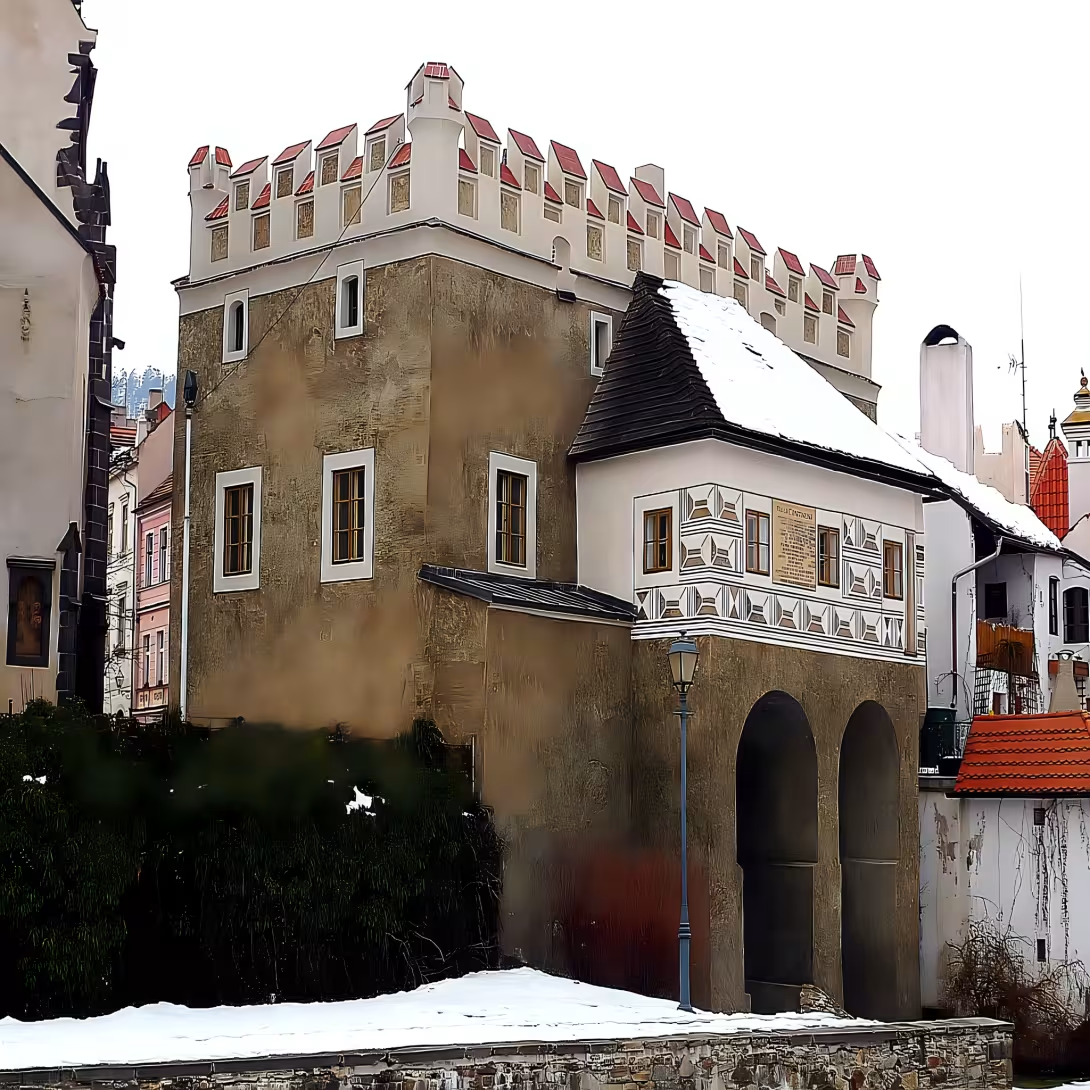
The Literátská škola in Prachatice, also known as the Municipal School, Latin School, or Rector's House, is a mid-16th-century Renaissance school building situated near the Church of St. James. Located in Děkanská ulička in Prachatice I, the structure remains relatively intact with a clearly legible original layout. It serves as a protected cultural monument within the Prachatice urban conservation area. The edifice is notable for its well-preserved architecture, which incorporates earlier Gothic elements alongside a distinctive Renaissance attic and avant-corps.
Written records trace the existence of a municipal school in Prachatice back to 1312, when a school teacher named Konrád was mentioned among the municipal council members. Further references appear in 1383 regarding a murder and a revenue transfer from the Vyšehrad Chapter to the schoolmaster, and in 1392 concerning the murder of a school teacher named Štěpán. Experts assume the school was originally located nearby, moving to its current parcel after a town fire in 1501. Builders constructed the current structure in the second quarter of the 16th century against the inner Gothic fortification wall after outer fortifications reduced the defensive value of the inner wall. Following complaints by the school bachelor about the building's condition in 1554, workers costly rebuilt and expanded the structure in 1557 into its present form. Subsequent smaller repairs followed in 1572, 1591, and the 17th century, including a 1640 repair of a clogged conduit. Vilém z Rožmberka later renewed and embellished the school, as documented in a 1569 privilege for the literary brotherhood.
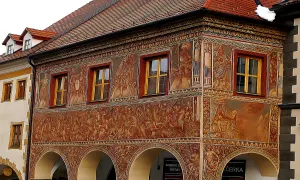
The building is a Renaissance one-story structure featuring an attic half-story, built against the inner Gothic fortification wall. Earlier Gothic elements include the adjacent defensive wall, the masonry of the ground and first floors, and the ground-floor vaults. The exterior showcases rough, trowel-stripped gray plaster, whereas window frames and upper attic sections feature smooth, light-colored plaster. The facade culminates in a crenellated attic with corner turrets spanning the entire roof perimeter, situated above a lean-to and gable roof with two drainage valleys. The main entrance from Děkanská ulička displays a late Gothic grooved portal with a horizontal lintel. Furthermore, the eastern facade facing the parkán features a projecting avant-corps resting on three massive pillars. This avant-corps facade is decorated with three layers of sgraffito bossage, an illusionistic painted Doric column, and a painted tablet bearing a damaged Latin inscription. Previously, an outdoor corridor at the first-floor level connected the institution to the old sacristy and a small choir in the presbytery of the Church of St. James.
A rector administered the school. This official was a university-educated man, sometimes holding a bachelor's degree, and was assisted by cantors and occasionally a succentor. The municipal treasury paid teachers in groschen and in kind, though instructors also relied on Christmas carolling due to unreliable municipal payments. Rotating townspeople provided meals for pupils, supplemented by thirty groschen weekly from the town, despite frequent complaints regarding food quality. The curriculum covered reading, writing, calculating, and Latin at the two-tiered partitional school. This institution prepared students for university studies under university supervision. Additionally, teachers and students organized and performed church singing. The academy also engaged in theatrical activities, such as a teacher reciting a comedy in 1561 and students performing the "Comedy of Susanna" in 1570. Officials officially designated the building as a protected cultural monument in 1958.
Today, the Literátská škola stands as an exceptionally intact example of Renaissance municipal architecture with minimal later alterations. It offers visitors a clear view of a 16th-century educational facility integrated into medieval urban fortifications. Situated in the heart of the Prachatice urban conservation area alongside the Church of St. James, the building provides a tangible link to the town's educational and architectural history. Tourists exploring Prachatice can easily view its sgraffito-decorated avant-corps and crenellated attic from the parkán, making the site a worthwhile stop for admirers of Renaissance civic heritage.
Historical milestones
- 1557
- Construction of the attic floor with crenellation, the avant-corps, and its painterly decoration.
- 1958
- The building was designated as a protected cultural monument on May 3.
Architectural development
The building incorporates earlier Gothic elements, including the adjacent defensive wall, the masonry of the ground and first floors, and the ground-floor vaults, as it was built against the inner Gothic fortification wall in the second quarter of the 16th century. During the construction phase in 1557, the attic floor with crenellation and the avant-corps facing the parkán were added, adorned with sgraffito bossage and a painted board with a Latin inscription.
Historical events
1557: The attic floor with crenellation, the avant-corps, and its pictorial decoration were constructed. 1569: Vilém z Rožmberka issued a privilege for the literary brotherhood, later mentioning the renewal and embellishment of the school. 1958: The building was declared a protected cultural monument on May 3.
Points of interest
– The Literátská škola in Prachatice is also known as the Municipal School, Latin School, or Rector's House, and dates back to the mid-16th century. – Written records trace the existence of a municipal school in Prachatice back to 1312, when a school teacher named Konrád was mentioned among the municipal council members. – Following complaints by the school bachelor about the building's condition in 1554, workers costly rebuilt and expanded the structure in 1557 into its present form. – The eastern facade facing the parkán features a projecting avant-corps resting on three massive pillars, decorated with three layers of sgraffito bossage, an illusionistic painted Doric column, and a painted tablet with a damaged Latin inscription. – The school was administered by a university-educated rector, sometimes holding a bachelor's degree, who was assisted by cantors and occasionally a succentor.
Guide
Show guide text
This text was created by artificial intelligence and has not been editorially reviewed. It may contain inaccuracies.
Welcome to Prachatice. As you stand here in the heart of this historic town, take a moment to simply breathe in the atmosphere of the surroundings. You are standing before a building that has served as a silent witness to centuries of learning, change, and the evolving spirit of this region. This is the Literátská škola. Depending on which historical period you might be researching, you might also hear it referred to as the Municipal School, the Latin School, or even the Rector's House. Regardless of the name, its presence here, standing in the shadow of the Church of St. James, is a testament to the long-standing importance of education and culture in this community.
As you look at the structure before you, try to imagine the streets as they were hundreds of years ago. The Literátská škola is a magnificent example of Renaissance architecture, a style that brought a new sense of proportion, elegance, and humanism to the landscape. While the roots of formal education in Prachatice reach much further back into the past, the building you see today is a product of the mid-16th century, a golden era of construction and cultural flourishing.
Now, I invite you to direct your attention upward, toward the roofline, where the building’s most striking character is revealed. Notice the unique attic structure. It is not merely a functional covering for the roof, but a decorative masterpiece. Look closely at the crenellations—those rhythmic, notched patterns that crown the top of the wall. They lend the building a sense of strength and historical dignity, almost as if it were a fortified place of knowledge. To further enhance this impressive silhouette, look to the corners, where you will see the turrets rising up. These corner turrets add a vertical elegance to the building, drawing the eye toward the sky and making the school a landmark that is difficult to miss.
As your eyes move down from the roofline, focus on the facade facing the parkán. You will notice a massive avant-corps, or rizalit, which projects forward from the main body of the building. This architectural element gives the facade a sense of depth and grandeur, breaking up the flat surface and creating a play of light and shadow that changes throughout the day. This specific part of the building, along with the decorative attic and the crenellations, was completed around 1557. If you look closely at the surfaces, you can still sense the legacy of the painterly decoration that was applied during that time, adding a layer of artistic sophistication to the stone and mortar. Though the names of the original architects remain lost to time, their skill is written clearly in the proportions and the enduring beauty of the structure.
To understand why such a grand building was constructed, we must look at the role this school played in society. This was a Latin school, a place where the language of scholars, scientists, and the Church was mastered. In the 16th century, learning Latin was the key to the wider world; it was the gateway to law, theology, and the great intellectual movements of the Renaissance. By establishing such a significant school, Prachatice was signaling its status as a center of intellect and a town that valued the future of its citizens.
The history of this place is also deeply intertwined with the powerful figures of the era. When we speak of the development and influence in this region during the Renaissance, the name Vilém z Rožmberka inevitably comes to mind. His influence shaped much of the social and political landscape of Southern Bohemia, and the prosperity that allowed for the construction of such fine buildings as the Literátská škola was often a reflection of the era in which such noble families held sway.
While the building itself is a jewel of the 1550s, the tradition of teaching in Prachatice is even older than the stones of this school. If we were to travel back in time, even further than the Renaissance, we would find that the town has been a place of learning for many centuries. Written records tell us that a municipal school existed here as far back as the year 1312. In those early medieval days, a teacher named Konrád was already mentioned in the town's records, performing the vital work of educating the local community. This means that as you stand here, you are not just looking at a 16th-century building, but you are standing on a site of educational continuity that spans over seven hundred years.
It is truly remarkable to think about the generations of students who have passed through these doors—the scholars who sat in these rooms, the teachers who paced these floors, and the many lives that were shaped by the knowledge shared within these walls. This building has survived the passage of centuries, through wars and social transformations, eventually being recognized for its immense historical value. On May 3, 1958, the Literátská škola was officially designated as a protected cultural monument, ensuring that its Renaissance splendor would be preserved for many more centuries to come.
As you prepare to continue your walk through Prachatice, take one last look at the interplay between the massive avant-corps and the delicate details of the attic. Let the image of this Renaissance school stay with you as you explore the rest of this beautiful town. There is so much more to discover around every corner, from the quiet streets to the grand churches. Thank you for joining me on this brief journey through time. Please, enjoy the rest of your exploration of Prachatice.
Tips for visitors
The best time to visit the Literátská škola in Prachatice is during late spring or early autumn when the weather is pleasant, allowing you to comfortably explore both the school building and its surroundings. These seasons offer vibrant natural scenery that enhances the historical ambiance of the area. Additionally, visiting outside peak tourist season ensures a more tranquil experience, enabling visitors to appreciate the architectural details without large crowds.
Parking and transportation options are convenient for those planning to visit the Literátská škola. The building is accessible by both car and public transport. For those driving, there are parking facilities nearby that can accommodate your vehicle. Alternatively, you can use local bus services or other forms of public transport to reach Prachatice I. It's advisable to check current routes and schedules in advance using a transportation search tool to ensure smooth travel plans.
When visiting the Literátská škola, it is recommended to bring comfortable walking shoes as you will likely explore both the school building and its surrounding area. A camera or smartphone for photography is also advisable, especially if you wish to capture the architectural beauty of the Renaissance structure and its picturesque setting near the Church of St. James. Additionally, carrying a water bottle and some snacks can enhance your visit, particularly on warmer days.
Photography enthusiasts will find several spots around the Literátská škola ideal for capturing stunning images. The best light is typically during the golden hours—shortly after sunrise or before sunset—when the soft lighting accentuates the building's intricate details and historical charm. Position yourself near the school to capture its facade, and consider including the Church of St. James in your shots for a more comprehensive view of the area’s architectural harmony.
For families with children visiting the Literátská škola, there are several attractions within a 30-minute distance that can make the trip enjoyable for all ages. The Church of St. James itself is an interesting site to explore, offering both historical insights and beautiful architecture. Additionally, the surrounding area includes other historic buildings like Heydl House and č.p. 28, which provide further opportunities for exploration and learning about Prachatice's rich cultural heritage.
Businesses nearby
Do you run a restaurant, accommodation, shop, museum, rental, wellness or other visitor service near this monument? Show yourself directly to the people heading to it — this is how they will see you in the app and on the web:
Nearby
The building is located in Děkanská ulička in Prachatice, closely adjacent to the Church of St. James the Greater and integrated into the block of houses between the church and the inner town wall, alongside Heydl House (č.p. 29) and č.p. 28. It is part of the broader Prachatice urban conservation area.
Accommodation nearby
Themed route
1. Literátská škola Type: Historic building Why it is worth visiting: This fascinating main destination is located in Děkanská ulička, offering a glimpse into the rich historical architecture of the town and serving as the focal point of your walking tour.
2. Church of St. James the Greater Type: Religious architecture Why it is worth visiting: Situated closely adjacent to the main destination, this prominent church is seamlessly integrated into the historic urban fabric of the area.
3. Heydl House (č.p. 29) Type: Historic house Why it is worth visiting: Part of the block of houses nestled between the church and the inner town wall, it showcases the traditional urban architecture protected within the Prachatice urban conservation area.
4. House č.p. 28 Type: Historic house Why it is worth visiting: Located right alongside the previous house within the same integrated block, it completes the authentic architectural atmosphere of this historic street.
Seasonal recommendations
Spring: The arrival of spring brings a gentle warmth and soft light to the Literátská škola, enhancing its historical charm with vibrant colors from blooming flowers nearby. This season is ideal for exploring the site when nature is in full bloom, offering a serene atmosphere perfect for reflection and appreciation. Visitors should consider bringing layers as temperatures can vary, and early mornings are recommended to avoid larger crowds that gather later in the day.
Summer: Summer at Literátská škola offers long days filled with bright sunlight that accentuates the architectural details of this historic site. The lush greenery surrounding Prachatice I provides a picturesque backdrop, making it an enchanting time for photography and leisurely strolls. It's advisable to visit in the early morning or late afternoon to escape the midday heat and crowds, while wearing comfortable walking shoes and light clothing.
Autumn: Autumn transforms the surroundings of Literátská škola with a stunning palette of reds, oranges, and yellows, creating an atmospheric setting that feels both cozy and inviting. The cooler temperatures make it perfect for unhurried exploration without the summer crowds. Visitors should dress warmly in layers to accommodate fluctuating weather conditions and consider bringing a light jacket as evenings can become chilly.
Winter: During winter, Literátská škola exudes a quiet charm under a blanket of snow, with soft lighting that highlights its historical features against the stark landscape. The colder months mean shorter opening hours, so it's wise to plan your visit accordingly and dress warmly in layers to enjoy the site comfortably. Early morning visits are recommended to experience the tranquil atmosphere before any potential winter crowds arrive.
Visualizations and artistic views


The visualisations are generated by artificial intelligence and serve as inspiration.
Photos from the area
Real photos taken near the monument


Zdroj a licence jsou uvedeny u každého snímku.
Tips from visitors
No tips yet. Be the first!
Log in and add your tip.
Sources and literature
Fotografie: H2k4 / CC BY-SA 3.0, rozlišení zvýšeno umělou inteligencí — Wikimedia Commons. The author and licence also appear when you hover over the image.
Faktickým podkladem tohoto textu byl článek na Wikipedii, jehož autory jsou přispěvatelé Wikipedie. Článek je dostupný pod licencí CC BY-SA 4.0.
Location on the map
More monuments – Prachatice I
Show all in the municipality

Příběhy a pověsti
Legendy, pověsti a příběhy spjaté s touto památkou
Fotografie návštěvníků
Zatím žádné fotografie. Buďte první, kdo přidá fotografii z návštěvy!
Přihlaste se a přidejte svou fotografii nebo hodnoťte.
Za ověřenou návštěvu v aplikaci získáte víc bodů — poznáme podle GPS, že jste na místě.
Reviews and comments