



Loretánská kaple u Pyšel Loretan chapel
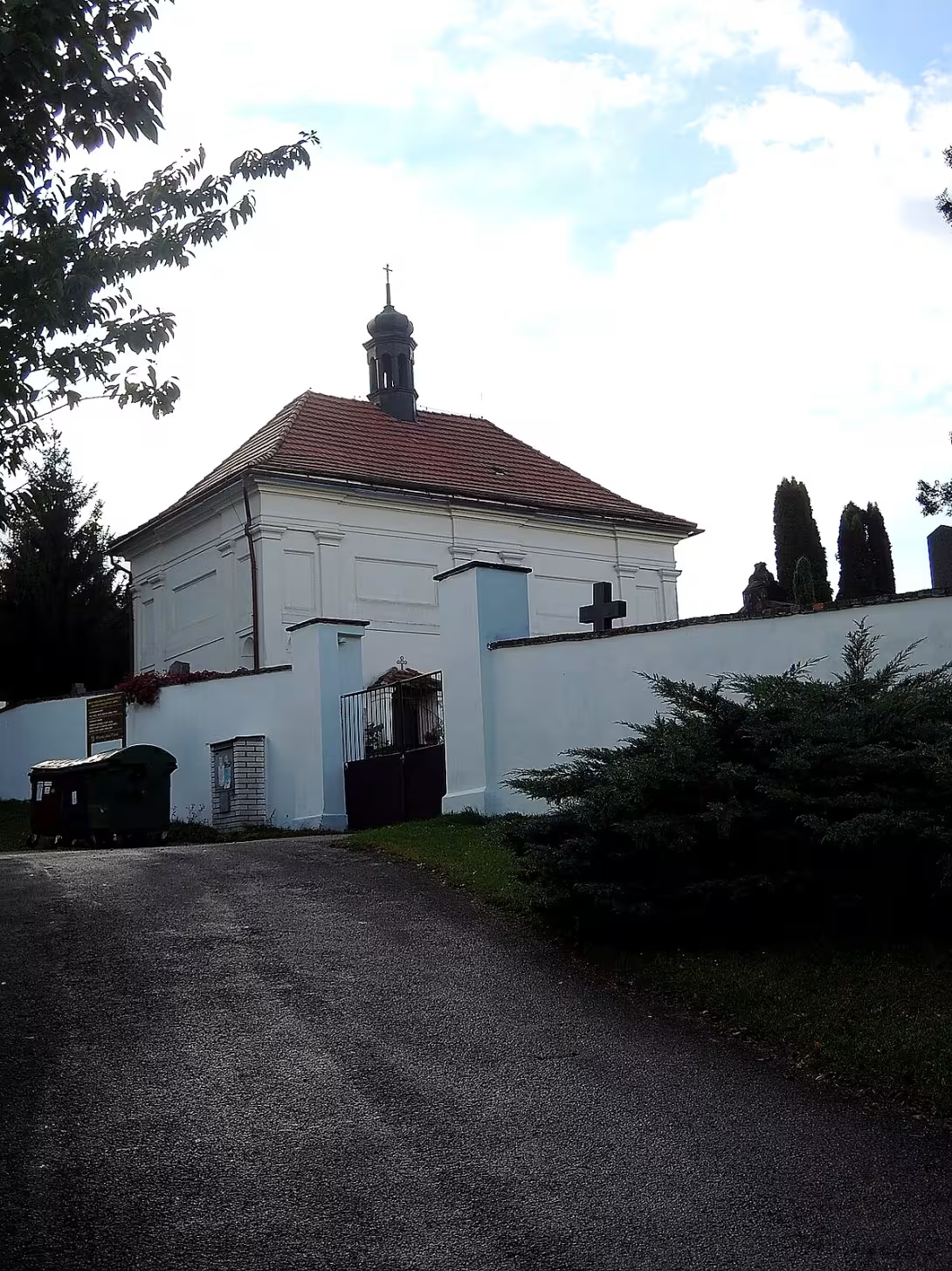
Loretánská kaple u Pyšel is a Baroque sacral monument. It is located on the hill northwest of the center of Pyšely, where today lies the local cemetery. It was built in 1699 and is protected as a real-estate cultural monument of the Czech Republic. Originally it was a sought-after pilgrimage place and an important part of the local spiritual landscape. Despite the abolition of pilgrims under the josephin reforms in 1781, the chapel survived. It helped to establish a nearby cemetery in 1790. Today it serves as a cemetery chapel and is valued for its architecture and historical value.
The construction from 1699 was built on the hill northwest of Pyšl. The donor of this sacral object was František Antonín hrabě z Halleweilu. At the time of construction in architecture he dominated the Baroque, which excelled with rich decoration and complex solutions. This style was Europe's dominant artistic direction, which was also reflected at this chapel.
Architecturally, the Lorethian Chapel is a quarter-shell. It has four entrances, a small window and stairs leading up to the floor. Its external dimensions are 13,03 × 7,68 metres. The inner space is decorated with a simple altar. Behind it is a wooden arm with bars and a door to the space behind the altar. In front of the front of the mensa is painted baroque anti-pendium with the painting of the Lorethanske Madonna, which forms an important artistic element. There is a niche in the corner behind the arm with a statue of the Loretan Madonna, which gives the space spiritual depth.
The fate of the chapel affected several key events. Since 1699, it has served as an important pilgrimage site until the Josephine reforms hit it in 1781. These changes were part of the broader reforms of ecclesiastical life in Austria aimed at limiting the Church's influence. Although the building lost its pilgrimage status, it was saved by the foundation of the cemetery in 1790. This turned her into a cemetery chapel, allowing her to survive until now.
In 1999, the Loretan Chapel was renovated. It helped preserve its historical and architectural value for future generations. Today it is a monument to cultural heritage and a place of peace for locals and visitors.
The chapel near Pyjl is open to the public. It is worth visiting for its historical importance and aesthetic beauty. Thanks to the 1999 visibility, visitors can appreciate the baroque details and spiritual atmosphere that the object keeps today. Visit this memory and perceive its value and beauty that transcends centuries.
Historical milestones
- 1699
- Chapel status.
- 1781
- The abolition of the pilgrimage site by Josephine reforms.
- 1790
- Establishing a cemetery in the neighborhood of the chapel.
- 1999
- Reconstruction of the chapel.
Architectural development
The chapel is quarter-coat with four entrances and a small window, stairs lead to the floor. Its external dimensions are 13.03 x 7.68 meters. In 1999 the chapel was reconstructed.
Historical events
- 1699
- Chapel status.
- 1781
- The abolition of the pilgrimage site by Josephine reforms.
- 1790
- Establishing a cemetery in the neighborhood of the chapel.
Points of interest
- Loretánská kaple u Pyšel is built in 1699. - The chapel was a protected cultural heritage of the Czech Republic. - It was originally a pilgrimage, but it survived the abolition of pilgrims under the josephin reforms thanks to the founding of the cemetery in 1790. - The chapel has a quarter-shell architecture with baroque antipendium and statue of the Lorethanske Madonna. - In 1999 the chapel underwent reconstruction, which helped preserve its historical and architectural value.
Guide
Show guide text
This text was created by artificial intelligence and has not been editorially reviewed. It may contain inaccuracies.
Welcome to the Loretian Chapel, which stands here on this hill, in silence and quiet, just above the city of Peshela. You're standing in front of a place that carries traces for many years, a building that survived a storm of history and remained a faithful witness to human faith and the changing world. Look around you. You are located in a place where history connects with the present, in a space that is now part of a local cemetery, but which once meant something quite different. Feel this atmosphere of peace that rules here, and let it pass through you feeling that right now you're touching something very old and rare.
Now let's go back deep into the past together to understand why this building is standing right here. Imagine the end of the seventeenth century, namely the year one thousand six hundred ninety-nine. That was the year this Loretan chapel was built. At that time, the baroque style was in full bloom and its aim was to induce strong emotions, amazement and deep piety in human hearts. The chapel wasn't just an ordinary building, it was a building with a great purpose. Originally, it served as an important pilgrimage site. Imagine the endless series of people who have traveled from afar to show their respect and seek spiritual support. It was a place where people met, where they prayed, and where their lives intertwined with sacred space.
Now, when you look at the chapel, pay close attention to its architecture. Even though we don't know the name of a particular builder, his work speaks for itself. Notice its unusual form. The chapel has so-called quarter-shell architecture. This expression means that its shape is not completely enclosed, but it has a specific geometry that is characteristic of this type of sacral structures. Look at the details you see here. Notice the baroque antipendium, which is the decorative element that gives the construction its unintended lightness and dignity. The whole building seems to be designed to harmonically fit into this design and yet to excel with its religious power. Although time is constantly changing, these shapes remain to remind us of aesthetics and ideas of the time.
But the history of this place has not always been about building and blooming. There came a time when everything that was built with such care seemed to be lost. In the year one thousand seven hundred and eighty one, the so-called Yosephin reforms came. It was government intervention that fundamentally changed the way people practiced their faith. One of the consequences was the abolition of many pilgrimage sites, including this. It was supposed to be a period of rationalisation and limitation of religious traditions that seemed too majestic. The chapel could become a forgotten ruin, a place no one ever visits.
But this is where one of the most important stories of this place takes place. The chapel wasn't lost. Thanks to the fact that the cemetery was established in its immediate neighbourhood in the year 1,000 seven hundred and ninety, the chapel maintained its existence. The pilgrim place became a cemetery chapel. This transformation, although dictated by new rules, paradoxically saved her life. The chapel became a guardian of the memory of those who were no longer with us, and as a result it remained a part of the daily life of the village. This ability to adapt and survive is one of the greatest evidence of its value.
Looking at the history of the chapel, we can't forget the people involved in this place. The name of František Antonín, Count of Halleweil, is written in the history of this place. Although we cannot say for sure about his direct involvement in every detail of the construction, his character represents the layer of nobility and powerful personalities that at that time shaped the landscape and supported the creation of such sacral structures. Without their support and without their vision, today's view of this design would be quite different.
Now I want to invite you to think about one interesting thing that makes this place even more special. This chapel is not just an old stone. It is a protected cultural monument of the Czech Republic. This means that its existence is seen as part of our common heritage, which we have a duty to preserve for future generations. It is a rare piece of the baroque soul that allows us to stop and look back in today's rapidly changing world. Even after the extensive reconstruction that took place in the year one thousand nine hundred ninety-nine, the chapel preserved its authentic face. The reconstruction was necessary so that this small but significant jewel could continue to be presented beautifully and that its structure could be preserved for centuries to come.
Imagine all the years the chapel has lived. From the joyous pilgrimage of a thousand six hundred ninety-nine, to the difficult times of reform in the eighteenth century, to the modern era when we look at it as a historic gem. Every year he added a new layer of importance to its existence.
Now that you've met the main points of history and architecture, I suggest you take a slow walk around the chapel. Feel its shapes from different angles. Look at the baroque line of the chapel drawing against the sky. Notice how light hits its walls and how the atmosphere changes depending on where you stand. You may notice the details you missed at first glance. Let yourself pass through the silence of this cemetery design and consider how powerful architecture can be if it can survive even the greatest social changes.
Thank you for spending this moment with us and for being interested in the history of the Loretan Chapel near Pyjl. We hope that this view of the past has helped you better understand the beauty and importance of this place. We wish you a pleasant walk around and other interesting discoveries on your journey. Goodbye.
Tips for visitors
The best time to visit the Loretan Chapel near Pyjl is in the spring or autumn season when vegetation is full of beauty and weather is favourable. This place offers a quiet atmosphere for relaxing and visiting without the noise of summer multiples.
For those travelling by public transport, it is advisable to verify the current connection in the online search engine. The chapel lies close to the center of the village, which simplifies the walking approach.
When visiting the chapel it is advisable to take with you protective clothes and shoes, especially in colder months. Fill your inventory with a map or GPS device for easy navigation. Don't forget the camera too, if you're planning on taking pictures.
For the photograph it is best to use natural light during early morning hours or evenings. The entrance part of the chapel offers a view of the surrounding landscape, while the interior is suitable for detailed pictures of architectural elements.
There is a local cemetery nearby the chapel, which can be visited. In addition, it is possible to explore nearby forests and trails, which provides an opportunity to relax in nature. For families with children, an interesting active program can be a short walk around the surrounding countryside.
Frequently asked questions
Can the monument be visited?
Religious buildings are usually open mainly during services; at other times a visit is normally arranged with the parish or the operator. We have not verified specific times.
Why is the monument protected?
It is listed in the Central List of Cultural Monuments of the Czech Republic as a cultural monument (register no. 1000146173).
Businesses nearby
Do you run a restaurant, accommodation, shop, museum, rental, wellness or other visitor service near this monument? Show yourself directly to the people heading to it — this is how they will see you in the app and on the web:
Events nearby

Zdroj akcí: otevřená data měst a obcí ČR (Národní katalog otevřených dat) a kalendář akcí Národního památkového ústavu.
Nearby
🏰 Historic sites (117)
- Pyšelské muzeum 0.5 km
- zámek Pyšely 0.6 km
- Transport smrti 1945 3.8 km
- Železniční vagón 4.0 km
- Hláska 4.2 km
- Tvrz Božešice 4.2 km web
- Jan Hus 4.3 km
- Padlým hrdinům 4.3 km
- Svět Škodovek 4.3 km Poříčí nad Sázavou 73 +420 602 705 155 web
- Husův Kámen 4.4 km
- místo letecké nehody 5.0 km
- Památník padlým 5.3 km
- Památník Josefa Lady 5.4 km web
- zámek Berchtold 5.4 km web
- Stará Dubá 5.6 km
- tvrz Mrač 5.7 km
- Josef Lada 5.7 km
- Odranec 5.8 km
- Pomník Járy Cimrmana 6.2 km
- Zbořený Kostelec 6.5 km
🍽️ Restaurants and dining (238)
- Hostinec u Ondrichu 1.9 km
- Stara Hospoda 2.5 km
- Pyšelka 2.8 km +420 317 705 914 web
- Ve Mlejně 3.0 km
- Paluba 3.4 km
- Paluba 3.4 km
- Pod Hradištěm 3.5 km
- Montana 3.5 km
- Restaurace U Čerta 3.6 km web
- Pizza 3.8 km
- Baštírna 4.1 km
- Terasa 4.1 km
- Na Hřišti 4.1 km
- U Škvorů 4.2 km
- Alexandra 4.2 km
- U Císaře 4.3 km
- Restaurace u Vlkové 4.4 km Benešovská 174
- Restaurant Franz 4.4 km
- Homolka 4.5 km
- Bistro Ledce 4.5 km
🏨 Accommodation (50)
- Hotel Lauřím 2.5 km +420 317 779 193 web
- Pyšelka 2.8 km +420 317 705 914 web
- Penzion s možností hodinového ubytování 2.9 km
- Ve Mlejně 3.0 km
- Penzion U Čerta 3.6 km web
- Sen 3.6 km web
- Vodacké tábořiště 4.0 km
- penzion U Vlkové 4.4 km Benešovská 174
- Kemp u BOŘKA 5.2 km
- Hotel Valnovka 5.3 km Benešovská 103
- Hotel zámek Berchtold 5.5 km +420 313 039 741 web
- Hotel U Ledu 5.7 km Ringhofferova 336 web
- U Míly 5.7 km
- Hotel Zámek Štiřín 6.6 km web
- U Studny 6.7 km
- Štiřínská stodola 6.9 km +420 323 607 784 web
- Vodácké tábořiště 7.7 km
- Hotel Myšlín 8.0 km
- Hotel Týnec 8.1 km Klusáčkova 2 +420 317 729 050 web
- hotel Akademie Naháč 8.8 km +420 317 759 711 web
🚲 Rentals and sport (29)
- cross arena 4.6 km
- Sportcentrum Zámek Berchtold 5.5 km
- Samba 7.8 km
- Bisport 7.9 km
- Bisport 7.9 km
- Vodacké potřeby a půjčovna Bisport 7.9 km
- TK Týnec nad Sázavou 8.1 km +420 775 303 465
- Bazén 8.7 km
- Sportovní hala 10.3 km
- Kineziotaping Benešov 10.8 km Masarykovo náměstí 157/23 +420606230788 web
- Sokolovna 11.0 km
- Plavecký bazén 11.5 km
- TK Wilson centrum 12.0 km
- Střída sport 12.1 km web
- Sportoviště u lesa 12.1 km
- Uliarczyk Jiří Ing. 12.2 km +420722930716 web
- Bowling Vojkov 12.5 km +420323660231 web
- Sokolák 12.7 km
- Na Fialce 12.8 km web
- Na Fialce 12.8 km web
🥾 Hiking and nature (112)
- V Hůře 2.2 km
- Bývalá cihelna 3.5 km Benešovská 669
- Lutov 3.6 km
- voda pro lokomotivu 4.0 km
- Rozhledna Ládví u Kamenice 4.4 km
- Vlková 5.0 km web
- Vlková 5.0 km
- Božkovské jezírko 5.4 km
- Bartošky 5.7 km
- Bílý kámen 5.8 km
- Bílý kámen 5.8 km
- Čerčanský chlum 5.8 km
- Čížov 5.9 km
- Hřiště u tygra 6.1 km web
- Park Járy Cimrmana 6.2 km
- Kněžská studna 6.8 km
- Ringhofferova studna krytá 6.8 km
- Dinka Quelle 6.8 km
- Ringhofferova studánka 6.9 km
- Park J. Holíka 6.9 km
Accommodation nearby
Trips and activities nearby
Guided tours, tickets and activities nearby from GetYourGuide
Affiliate link: if you buy from the partner, we may receive a commission. The price for you does not change.
Search tours and activities →Themed route
Thematic cruise route around the Loretine Chapel near Pyšl
1. Loretánská kaple u Pyšel (Loretan Chapel) Type: religious monument Why is it worth a visit: This small but pilgrimingly very popular chapel is famous for its rich historical background and beautiful architecture. It is a place of peace and shelter for all visitors who want to enjoy the view of the surrounding countryside.
2. St. John Nepomuk's Chapel Type: Chapel Why is it worth a visit: This small chapel is located near the Loretian Chapel and serves as a place of prayer and peace. It is known for its historical significance and its beautiful frescoes.
3. The pilgrimage path to the Lorethan Chapel Type: walking route Why is it worth a visit: This route leads through a picturesque landscape and offers beautiful views of surrounding forests and half empty fields. It's an ideal way to move around the Lorethan Chapel and enjoy nature.
4. Natural Science Park Type: park Why is it worth visiting: This park offers the opportunity to explore local flora and fauna in a quiet environment. It is an ideal place for families with children who want to learn more about nature.
5. Information booth Type: Information centre Why is it worth a visit: Here you will find all the necessary information about the Loretanian Chapel and surrounding attractions. It's also a place where you can get a map to explore the area further.
This route offers a combination of religious, historical and natural experiences that allow you to get to know the Lorethian Chapel at Pyšl and its surroundings.
Seasonal recommendations
Spring: During the spring season Loretánská kaple u Pyšel is fertilized by flourishing nature, when flowering shrubs and trees colour the surroundings with vivid colors. Sun rays illuminate the chapel with a finely variable light, which contributes to a quiet atmosphere. It is advisable to visit morning or evening in the early hours to avoid the noon sun and possible crowds. It is recommended to wear clothes suitable for mild temperatures and prepare for suddenly changing weather.
Summer: In the summer months, the Loretan Chapel is surrounded by a mature, full of leaves with a roof, creating a friendly shadow and protection from strong sunlight. The atmosphere is charged with warm energy, where people gather in the outdoor spaces around the monument. The best time to visit is in the morning or in the evening to minimize exposure to the sun and avoid trotted places. It is advisable to wear light clothes and bring a sun protection.
Autumn: In the autumn months, the Loretan Chapel is covered in the colour of red, yellow and orange leaves, adding melancholy beauty to the atmosphere. Sunny days are often variable with cold evenings, so it is advisable to visit in warm clothes and prepare for the possibility of rain. This time of year can be ideal for a peaceful visit, because crowds are usually smaller.
Winter: In the winter months, the Loretan Chapel is covered with snow or green leaves under a narrow glacier roof, creating a unique and quiet atmosphere. The sunlight illuminates the chapel with bright colors that change according to the time of day. Visiting is best in warm clothes and with suitable shoes for freezing surfaces. The opening times of the chapel may be shorter, so it is good to check the current times before visiting.
Visualizations and artistic views

The visualisations are generated by artificial intelligence and serve as inspiration.
Photos from the area
Real photos taken near the monument


Zdroj a licence jsou uvedeny u každého snímku.
Tips from visitors
No tips yet. Be the first!
Log in and add your tip.
Sources and literature
Photos: Feťour / CC BY-SA 3.0 — Wikimedia Commons. The author and licence also appear when you hover over the image.
Faktickým podkladem tohoto textu byl článek na Wikipedii, jehož autory jsou přispěvatelé Wikipedie. Článek je dostupný pod licencí CC BY-SA 4.0.
Location on the map





Příběhy a pověsti
Legendy, pověsti a příběhy spjaté s touto památkou
Fotografie návštěvníků
Zatím žádné fotografie. Buďte první, kdo přidá fotografii z návštěvy!
Log in a přidejte svou fotografii nebo hodnoťte.
Za ověřenou návštěvu v aplikaci získáte víc bodů — poznáme podle GPS, že jste na místě.
Reviews and comments