



Malostranská vodárenská věž Water tower
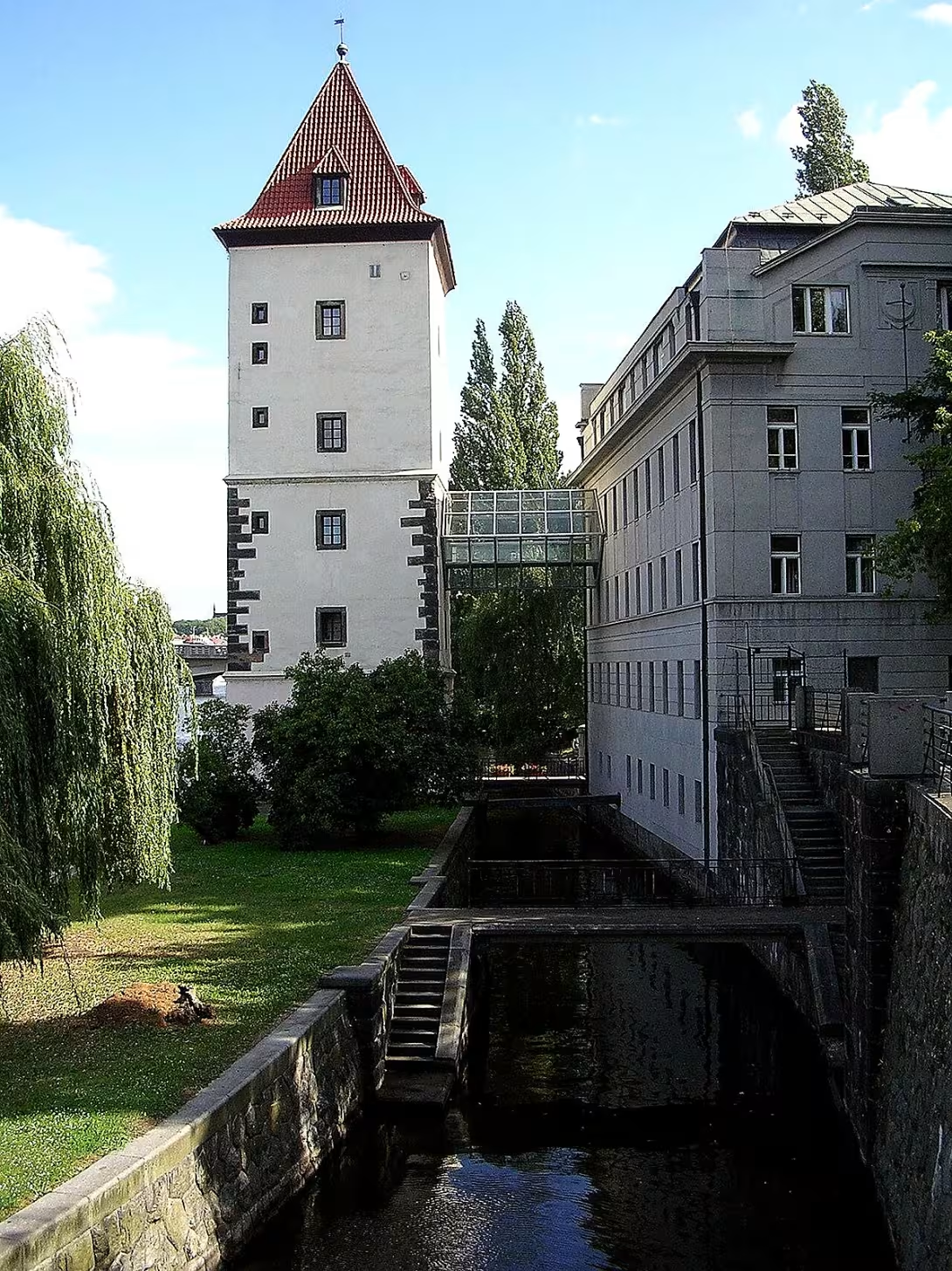
The Malostranská vodárenská věž, also known as the Pezlouk Tower, is the smallest of Prague's old waterworks and the only historical structure on the left bank of the Vltava River. It is located on the Smíchov, specifically on the Peparalock Island near Janáček's waterfront and southern tip of the Children's Island. This monument is an important part of the local history, the origin of which dates back to the 16th century, when it was crucial for the water supply of Prague's Mala Party until the end of the 19th century.
The creation of this tower is linked to the development of the Renaissance era, which has brought technological progress and urbanisation of Europe. In the years 1561 to 1562, a stone structure was built on the site of the former wooden mill, which aimed at more efficient water supply. The miller Jan Petržilka, after which the tower is named, played a key role in the creation of this important infrastructure element.
Architecturally, the Malostranská vodárenská věž represents an interesting transition from the original wooden structure to the stone structure, which was typical of technological progress at the time. The tower was renovated in 1987 to 1988, during which it was connected by a bridge to the administrative building, thereby increasing its functionality and aesthetic value.
The history of ownership and administration of this monument is connected with the miller Jan Pechalelka. For centuries, the tower served its original purpose of water supply until 1886 when its function was terminated. The adjacent water plant was equipped with pumps by Josef Bozek in 1826, which contributed to the modernisation of the supply system.
The reconstruction between 1987 and 1988 not only preserved the historical character of the tower, but also adapted it to modern needs. Today, Malostranská vodárenská věž stands as a witness to technological and architectural changes in Prague.
Currently, the tower is accessible to visitors and is worth visiting not only for its historical value, but also for its unique location on Smíchov. It's a place where history and the present intersect offering views of Janáček's waterfront and Children's Island.
Malostranská vodárenská věž is therefore not only a technical monument but also a witness to the changing face of Prague. Its history is reminiscent of the importance of water for urban life, while at the same time pointing to the technological advances that shaped the modern world. Visiting this monument offers a unique opportunity to become familiar with an important aspect of local history and culture.
Then and now
Drag the slider to compare how the landmark may have looked when it was built with the view today.
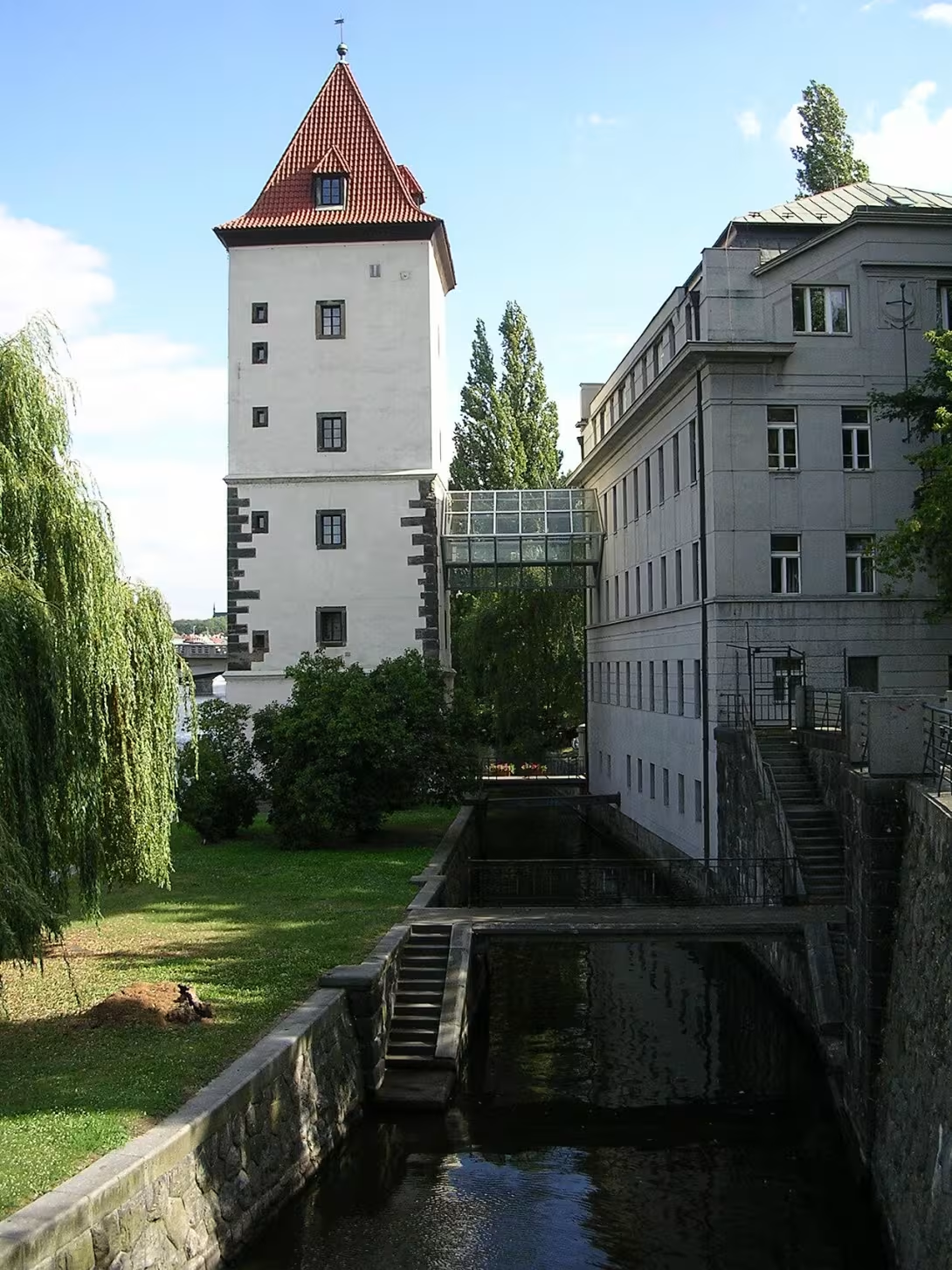
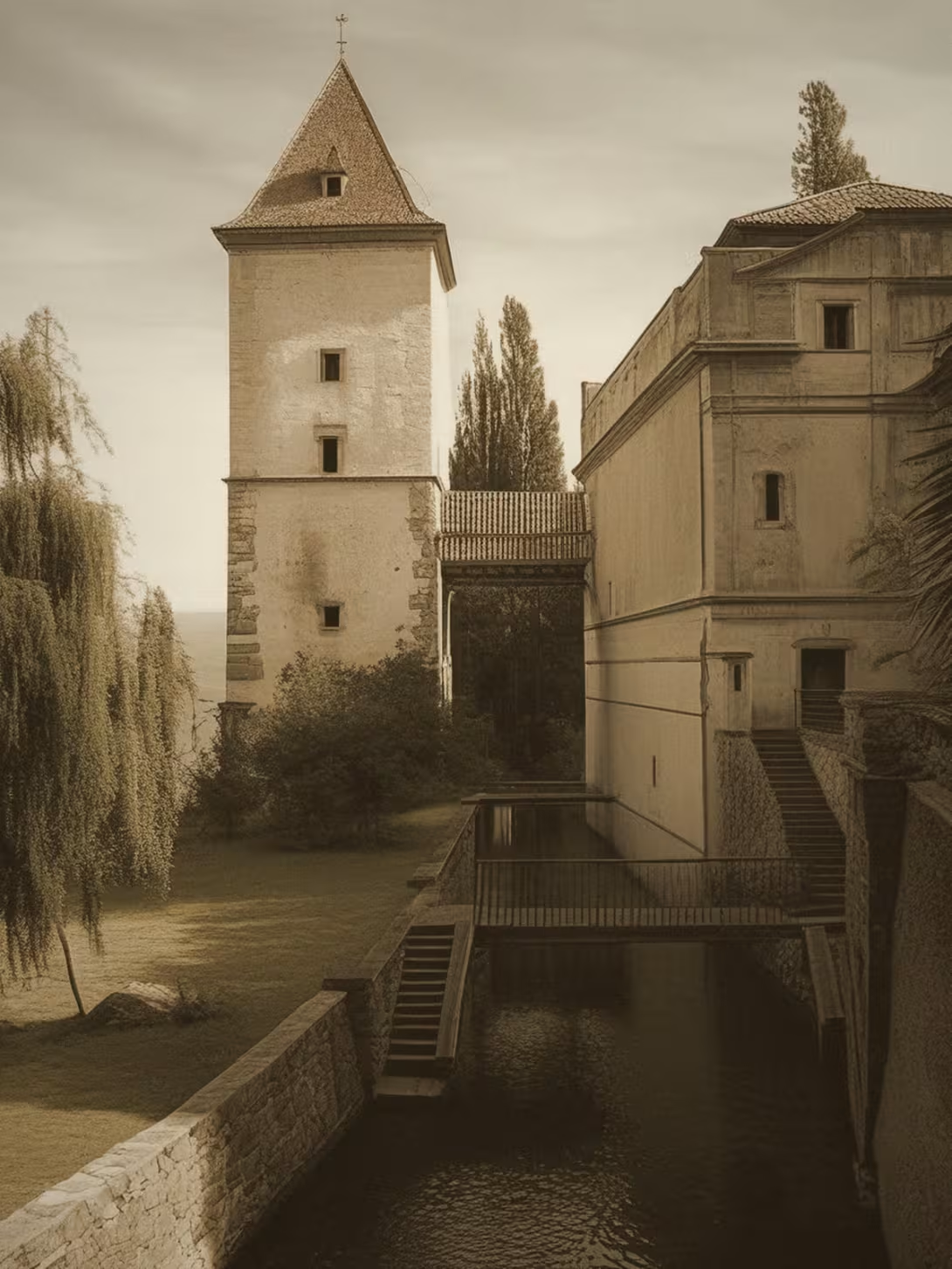
The historical appearance on the left is an AI-generated visualisation and serves as inspiration only.
Historical milestones
- 1826
- The adjoining waterworks equipped with pumps of Josef Bozek.
Architectural development
Originally there was a wooden tower, which was replaced by a stone structure. The tower was renovated in 1987 to 1988 during which it was connected by a bridge to the administrative building.
Historical events
- 1561
- The beginning of the construction of the stone water tower.
- 1886
- The tower stopped serving its original purpose of water supply.
Points of interest
- Malostranská vodárenská věž is the smallest of Prague's old waterworks and the only historical structure on the left bank of the Vltava River. - It is located on the Smíchov, specifically on the island of Peopark near Janáček's waterfront and southern tip of the Children's Island. - The creation of this tower is connected to the development of the Renaissance era, when the stone structure was built on the site of the former wooden mill between 1561 and 1562. - The miller Jan Petržilka, after which the tower is named, played a key role in the creation of this important infrastructure element. - Reconstruction from 1987 to 1988 preserved the historical character of the tower and adapted it to modern needs.
Guide
Show guide text
This text was created by artificial intelligence and has not been editorially reviewed. It may contain inaccuracies.
Welcome, distinguished visitors. Stop for a moment, take a breath and feel the atmosphere of this place. You are standing in front of one of the silent but very important witnesses of Prague history, which is Malostranská vodárenská věž. It may interest you at first glance with its modesty, but it is in this stealth that its great importance lies. The view of this building brings us back to a time when water was not available simply by turning the tap, but its transportation to the city required complex technical systems and great effort. Look around you at the surrounding landscape of Smíchova, the proximity of Janáček's waterfront and the southern tip of Children's Island. It is here, at this strategic point at the Vltava River, that this tower was built to serve the inhabitants of one of the oldest and most beautiful parts of our city.
Let us now look together at how this building was created and why it was so necessary at the time. Imagine Prague in the 16th century. The city grows, blooms, and the need for clean water increases. A small party that lies on the other side of the river needed a reliable water source for its inhabitants and gardens. This is why this tower was built between 1561 and 1562. It is fascinating to realize that this building was not created in an empty field, but was located in the place where the Pedalulk Mill used to work. This tells us that this place was used to work with water long before the tower itself stood here. This whole process of water supply at that time was at the peak of engineering and was closely linked to the development of the Renaissance era, which brought a new perspective on hygiene, urbanism and technical progress.
Now pay attention to the architecture itself before you. Notice its size and overall appearance. Even if we don't know the names of the particular architects who designed this structure, its form speaks for itself. Look at the facade and see its proportions. As you go around the tower, notice how harmonically it fits into the surroundings. It is important that you realize that you are looking at the smallest of all the old Prague water towers. This compactness is not random, but corresponded to the specific needs and possibilities of the time. Follow the line of construction and think about how many generations of Pražanis passed by it and how much water was flowing through the pipeline towards Little Side. It is a fascinating contrast to today's massive waterworks that such a small structure has been able to perform its vital function for so long.
Speaking of this place, we can't forget the personalities that were connected to it. The first one is Jan Petržilka, after which the building has acquired its middle name, the Pechlouk Tower. It was his mill that stood here, and it was his name that remained in the memory of generations, even though the function of the site changed from mill to water mill. But history did not stop standing in the 16th century. Let's move forward in time much, until 1826. At this time, the adjoining waterworks underwent modernization. The pumps made by Josef Božek were put into operation. Imagine the difference in technology between the original Renaissance base and the nineteenth-century industrial enthusiasm. God's machines meant a new leap in efficiency and reliability of water supply. It's a beautiful example of how one monument evolved along with human knowledge and technology. This historical function of the tower lasted until 1886 when it was replaced by more modern systems.
Now I want to impress you with one fact, which makes this tower quite unique. Look at your position again. Notice we're on the left bank of the Vltava. Most of the historical water structures in Prague are located on the right bank. Malostranská vodárenská věž is the only such historical structure on the left bank of the river. This makes it not only a technical monument, but also a strategic landmark in the history of the Prague Waterhouse. It is basically a lone guardian of the left-wing history that survived centuries of changes, flooding the river and the development of Smíchova from the suburbs in a busy urban district. It may be a mystery how such a small structure managed to maintain itself in such a dynamic environment, but it is this resistance that gives it some charm and mystery.
Now, when you look around, feel the contrast between this historic tower and the modern city surrounding it. This tower reminds us that even the smallest buildings can be of great importance if they served the basic needs of people. It was an artery that pumped life into the Little Party, and its existence allowed one of the most important neighborhoods in Prague to flourish. It's a silent proof of Renaissance sense and later industrial pragmatism.
I hope this short trip to history has helped you see the Malotru Water Tower in a new light. Now I encourage you to walk around it again slowly, maybe take a picture from different angles and try to imagine the sound of God's Pumps or the noise of water from the Pedalulkova Mill. Then you can continue to explore the beauty of Smíchova or walk along the waterfront towards the Children's Island, where the history of the town meets the nature of Vltava in complete harmony. Thank you for your attention and I wish you a pleasant continuation of your trip to Prague. Goodbye.
Tips for visitors
The best time to visit is early morning or late afternoon, when the light is softer and the glitter on the water makes it feel quieter. There are fewer people at the waterfront these hours, which allows better observation of the tower details.
You can easily reach the monument either by public transport or by car.
We recommend that you bring drinking water and comfortable shoes suitable for walking on the surrounding roads. For photography are the best places near the water, especially during the golden watch, when the tower beautifully highlights shadows and historical structure.
In the vicinity you can explore Janáček's waterfront or the southern part of Children's Island. For families with children it is ideal to walk in these open spaces near the water that offer free movement in a pleasant environment.
Frequently asked questions
Can the monument be visited?
This is a technical monument. Some are open as exhibitions, others are out of use or on private land. We have not verified whether this one is accessible.
What are the opening hours and admission?
We have not verified the opening hours or admission. Current information is published by the operator.
Where is the monument?
Location: Smíchov, Hlavní město Praha. The map on this page shows the exact spot.
Why is the monument protected?
It is listed in the Central List of Cultural Monuments of the Czech Republic as a cultural monument (register no. 1000152401).
Businesses nearby
Do you run a restaurant, accommodation, shop, museum, rental, wellness or other visitor service near this monument? Show yourself directly to the people heading to it — this is how they will see you in the app and on the web:
Events nearby

Zdroj akcí: otevřená data měst a obcí ČR (Národní katalog otevřených dat) a kalendář akcí Národního památkového ústavu.
Nearby
The tower is located near Janáček's waterfront and southern tip of Children's Island, which are important local monuments.
Accommodation nearby
Trips and activities nearby
Guided tours, tickets and activities nearby from GetYourGuide
Affiliate link: if you buy from the partner, we may receive a commission. The price for you does not change.
Search tours and activities →Themed route
Thematic cruise route: Malostranská vodárenská věž and its surroundings
1. Malostranská vodárenská věž (Water Works) This historical water tower is a key part of the Prague water pipeline from 1874 and stands as a witness to the engineering art of the 19th century. Its architecture and technical layout are fascinating for anyone interested in the history of water works.
2. Janacek's waterfront Near the water tower is Janáček's waterfront, named after the famous Czech composer Leoš Janáček. This place is ideal for relaxing and sightseeing, especially when you look at the water area of Dvořák's Mill.
3. Children's Island The southern tip of the Children's Island is another interesting place to visit after exploring the water tower. The island is famous for its gardens and park areas, where you can enjoy quiet moments on the natural background.
4. Water Works Dvořák Mill When walking through Janáček's waterfront, you can reach Dvořák's Mill, which is not only a historical monument, but also a technical piece. His water works and ancient architecture attract many visitors.
5. Dvořák Mill Port In addition to technical attractions, this place offers relaxation on water. The marina is popular for eatery, where you can enjoy the view of Prague from the water and enjoy the traditional Czech food.
This route offers a combination of historical and technical attractions with opportunities to relax and explore the city, making it ideal for a day trip.
Seasonal recommendations
In spring, the surrounding area of the tower is painted in fresh green and the air smells of blooming vegetation. The soft morning sun creates ideal conditions for shooting architecture without sharp shadows. We recommend that you bring layered clothes because the morning cold quickly turns into a warmer afternoon. It's the perfect time for a quiet walk before the main season.
The summer season brings the longest days and intense sunlight that highlights the details of the historical work. Due to the high temperatures and increased interest of visitors, it is advisable to arrive immediately after opening to avoid the biggest crowds and the most intense heat. Don't forget the sun protection and enough fluid to freshen up.
Autumn moons offer a nostalgic atmosphere accompanied by golden and brown shades of the surrounding countryside. There is often morning fog that gives the water tower a mysterious touch. For a pleasant experience, prepare waterproof shoes and a warmer layer of clothing, especially if you plan to visit in the afternoon when the sun falls rapidly to the horizon.
In winter, the monument is quiet and thanks to the short days there is a quiet, melancholy atmosphere. Freezing air and any snow highlight the shapes of the historical object. It is necessary to count on a shorter opening time and take with you very warm clothes and gloves. The best thing to do is to visit the place in the morning before the darkness falls.
Visualizations and artistic views


The visualisations are generated by artificial intelligence and serve as inspiration.
Photos from the area
Real photos taken near the monument

Zdroj a licence jsou uvedeny u každého snímku.
Tips from visitors
No tips yet. Be the first!
Log in and add your tip.
Sources and literature
Photos: cs:ŠJů / CC BY-SA 3.0 — Wikimedia Commons. The author and licence also appear when you hover over the image.
Faktickým podkladem tohoto textu byl článek na Wikipedii, jehož autory jsou přispěvatelé Wikipedie. Článek je dostupný pod licencí CC BY-SA 4.0.
Location on the map

Příběhy a pověsti
Legendy, pověsti a příběhy spjaté s touto památkou

Fotografie návštěvníků
Zatím žádné fotografie. Buďte první, kdo přidá fotografii z návštěvy!
Log in a přidejte svou fotografii nebo hodnoťte.
Za ověřenou návštěvu v aplikaci získáte víc bodů — poznáme podle GPS, že jste na místě.
Reviews and comments