



Mariánský sloup v Písku Marian column
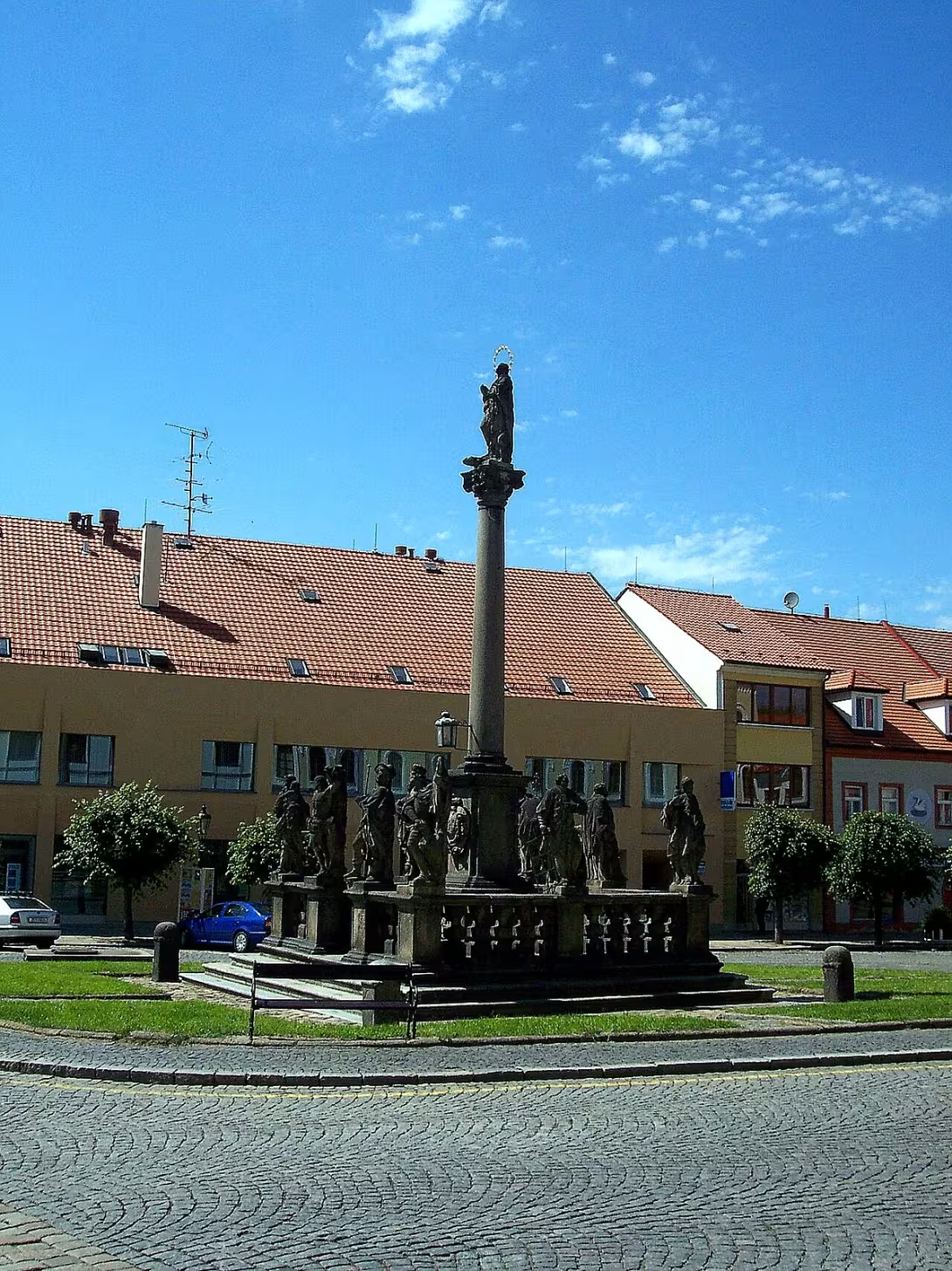
The Marian sculpture in Sand is a Baroque monument from 1713-1715. It stands in the middle of the Alš Square in the location Vnitřní Město. It consists of a Corinthian pillar with the figure of the Virgin Mary Immaculata and balustrados with ten statues of saints. It was created as an ex-voto for averting plague wounds, crops and high taxes.
In 1713 the plague from Hungary and Poland spread to Czech countries. At the time, the Prague Medical Faculty recommended prayers for the patrons against the plague and for the Fourteen Holy Helpers. On October 9, 1713, the Sandy City Council decided on the status of sculpture as the first step towards protecting the city. The residents were forced by order to pray at the bell. On 15 October 1713 Jan Jiří Kochan z Prachové read in the Church of the Birth of the Virgin Mary the promise of the townspeople to forgive sins and avert the epidemic.
The preparatory work began on 28 November 1713. Plzeň sculptor Christian Widmann received a contract of 280 gold pieces from the city. He created a statue of the Virgin Mary with a dragon under his feet in accordance with the pattern of statues from Old Town Square in Prague. In 1713-1714 Christian worked on the work and in 1715 his son Lazar Widmann. Lazarus carved an artistically progressive, bolted figure in the workshop, which is evident for example in the statue of St. Lawrence. The stones František Zeber and Jan Bauer carved a smooth granite column and a bowling ball on four stairs. The Corinthian head of the pillar was carved from one piece of stone along with Maria's dragon. There is a shallow cave at the bottom of the pillar with a reclining statue of St. Rosalie.
There are ten saints on the balcony. The original seven were St. Joseph and Jesus, St. Wenceslas, Pope Pius V., St. Shebestian, St. Roch, Saint Rosalie and Saint Barbara. Later thanks to the benefactors, the statues of St. Vavřinec, St. Francis Xaversky and Saint Mary Magdalene with skull and cream jar were added. The balustrada is supplemented by a forged iron grate and a stone menu of the altar. In the event of an epidemic, it was possible to serve mass instead of church. Originally there were also four corner pavements with balls and chains to protect the object from chariots, but today it is already missing.
The lifting of the column with the figure of the Virgin Mary took place on 6 October 1714. The necessity of the construction was also justified in this year by the lack of crops, the fall of cattle and the unbearable tax of action. In Prague, there was a plague in which 45,000 people died in five months. The whole sculpture was completed and sanctified on 8 September 1715. As a token of thanks for saving the city and abolishing the taxes, the memorial was led by a procession from the Marian church accompanied by gunfire, trumpets and drums.
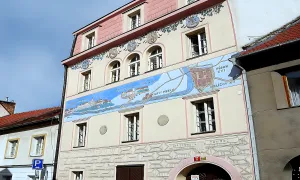
The monument stands in the centre of Alšov Square near other monuments. Next to this is the narrowest house in Písek (No.17) and house No.16, where August Sedláček lived at the time of his high school. To them comes the Gothic house No. 36 with vaulted cellars and medieval masonry.
The Marian sculpture represents an important example of baroque art. Indicates the historical experience of the city with epidemics and social burdens. It is the dominant element of the square, which is behind the visit in the survey of the historical centre of Písek.
Then and now
Drag the slider to compare how the landmark may have looked when it was built with the view today.
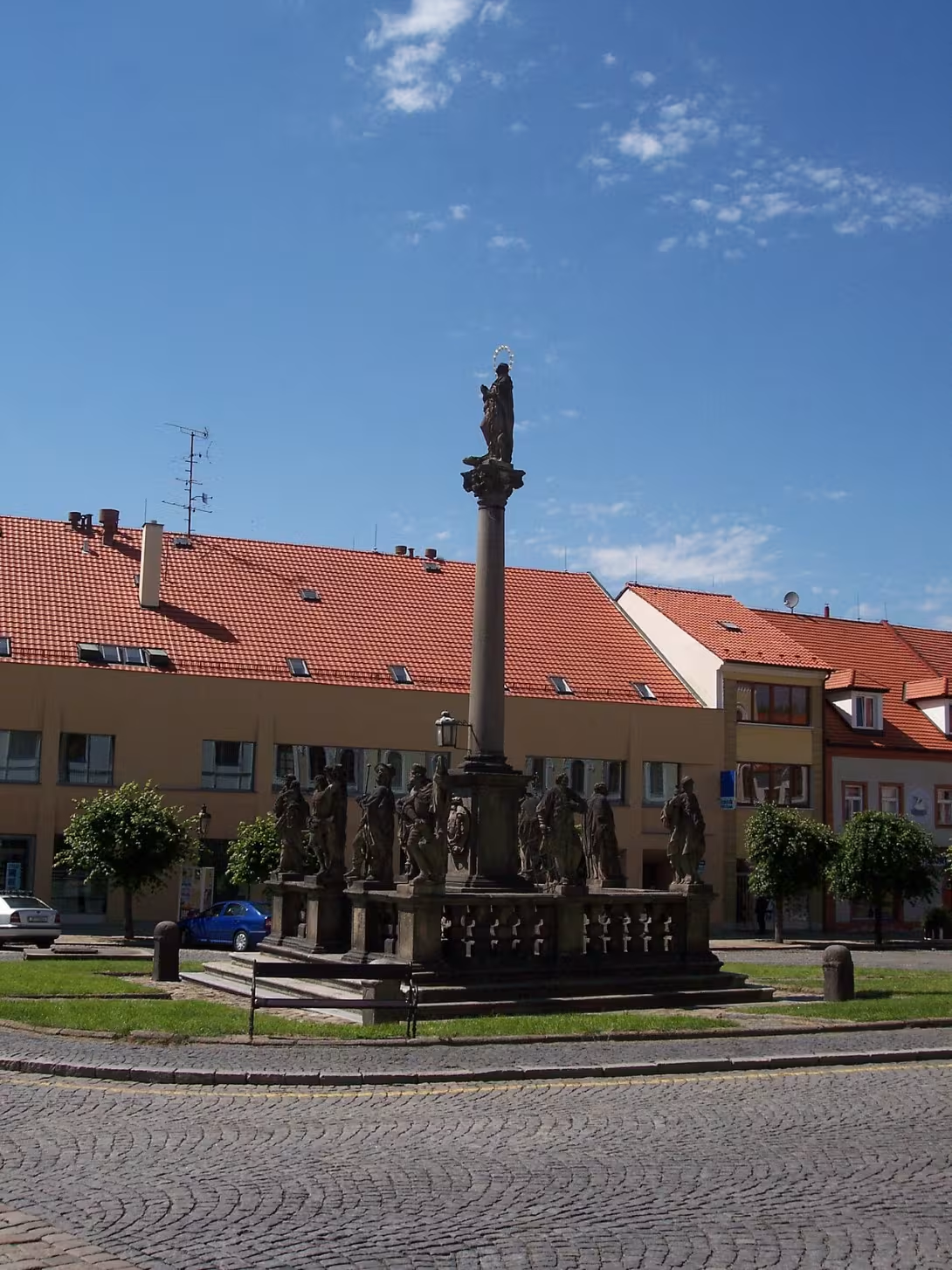

The historical appearance on the left is an AI-generated visualisation and serves as inspiration only.
Historical milestones
- 1713
- City Council decision on the construction of sculptures as an ex voto against the plague.
- 1714
- Raise the column with the figure of the Virgin Mary.
- 1715
- Complete and sanctify the entire sculpture.
Architectural development
The sculpture consists of a smooth granite pillar with a Corinthian head and a bowling ball on four stairs. A shallow cave with a statue of St. Rosalie is carved at the base of the pillar. The balustrada was originally supplemented by a forged grate and four corners with balls and chains, which are now missing.
Historical events
In 1713 the city council decided to build sculptures as a protection from the plague. On 6 October 1714 the column with the figure of the Virgin Mary was raised. On September 8, 1715 the statue was completely completed and sanctified.
Points of interest
- The Marian sculpture in Písek is a Baroque monument from 1713-1715. It was created as an ex-voto for averting plague wounds, crops, and high taxes. - The preparatory work began on November 28, 1713 with sculptor Christian Widmann. - The lifting of the column with the figure of the Virgin Mary took place on 6 October 1714. The whole sculpture was completed and sanctified on September 8, 1715.
Guide
Show guide text
This text was created by artificial intelligence and has not been editorially reviewed. It may contain inaccuracies.
Welcome to the historic heart of the city of Sand. You are standing right in the middle of the Alš Square and your eyes can fully devote themselves to the monumental monument, which stands here as a silent witness of ancient times. In front of you stands a Marian pillar, a baroque sculpture that completely changes the atmosphere of the entire square with its presence. Look at its majestic appearance and try to imagine what this place looked like hundreds of years ago when this stone was only being carved and when people were praying with hope in their hearts for a better tomorrow.
Now pay attention to why this column was created. It wasn't just the aesthetic decorating of the square or a demonstration of the wealth of the city. History tells us about much harder times. We must return to the years of a thousand seven hundred thirteen to fifteen, when the city and its inhabitants went through a very trial period. At that time, people faced constant fear of the plague, which at that time was absolutely terrifying and unpredictable to everyone. In addition, crops that threatened people's survival alone and high taxes that imposed huge financial burdens on each family were added. This column was therefore created as a gift and an expression of deep gratitude for the fact that these disasters were averted. It was a symbol for the people back then of the victory of life over death and misery.
Now let's look at the work itself and what exactly you have in front of you. Notice how the pillar sticks to the sky and at its peak dominates the figure of the Virgin Mary Immaculata. It's the center of this whole sculpture, a character to express purity and divine protection. If you look around the column itself, you'll see a balustrade surrounding it. This stone structure is not only an ornament, but it forms an important framework for the whole work. If you focus closer, you can see ten statues of saints. Each of these figures was drawn with great care and each of them at the time was of profound importance to people. In the lower part of the sculpture you can also see the stone menza, which was intended for divine service, which proves that this place also had a deep spiritual dimension.
This whole process of creation was a fascinating thing, which required not only great faith, but also incredible technical skill and artistic talent. The work on this monument began with a very specific date when it was decided on its construction. The first preparatory steps were taken by sculptor Christian Widmann already at the end of November of the year a thousand seven hundred thirteen. Imagine the work, the constant working of stone and planning every detail. Two talented sculptors, Christian and Lazar Widmann, collaborated in the creation process, putting their artistic imagination into the work. They were also helped by masters of stonemakers, František Zeber and Jan Bauer, who had to ensure that the stone was worked perfectly and that the whole structure was solid and permanent.
In the history of this place also appears the name of John Jiří Kochan from Prach, which reminds us that every such construction is the people whose names we try to preserve in time. The whole construction process was divided into several important stages. The initial preparatory work was followed by one of the most exciting moments in the history of this square. It was the sixth October of the year a thousand seven hundred fourteen, when it was possible to lift the column itself with the figure of the Virgin Mary. Imagine the tension, the joy and the relief of all those present when this monument finally came to its place. The whole sculpture was subsequently completed and sanctified in a thousand seven hundred and fifteen, making it a permanent part of the urban landscape.
If you are now standing right at the balustard, try to realize in your mind the work that the stonemakers Zeber and Bauer had to do to make this whole act so harmonious. Every detail, from the menza to the statues of the saints, was part of a wider plan to bring people peace and security in times when everything seemed to be against them.
It is fascinating how this baroque pillar can still act alive and strong today, after more than 300 years. It is not only a work of art, but above all a record of human efforts, a joint decision to overcome fear and expression of hope that never stops. Every statue, every detail of the stone carved by the hands of the Widmann masters and their coworkers, tells us a story about how much people can connect in difficult times.
But now I will not take you too long. I hope this view of the Marian Column has helped you better understand its meaning and history, which is so closely linked to the city of Sand. Please continue to walk around the city, discover further corners and let yourself drift through the atmosphere of this place. Every aisle and monument here has its own story waiting for you. Thank you for your attention and I wish you a wonderful and inspiring continuation in exploring our city. Goodbye.
Tips for visitors
The best time to visit the Marian pillar in Sand is an early spring or late autumn day when the light is soft and pleasant. This period also offers a quieter environment for a tour without a large number of tourists.
Take a camera with you and maybe some basic photographic equipment if you like photography. The column is located in the middle of the square, which offers ideal conditions for capturing the overall view and details of the sculpture.
Photograph yourself best in the early morning or in the evening when the light is less intense. This allows you to better capture the colors and shadows on the column and figure of the Virgin Mary Immaculata.
In the vicinity of Alšov Square is located the narrowest house in Písek (no. 17) and Gothic house no. 36, which are interesting for a short walk around historical places. These buildings represent another view of the architectural past of the Sand.
Frequently asked questions
Can the monument be visited?
This is a structure in a public space that can usually be seen from outside free of charge. We have not verified that this particular one is freely accessible.
Where is the monument?
Location: Vnitřní Město. The map on this page shows the exact spot.
Why is the monument protected?
It is listed in the Central List of Cultural Monuments of the Czech Republic as a cultural monument (register no. 1000144408).
Businesses nearby
Do you run a restaurant, accommodation, shop, museum, rental, wellness or other visitor service near this monument? Show yourself directly to the people heading to it — this is how they will see you in the app and on the web:
Events nearby
Zdroj akcí: otevřená data měst a obcí ČR (Národní katalog otevřených dat) a kalendář akcí Národního památkového ústavu.
Nearby
Alšovo náměstí v Písku, v blízkosti se nachází nejužší dům v Písku (čp. 17) a gotický dům čp. 36.
Accommodation nearby
Themed route
1. Alš Square in Sand, Square. It's the perfect place to start your walk. 2. The narrowest house in Sand (No. 17), house. This building will amaze you with its unusually small width. 3. Gothic House No. 36, House. A historical object that represents an ancient style of construction. Mariánský sloup v Písku, memorial. The main destination of your journey, which stands nobly in the middle.
Seasonal recommendations
Spring brings to the Sand the awakening nature that frames the Marian pillar of the inner city. The trees around the square and around them bloom, creating a fresh and bright atmosphere. The light is soft and scattered at this time, ideal for observing details of sculpture decoration without sharp shadows. The spring weather is practically variable, so bring a light jacket and umbrella, because spring rains are common. I recommend visiting a monument in the morning when the air is fresh and the streets are not crowded yet. Clothing should be laminated in order to be easily adapted to temperature fluctuations.
Summer offers the longest days and brightest light which reveals the texture of the stone and the color of the column in full beauty. The sun shines high so that morning and afternoon can be hot while morning and evening are pleasant. The atmosphere is alive because the summer season attracts more visitors to the historic core of the city. It is best to choose the morning or evening hours for a comfortable tour from the outside, when temperatures fall and shadows extend, which gives the scene dramatic character. Clothes should be light, breathable and of natural materials to prevent overheating. Don't forget to drink and protect from the sun, such as a hat or sunglasses.
Autumn brings warm shades of gold, orange and red to the Sand, which contradict the cold grey color of the stone pillar. Leaves on trees create a romantic and peaceful character that is ideal for a thoughtful walk. The light is lower and warmer, which highlights the reliefs and shapes of the monument. The atmosphere is colder and the air is clear, which improves visibility of details. Practical advice includes layered clothes because morning and evening frosts can be felt. I recommend visiting a memory after lunch when the sun falls and shadows become longer, creating a fascinating game of light and shadow on statues.
Winter brings peace and quiet to Sand, which are typical of this season. The snow, if it falls, covers the square with a white carpet and highlights the architectural elements of the column. Light is short and weak, which creates an intimate and dreamy atmosphere. In advent time, the surroundings can be illuminated by Christmas decorations that provide a magical feel for the place. Practically winter is the coldest season, so warm clothes are necessary, including winter jackets, gloves and hats. The best time to visit is the late afternoon when the first evening lights are on and the temperatures are still tolerable. Short days mean you have to decide when to leave quickly to catch the last rays of the sun.
Visualizations and artistic views


The visualisations are generated by artificial intelligence and serve as inspiration.
Photos from the area
Real photos taken near the monument


Zdroj a licence jsou uvedeny u každého snímku.
Tips from visitors
No tips yet. Be the first!
Log in and add your tip.
Sources and literature
Photos: Schneeman / CC BY-SA 3.0 — Wikimedia Commons. The author and licence also appear when you hover over the image.
Faktickým podkladem tohoto textu byl článek na Wikipedii, jehož autory jsou přispěvatelé Wikipedie. Článek je dostupný pod licencí CC BY-SA 4.0.
Location on the map
More monuments – Vnitřní Město
Show all in the municipality
Příběhy a pověsti
Legendy, pověsti a příběhy spjaté s touto památkou

Fotografie návštěvníků
Zatím žádné fotografie. Buďte první, kdo přidá fotografii z návštěvy!
Log in a přidejte svou fotografii nebo hodnoťte.
Za ověřenou návštěvu v aplikaci získáte víc bodů — poznáme podle GPS, že jste na místě.
Reviews and comments