



Městské opevnění (Český Dub) Town walls
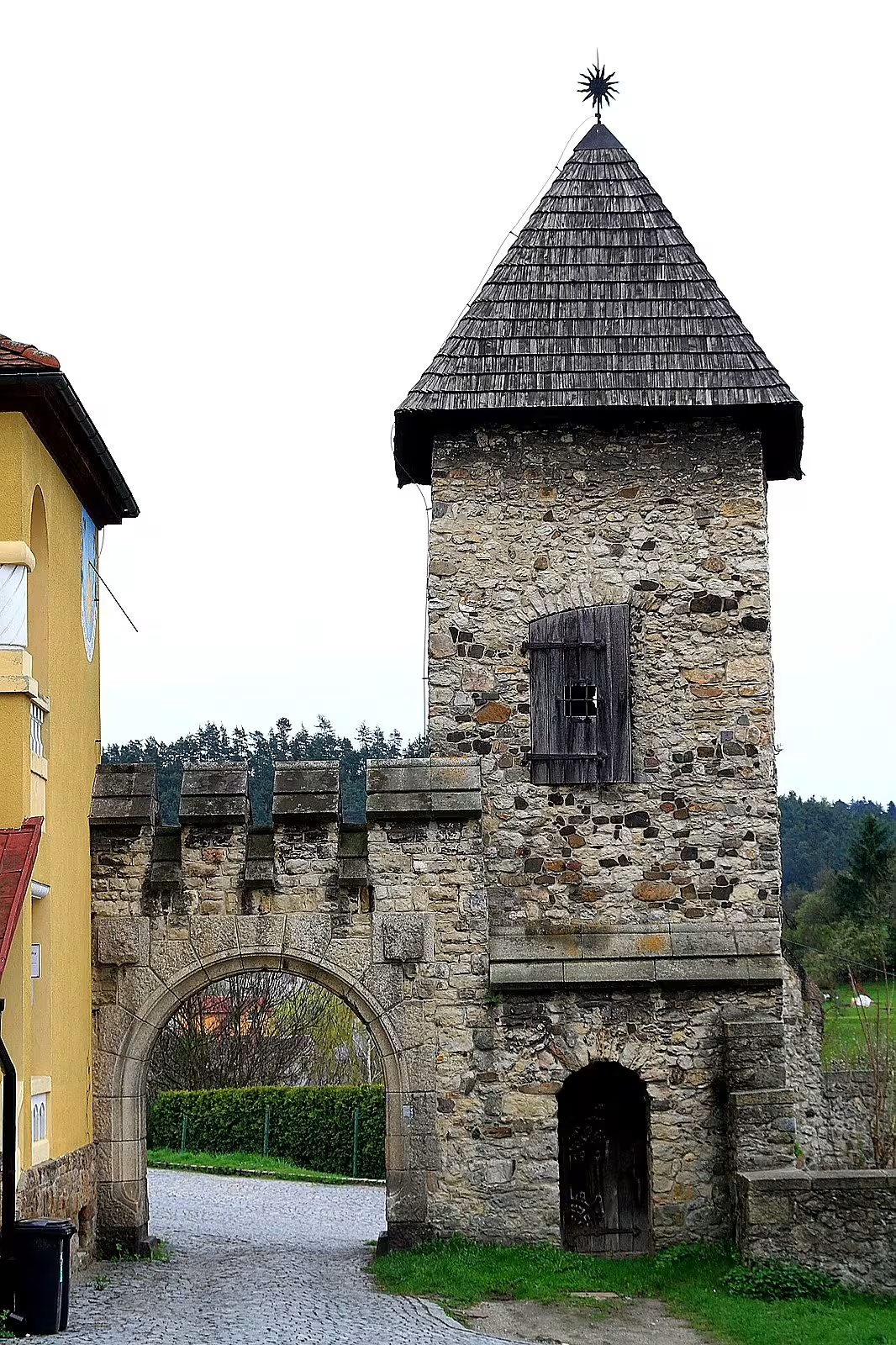
The town fortification in Český Dubu, located in the district of Liberec in the same region, represents the remains of historical walls surrounding the medieval core of the city. This monument is listed in the Central List of Real-Estate Cultural Monuments of the Czech Republic and belongs to the town monument zone declared in 1992. It is important as a testament to historical development from the medieval settlement to the classical reconstruction.
According to the National Monument Institute, the walls were probably built in the 13th century as part of the fortification of the then Johanite commendation. The first written mention of the city fortification in Český Dub appears in 1512. In a form that partially survived until the 21st century, the walls were built in the last decade of the 15th century. Between 1490 and 1500 he held the Czech manor Jan ze Šelemberka, which extended the local castle, rebuilt the church of the Holy Spirit and founded this fortification. At that time, the Czechs ruled the Jagellonian Dynasty.
The original castles were built in the style of goth around the island hall on which the city developed. In the west, this island is bounded by the flow of Jestředek, which surrounds the urban core in the area of the former old castle and johanite commendas. The defense system included two gates - Burning and Doleni - located on the north and south side of the city, equipped with towers and drawbridges. The whole fortifications were surrounded by a moat and across the city led an artificial water grate with halters. The main material for the construction of the walls was opka and sandstone.
The fate of the fortifications was influenced by several events, including fires that have turned the city into a burning ground several times. Since the 18th century, the houses have been attached to the walls, which has changed their original appearance. In 1782, the city became the property of the Lower Austrian Religious Fund. Classicist adjustments during which historical castles were demolished took place in the 1920s and 1930s. Both city gates were destroyed in the middle of the 19th century. After the fires of 1858 and 1866, which burned down the castle and destroyed the central part of the city, there was another change in the spirit of late classicism and historic modifications.
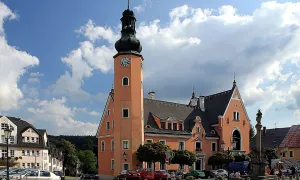
The most significant rest of the fortifications is the urban sound - the prismatic tower from the spuce and sandstone, located east of Bedřich Smetana Square. From the 16th to the 18th century, she served as a city hall and torture chamber. In 1904-1905 the tower underwent romantic modifications and was connected by a neo-gothic passage to the Art Nouveau villa of Helena's chateau, built by Helene von Schmitt, the daughter of a major businessman Franz Schmitt.
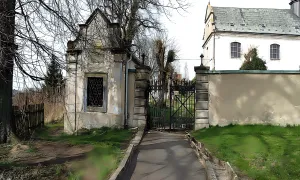
Today, only parts of the original Gothic castles are preserved, for example near the Church of the Holy Spirit on the western edge of the city's core. The city fortification is an important historical element that allows you to look into the development of the city from the medieval period to its new reconstruction. Visiting him is suitable for understanding the architecture and history of this region.
Historical milestones
- 13th Century
- Likely position of the walls as part of the Johanite commendation
- around 1490-1500
- Jan ze Šelemberka founded fortifications and expanded the local castle
- 1512
- First written mention of the city fortification in Český Dub
- 1782
- Transfer of the city to the property of the Lower Austrian Religious Fund
- 1820-1830
- Classicist modifications and demolition of historical castles
- 1904-1905
- Romantic urban voice modification
Architectural development
The castles were originally built in a Gothic style, but during the Classicist modifications in the 19th century they were partially destroyed and the urban development changed. An important part of the fortifications was the Gothic voice, which underwent romantic adjustments in the early 20th century.
Historical events
- 1357
- The first written mention of the city fortification in Český Dubu.
- 1512
- Direct mention of city walls.
- 1782
- The city went into possession of the Lower Austrian Religious Fund.
Owners
- 1490-1500
Points of interest
- The urban voice served as a sabbatical and torture hall between the 16th and 18th centuries. - The tower was connected in 1904-1905 by a neo-gothic passage with the Art Nouveau villa of Helen's castle. - The defense system included two gates equipped with towers and drawbridges that were destroyed in the mid-19th century. - The walls were probably built in the 13th century as part of the fortification of the then Johanite commendation. - The entire fortification was surrounded by a moat, and across the city, there was an artificial water grate with halters.
Guide
Show guide text
This text was created by artificial intelligence and has not been editorially reviewed. It may contain inaccuracies.
Welcome to Czech April. Right now, listening to these words, you're facing one of the most important symbols of this city. Before your eyes, there is an urban fortification that has set the border between the city's safe interior and the dangerous outside world for centuries. Feel this atmosphere - you are standing in a place where the past meets the present and where every stone you see tells the story of protection, power, and human life changes. These walls are not just an element of the landscape, they are a living witness to history that goes deep into the Middle Ages.
Looking at these remnants of fortifications, you can imagine what the city looked like at a time when security was the top priority. In order to understand why these structures are even standing here, we need to go back very far into history. The first traces of the defense structure in this area probably range back to the 13th century. At that time, this area was linked to the Johanite commendation, which suggests that the site was already of important strategic and religious importance. However, the form of the walls that you can observe today in various parts is the result of decisions that have been made much later.
Now, let's move on to the end of the 15th century, which is the key period for today's urban monument zone. Around 1490 to 1500 there was a man named Jan ze Šelemberka. He was the one who decided to reconstruct and expand the local castle and the entire fortification system. Jan ze Šelemberka perceived the need to create a robust defense system that would actually protect the city. The first written mention of this city fortification appears only in 1512, which confirms that at that time this solid structure was already a solid part of life in Český Dub.
Now pay attention to how this defense system has been constructed. It wasn't just about the stone walls. Imagine a city as a whole that was protected more comprehensively. Part of the defense was a moat and an artificial water grate, which led across the city and headed for a halter. This water was not only an aesthetic element, but a key part of the military strategy. Note how the walls surround the historical core of the city - it is thanks to this arrangement that the centre of the city is preserved in the form that you are walking around today.
Now if you look towards the places where the gates used to stand, you can imagine in your mind what the original entrance to the city looked like. The whole system used to be much richer. There were two main gates that were equipped with towers and drawbridges. These elements gave citizens a sense of security, but at the same time they controlled every move towards the city. Unfortunately, this era of closed gates ended in the middle of the nineteenth century when these gates and bridges were destroyed. What you're seeing today is just a fragment of a much larger system.
But the history of these walls is not just a story about war and defense. It is also a story about political and property change. In 1782, there was a significant moment when the city became the property of the Lower Austrian Religious Fund. This brought about a new period, which was reflected in the classical arrangements during the nineteenth century. Between 1820 and 1830 the city changed - at this time the old historical castles were being demolished to make room for newer architecture and a more modern arrangement.
But not everything you see is the result of the demolition. On the contrary, some parts were deliberately repaired in later times to act more magnificently. Pay attention to the sound of the city. It went through an important transformation in 1904 and 1905. During this period the voice was modified in a romantic style, which was in line with the desire for aesthetic beauty and a return to historical ideals. This modification has given the place an unrepeatable character, which you still perceive.
In this context it is fascinating to notice the connection between the tower and the surrounding architecture. In those years at the turn of the century, the tower was connected by a neo-gothic passage with the Art Nouveau villa of Helen's castle. This detail shows how the old military structures were connected to the new, luxurious urban architecture at the time, making the walls part of the city's representative environment.
But now I must invite you to the darker side of this place. History is not always about beauty and romance. If you look at the tower, try to imagine what emotions it has produced in the past. In the years from the 16th to the eighteenth century, this urban voice served as a checkroom and torture chamber. This is a fascinating and freezing contrast to the quiet atmosphere you are experiencing here today. The place that today serves to walk and observe history was once a place of punishment and fear. This duality - between the city's defence and its internal control through punishment - is deeply rooted in the history of these walls.
Now, if you're going to keep walking, try to see the details that the neighborhood offers. Although many original elements such as drawbridges or original gates no longer exist, the spirit of the original fortification is still present. Feel how the walls define space and how they determine people's movements in the historical center. Each part of this fortifications, from the water grate to the romantically modified towers, form a unique whole that is unprecedented.
I hope that this short journey through the history of the city walls in Český Dubu has attracted you and brought you to think about how our worlds are changing. These walls have survived for centuries, they have survived changes in owners, political regimes, and technological progress. They're here to remind us of our roots.
Now I cordially urge you to continue your tour of the city. Take a walk through the historical core that once protected these walls so firmly, and try to find traces of that ancient time in every street. Thank you for choosing to visit this place and devote your time to its history. We will brighten you with a nice walk and enjoy everything Český Dub has to offer. Goodbye.
Tips for visitors
The best time to visit the city walls in Český Dub is spring and autumn months when the weather is friendly for walking and the surrounding green landscape provides a beautiful contrast to stone walls. The morning hours are ideal if you plan to take pictures because the light hits the walls from the side and highlights their structure and texture. The afternoon is suitable for a quieter walk when there is less chance of gathering tourists.
Transport availability is ensured both by car and public transport. For passengers travelling by public transport it is best to verify the current connections and timetables in the search engine or on the carrier's website because the number of lines and times may vary according to the season and day of the week.
When visiting the walls, bring comfortable shoes with a good heel, because the terrain can be uneven and stone. We also recommend having drinking water and a light snack if you are planning a longer walk. Depending on the season, it is advisable to equip yourself with layered clothing to adapt to temperature changes, especially if you are on open sections of fortifications.
The best places for photography are the sections of the walls, which offer views to the historical core of the city and the surrounding landscape. Morning light is ideal for capturing details of stone and shadows, while sunset creates dramatic contrasts and warm tones. If you want to take pictures with fewer people, try visiting less frequent sections of fortifications that are often less visible from the main streets.
Since there are no specific places in the area in the background, we recommend to explore the historical core of the city itself, which is part of the urban monument zone. For families with children, walking on walls is suitable if children are able to walk safely on stoneways. We recommend holding children's hands and making sure they do not climb walls unless they are intended for such activity. Short rest stops are appropriate for children not to be exhausted.
Frequently asked questions
Can the monument be visited?
This is a structure in a public space that can usually be seen from outside free of charge. We have not verified that this particular one is freely accessible.
Where is the monument?
Location: Český Dub, Liberecký kraj. The map on this page shows the exact spot.
Why is the monument protected?
It is listed in the Central List of Cultural Monuments of the Czech Republic as a cultural monument (register no. 1000124814).
Businesses nearby
Do you run a restaurant, accommodation, shop, museum, rental, wellness or other visitor service near this monument? Show yourself directly to the people heading to it — this is how they will see you in the app and on the web:
Events nearby



Zdroj akcí: otevřená data měst a obcí ČR (Národní katalog otevřených dat) a kalendář akcí Národního památkového ústavu.
Nearby
🏰 Historic sites (282)
- Marian Columns 0.2 km
- Chapel of St. John Nepomuk 0.3 km
- Johan commendation of St. Zdislava and Havel of Lemberka 0.3 km web
- Monument 0.3 km
- Schmitt Castle 0.4 km
- Podzedském 0.5 km
- Column St. Jana 1.4 km
- 1914-1918 3.4 km
- 1914-1918 3.8 km
- Socha P. Marie Immaculata 4.5 km
- 1914-1918 5.1 km
- Stone Table 5.6 km
- Column with statue of Virgin Marie 5.6 km
- 1914-1918 5.8 km
- 1914-1918 5.8 km
- Carolina Svets 5.8 km
- Cross site at Potokax 5.9 km
- sv Jan Nepomucký 6.0 km
- Vlastibořice 6.1 km
- sv Linhart 6.1 km
🍽️ Restaurants and dining (414)
- Restaurant U Adamo 0.4 km
- Restaurant Wolčetín 2.8 km
- Restaurant Jamaica White 2.9 km
- Črtová zemed 3.4 km
- Golf Jested bar restaurant 4.9 km web
- Restaurant U Zvolice 6.1 km
- Guesthouse 6.1 km
- Na Crossing 6.2 km
- Under the Church 6.4 km Pink 125 web
- abc 6.4 km
- Café Brasil 6.5 km
- Kiosk 6.5 km
- Slunce 6.6 km + 420 720 020 608 web
- Planes under Jested 6.7 km
- Giant keg Javornine 6.8 km web
- Refreshment 7.1 km
- Restaurant and Hotel Giant keg Javorník 7.2 km Maple 350 + 420 725 456 431 web
- Horka 7.2 km
- Guesthouse Konrad 7.3 km web
- Rohanka 7.3 km
🏨 Accommodation (78)
- Črtová zemed 3.4 km
- Farm under Jested 4.0 km + 420 724 934 216 web
- Jested golf restaurant and guesthouse 4.9 km
- Camping 2000 6.3 km
- Accommodation in Museum 6.5 km
- Slunce 6.6 km + 420 720 020 608
- Bushka Cave 7.5 km
- V Valley 7.8 km web
- Hotel Jechost 8.1 km web
- Jadran 8.6 km
- Guesthouse No. 30 8.8 km web
- U Konicch 9.0 km
- Pytloun Desig 9.2 km web
- Hotel Petra 9.3 km Jested 680 / 121 web
- Impuls 9.8 km
- Pytloun Self Check-in Hotel Liberec 10.2 km
- Hotel Svijany 10.4 km web
- Tyršova chata 10.6 km
- U Prasete 11.0 km
- Hotel Arena 11.0 km
🚲 Rentals and sport (97)
- ATV Tours 5.7 km
- Søelnice 6.9 km
- Sports complex Vesec 8.8 km web
- Sokolovna TJ Slovan Vesec 9.8 km
- Pumptrack 9.8 km
- gym Jenishovice 10.2 km
- Gym ZŠ 10.2 km
- Pumptrack Radlo 10.2 km
- Cykla Liberda 10.3 km web
- Bowling, billiard 10.8 km
- Artificial climbing wall 10.8 km
- Arrow 10.8 km
- Kolofix 10.8 km web
- Sport 10.8 km web
- Boat rental Koza 10.8 km + 420 737 501 491 web
- A-style 10.9 km
- Sokolovna 10.9 km
- Sport hala 10.9 km
- Bowling 11.0 km
- KUR Sport Liberec 11.0 km web
🥾 Hiking and nature (316)
- Sheep above 1.4 km
- Killed 2.2 km
- Špičás 2.4 km
- Čihadlo 2.7 km
- Pelousek 2.8 km
- Chloumek 3.9 km
- Carrier top 3.9 km
- Črtová zemed 4.0 km
- Čertová hlavs 4.0 km
- Jeline 4.2 km
- Hawk 4.2 km
- Topolina 4.3 km
- Maz hot 4.4 km
- Skalákovna 4.5 km
- Stone 4.7 km
- Red top 4.7 km
- Antošová kopec 4.8 km
- Fairy Les 4.9 km
- Kamenec 5.3 km
- Zzábrdské kopec 5.5 km
Accommodation nearby
Trips and activities nearby
Guided tours, tickets and activities nearby from GetYourGuide
Affiliate link: if you buy from the partner, we may receive a commission. The price for you does not change.
Search tours and activities →Themed route
1. Entrance gate, type: architectural element, serves as a historical entrance to the complex and shows the original method of access to fortifications. 2. City walls, type: historical fortifications, tour of stone structures allows you to understand the former defence of the city. 3. Tanks, type: open space, offers a place to observe details of the remains of the fortifications up close. 4. Tower, type: Projection point, from this elevated part can be monitored for strategic location of the entire fortification system.
Seasonal recommendations
Spring: In the spring period, the city fortification in Český Dubu is transformed into a living flower formation, where green grass and emerging trees provide pleasant lighting. Sun rays reflect on newly blooming leaves, creating a unique atmosphere of calm and recovery. Visitors can enjoy mild weather, but it is advisable to prepare for sudden rain or cool winds. It is recommended that you visit the memory in the early afternoon to enjoy a mild temperature and avoid initial tourist doses.
Summer: In summer, the city fortifications in Český Dubu are full of life, when the sun lights up the walls and increases the temperature. The atmosphere is charged with tourists and families, which adds its own rhythm to the local environment. We recommend visiting the memory earlier in the afternoon to avoid the hottest hours while avoiding large crowds. Don't forget the protective sun tie and enough drinking water to enjoy your walks under the moon.
Autumn: In the autumn period, the town fortification in the Czech Dubu of Melancholic beauty takes place with colorful leaves, which is prepared for winter. The sun sets earlier and long shadows add to the atmosphere a sense of calm and reflection. Autumn weather can be sudden, so it is advisable to equip yourself with warm clothes and a protective court. The best time to walk is in the early afternoons, when the shadow is milder and the weather is usually welcoming.
Winter: In winter, the city fortification in Český Dubu has a beautiful snow blanket, which decorate the walls and creates a romantic atmosphere. Sun rays are projected into white snow, adding magic and peace to the place. Visitors should be prepared for warm clothes, including hat and gloves, and short open days of sights. The best time to visit is in the early afternoon when you can enjoy bright snow images before setting the sun.
Visualizations and artistic views


The visualisations are generated by artificial intelligence and serve as inspiration.
Photos from the area
Real photos taken near the monument


Zdroj a licence jsou uvedeny u každého snímku.
Tips from visitors
No tips yet. Be the first!
Log in and add your tip.
Sources and literature
Photos: Ondřej Kořínek / CC BY-SA 3.0 — Wikimedia Commons. The author and licence also appear when you hover over the image.
Faktickým podkladem tohoto textu byl článek na Wikipedii, jehož autory jsou přispěvatelé Wikipedie. Článek je dostupný pod licencí CC BY-SA 4.0.
Location on the map


Příběhy a pověsti
Legendy, pověsti a příběhy spjaté s touto památkou

Fotografie návštěvníků
Zatím žádné fotografie. Buďte první, kdo přidá fotografii z návštěvy!
Log in a přidejte svou fotografii nebo hodnoťte.
Za ověřenou návštěvu v aplikaci získáte víc bodů — poznáme podle GPS, že jste na místě.
Reviews and comments