



Radnice v Českém Dubu Town hall
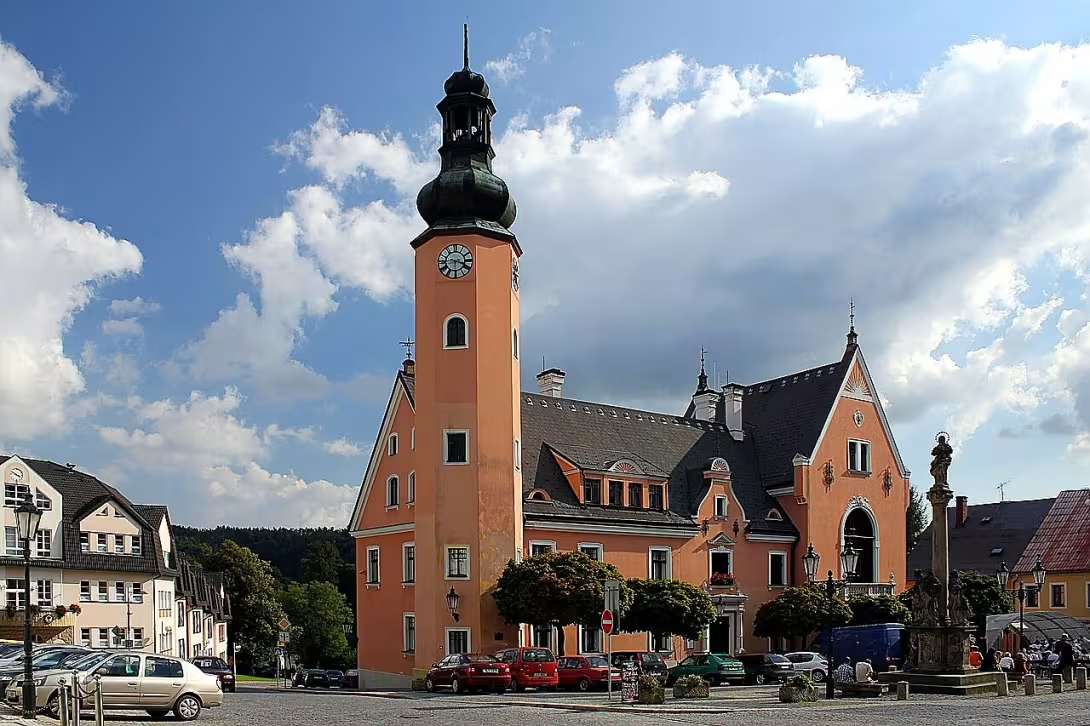
Radnice v Českém Dubu is one of the most important Renaissance buildings of this kind in the Czech Republic. The building with eight-sided tower is situated in the middle of Bedřich Smetana Square. It is registered as a cultural monument and forms part of the urban monument zone announced in September 1992.
The city Český Dub is one of the oldest settlements in northern Bohemia. His history goes back to Roman times. During the 15th century, the city was hit twice in the fall of Hussite troops between 1425 and 1429. That's when Prokop Holý's troops destroyed the Johanite commendation. In the second half of the 15th century, the fires and raids of Lusatian Six Cities followed. After 1490 Jan from Vartenberk began to build a new town and built a house in the square. Significant development occurred after 1552, when the estate was acquired by Jan z Oppersdorfu. In 1552 he rebuilt the original Romanesque monastery and a late Gothic castle, granted the city privileges and in 1565 he built a new town hall. During the beginning of the town hall in the 16th century, Czech countries were under the rule of the Habsburg monarchs Ferdinand I. and Maximilian II. In the 17th century, the city began to lose its meaning. A big fire from 1694, which also damaged city hall, contributed to this.
The building is situated in the middle of Bedřich Smetana Square and has a rectangular plan with southwest part extended to the form of risalites. At the north corner, there is an eight-sided five-storey tower ending in onion fighting with lantern. The roof is saddled and covered with bags. The building has two floors above ground and a basement, which is accessible by an internal three-arm staircase and an outdoor staircase. The internal arrangement includes six transverse tracts. Two southwest are the extension from 1905 to 1907. The interior preserved half-circle rolled vaults, brick rolled vaults in the undertower and several Renaissance portals. There is a Baroque plague column from 1723 outside the town hall with a statue of the Virgin Mary and Saint Florian, John Nepomuk, František Xaversky and Rocha.
During the 16th century, the oak estate belonged to the Oppersdorfs. In 1838, the Rohan family won the estate. Since 1843, the Czech-German factory Franz Schmitt has started its business in Český Dubu, which has been significantly worthy of restoring the city's development.
The 1590 report states that Shenko was located in the town hall building. After a big fire in 1694, which destroyed houses, church, school, hospital and damaged the town hall, repairs of the town hall until 1733. Other partial adjustments followed in 1800 and 1801. At the beginning of the 20th century, namely between 1905 and 1907, the town hall underwent a large reconstruction according to the design of Viennese architect Wilhelm Klingenberg. The implementation project was developed by the Liberec architect Ernst Schäfer. During this reconstruction, a new south wing with a large council hall on the first floor was established. A new representative staircase was built into the older Renaissance section.
Today, the building serves as a valuable historical landmark in the centre of the city monument zone. It combines the original Renaissance core with the Neo-Renaissance and Art-Nouveau elements. The visit to this building offers a unique view of the development of the North Bohemian region and represents an ideal destination for everyone interested in Czech architecture and history.
Historical milestones
- 1565
- Jan z Oppersdorfu had a new city hall built.
- 1694
- A big fire destroyed City Hall, whose repairs lasted until 1733.
- 1905
- Opening of a large reconstruction of the town hall until 1907 according to the design of architect Wilhelm Klingenberg.
Architectural development
The original Renaissance Town Hall was built in 1565 and was damaged during the 17th century by fire and subsequently repaired. At the beginning of the 20th century, a large rebuilding was carried out combining Neo-Renaissance and Art-Nouveau elements. A new south wing with a large council hall was added and a representative staircase was built into the older part of the building.
Historical events
In 1565, a new town hall was built. The big fire in 1694 destroyed the town hall building, whose repairs lasted until 1733. From 1905 to 1907 a large reconstruction of the town hall was carried out according to the design of architect Wilhelm Klingenberg.
Owners
The city of Český Dub, the genus Oppersdorf and later since 1838 the estate belonged to the Rohan.
Points of interest
- Radnice v Českém Dubu in the Liberec Region is among the most important Renaissance buildings of this kind in the Czech Republic and stands in the middle of Bedřich Smetana Square. - He built a new city hall in 1565. - The building has a rectangular floor plan with an eight-sided five-storey tower ended with onion fighting with lantern and basement accessible by internal and outdoor stairs. - The 1590 report states that there was a shank in the town hall building. - City Hall was damaged in a major fire in 1694 and its repairs took place until 1733.
Guide
Show guide text
This text was created by artificial intelligence and has not been editorially reviewed. It may contain inaccuracies.
Welcome to the heart of Czech oak! You are standing in front of one of the most important historical monuments of this area, a city hall that boasts its Renaissance architecture. Take a look up at the eight-sided tower with five floors and onion-shaped dancing ending with a lantern. This impressive object stands in the middle of Bedřich Smetana Square, reminiscent of many historical events.
The town hall was built here by Jan z Oppersdorfu in 1565. This period was marked by the prosperity and development of urban architecture, when Renaissance styles became dominant. The town hall served as an administrative centre of the city and as an important symbol of its autarkie.
Note the elegant rectangular plan of the building, which is now one of the most prominent examples of Renaissance architecture in the Czech Republic. The tower with its onion minding adds a structure of nobility and elegance that are characteristic of this architectural style.
The key personality associated with this monument is Jan z Oppersdorfu, which had city hall built. His vision was reflected in this monumental work. Later, in 1905, the building was subjected to a large reconstruction of the architect Wilhelm Klingenberg and Ernst Schäfer, who restored it in the style of neo-Renaissance with Art Nouveau elements.
The interesting thing is that in 1694 there was a big fire that destroyed the city hall. The repairs lasted until 1733, which added another layer of the history of this masterpiece.
It is not possible to part with this place without encouragement to explore the whole square and surrounding monuments. Český Dub offers many other historical gems that await your discovery soul. I hope this place has reached out to you and encouraged you to become deeper blind to its rich history. Thank you for your attention and have a nice day!
Tips for visitors
The best time to visit Bedřich Smetana Square in Bohemian Dubu is early morning or late afternoon, when the sun's rays illuminate the Renaissance façade and the high octagonal tower of the town hall beautifully. In these hours, there is less excitement in the area, which shows a peaceful admiration for this important building. Take your comfortable shoes for walking on historic pavement with you, a camera to capture architectural details and plenty of drinking water in warmer months. The best places to photograph the Renaissance Town Hall can be found from the opposite side of the square, from where the total rectangular ground plan of the building and its slender five-stage tower stand out, with ideal light for the pictures in the side sun. If you go on a trip with children, you will appreciate the area of the square as a safe space for a slow walk associated with the story of the old building styles and the history of the city. The city of Český Dub, whose historical core is protected as an urban monument zone, and the nearby Church of the Holy Trinity built after 1570, offers another interesting destination for your walk.
Frequently asked questions
Can the monument be visited?
The building is in use (offices, a school, shops and the like). The interior is generally accessible only during operating hours and tours are not usually offered; we have not verified the details. You can see the exterior from the street.
Where is the monument?
Location: Český Dub. The map on this page shows the exact spot.
Why is the monument protected?
It is listed in the Central List of Cultural Monuments of the Czech Republic as a cultural monument (register no. 1000158487).
Businesses nearby
Do you run a restaurant, accommodation, shop, museum, rental, wellness or other visitor service near this monument? Show yourself directly to the people heading to it — this is how they will see you in the app and on the web:
Events nearby

Zdroj akcí: otevřená data měst a obcí ČR (Národní katalog otevřených dat) a kalendář akcí Národního památkového ústavu.
Nearby
Město Český Dub leží v Libereckém kraji a jeho historické jádro je chráněno jako městská památková zóna. V okolí se nachází kostel Nejsvětější Trojice postavený po roce 1570.
Accommodation nearby
Trips and activities nearby
Guided tours, tickets and activities nearby from GetYourGuide
Affiliate link: if you buy from the partner, we may receive a commission. The price for you does not change.
Search tours and activities →Themed route
Thematic cruise route: City Český Dub and its historical monuments
1. Radnice v Českém Dubu (Town Hall) Type: Historical building Why is worth a visit: Town Hall is an icon of a city with rich history and architectural elements from different periods. It is an ideal entrance to understanding the history and culture of Czech oak.
2. Church of the Holy Trinity Type: Church Why is it worth a visit: This church, built after 1570, is an example of Renaissance architecture and offers a view of the rich spiritual history of the city. Its interior and outdoor space are both peaceful and inspiring.
3. City Square Type: Historical Square Why is it worth a visit: The square is the centre of the city and its atmosphere reflects the history and life of Czech oak today. It's where tourists and locals meet.
4. Old Town Park Type: City Park Why is it worth a visit: The park offers a quiet break on a walk around the city. It's a place where you can enjoy nature and the garden environment in the center of the historic core.
5. City Library Type: Cultural institutions Why is worth a visit: The library is part of the cultural heritage of the city and offers exhibits that document the history and culture of Czech oak. It is a suitable place for those who want to know the historical context of the village.
This route will guide you through the historical and cultural centers of the city, each location offering a unique perspective on Český Dub.
Seasonal recommendations
In the spring, the city hall is waking up and the air is very fresh. The light is soft and nature is beginning to pick up new colors. It is advisable to take several layers of clothing because the weather can quickly change between heat and cold. The best is to come early in the morning when everything is still clean and calm.
In summer, the days are very long and the sun shines strongly. Green plants around the building are in full bloom. I recommend that you wear light and airborne substances and protect yourself from direct sunlight. The best time for observation is the late afternoon when the heat is more pleasant and the shadows are longer.
Autumn brings golden and brown shades to the area and often morning fog appears. The mood is calm and a little sad. It's important to have a waterproof jacket and a warmer sweater with you because wet and cold can be unpleasant. A visit is appropriate when the sun still shines through the clouds.
In winter, the days are short and the light is very weak. If it's freezing, the surroundings can be covered with snow, which gives the place peace and quiet. It is necessary to prepare for frost, so choose strong shoes, hat and gloves. The best place to visit is around noon, when the lights are the most.
Visualizations and artistic views

The visualisations are generated by artificial intelligence and serve as inspiration.
Photos from the area
Real photos taken near the monument

Zdroj a licence jsou uvedeny u každého snímku.
Tips from visitors
No tips yet. Be the first!
Log in and add your tip.
Sources and literature
Photos: This image is a work by Miloslav Rejha (User:M.Rejha). When reusing, please credit me as: Miloslav Rejha, Wikimedia Comm / CC BY-SA 3.0 — Wikimedia Commons. The author and licence also appear when you hover over the image.
Faktickým podkladem tohoto textu byl článek na Wikipedii, jehož autory jsou přispěvatelé Wikipedie. Článek je dostupný pod licencí CC BY-SA 4.0.
Location on the map


Příběhy a pověsti
Legendy, pověsti a příběhy spjaté s touto památkou
Fotografie návštěvníků
Zatím žádné fotografie. Buďte první, kdo přidá fotografii z návštěvy!
Log in a přidejte svou fotografii nebo hodnoťte.
Za ověřenou návštěvu v aplikaci získáte víc bodů — poznáme podle GPS, že jste na místě.
Reviews and comments