



Městské opevnění (Louny) Town walls
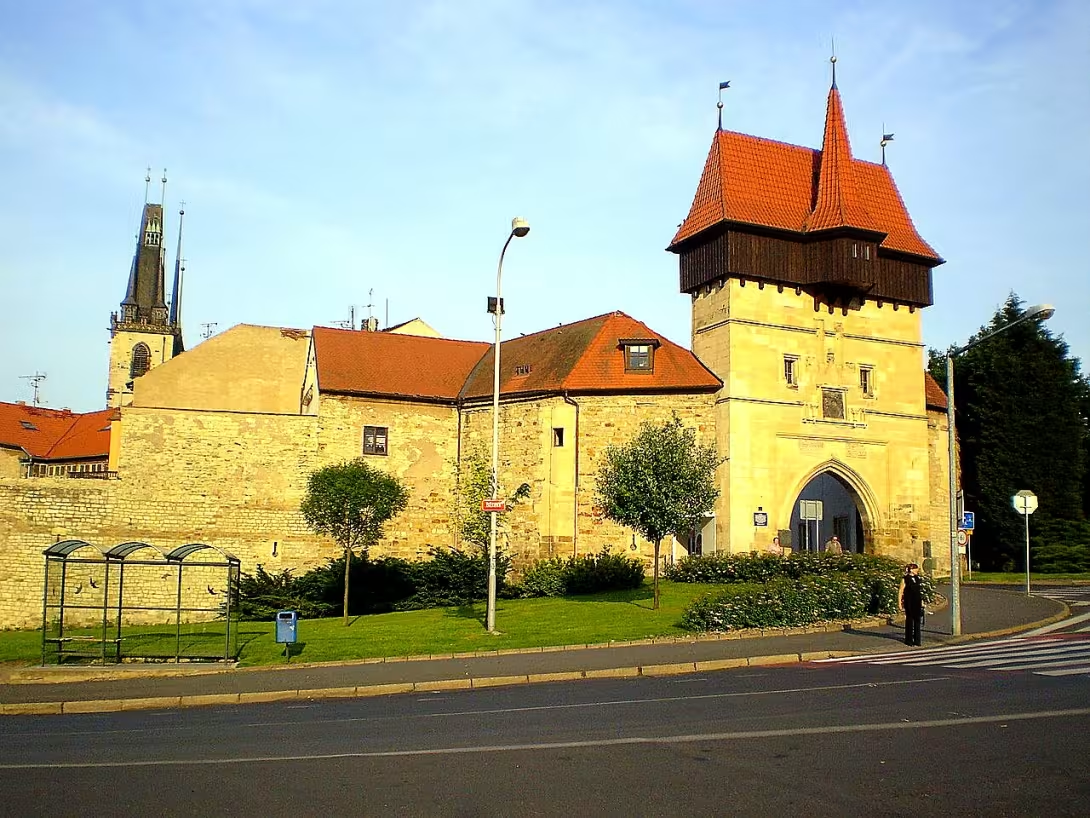
The town fortification in Louny is a fascinating historical monument, which represents the dominant part of the medieval defence system of the city. Located in the village Louny and its most significant preserved part is the northern section of the walls, which dates from the turn of the 15th and 16th centuries. This monument is remarkable for its historical significance and architectural value.
The creation of the city fortifications was linked to the gradual establishment of Louns sometime after the mid-13th century. The first written mention of the walls appears in the Charter of John of Luxembourg of 1317, when the king forgave the city the payment of the earring for six years for repairs of the walls. This document suggests that at least part of the fortifications have already been walled and equipped with moats. During the 15th century, the reconstruction of the walls took place in accordance with the general trend when the royal cities modernised their fortification systems during the Podebrad and Jagellonian times. After the fire in 1490 there was another reconstruction, which probably led to the formation of the third wall belt.
The architecture of the city fortifications of Louns went through several phases. During the 15th century a park wall with a moat was gradually built, which surrounded the whole city. This reconstruction included the construction of new baskets and digging ditches, as documented in city accounts between 1451- 1471. After the fire in 1490, the castle structure was further modernised, which probably included the creation of a third belt of walls. An interesting feature is the preservation of two baskets: the Boundary Bastion for No. 387 and the Bastion for No. 136, which shows the historical development of the Fortification System.
Owning and managing city fortifications has been associated with a number of important personalities. Jan Lucemburský, Karel IV., Václav IV. and Ludvík Jagellonský provided privileges for repairs of walls. After the fire in 1517, which destroyed the city, the castles were reconstructed again, indicating their strategic and economic importance.
Key events in the development of fortifications included not only repairs and reconstruction, but also changes in the urban industry and trade. For example, the Žatecká gate was built in 1500 and its barbadian was preserved as the only one of the two gates. The internal Prague Gate, described by Martin Rakovsky, had two towers and a passage between them.
Today, parts of the city fortifications Loun are well preserved, especially the northern section of the walls. Although a large part of the walls were torn down and the trenches were buried in the 19th century, there are still elements that testify to the rich history of the city. Exploring these monuments offers visitors a view of the past and an understanding of the importance of defence structures in the life of the medieval city. The town fortification Louns is therefore not only a historical monument, but also an inspiration for those interested in the architecture and history of the region.
The important history of the city fortifications of Loun represents not only a defensive function, but also cultural and economic aspects of life in the past. Visiting these monuments offers a unique view of the history of the city and its population.
Historical milestones
- 1317
- Jan Lucemburský has forgave the city Louny for six years to pay for repairs of walls.
- 1500
- The inscription on the front of the Žatecká gate dates back to 1500.
Architectural development
The Louns castle system has undergone several phases of construction and reconstruction. During the 15th century a park wall with a moat was gradually built, which surrounded the whole city. After the fire in 1490, there was another reconstruction and probably a third wall belt.
Historical events
- 1317
- Jan Lucemburský has forgave the city Louny for six years to pay for repairs of walls.
- 1490
- The Great Fire in Louny led to another reconstruction of the walls.
- 1500
- The inscription on the front of the Žatecká gate dates back to 1500.
Points of interest
- The city fortification in Louny represents the dominant part of the medieval defence system of the city. - The most distinctive preserved part is the northern section of the walls, which dates from the turn of the 15th and 16th centuries. - The first written mention of the walls appears in the Charter of John of Luxembourg of 1317. - After the fire in 1490, there was another reconstruction which probably led to the creation of a third wall belt. - Preservation of two baskets: Boundary bastion for no. 387 and bastion for no. 136, testifies to the historical development of the fortification system.
Guide
Show guide text
This text was created by artificial intelligence and has not been editorially reviewed. It may contain inaccuracies.
Welcome to the Louns, a city that still carries a deep trace of its medieval past. Right now, you're facing one of the most important testimonies of the time, which is the city's fortification. Stop for a moment, take a breath and feel the atmosphere of this place. Before you, there are walls that have separated the safety of urban space from the unknown and danger of the outside world for centuries. What you see is not just a pile of stone, but a dominant part of a complex defense system to protect citizens, their property and trade routes. Imagine what this place looked like centuries ago, when the walls formed an impenetrable ring around the city and each gate was carefully guarded.
To understand why these walls are so important, we must go back very far in time. The first stones of this defense system were laid gradually after the town was founded, probably sometime after the mid-13th century. At that time, it was crucial for every prosperous city to have its own fortifications. The walls were not only military protection, but also a symbol of the city's status, power and autonomy. Louny has thus gradually built into a fortress that has been able to resist attacks and give refuge to its inhabitants. However, the history of this fortification was not static. The walls were not built once for all, but constantly adapted to new threats and changes in siege technology. That is why they have undergone several extensive reconstruction over the years, the most important of which took place in the 15th and 16th centuries.
Now please focus on what you see right in front of you. If you are in the northern part of the city, watch carefully the walls in this section. It is the most distinctive and most reliably preserved part of the entire fortification. This particular part comes from the turn of the 15th and 16th centuries and represents the peak of the then defensive thinking. Notice the power of these structures and perceive how dominant they have taken over the surrounding space. If you look at the facade of the Žatek Gate, look for a sign. It is this detail that gives us a clear answer to the question of when the gate was completed, because the inscription dates back exactly to the year of a thousand five hundred. It's fascinating to think that this inscription has survived centuries of history, war, and fires so that he can tell his story to you today.
When we think about the walls, we can't forget the people who were connected to them. The history of the Lounian fortification is closely linked to the most important personalities of Czech history. Let's stop at a thousand three hundred and seventeen. At this time, the name of John of Luxembourg appears in the lists. King Jan Lucemburský showed great interest in the Louns and understood that maintaining the walls was an extremely costly matter. That is why he forgave the city in a thousand and three hundred and seventeen the payment of the tax on the land for six years. The entire financial area was intended solely for repairs of walls. Imagine the relief the city felt when it could invest its resources in strengthening its security instead of sending it to the royal treasury.
The castle walls witnessed the presence of other great rulers. In their shadow there were events under the rule of Charles the fourth, which as a great builder and organizer perceived the strategic importance of cities in Czech countries. Also Václav the fourth or later Ludvík Jagellonský was connected to the fate of the city and its fortifications. Although we do not know the names of the particular architects who designed these walls, their work gives us deep respect. They were masters of their craft, who had to combine knowledge of materials with military tactics to create a system that could resist the test of time.
Now I want to impress you with one interesting thing that may not be visible at first sight, but gives the whole place a deeper dimension. The first written mention of the walls in the John Luxembourg Charter of the year three hundred and seventeen is a key moment for all historians. It's basically the birthday of the walls in the written records. It is fascinating that the financial relief for repairs has become our main proof of the existence of the fortifications at that time. This shows us that the walls were not just a static structure, but constantly required care, maintenance and a huge amount of human work. Every stone you see today was once brought, worked and carefully placed by people who believed that these walls were the only guarantee of their survival.
If you're looking at these remnants of the medieval system today, you might be wondering why the northern section has acted and why not the entire perimeter. The history of cities is often full of compromises. With the advancing time when the weapons have changed and the walls have ceased to be an inaccessible barrier, cities have gradually begun to dismantle their fortifications in order to gain space for development, new streets or to obtain building materials. However, the northern part remained a reminder of the time when the border between the city and the surrounding area was clearly defined and inpenetrable.
Feel now the silence that prevails around the walls and try to imagine the noise that used to be here before. The sound of the hooves of horses, the screams of the guards on the walls, the framing of commercial goods to the city and the closing of heavy gates when the sun sets. These walls were the border between two worlds. Inside he ruled the order of urban law, craft tradition and neighborly belonging. There was a wild country and uncertainty.
I hope this short journey over time has helped you see the city fortification in the Louns in a new light. It's not just architecture, it's materialized history that tells us about ambition, fear, courage and royal generosity. Take one last look at the details of the Žatek Gate and feel the power of the northern walls.
Now I invite you to explore the city again. Go through the surrounding alleys, look for more traces of the Middle Ages and be inspired by the Louns atmosphere. Perhaps in one of the other corners of the city you'll find other hidden details telling you stories about people who lived here centuries ago. Thank you for accompanying me with this short walk through the history of the Lounian fortification. I wish you a pleasant rest of the day and many new discoveries in our beautiful city. Goodbye.
Tips for visitors
The best times to visit are spring and autumn - pleasant temperatures, fewer crowds and beautiful soft light on the walls. What to take with you: comfortable shoes, bottle of water, umbrella or raincoat, city map or mobile with GPS and camera. Photography: The best views are from the south tower and along the west side of the wall, morning and late afternoon provide the most favourable light. Tips for families with children: take advantage of children's trails along the walls, short interactive exhibitions and relaxation zones, plan for walks of no longer than an hour to keep their attention.
Frequently asked questions
Can the monument be visited?
This is a structure in a public space that can usually be seen from outside free of charge. We have not verified that this particular one is freely accessible.
Where is the monument?
Location: Louny, Ústecký kraj. The map on this page shows the exact spot.
Why is the monument protected?
It is listed in the Central List of Cultural Monuments of the Czech Republic as a cultural monument (register no. 1000156025).
Businesses nearby
Do you run a restaurant, accommodation, shop, museum, rental, wellness or other visitor service near this monument? Show yourself directly to the people heading to it — this is how they will see you in the app and on the web:
Nearby
🏰 Historic sites (41)
- Mistr Jan Hus 0.2 km
- Galerie Benedikta Rejta 0.2 km
- Panna Maria 0.3 km
- Chmelniční kotva 0.5 km
- Kapitán Otakar Jaroš 1.4 km
- Zámek Lenešice 3.0 km
- Sloup se sochou sv. Václava 3.1 km
- Pomník Matveje Grigoroviče Kaširského 3.2 km
- Pomník obětem 1. a 2. světové války 3.2 km
- Pomník pochodu smrti 3.2 km
- Pamětní deska Augustina Schránila 3.3 km
- Archeologický skanzen Březno u Loun 3.4 km
- Památník vojákům Rudé armády 3.7 km
- Památník obětem světových válek 3.7 km
- Galerie Emila Juliše 3.8 km
- Památník obětem II. odboje 3.9 km
- Pomník obětem 1. světové války 5.0 km
- Památník vojákům Rudé armády 5.1 km
- Nový Hrad Jimlín 5.2 km
- Pomník letadla Ae-45 6.1 km
🍽️ Restaurants and dining (48)
- Merlot 0.0 km Žatecká 186 +420 415 653025 web
- Caffe Moak 0.1 km Na Valích 330
- Minigolf 0.1 km
- Pivnice u Karla 0.1 km
- DePresso 0.2 km Na Valích 348 +420 777 811 918 web
- Fragoloso 0.3 km
- Antalya 0.4 km +420776899096
- Johnny Pizza 0.4 km
- Bellagio 0.4 km
- U Žida 0.5 km
- Kebab4ypu 0.6 km
- U Brachy 0.8 km
- Gala 0.9 km
- Pivovarská restaurace Na Letňáku 1.1 km +420736400655 web
- Pohoda 1.4 km Rybalkova 2978 +420 739 285 179 web
- U Jíchů 1.4 km web
- Stop Cafe 1.8 km web
- Food Book 1.9 km
- Zichovec pivovar 1.9 km 5. května 2789 725 879 944 web
- Stop Cafe 2.3 km web
🏨 Accommodation (20)
- Merlot 0.0 km Žatecká 186 +420 415 653 025 web
- Union 0.1 km web
- Hotel Černý kůň 0.1 km +420 739 609 800 web
- Barokní Špitál 0.1 km
- Hudebka 0.2 km web
- U Radnice 0.2 km
- Caramell 0.3 km web
- U Daliborky 0.4 km web
- Zlatý Lev 0.4 km web
- Na Hradbách 0.4 km web
- Apartmány Rossa 0.5 km Pražská 78 +420 777 195 904 web
- Heller 1.0 km
- Alena 1.0 km
- Kasárna 1.7 km web
- Laura 1.8 km web
- Sklenik 5.6 km
- Sklenik 5.7 km
- Penzion Palma 6.5 km Mírové náměstí 62
- Koruna 7.2 km Masarykova 302
- Kemp Peruc 11.8 km
🚲 Rentals and sport (6)
- Kola Chrobák 0.9 km Hrnčířská 583
- Cyklistický stadion 1.2 km
- Kola Fiala 1.4 km Říční 1120
- Plavecký areál Postoloprty 6.8 km
- Pláž koupaliště Hřivčice 9.5 km
- Koupaliště 11.9 km
🥾 Hiking and nature (74)
- nám. Rudé armády 0.3 km
- Holánkovy sady 0.6 km
- Luna 1.4 km
- Mělce 2.0 km
- Riegrovy sady 2.0 km
- Park generála Fajtla 2.1 km
- Červený vrch 3.0 km
- Barokní brána 3.1 km
- Lenešický park 3.1 km
- Malý vrch 3.5 km
- Blšanský chlum 3.6 km
- Březenský vrch 4.1 km
- Velký vrch 4.2 km
- Hladový vrch 4.7 km
- Raná 5.8 km
- Oblík 6.1 km
- Srdov 7.0 km
- Brník 7.3 km
- Údolí Hasiny u Lipence 8.1 km
- Křižák 8.3 km
Accommodation nearby
Themed route
1. Entry Gate (Entry) - Place of start of tour and orientation on the premises. 2. Walls (Walk) - Walk on the walls offers a unique view of the architecture of the city. 3. Watchtower - The tower output allows you to observe the extent of the entire fortification. 4. Internal exposition (Exhibition) - Information space with details about the history and construction of the walls.
Seasonal recommendations
Spring: In the spring of the town fortification in Louny offers visitors an unforgettable view of flowering shrubs and trees that celebrate the arrival of heat. The sunny morning amplifies the colour of the region and provides ideal conditions for photography. Although this is a period of initial revival, the visit may still be slightly influenced by flower markets and other actions, so it is recommended to adopt earlier afternoon time. For convenience it is advisable to wear light clothes with the possibility to add a layer for a cooler morning.
Summer: Summer in Louny offers the main summer season when the days are long and sunny. The city fortification becomes a popular place for recreational activities, especially in the case of events or market days, which increases the number of visitors. Early arrival is crucial to avoiding the crowd and full of sunlight. A wet summer requires light, distant clothes and plenty of drinking water. It is advisable to wear a UV protective patch.
Autumn: The autumn atmosphere of urban fortification is characterized by rich colours of leaves and mild heat, making this time ideal for relaxation in calmer conditions. Less visitors means shorter queues when entering and better options for photo without disturbing background. It is recommended to wear layered clothes because the temperature during the day can still be pleasant while the evening is colder. The beautiful autumn sun offers ideal conditions for a view of the fortifications.
Winter: Winter visit to the city fortification in Louny offers a unique view when walls and adjacent buildings are covered with snow. The atmosphere is calmer, which allows a more intimate experience from the visitor. Hot clothing with moisture protection is essential for the comfort of visiting. Winter dawn may be particularly beautiful, but it also requires additional caution due to the inclination and potential snow conditions.
Visualizations and artistic views


The visualisations are generated by artificial intelligence and serve as inspiration.
Photos from the area
Real photos taken near the monument

Zdroj a licence jsou uvedeny u každého snímku.
Tips from visitors
No tips yet. Be the first!
Log in and add your tip.
Sources and literature
Photos: Horakvlado / CC BY-SA 3.0 — Wikimedia Commons. The author and licence also appear when you hover over the image.
Faktickým podkladem tohoto textu byl článek na Wikipedii, jehož autory jsou přispěvatelé Wikipedie. Článek je dostupný pod licencí CC BY-SA 4.0.
Location on the map


Příběhy a pověsti
Legendy, pověsti a příběhy spjaté s touto památkou
Fotografie návštěvníků
Zatím žádné fotografie. Buďte první, kdo přidá fotografii z návštěvy!
Log in a přidejte svou fotografii nebo hodnoťte.
Za ověřenou návštěvu v aplikaci získáte víc bodů — poznáme podle GPS, že jste na místě.
Reviews and comments