






Městské opevnění v Broumově Town walls
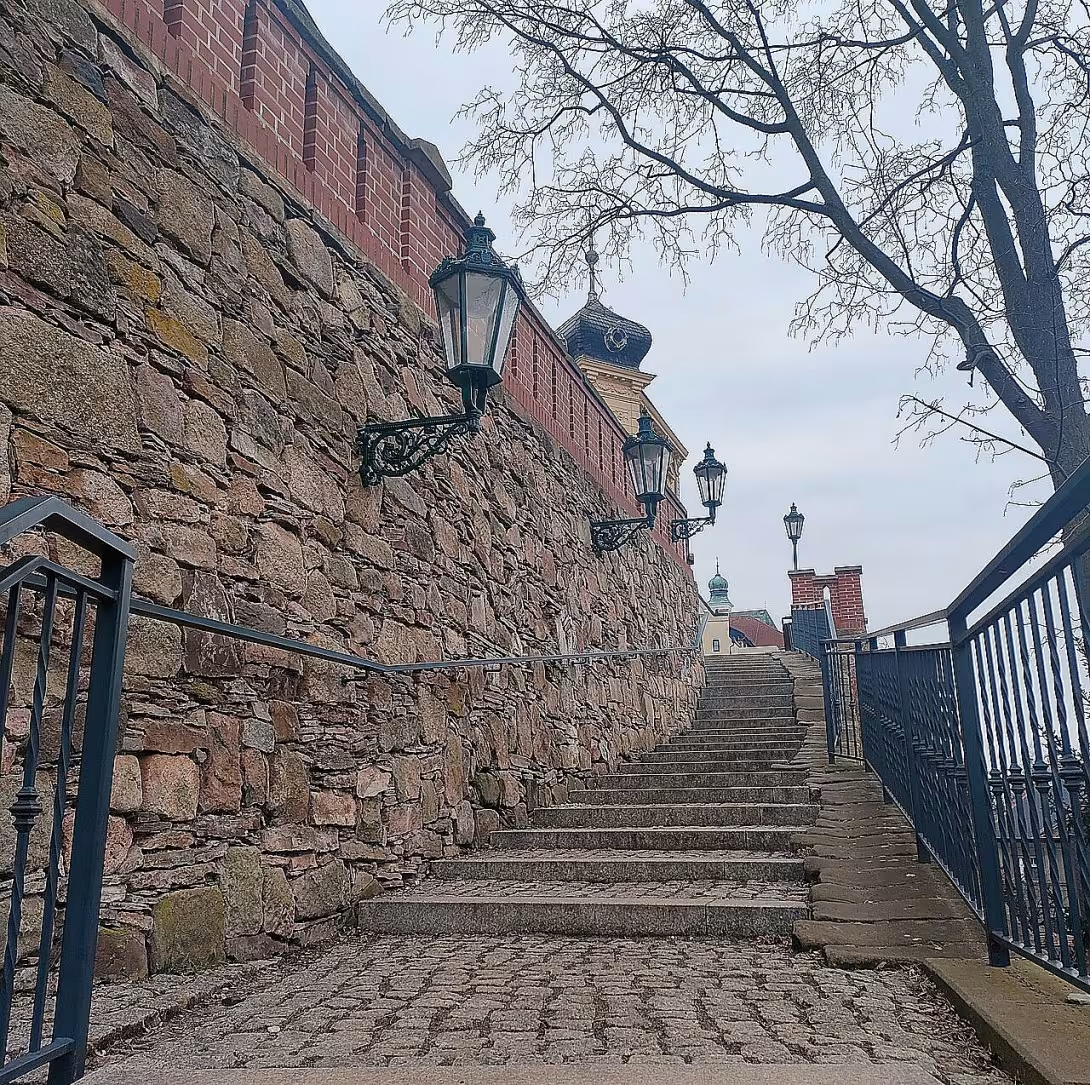
Městské opevnění v Broumově is a remarkable monument representing a torsovian remnant of medieval and partly early Baroque fortification of the city and adjacent monastery. It is located on the island above the right bank of the river Zonava, where the historical core of the city is a medieval floor plan of the Silesian type, defined by the walls. This building is protected as a cultural monument and falls within the City Monument Zone Broumov, which increases its historical importance and contribution to the conservation of local culture.
The emergence of fortifications is closely linked to the development of the city and the need for its defence. Broumov was founded as a subordinate colonization city which evolved into a full centre during the 14th century. The key moment was 1348, when Karel IV. extended the right of the castle abbot Broumov, thereby allowing fortification to be built. This phase of the construction took place mainly from the second half of the 14th century and was essential for protecting against Hussite invasions, leading to continuous strengthening of the walls until the 1920s.
The architecture of the fortifications is characteristic of the medieval and early Baroque periods and shows significant Gothic elements. The walls were gradually amplified by artificial landscapes such as parks and neck moats. Four forts have been created; on the west side stands the church gate with a tower and in the east the spa gate with its prism towers. In the first half of the 16th century, the Barbadian of the Upper Gate was built, suggesting constant efforts to strengthen the city's defence capabilities.
Various actors have been involved in the ownership and administration of fortifications over the years, with the Broum monastery playing a key role. The monastery authorities often became in dispute with townspeople about the construction of walls, which led to the issuing of prohibitions and subsequent agreements. In the 18th and 19th centuries, the gates were phased out and the remaining parts of the fortification were modified to facilitate operation within the city.
Key events include extinction Lower gate in 1826 and Upper gate around 1880. At the same time, the spa fortress was adapted to the view with a parapet, making it a popular place for visitors. A significant change for fortification was also its gradual demolition and adaptation to the modern needs of the city.
Today, the fortress in Broumov is protected as a cultural monument, allowing visitors to explore its historical roots. Although many parts no longer exist, preserved segments of walls and significant structures such as the Spa Fortna represent a valuable view of the past. These objects offer a unique insight into the history of the city and its defence strategies, making Broumov an ideal goal for lovers of history and architecture.
Městské opevnění v Broumově is not only a monument to the past, but also a witness to the changes that the city was subject to. It allows future generations to appreciate the rich history and cultural heritage of this region. Visiting these places offers not only an educational experience, but also an opportunity to explore the beauty and historical value of Broumova.
Historical milestones
- 1958
- Parts of the preserved fortification were registered as a cultural monument.
- 1826
- The Lower Gate has disappeared.
- 1880
- The Upper Gate has disappeared.
- 1885
- The spa fort was adjusted for a view with a parapet.
Architectural development
The construction took place mainly from the 2nd half of the 14th century, the walls were continuously reinforced until the 1920s due to Hussite intrusions. There were artificial landscaping, parks, neck ditches, fortns and in the first half of the 16th century also barbacan Upper Gate. Later, a new belt of fortifications with ground and prismatic bastions was built, while in the 18th and 19th centuries, the gates were gradually demolished and the remaining parts were modified.
Historical events
1348: Karel IV. extended the law of the wall; 1357: Complaint of the monastery superintendent leading to building bans; 1826: The demise of the Lower Gate; 1880: The demise of the Upper Gate.
Owners
City of Broumov and Broum monastery
Points of interest
- The fortification represents the remains of the medieval and partly early Baroque fortification of the city and the adjacent monastery. - In 1348 Karel IV. extended the right of walls to the Abbot Broumov, which allowed fortification to be built. - The walls were amplified by artificial landscapes such as parks and neck ditches. - There were four forts, including a church gate with a tower in the west and a spa gate with a prism tower in the east. - The spa Fortna was adjusted for a view with a parapet, making it a popular place for visitors.
Guide
Show guide text
This text was created by artificial intelligence and has not been editorially reviewed. It may contain inaccuracies.
Welcome to Broumov. You are standing right in front of the torsion remnants of the city fortification, which form the historic corral of the ancient centre. Let me guide you through the history and secrets of these ancient walls, which have protected the city and the nearby monastery for centuries. Now raise your head and look around you. The historical core of Broumova lies on the natural edge above the right bank of the river Zonava and before you is a medieval plan of the so-called Silesian type, which is still defined by these massive, even partially preserved walls.
Let's go back together in time to when these walls began to write their story. The creation and development of fortifications are closely linked to the blooming of the entire region. The key moment occurred in 13300 forty eight, when the Czech king Charles the Fourth extended the right of the walls of the abbot in Broumov. It was this royal decision that allowed the construction of large-scale fortifications. The original medieval defense system was gradually supplemented and modified, partly in the early Baroque period. The city was not only entrusted with the wall itself, but with the whole building complex. In the past, two main gates led to the city, namely the Upper and Lower gates, which were supplemented by several smaller fortens and also bastions.
Now pay attention to the architecture itself and the details you have right in front of you. The walls you are looking at represent an important reminder of the defensive construction of the past centuries. Notice how these stone structures were protected and amplified. The builders did not only use the wall height itself, but also helped themselves with artificial landscaping. In order to strengthen the defensive function, the parks and deep neck moats were also used to make access to the walls difficult for the enemy. Although only the torsion part of the whole system has been preserved until today, the monument still carries a strong genius loci and speaks of the strategic importance of Broumova.
Important historical figures are associated with this place. The already mentioned King Charles the Fourth, with his decision, has essentially signed under the form and security of the city. Later, in the nineteenth century, Karel Wischin also intervened in the fates of the fortifications. In fact, the second half of the nineteenth century brought about major changes that led to the demise of the original gates. In the year eighteen hundred twenty-six, the Lower Gate finally died, and more than half a century later, in the year eighteen hundred and eighty, it was followed by the Upper Gate, which changed the form of the city forever.
But the walls here have found new applications after their military decommissioning. A beautiful example is the year eighteen hundred and eighty-five, when the so-called Spa Fortna was sensitively adapted to the prospect of a parapet. This place thus began to serve people to walk and admire the surrounding countryside instead of reflecting enemy attacks. The fact that these ancient walls are of incalculable value also shows that already in nineteen hundred and fifty-eight parts of the preserved fortification were officially listed on the list of cultural monuments of the Czech Republic.
In conclusion, I would like to invite you to further explore Broumov. Go along the walls, see the atmosphere of a place where medieval Gothic meets with baroque influences, and let yourself breathe history tightened in stone. Thank you for your attention, I believe you enjoy the tour of the city, and I bid you farewell.
Tips for visitors
A tour of the Broum city fortifications is best enjoyed in the morning, when the morning sun illuminates the historic walls and there is a quiet atmosphere in the streets. We recommend to set off in spring or autumn when the surrounding landscape of Broumov is coloured in impressive tones.
The city Broumov is easily accessible by car and public transport; Check the current connection in the search engine. For parking use the reserved parking lot within walking distance of the historical core, from which you can easily reach the walls on foot.
Take a walk along the torsovian remains of medieval and early baroque fortifications with you comfortable shoes suitable for walking on uneven surfaces in the historical centre and clothing matching the current weather.
For photography lovers, the best pictures offer a view of the walls from elevated places above the right bank of the river Zonava, where the island excels in its whole beauty, especially in late afternoon lighting.
In the immediate vicinity of the monument you can visit the magnificent Broumov monastery, explore the City Monument Zone Broumov or discover the natural beauty along the river Wall and the surrounding landscape of the Broumov corner.
Businesses nearby
Do you run a restaurant, accommodation, shop, museum, rental, wellness or other visitor service near this monument? Show yourself directly to the people heading to it — this is how they will see you in the app and on the web:
Nearby
Broumov Monastery, City Monument Zone Broumov, River Wall, surrounding landscape of Broumov excerpt.
Accommodation nearby
Themed route
Designed cruise route in Broumov and its nearest surroundings:
1.Městské opevnění v Broumově (walls) Type: Historical monument Why is it worth a visit: Historical walls form the backbone of the entire main goal and define the ancient character of the city. Walk along these defensive elements offers a unique view of the medieval construction history of Broumova.
2. City Monument Zone Broumov Type: Historical zone Why is it worth a visit: It is located in the immediate vicinity of the city fortifications and offers a coherent whole of historical buildings. You can admire the unique atmosphere of ancient alleys and townhouse.
3. Broumov monastery Type: Monastic complex Why is it worth a visit: Located in the heart of the city near the walls and represents a monumental baroque gem. Its extensive complex and adjacent areas complete the total spiritual and cultural character of Broumova.
4. The River Wall Type: Water flow Why is it worth a visit: It flows around the city and forms a natural axis of the local landscape. Its shores provide a peaceful environment for relaxation and perception of the surrounding nature of the Broumov Corner.
5. Ambient landscape of Broumov excavation Type: Natural landscape Why is it worth a visit: Surrounded the whole city and offers typical picturesque scenery of the region. The whole area links urban monuments with open natural space.
Seasonal recommendations
Spring brings awakening nature, where the surrounding greenery under ancient stone walls play all shades of fresh color and the sun's rays pleasantly warm the walking routes. The atmosphere is quiet and ideal for quiet contemplation over the history of Broumova. During this period you will not meet crowds of tourists, which allows you to enjoy the prospect in complete privacy. Comfortable walking shoes and a light windbreaker will be sufficient to go around the walls, as spring weather is usually variable and the afternoon wind in elevated places can cool. The best time to visit is the morning hours when the city is still alive and the morning fog slowly rises over the Broumov boiler.
Summer reveals the city's fortification in full force, accompanied by long sunny days and sharp midday light, which creates dramatic shadows on the historical wall. Nature is lush and trees provide welcome shade in some parts of the route. The main season brings with it a higher attendance rate, so it is worth getting up and going first thing in the morning to avoid the biggest crowds and afternoon heat. Choose breathable clothes, headgear and don't forget enough fluids, because climbing the walls can be more physically demanding on warm days. The evening hours just before sunset then offer a unique romantic atmosphere and golden lighting ideal for photography.
Autumn transforms Broumov into a painting canvas full of warm tones of red, yellow and brown colors that contradict the dark stone of the walls beautifully. The atmosphere is melancholy, quiet and encourages slow walks associated with watching falling leaves. Visitors here at this time almost on the Italian terrace or near the bastion rarely hit, which guarantees maximum peace. The practical site requires layered clothes, fixed waterproof shoes due to fallen and occasionally wet leaves and waterproof jacket in case of autumn showers. The ideal time for a visit is the late morning, when the morning twinkle has fallen and the sun can still warm.
Winter covers the Broum monuments in silence and often also in the snow cover, which gives fortification quite the character of a fairytale fortress. The lighting is muted and the days are very short, which amplifies the mysterious historical atmosphere of old times. In Advent time, the wider city centre is revived, but the walls themselves remain an oasis of peace without tourist crowds. The key to successful inspection is quality winter clothes, hats, gloves and mainly solid shoes with anti-slip soles, because historic stone surfaces and stairs can freeze. The best time to visit is around noon, when the lights are the most and temperatures reach their daily maximum.
Visualizations and artistic views

The visualisations are generated by artificial intelligence and serve as inspiration.
Photos from the area
Real photos taken near the monument


Zdroj a licence jsou uvedeny u každého snímku.
Tips from visitors
No tips yet. Be the first!
Log in and add your tip.
Sources and literature
Fotografie: Palickap / CC BY-SA 4.0 — Wikimedia Commons. The author and licence also appear when you hover over the image.
Faktickým podkladem tohoto textu byl článek na Wikipedii, jehož autory jsou přispěvatelé Wikipedie. Článek je dostupný pod licencí CC BY-SA 4.0.
Location on the map


Příběhy a pověsti
Legendy, pověsti a příběhy spjaté s touto památkou
Fotografie návštěvníků
Zatím žádné fotografie. Buďte první, kdo přidá fotografii z návštěvy!
Přihlaste se a přidejte svou fotografii nebo hodnoťte.
Za ověřenou návštěvu v aplikaci získáte víc bodů — poznáme podle GPS, že jste na místě.
Reviews and comments