






milník v Přední Lhotě Other
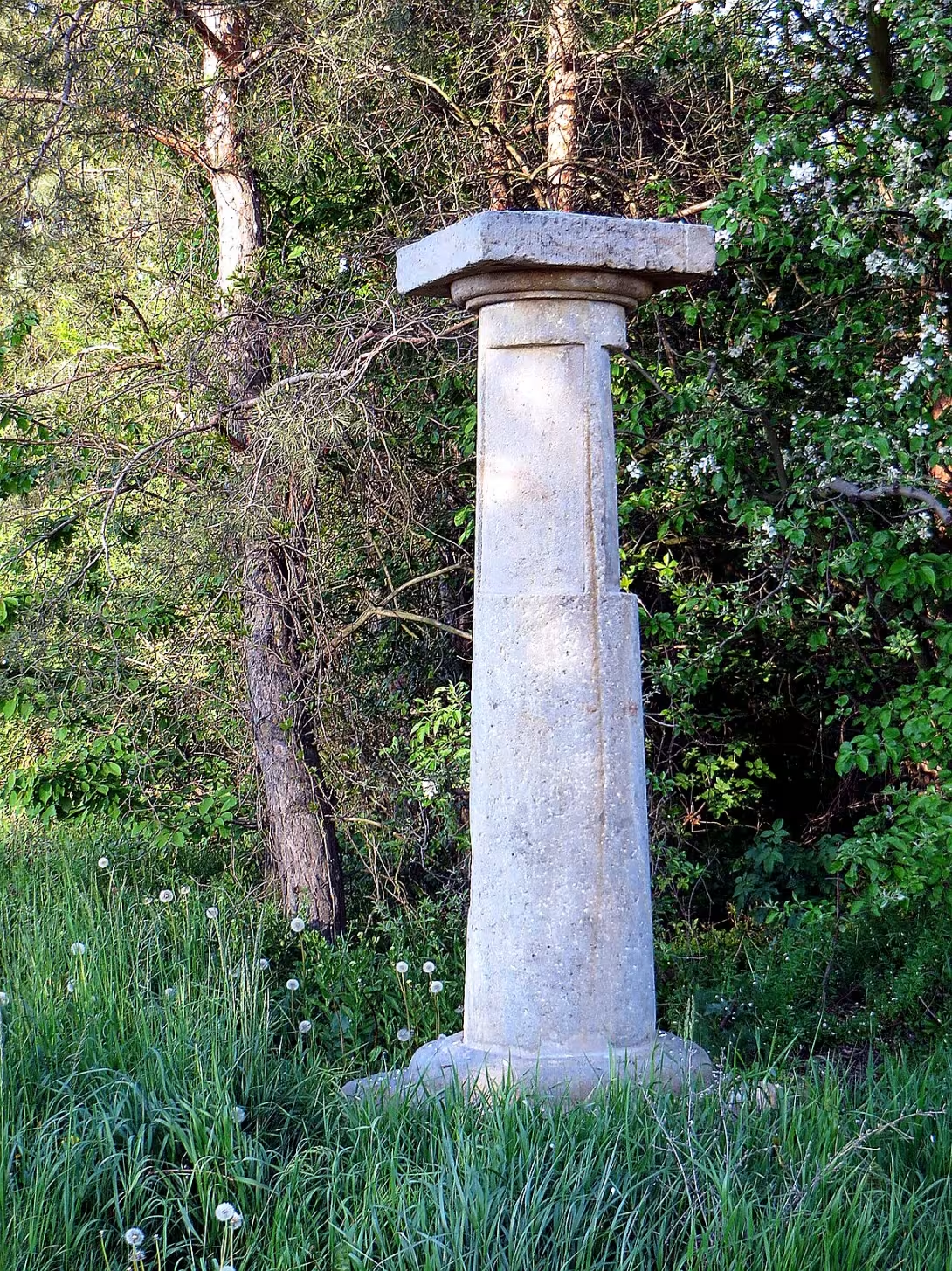
The historical milník v Přední Lhotě near Poděbrad is a 19th-century sandstone column that served as a distance meter and a crossroads on the former imperial road. This technical monument from the period of historism has enjoyed monument protection since 1965. The building stands by the road II / 329 at the turn to Pečky and represents a documented example of the then traffic signs.
The monument is located in Poděbrady in the local part of Front Lhota. The building was built in the 19th century when the imperial road was built from Prague to Hradec Králové, also called Kladská. The road also led through the bridge in Poděbrady. At the same time, extensive modernization of the road network took place in Czech countries in order to improve transport and trade quality. The construction of imperial roads was a key infrastructure project of the Habsburg monarchy.
The construction takes the form of a monolithic conical sandstone column with a circular base and a small square stone head. The object reaches a height of about three meters. On the one hand, two rectangular surfaces have been cut down to indicate directions to the nearest cities.
Milestones lined the imperial road at a distance of one Austrian mile, corresponding to approximately 7.5 kilometers. In addition to measuring distance, the construction also performed the function of the crossroads; the directions were marked in its upper half. The historical context of the monument is the mentioned imperial road or Kladská road.
In 1965 this milestone became a protected cultural monument.
Today, this technical monument is freely accessible by road II / 329 near the turn to Pečky in Front Lhota. The visit to the building offers a view of the preserved form of historical marking within the transport infrastructure of the 19th century.
Historical milestones
- 1805
- Construction of the Kladská Road
- Around 1850
- Position of sandstone milestone in Front Lhota
- 1965
- Classification of the milestone under the protection of cultural heritage
Architectural development
The milestone is made as a monolithic conical sandstone pillar with a circular foot and a small stone square head. On one side it has two rectangular surfaces to indicate directions.
Points of interest
- Historical milník v Přední Lhotě is a 19th-century sandstone pillar that served as a distance meter and a crossroads on the imperial road. - This technical monument from the period of historical history has enjoyed monument protection since 1965. - The construction takes the form of a monolithic conical sandstone column with a circular base, a small square stone head and reaches a height of about three meters. - Milestones lined the imperial road at a distance of one Austrian mile, which is approximately 7.5 kilometers.
Guide
Show guide text
This text was created by artificial intelligence and has not been editorially reviewed. It may contain inaccuracies.
Welcome to Front Lhota, the quiet part of Poděbrad, where time stopped. Stop for a moment, take a deep breath and look straight ahead. What you see may appear at first glance to you as an ordinary stone by the road, but in fact you stand before the fascinating witness of a forgotten era. In front of you is a historic milestone, a silent guardian of the old ways, and a storyteller of stories about thousands of pilgrims, merchants and travel companies that once passed through here. Feel his presence in the landscape and imagine what role he played in people's lives centuries ago.
To understand why this stone is so significant, we must return to the nineteenth century in our minds. Let's move back in time to 1805. At that time, it began with an ambitious project to build the so-called imperial road to connect Prague to Hradec Králový. This strategic route was known as the Kladská Way. At a time when there were no maps in the phones, no signs of traffic or navigation, there was a road of the artery of the empire. To travel at that time was to suffer from dust, mud and most of all uncertainty about distance. This is why these milestones were distributed at regular intervals. The one you are standing with was placed in the region of Poděbrady, specifically here in Front Lhota, around 1850. Imagine the excitement that existed at the time, the sound of the hoof of of horses falling on a hard surface and the hurtling of the wheels of cars that stopped at this very column to see how far they still had to go.
Now pay attention to the very form of this object. Take a closer look at its shape and material. You're standing in front of a monolithic conical column, which means this entire object was carved from one single piece of stone. It is made of sandstone, material that is closely linked to our Czech landscapes, but it also has a certain nobility and durability. Note how the column gradually narrows upwards, giving it both stability and elegant appearance. Look down, to the ground where you see a circular heel that serves as a base and holds the entire structure firmly in the soil. This simple but functional shape is typical of technical constructions of the time.
If you look at the top half of the column, try to imagine what it looked like at the time of its greatest glory. The milestone was not only used as a distance meter, but also operated as a crossroads. At the top were engraved data and directions to the nearest cities. For the time travelers, it was crucial information that gave them a sense of security and orientation in space. Today, some of these inscriptions may not be so easy to read, but they encode the history of communication in our region. Feel the texture of sandstone under your fingers if the surroundings allow you to, and feel the cold of the stone that has survived generations, wars and regime changes.
Although we do not know the names of the particular architects or craftsmen who carved and built this column, their work gives us respect. They were people who understood material and knew they were creating something to serve the public for decades. It is fascinating to think that this milestone was part of a wider transport management system within the Empire. Each such stone was as part of a puzzle that combined the image of the then state, its ambitions and efforts to modernize. Even though we are driving on Road II / 329 today at the turn of the Pike in cars and we perceive distances in minutes, this column reminds us of the time when the distance was measured by steps, miles and horse fatigue.
You may find one interesting thing that makes this milestone more than just an old stone. This building is an example of a style called historism, which sought to build on traditions and proven forms of the past. It's a technical monument that has its own dignity. Thanks to its uniqueness and historical value, milník v Přední Lhotě was included in the protection of cultural heritage in 1965. This means that the state has acknowledged that this sandstone column is an important part of our identity and that it deserves to be preserved for future generations. It is a strange paradox that the thing that was originally created for a purely practical purpose has become an artistic and historical object over time that will stop us today on our hasty day.
Now try to close your eyes for a moment and forget the noise of modern transport. Imagine you're a passenger in 1860. You're tired, your clothes are covered with dust from the road from Prague, and right now you see this conical column in the distance. For you, it is not only a monument, but a signal that you are close to Poděbrad, that your journey continues in the right direction and that the targets are already within reach. That feeling of relief that people at the time felt when looking at the milestone is the real soul of this place.
This sandstone guard by the road reminds us that even the smallest things can have profound meaning if we know their story. The Milestone in Front Lhota is not just a piece of stone, it is a symbol of connection, movement and human effort to overcome distances. He's a silent witness to how our landscape was changing, how old cars were disappearing and new machines were coming, but how some values like orientation and direction remain the same.
Now that you know the story of this fascinating object, I suggest you take a closer look. Notice how light is reflected from the sandstone surface and how naturally this pillar fits into the surrounding landscape. It's a place where technology meets art and history still breathes.
Thank you for letting me accompany you on this short journey in time. I hope this meeting with the imperial road of Kladsky enriched you and that you will perceive the surrounding landscape with new curiosity. Now, let's invite you to further explore the surroundings of Podebrad and their hidden treasures. Let yourself be guided by curiosity and discover details that others overlook. I wish you a pleasant continuation of your journey and a beautiful day spent in our region. Goodbye.
Tips for visitors
The best time to visit the historic milestone in Front Lhota is during spring or autumn months, when the surrounding nature offers a pleasant climate for a short stop without crowds of tourists.
For transport, select a car or bike, because the monument is on the side of the road II / 329 at the turn to Pečky. The location is available by car and by public transport; Check the current connection in the search engine. Parking is possible in the immediate vicinity of the road.
Take with you especially comfortable shoes to move in the surrounding terrain and camera, as this 19th-century stone monument from the period of building the imperial road offers an interesting detail to document.
For photography we recommend to use the morning or afternoon light, which will nicely draw the structure of the old stone and inscriptions. You can get the best angle right from the side of the road with a turn to the Pike.
In the wider area, within 30 minutes visit Poděbrady itself, where there is an inundation bridge, which also led the historic Kladská route.
Tips for families with children: As the monument is located near a busy road, take care of the maximum safety of children and explain the basics of safe movement near road traffic.
Businesses nearby
Do you run a restaurant, accommodation, shop, museum, rental, wellness or other visitor service near this monument? Show yourself directly to the people heading to it — this is how they will see you in the app and on the web:
Nearby
There is an inundation bridge in Poděbrady, which also led the historic Kladská way.
Accommodation nearby
Trips and activities nearby
Guided tours, tickets and activities nearby from GetYourGuide
Affiliate link: if you buy from the partner, we may receive a commission. The price for you does not change.
Search tours and activities →Themed route
I propose a thematic cruise route focused on historical transport structures and attractions associated with the old transport service in Poděbrady.
1. Milnik in Front Lhote Type: Other Why is it worth a visit: This main objective is the historic milestone, which in the past served to orient passengers and measure distances on old paths.
Inundation bridge Type: Technical monument Why it is worth a visit: this important building was used to overcome the flood area and still reminds us of the sophisticated construction of the past centuries in Poděbrady.
3. Historical Kladská cesta Type: Historical route Why is it worth a visit: The route through which this important historical journey led enables visitors to perceive the former tourism and interconnections of regions around Poděbrad.
Seasonal recommendations
Spring brings awakening nature, where the surrounding green and the first flowers around the Elbe create a fresh background for the photography of this tiny historical object. The light is soft and pleasant for most of the day due to the low sun. During this period you will not meet crowds of tourists, so you will enjoy the tour in complete peace. A firmer shoe is suitable because the field roads can be wet and muddy after spring thaw, and a lighter windbreaker against a colder wind blowing from the river. The best time to visit is the morning hours, when the sun's rays are warm and the air is the purest.
Summer offers lush vegetation and long sunny days, when the monument completely blends with the surrounding summer landscape full of shade of old trees. The specific feature is strong noon light, which creates sharp shadows, so it is ideal to arrive early in the morning or vice versa in the evening when the atmosphere is most calm and idyllic. Due to the warm weather you will appreciate breathable clothes, headgear and plenty of drinking water, as you will not find refreshments in the immediate vicinity. The location is located on the side of the main tourist routes of the spa town, so you don't have to worry about the big crowds, yet on weekends you sometimes find cyclists passing.
Autumn turns the whole area into a colorful palette of shades of yellow, red and brown, which gives this historic place a melancholy and noble character. Common morning fog and low clouds create a mysterious atmosphere, ideal for lovers of chamber landscape photography. With colder weather and dripping days, it is necessary to choose waterproof shoes and a warm layer of clothing that can withstand moisture and wind. The visit is best planned for noon, when the fog usually spreads and daylight provides the best conditions for a detailed tour of the stone milestone.
Winter covers Poděbrady and its surroundings in silence and occasional snow sheets, which makes the ancient structure of the stone stand out in sharp contrast with white snow. The atmosphere is completely calm, disturbed only by the scourge of a nearby river and the crunching of snow beneath its feet. For practical reasons, it is necessary to wear a high-quality winter jacket, hat, gloves and fixed non-slip shoes, because the access routes are not regularly maintained. The days are very short, so plan to arrive early in the afternoon to catch daylight, as there is no artificial lighting in the vicinity of the monument.
Visualizations and artistic views

The visualisations are generated by artificial intelligence and serve as inspiration.
Photos from the area
Real photos taken near the monument


Zdroj a licence jsou uvedeny u každého snímku.
Tips from visitors
No tips yet. Be the first!
Log in and add your tip.
Sources and literature
Fotografie: Michal Louč / CC BY-SA 4.0 — Wikimedia Commons. The author and licence also appear when you hover over the image.
Faktickým podkladem tohoto textu byl článek na Wikipedii, jehož autory jsou přispěvatelé Wikipedie. Článek je dostupný pod licencí CC BY-SA 4.0.
Location on the map
More monuments – Poděbrady
Show all in the municipality
Příběhy a pověsti
Legendy, pověsti a příběhy spjaté s touto památkou

Fotografie návštěvníků
Zatím žádné fotografie. Buďte první, kdo přidá fotografii z návštěvy!
Přihlaste se a přidejte svou fotografii nebo hodnoťte.
Za ověřenou návštěvu v aplikaci získáte víc bodů — poznáme podle GPS, že jste na místě.
Reviews and comments