



Minice Hillfort
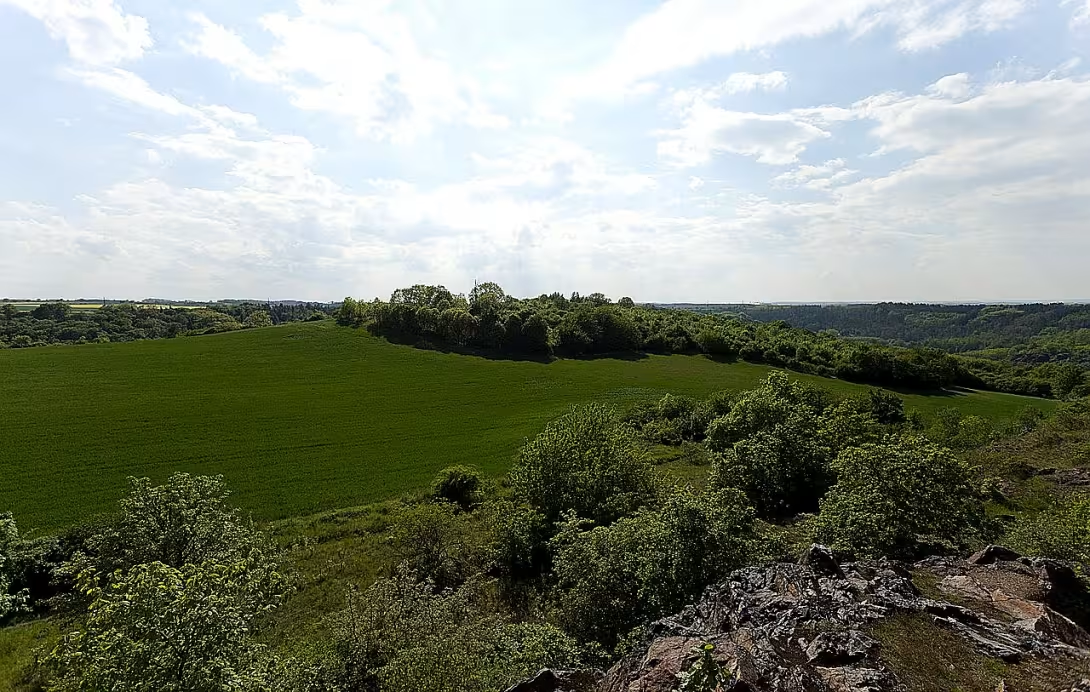
Minice is a prehistoric castle from the younger age of the Hallatians. It is located on the island above the confluence of Holubický and Zakolanský creek in the district of Mělík. It originated in the 6th century B.C. and probably served as a seat of the then elites and cult center. Today, the remains of this archaeological site are protected as a cultural monument of the Czech Republic.
The fort was established in the 6th century BC. At that time, in Europe, the culture of Hallatians dominated. This was characterised by the development of iron technologies and the creation of fortified centres. The social hierarchy was formed in the Czech Republic during this period.
The object had a tripartite. On the west side there was an acropolis of 40 × 40 meters. It was separated from the rest of the castle by a ditch 60 metres long, 3 metres deep and up to 6 metres wide. The north, west and south side of the acropolis was protected by a three-metre wide wall. It consisted of a pair of walls with a rock buried in it. The terrain of the northern part of the island hall has been artificially aligned. In the acropolis space there was a rectangular building with dimensions of 12 × 8 meters. It had stone tiles and clay-lined floors, surrounded by stone walls. Another building 6 × 3 meters was located on the north edge of the acropolis.
East of the acropolis lay the main fort with a surface of 200 × 50 meters. The accessible east side was protected by a three-metre-wide stone wall made of dry-laid shale fences based on bulging boulders. In front of it, a ditch was dug four metres wide and two metres deep. The south side protected a similar wall with an estimated height of three meters without a ditch. The steep slope below it was modified into three distinct terraces. The north side of the fort was not fortified.
North of the main castle, the front was spread over two hectares. There were lounges, storage holes and holes in the stakes. The northern and eastern sides of the prezonera defined more than two metres high. Its core is the natural vein of the doomsday. In the east, there could be another outpost and a settlement that lasted until the early Latin era.
The fort existed for approximately seventy years and it was still destroyed in the 6th century B.C. The probable cause of its demise was a fire.
In the 1970s and 1980s, archaeological research led by Miloslav Slabina took place. During it, several tens of thousands of findings were obtained, mainly fragments of ceramics and animal bone. Among the most important artifacts are the oldest ceramics in Bohemia made on the pottery ring, a three-razor bronze arrow, a necklace made of sea coral and a bronze pin. The artefacts of the culture of cord cups and utenistic cultures were found in the hubris, which was based on the inner side of the wall of the acropolis.
At the same time, the remains of this complex are declared a cultural monument of the Czech Republic.
This monument represents a unique insight into the social structure and technology of prehistoric times in Czech countries. Her visit allows a better understanding of the early settlement of the landscape around Kralup nad Vltavou.
Historical milestones
- 6th Century B.C.
- The beginning of the fort in the younger age of the Hallatians.
- 6th Century B.C.
- The destruction of the fort due to the fire.
- 1970-1989
- Archaeological research led by Miloslav Slabina.
Architectural development
The fort was made up of stone walls from dry laid shale fences and deep trenches. The acropolis was protected by double walls filled with stones. In the space there were half-grounds, storage spaces and rectangular buildings with stone tiles and clay floors.
Historical events
6th century b.c. - the formation of the fort during the younger period of the halštatians; 6th century bc - the demise of the fort probably due to fire.
Points of interest
- The fort probably served as the seat of the then elites and cult center. - It existed for about 70 years and probably died from a fire. - The acropolis was separated from the rest of the castle by a ditch up to six metres wide. - Among the findings are the oldest ceramics in the Czech Republic made on the pottery ring. - A three-point bronze arrow and a necklace from a sea coral was found here.
Guide
Show guide text
This text was created by artificial intelligence and has not been editorially reviewed. It may contain inaccuracies.
Welcome to the archaeological site Minice. You're standing in a place that's much more than just a pile of remains in the landscape. In front of you, there is a space that is interwoven with history that goes deep into the dark past. While you're looking around, try to shut up for a moment and listen to the surroundings. Feel the gentle breeze and perceive the water movement below in the valley. It is here, on this strategically located sharpness, that two streams of water meet, the Holubický and the Zakolanský brook. This water-course link was not random for the people at the time. It was the water, this most important element, that determined the place where people decided to settle, build and rule.
Imagine that we are now going back many centuries in time. We're not in the time we know about knights or kings in textbooks. We are in the sixth century ahead of our present sign, the era we call the younger age of the Hallatians. This was the time when the foundations of society were being formed in our countries, as we may even suspect it now. Minice was not just a common fortified mansion to protect against the enemy. From her remains and her findings, this place carried a much higher, more noble function. You're standing in a place that probably served as the seat of the elites back then. Imagine the people who were here deciding the fate of the entire families who held power and wealth. But it was not just a political point. Minice was also a cult center. This means that rituals were taking place here, victims were taking place, and people were looking for connections with the invisible, the gods, and the spiritual power of the country on which they are standing.
Now pay attention to the very structure of this place, although today its shapes are merely indicated in the field. If you look around the area, you can figure out in your mind how this castle was organized. Minice was not one large circle, but it had a complex, triangular range. This suggests a high level of engineering and a clear hierarchy. The highest, at the safest point, was the acropolis. It was the heart of the complex, the place of the highest power and probably the greatest sanctity. To make this acropolis truly impenetrable and separate from the rest of the world, it was surrounded by a deep and wide moat. Imagine that deep notch in the ground that was up to six meters wide. This moat was not only an obstacle, it was a symbolic and physical interface between the sacred and the common. Under the acropolis, the main castle was spread out, where probably the majority of the inhabitants lived and where daily life took place, and all this was added to the front line, which served as the first line of defense and space for first contact with the outside world.
Even though you see today only nature and remains of clay, knowledge of what happened here was not given to us by random people, but by patient researchers. Science about this place has become much clearer thanks to intensive archaeological research that took place in the 1970s to 1980s. It is thanks to the work of archaeologist Miloslav Slabina that we can speak with certainty today about what was here. He and his team were able to tell the story of the civilization that existed here from the unreadable chaos of the earth's layers. Thanks to their patient removal of layers by layer, because of each dug-up fragment, we understood that Minice was not just a random campsite, but a thought-out and firm point in the world back then.
And this is where we come to one of the greatest mysteries of this place. Think about how fragile life is. This castle, this centre of power and spiritual life, existed for about 70 years. For us, seventy years is a short time, but for the then society, it was an entire era, a generation of people who grew up here, built their houses and believed in their gods. And then, in a sudden moment, it was all over. Archaeological findings suggest that the fort was destroyed by a devastating fire. Imagine the scene - a fire that spread so fast that no one could save what was most important. Maybe it was a random unfortunate incident, maybe a result of conflict, but the result was the same. A place that was a symbol of stability and power became a dumpster.
Yet, even in this tragic end, there is something incredible. Even though the fire destroyed everything, it did not save what was hidden deep in the earth. The findings found here by archaeologists are one thing that fascinates us today. It is ceramics, which belongs to the oldest pieces found in the whole Czech Republic. If you look at today's world, ceramics may seem like a common thing to us, but for people back then, it was the peak of technology, art, and everyday needs. Every dish, every piece that was made here, tells a story about the hand of a craftsman, the furnace in which he burned himself, and the way people ate, drank and kept their treasures at that time. These tiny pieces of shrapnel are our only true witnesses at the time.
Now I want to invite you to continue this journey. Let the atmosphere of this place drift. Walk around the area and try to find places in your imagination where there could be lines of the moat, or where the acropolis could be found. Feel the silent presence of history that is still floating in every breath. Minice is not just a place for a quick tour, it is a place to think about how quickly things change and how deep traces of us can leave even a small fragment of the vessel.
I wish your walk to be full of discoveries, even if they do not only concern what you see with your eyes, but also what you feel in your mind. Thank you for choosing to visit this important place and devote your time to understanding our roots. Enjoy the rest of your trip in a beautiful landscape.
Tips for visitors
The best time to visit is the late afternoon when the sun shines on the island and highlights the archeological shapes of the terrain. Light at this time creates ideal conditions for photographing the findings and the overall appearance of the castle.
We recommend we plan our journey in advance.
take with you comfortable shoes suitable for uneven terrain and possibly repellent, because the proximity of the stream confluence can attract insects. For families with children, movement in this natural area is an interesting opportunity to explore the surroundings.
For the best photos try the views towards the confluence of the Holubický and Zakolansky brook. This location south of the village Minice offers interesting natural scenery to capture the atmosphere of the castle.
Frequently asked questions
Can the monument be visited?
This is an archaeological site. Often there is little to see on the ground and the land may be private. We have not verified access.
Where is the monument?
Location: Minice, Středočeský kraj. The map on this page shows the exact spot.
Why is the monument protected?
It is listed in the Central List of Cultural Monuments of the Czech Republic as a cultural monument (register no. 1000146587).
Businesses nearby
Do you run a restaurant, accommodation, shop, museum, rental, wellness or other visitor service near this monument? Show yourself directly to the people heading to it — this is how they will see you in the app and on the web:
Events nearby
Zdroj akcí: otevřená data měst a obcí ČR (Národní katalog otevřených dat) a kalendář akcí Národního památkového ústavu.
Nearby
The fort is located above the confluence of Holubický and Zakolanský creek south of the village Minice near Kralup nad Vltavou.
Accommodation nearby
Trips and activities nearby
Guided tours, tickets and activities nearby from GetYourGuide
Affiliate link: if you buy from the partner, we may receive a commission. The price for you does not change.
Search tours and activities →Themed route
1.Minice Type: Village Why: It serves as a starting point for traveling to archaeological monuments.
2. The fort Type: Archaeological site Why: The main destination of the trip, which represents an important place in this location.
3. The Holubic stream and the Zákolan stream Type: Water flows Why: Their confluence at the castle creates an interesting natural point in the surroundings.
Seasonal recommendations
Spring: Minice offers a unique atmosphere in spring, where newly grown green leaves and flowering shrubs become the background of archaeological ruins. The sun's rays illuminate the structures with a fine light, creating a romantic touch. At this time more tourists may appear due to pleasant weather and beautiful greenery, so we recommend visiting early in the morning or later in the day to avoid larger crowds. A good time to visit is the afternoon hour when the sun lights up the memory and the temperature is not too high. We recommend wearing comfortable shoes and clothes suitable for mild weather so that a visit can be better enjoyed.
Summer: In summer Minice is full of life thanks to warm days and long evenings. The sun illuminates archaeological sites in complete beauty, which may be an ideal time for photography. However, due to attractive weather, more visitors can gather here, especially in the main flying days. We recommend visiting early in the morning or in the shade of the afternoon sun to avoid the hottest hours while avoiding the larger crowds. Remember sun protection - you must not miss cream with a high protective factor, wide hats and light clothes.
Autumn: Minice in autumn offers a calmer atmosphere and a wonderful colour spectrum of leaves. Sunshine days bring warm light that illuminates archeological structures in soft colors. Due to the colder weather and beautiful radiance, this time is ideal for visiting when you can relax and enjoy the peace without overfilling the crowd. We recommend visiting the memorial during the afternoon until the evening when the temperature is most pleasant. Comfortable shoes and top clothes are important to protect against a cool wind.
Winter: In winter months, Minice offers a calm atmosphere where archaeological sites are covered with snow or wet leaves. Sunshine days illuminate structures in fine light and bright light, creating beautiful scenes. Less visitors may show up because of the cold and shorter opening time. The best time to visit is in the afternoon when the temperature is softer and the sunlight illuminates the memory. We recommend wearing warm clothes, including wide gloves, leather shoes and protective hat or cap against cool windshield.
Visualizations and artistic views


The visualisations are generated by artificial intelligence and serve as inspiration.
Photos from the area
Real photos taken near the monument

Zdroj a licence jsou uvedeny u každého snímku.
Tips from visitors
No tips yet. Be the first!
Log in and add your tip.
Sources and literature
Photos: CeStu / CC BY-SA 3.0 — Wikimedia Commons. The author and licence also appear when you hover over the image.
Faktickým podkladem tohoto textu byl článek na Wikipedii, jehož autory jsou přispěvatelé Wikipedie. Článek je dostupný pod licencí CC BY-SA 4.0.
Location on the map





Příběhy a pověsti
Legendy, pověsti a příběhy spjaté s touto památkou

Fotografie návštěvníků
Zatím žádné fotografie. Buďte první, kdo přidá fotografii z návštěvy!
Log in a přidejte svou fotografii nebo hodnoťte.
Za ověřenou návštěvu v aplikaci získáte víc bodů — poznáme podle GPS, že jste na místě.
Reviews and comments