






Mlíkárna Pavilion
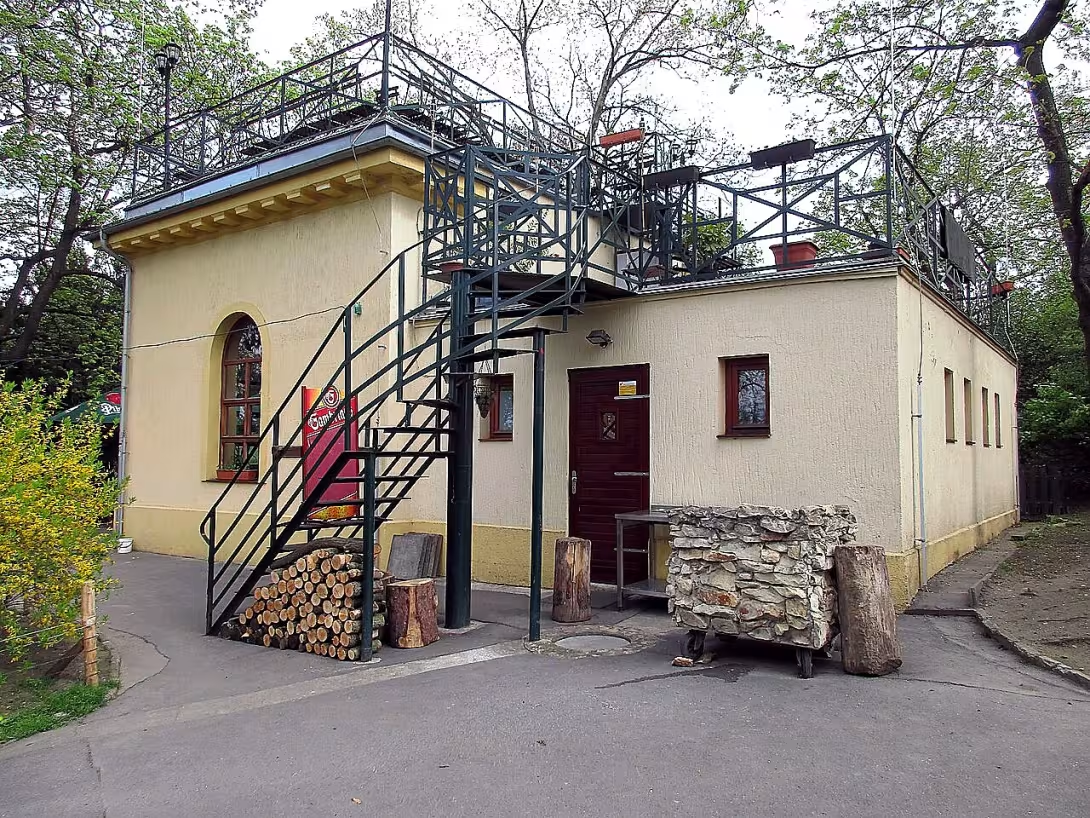
Mlíkárna, also known as the Outlook Pavilion Mlíkárna, is a lookout tower located in the centre of Rieger orchards in Prague's Vinohrady. The building boasts a late classical architecture and has a rich history dating back to the 1920s. It was created as part of the garden of Josef Emanuel Malabaily de Canal. Originally, there was a candy store offering dairy products from Baron Frey's University Dairy House, which reflected the cultural and economic trends at the time. After a long period of demise, the building was redeemed in 2002 by Jakub Vakoč. It has been renovated and since 2009 it has been operating a restaurant with an open observation platform.
The creation of the Milk factory is closely linked to the historical context of the beginning of the 19th century. Classicism prevailed in Europe and private gardens were developed in Prague for recreation of the upper classes of society. Josef Emanuel Malabaila de Canal, founder of the Canal Garden, was one of the pioneers of this trend. Mlíkárna became part of his visionary plan for Rieger sets. This lookout tower served not only as a resting place, but also as a cultural and social centre of the garden.
The architecture of the object is characteristic of the late classical style. The building with an external staircase of 29 degrees leading to the roof observation platform represents typical elements of this period. The reconstruction carried out by Jakub Vakoc in 2002 included connection to engineering networks and extension, which enabled the building to serve as a restaurant again. This reconstruction not only preserved the historical form of the construction but adapted it to modern needs.
The history of ownership and administration of the Milk House is marked by several key events. After the cessation of the activities of the pastry factory in 1956, the building was abandoned and gradually decayed until Jakub Vakoč saved it in 2002 by not purchasing it. His initiative and the conversion of the building to the restaurant gave Milk a new life and enabled it to recognise its historical importance again.
A key interest is the original name, which refers to the time when there was a cake shop with milk and yogurt products. This aspect highlights the cultural and economic history of the building associated with local traditions and industry. Despite the fact that grown trees today limit the view from the lookout tower, Mlíkárna remains a popular destination for visitors to the Rieger orchards.
Today Mlíkárna is freely accessible during the restaurant opening hours. People can use the gastronomic offer and historical views of the surrounding countryside. Although the panorama is limited, the building remains an important cultural monument and a testament to the architectural and social development of Prague in the 19th century.
Visiting the Milk House is an opportunity to explore its history and enjoy the peace in the middle of Rieger's orchards. This monument bears a rich cultural heritage and recalls the importance of private gardens as places of recreation and social gatherings in the past. It is a place worth visiting for anyone who is interested in the history of Prague or seeking peace in the heart of urban activity.
Historical milestones
- 1820
- the creation of a lookout tower in the 1920s
- 1956
- end of operation of the confectionery shop Mlíkárna
- 2002
- acquisition of the building Jakub Vakoč and start of reconstruction
- 2009
- opening as a restaurant and sightseeing pavilion
Architectural development
It is a walled late classicist building with 29 steps leading to the roof platform. In 2002 the reconstruction was carried out in the original form, connection to the networks and extension.
Historical events
Until 1956 it operated as a confectioner Mlíkárna; a change in ownership took place in 2002; the construction was reopened in 2009.
Owners
Josef Emanuel Malabaila de Canal (founder), Jakub Vakoč (since 2002)
Points of interest
- It originated in the 1920s as part of the garden of Josef Emanuel Malabaily de Canal. - Originally there was a bakery offering dairy products from Baron Frey's University Dairy. - The building represents late classical architecture and has an external staircase of 29 degrees. - After the end of the cake shop in 1956, the building was abandoned until it was redeemed in 2002 by Jakub Vakoč. The view from the observation tower is now limited because of the trees.
Guide
Show guide text
This text was created by artificial intelligence and has not been editorially reviewed. It may contain inaccuracies.
Welcome to the heart of Prague's Vinohrad, one of the most beautiful green spaces in our city. You're standing right in front of a building that is a completely irreplaceable symbol and an orientation point for Rieger sets. You may have seen her several times walking through the park, but only now, when you stop and pay full attention to her, you begin to perceive her true nature. In front of your eyes, Mlíkárna, a historical observation pavilion and a lookout tower that carries fragments of ancient elegance and stories of demise and rebirth. Feel the atmosphere of this place where the calm of the park is mixed with the history that took place here for two centuries. This building is not just an ordinary object in the landscape; It is a witness to the changes that all of Prague and its district have been going through.
Now let's go deeper into the past to understand why this building is standing right here. To understand its origins, we must return to the 1920s. At that time, there were no public parks as we know them today. This whole area was part of a private garden owned by Josef Emanuel Malabaila de Canal. It is within this garden, as part of its rich and carefully woven whole, that this view tower was built. Please imagine what this garden looked like 200 years ago, how it was arranged and how it served its owner as a place of rest and a context of the beauty of nature. Mlíkárna was then part of the private world, which was completely different from today's public space, where thousands of people now move freely.
Now pay attention to the very form of the building that surrounds you. If you look at her more carefully, you can see traces of late classical architecture in her lines. This style is characterized by its balance, harmony and efforts for certain clear and clear shapes, which are intended to act calmly and nobly. While time is changing relentlessly, this building has retained its elegance. Note above all one very specific detail that is right in front of you. Take a look at the outer stairwell that leads to the entrance. If you decide to get off after him, you'd have to get through exactly twenty-nine degrees. Each step is like a step in time that separates you from the ground and brings you closer to the view this building offers. Look at its facade and see how this architecture is compounded into the surrounding green environment. It is a building that does not act aggressively, but rather as a natural complement to the landscape, which has the task of offering a view of the surroundings while being an aesthetic element of the park itself.
However, in order to fully understand the importance of this place, we must ask in its name. Why is it called Mlíkárna? The story is fascinating and closely linked to the lifestyle and business at the time. At a certain time, it was not only as a view, but as a confectioner. It was a place where people could find refreshments and enjoy a little candy. Dairy products were a key element of this business. They did not come from an unknown source, but were supplied directly from the Highlands Dairy Company owned by baron Frey. Imagine the times when people used to come here to enjoy fresh dairy and enjoy the landscape. The character of Baron Frey and his business so directly influenced the way this place was written in people's memories. The site became a social hub, a meeting point, where gastronomy was combined with relaxation in nature.
But history is not always a linear rise in success. After a long period of bloom, the era of decline came. In the year fifty-six, the operation of the confectionery factory was closed and the building gradually lost its original shine. We should be aware of how fragile a monument can be if the human hand is not interested in it. Mlíkárna became an object of doom, gradually falling apart, and its beauty was forgotten under layers of time and ignorance. It was hard to imagine that this object would shine again.
And it is here that one of the most important characters appears in the modern history of this place. To bring Mlíkárna back to life, it needed someone who saw more than just an old abandoned structure in it. In the year two thousand and two, the object was acquired by Jakub Vakoc. That was a turning point. Thanks to his decision and the reconstruction that began, this historic gem survived from the abyss of oblivion. The recovery process was challenging, but it paid off. Since the year two thousand and nine, the restaurant and sightseeing pavilion have been working here again, thus closing the circle of history. The building has returned to its original function - it serves people, offers them rest and allows them to observe the world from a height.
The interesting thing that may surprise you is the transformation that the building went through. From a private garden of noble nobles, to a commercial bakery supplied with baronian milk, to a period of total extinction and subsequent modern renewal. It's a fascinating story about how society's needs change and how our perception of monuments changes. Mlíkárna is now a symbol that even what seems to be lost can be refound and reappreciated thanks to human efforts.
Now that you know the secrets and stories that lie within these walls, you can move on. You're standing in a place where history meets the present. You may decide to enter, take advantage of the restaurant offer or simply stop and enjoy the view this pavilion offers. Don't forget to look again at those twenty-nine degrees on your next walk through the park and realize how many generations have passed them. Thank you for spending this moment with us and for being interested in the history of this special place. We wish you a nice walk through the Rieger sets and many other experiences. Goodbye.
Tips for visitors
The best time to visit the Milk House is early afternoon when the sun lights up the surrounding gardens and creates ideal conditions for photography. This time also offers a quieter environment because many visitors visit the memory in the morning.
Parking can be found in the nearby streets of Vinohrady. For those who prefer public transport, Mlíkárna is well accessible by buses and trams from the centre of Prague. We recommend checking the current connection with an online search engine.
When visiting the Milk House, take a hat or parasol with you to protect you from sunlight. Good shoes are also useful for walking on garden paths. Don't forget the water and breakfast if you plan to spend the whole day in the area.
The best place for photography is right at the Milky House, where you can capture panoramic views of Rieger sets and Prague. The best light for photography is usually in the early afternoon or evening at the sunny west.
In the vicinity of the Milk House there are Rieger sets offering beautiful pavements and places for relaxation. For families with children, it is ideal to visit the playground in these gardens or walk on trips where children can run freely.
Businesses nearby
Do you run a restaurant, accommodation, shop, museum, rental, wellness or other visitor service near this monument? Show yourself directly to the people heading to it — this is how they will see you in the app and on the web:
Events nearby

Zdroj akcí: otevřená data měst a obcí ČR (Národní katalog otevřených dat) a kalendář akcí Národního památkového ústavu.
Nearby
Rieger sets, Prague 2
Accommodation nearby
Trips and activities nearby
Guided tours, tickets and activities nearby from GetYourGuide
Affiliate link: if you buy from the partner, we may receive a commission. The price for you does not change.
Search tours and activities →Themed route
1. Rieger sets, park, offers a pleasant environment for starting walks in nature. 2. Prague 2, the urban part, allows you to explore interesting parts of this territory. 3. Mlíkárna (lookout tower), lookout tower, main destination trip with exceptional architecture and beautiful view.
Seasonal recommendations
Spring brings awakening greenery and fresh air, which complements a clean view from the lookout tower. The atmosphere is full of hope and nature is beginning to flourish around the Milk House. We recommend to dress in layers because the morning cold can still be felt. It is best to visit the memory in the morning when the stream of visitors is still mild.
In the summer months, the surrounding area is dominated by dense trees and intense sunlight. The views are partially covered with leaves, but the overall atmosphere is playful and energetic. Due to high temperatures and high season, come as early as possible in the morning to avoid the biggest crowds. Don't forget light clothes and plenty of fluids.
Autumn with the arrival of golden colours of leaves and morning fog creates a melancholy and romantic mood. Lighting is softer in this period, which is ideal for landscape photography. The practical tip is a waterproof jacket and a visit in late afternoon, when the sun paints the horizon in orange.
Winter season offers the best visibility thanks to fallen leaves, while frosty air keeps the sky clear. The atmosphere is calm and quiet, often accompanied by snow. It is necessary to wear warm thermal clothing and solid footwear. Pay attention to shorter opening times and plan to travel in the morning to make sure you have enough daylight.
Visualizations and artistic views


The visualisations are generated by artificial intelligence and serve as inspiration.
Photos from the area
Real photos taken near the monument


Zdroj a licence jsou uvedeny u každého snímku.
Tips from visitors
No tips yet. Be the first!
Log in and add your tip.
Sources and literature
Photos: Alena Pokorná / CC BY-SA 4.0 — Wikimedia Commons. The author and licence also appear when you hover over the image.
Faktickým podkladem tohoto textu byl článek na Wikipedii, jehož autory jsou přispěvatelé Wikipedie. Článek je dostupný pod licencí CC BY-SA 4.0.
Location on the map
More monuments – Vinohrady
Show all in the municipality
Příběhy a pověsti
Legendy, pověsti a příběhy spjaté s touto památkou
Fotografie návštěvníků
Zatím žádné fotografie. Buďte první, kdo přidá fotografii z návštěvy!
Log in a přidejte svou fotografii nebo hodnoťte.
Za ověřenou návštěvu v aplikaci získáte víc bodů — poznáme podle GPS, že jste na místě.
Reviews and comments