



most silnice III/14125 přes jižní výpust Dubského rybníka Road bridge
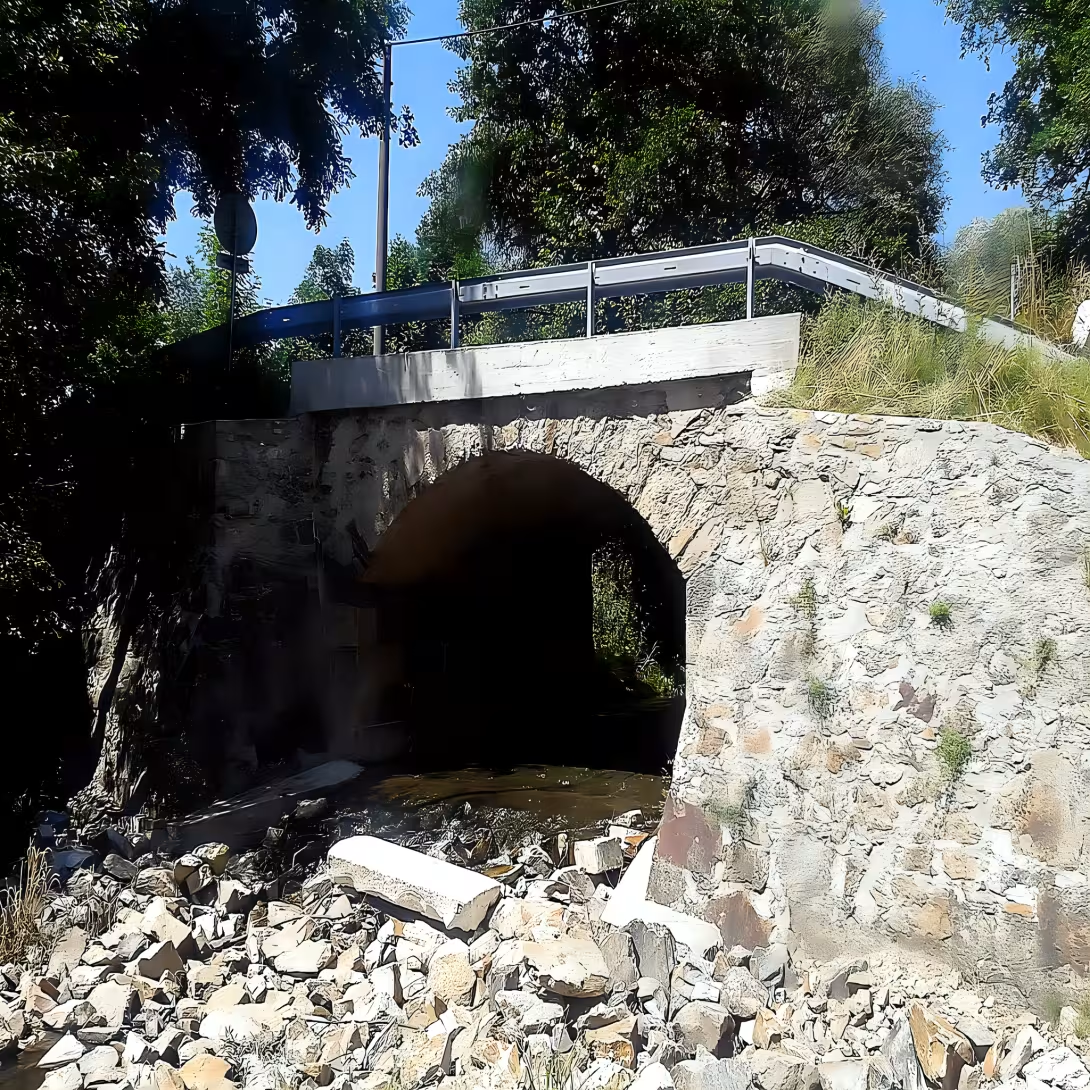
The stone road bridge through the southern discharge of the Dub pond on the road III / 14125 from the village Dub to Borčic in South Bohemia is a cultural monument of the Czech Republic. This historical object brightens the flow of water and lies near the mill. The bridge boasts a single segment arch, built from quarry stone and carved blocks, which shows its architectural importance and the technology of the time. Its reconstruction took place in 1985, which preserved it for future generations.
The bridge represents a significant example of building art, where the use of quarry stone and carved blocks on the pillars gives the structure not only strength but also aesthetic value. The bridge length is 3.03 metres with a 5-metre bridge and a width of 6.57 metres, while its height is 3.25 metres. The surface of the road is formed by a nutrient layer, which was typical of the bridges of the time and used to protect stone surfaces from erosion. The Dub creek under the bridge is unloaded with quarry stone tiles, thus giving the overall impression of robustness and endurance.
The history of this bridge is mainly linked to its reconstruction in 1985. This process not only restored the bridge to the original function, but also ensured its protection as cultural monuments. The reconstruction was carried out with a view to preserving historical elements and using traditional building materials, allowing the bridge to remain faithful to its original design.
The bridge is not only an architectural monument, but also part of the natural and cultural environment of the village Dub. Its location near the mill and around the Dub pond gives the place a unique character, which is popular among the locals as well as visitors. The bridge represents a link between history and nature, making its surroundings ideal for relaxing and exploring the beauty of the region.
Today the bridge is open to the public and serves as an important part of local infrastructure. Its protection as a cultural monument ensures that future generations can enjoy not only its practical use, but also learn about the history and architecture of the region. The bridge over the Dub stream is therefore not only an important building object, but also a witness to the past, which carries the values and traditions of the area.
Visiting this bridge offers a unique opportunity to explore part of Czech history through the prism of architecture and construction. It is a place where traditions can meet modern life, which makes it not only a monument, but also part of the daily life of the region's inhabitants and tourists. The bridge via Dub stream is therefore welcomed as an important element of the cultural heritage of the Czech Republic, which is worth visiting and award.
Historical milestones
- around the 18th century
- The creation of the bridge as part of the infrastructure in the area.
- 1985
- Reconstruction of the bridge with preservation of historical elements.
Architectural development
The bridge consists of one stone segment arch using quarry stone and carved blocks. Pillars are made of processed rice blocks, the binder is calcium cement mortar. In 1985, the bridge was reconstructed.
Historical events
- 1985
- Bridge reconstruction.
Points of interest
- The stone road bridge over the southern discharge of the Dub pond is a cultural monument of the Czech Republic. - The bridge has a single segment arch made of quarry stone and carved blocks, which shows its architectural significance and the technology of the time. - His reconstruction took place in 1985, which preserved him for future generations. - The bridge is not only an architectural monument, but also part of the natural and cultural environment of the village Dub. - The surface of the bridge road is formed by a nutrient layer, which was typical of the bridges of that time.
Guide
Show guide text
This text was created by artificial intelligence and has not been editorially reviewed. It may contain inaccuracies.
Welcome to this quiet but extremely important place that we will discover together today. You are standing right in front of a stone road bridge that crosses the water flow at the southern outlet of the Dub pond. It may seem to you at first glance that it is just a normal part of the road that connects the municipalities of Dub and Borčice, but if you stop and pay attention to details, you will see something much deeper. Before your eyes, there is a structure that witnessed many years of history and was chosen as a cultural monument of the Czech Republic because of its authenticity and technical skill of its creators. Feel the atmosphere, the sound of water flowing under the bridge and the feeling of stability that radiates this stone whole.
Now let's move forward in time together and understand why this bridge is even standing here. To understand its meaning, we must return around the eighteenth century. At that time, infrastructure in this area began to develop and it was necessary to ensure a stable link between the various settlements. This bridge was built not only as a barrier to water, but as a key point for transport, for the movement of people and goods in this country. It was part of a wider network of roads, which at the time formed the arteries of the local economy and social life. Even though the world was changing quickly back then, this stone point remained firm and served generations of people who walked after it before you did.
Now pay attention to the architecture itself and to what you can see right in front of you. Look at the very center of the bridge, where it dominates its main design element. Notice this one arc. This is not a classic semi-circular arc, as you may know from other structures, but a so-called segment arc. This shape is very specific and requires a lot of precision from the builders when the weight of the whole bridge is distributed. It is an elegant and very functional solution that points to the technological level of the time.
If you approach the surface of the stone now, you will see the fascinating contrast of the materials. Notice how two different ways of processing stone are used here. The first is a quarry stone that acts naturally, grossly and unprepared. This stone gives the bridge its strength and it seems to be directly part of the country itself. On the other hand, you will also see carved blocks. These stones are worked, have a smoother surface and more precise shapes. It is this combination of the brute force of nature with precise human work that creates the unique look that makes this bridge such a valuable object. These carved shapes are not random, they serve to keep the structure stable and to make the individual parts of the bridge perfectly connected.
When you look at these stone blocks, you can ask who was behind this work. It's interesting, but the names of architects and specific builders who built this bridge in the eighteenth century have not been preserved. We don't know their faces or their names, but their abilities and their visions are clearly visible here. Every detail carved and every stone placed correctly is their signature, even if it remains anonymous. It is this ignorance that gives the place some mystery and reminds us that history consists not only of great personalities, but above all of thousands of hardworking hands of ordinary people.
Even if this bridge became part of history, it wasn't just a passive object that would just stay. Did you know that in the year one thousand nine hundred and eighty-five this monument had to be thoroughly reconstructed? It was not just a simple correction, but a sensitive work whose main aim was to preserve all historical elements. It was important to ensure that modern repairs didn't destroy the soul of this place. Thanks to this reconstruction, the bridge is in such good shape today and we can admire its original form. It's proof that we can protect what's left of the past and transmit it to the future.
The interesting thing to realize is just how unique this object is throughout the region. The only segment arch built from a combination of quarry stone and carved blocks is not just technical detail, it is a symbol of technological progress of its time. This bridge is not just a way across the water, it is a preserved lesson from the history of construction, which you can see right under your steps today.
Now that you have seen the main features of this stone bridge and understood its importance, I suggest you continue your walk along this road. Maybe if you look at the water or the surrounding landscape again, you'll think about how much these stone tracks are connected to our lives. I wish you a beautiful and peaceful journey further along this historic track and I hope that this brief insight into the past has brought you new experiences. Goodbye.
Tips for visitors
The best time to visit is in the morning or shortly before sunset. In these hours the light is softer, which ideally highlights the texture of the stone on the historic bridge and surrounding nature.
You can get to the monument by car on road III / 14125. The location is also available by public transport; Please check the current connection in the search engine.
Take a walk around the water with comfortable shoes and possibly repellent. The surroundings are suitable for families with children due to the proximity of the Dub pond and the possibility of observing nature in the Dub creek.
Pro nejlepší fotografie se postavte k Dubskému potoku, odkud je vidět celý most v jeho přirozeném prostředí. Nejlepší světlo pro zachycení historické architektury získáte v ranních nebo večerních hodinách.
Close to the bridge you can explore the old mill or take a walk on the shores of the Dub pond, which offers other interesting places for a short walk.
Frequently asked questions
Can the monument be visited?
This is a structure in a public space that can usually be seen from outside free of charge. We have not verified that this particular one is freely accessible.
Where is the monument?
Location: Dub, Jihočeský kraj. The map on this page shows the exact spot.
Why is the monument protected?
It is listed in the Central List of Cultural Monuments of the Czech Republic as a cultural monument (register no. 1000157045).
Businesses nearby
Do you run a restaurant, accommodation, shop, museum, rental, wellness or other visitor service near this monument? Show yourself directly to the people heading to it — this is how they will see you in the app and on the web:
Nearby
Most se nachází v blízkosti mlýna a překlenuje Dubský potok, který vytéká z Dubského rybníka. V okolí je možné najít další přírodní prvky a historické památky.
Accommodation nearby
Themed route
Thematic cruise route: Bridge of road III / 14125 through southern discharge Dub pond
1. Bridge of road III / 14125 through southern discharge Dub pond - Type: Historical landmark - Why is it worth a visit: This bridge is an architecturally interesting structure that brightens the stream and serves as an important element of local infrastructure. It's an ideal place to understand the history of local transport.
2. Mill at the Dub pond - Type: Historical building - Why is it worth visiting: Mill is an example of traditional technology and local culture. Its proximity to the bridge offers a view of the history of industry in this area.
3rd Dub stream - Type: Natural elements - Why is worth a visit: The stream is a living example of local hydrography and provides beautiful landscape views. It is ideal for short walks on its shores.
4. Ambient forest - Type: Natural elements - Why is it worth a visit: The forest around the pond and the creek offers a quiet space for relaxing and observing wild flora and fauna. It's a great way to connect with nature.
5. Bridging Dub creek - Type: Natural elements - Why is it worth a visit: Other parts of the creek outside the bridge are suitable for observing natural processes and providing additional landscape views on the surrounding landscape.
This route offers a combination of historical and natural attractions that are easily accessible from the main destination of the bridge.
Seasonal recommendations
Spring: During the spring season, most silnice III/14125 přes jižní výpust Dubského rybníka is presented in a special atmosphere where the surrounding vegetation is revived by flowers and new leaves. The sunny days offer ideal conditions for walking, where you can relax and enjoy the natural beauty in the rebuilding landscape. It is recommended to visit early morning or evening to avoid unnecessary crowds and enjoy a peaceful walk.
Summer: Summer brings long sunny days and warm noon, which embodies the summer atmosphere. The bridge becomes a popular place for tourists and locals who want to take advantage of the pleasant weather and beauty of surrounding landscapes. In the main summer season it is advisable to visit early morning or late evening to avoid large crowds. Don't forget to bring sun cream and drinks.
Autumn: In the autumn season the bridge offers a unique atmosphere when the surroundings are coloured with yellow and red leaves. The sun becomes warm and warm, which creates ideal conditions for relaxation on the outside. Visit this place in between hours when there are fewer people to enjoy a quiet and pleasant moment. Clothes should be suitable for mild temperatures.
Winter: Winter brings cool air and a beautiful view of the ice water pond, giving the bridge a unique winter atmosphere. Visit this place early in the morning or in the evening when it is quieter and warm clothes are necessary for comfort. Although you can wait for a shorter opening time of the sights, the winter visit offers a quiet and relaxing moment in pleasant winter landscape beauty.
Visualizations and artistic views


The visualisations are generated by artificial intelligence and serve as inspiration.
Photos from the area
Real photos taken near the monument


Zdroj a licence jsou uvedeny u každého snímku.
Tips from visitors
No tips yet. Be the first!
Log in and add your tip.
Sources and literature
Photos: Jklamo / CC BY-SA 4.0, rozlišení zvýšeno umělou inteligencí — Wikimedia Commons. The author and licence also appear when you hover over the image.
Faktickým podkladem tohoto textu byl článek na Wikipedii, jehož autory jsou přispěvatelé Wikipedie. Článek je dostupný pod licencí CC BY-SA 4.0.
Location on the map




Příběhy a pověsti
Legendy, pověsti a příběhy spjaté s touto památkou
Fotografie návštěvníků
Zatím žádné fotografie. Buďte první, kdo přidá fotografii z návštěvy!
Log in a přidejte svou fotografii nebo hodnoťte.
Za ověřenou návštěvu v aplikaci získáte víc bodů — poznáme podle GPS, že jste na místě.
Reviews and comments