



most ulice 28. října přes Radbuzu ve Staňkově Road bridge
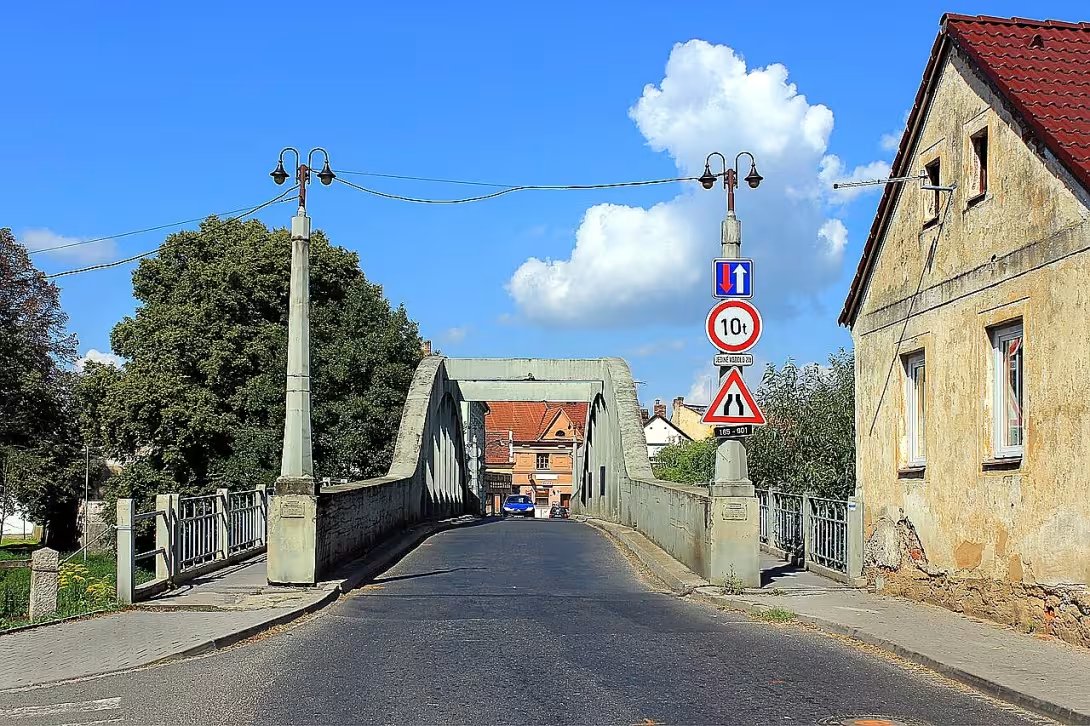
The road bridge in the village Staňkov in the district of Domažlice is a reinforced concrete arc bridge from 1919- 1921. He's transferring the street on October 28 across the Radbuzu River. It is one of the first bridges of this type in Pilsen, which gave him the status of cultural monument of the Czech Republic in 2005.
The current construction was replaced by the original wooden bridge built by builder Matas in 1845. The new project was developed by Prague engineer Eduard Viktora and implemented by the Pilsen firm Müller and Kapse. The bridge connected two previously separate municipalities: Staňkov- town on the left bank and Staňkov-ves on the right bank, where the road Nárazni continues. Both municipalities were merged in 1938.
The building is a direct monolithic construction with a total length of 60,60 metres and a width of eight metres. The construction consists of three fields with a range of 13,6, 33,4 and 13,6 meters. The middle field crosses the Radbuzu River and the open waste channel of the hydropower plant; it is formed by Langr's beam with the lower bridge. On this one are articulated extreme fields. Their supporting element is massive parapet beam filler beams with a height of 1.4 metres and a width of 0.7 metres. These elements end with a pair of eight-sided conical candelabra.
Langr's beam is set on the pillars. It is made up of six-metre-high arched beams with drag, drapes and bottom grate bridge. The bridge gauge defines the transverse at the top of the arches at a height of 4,45 metres. Wagon of 4.2 metres width is paved with granite cubes and is located 5,50 metres above the terrain. On both sides there are concrete pavements 1.2 metres wide, which are equipped with railing made of concrete columns and solid steel.
The lower structure is based on two cadastral territories. The bridge support and the pillar on the left side of the river lies in the k. Concrete supports and pillars are lined with precision-worked stone blocks on both the guide and flood side. The side surfaces are lined in the character of Cyclops masonry. Pillars are three feet tall and eight metres long. On the front side, they're bevelled to perform the function of the ledoum. There are two inscription boards on the bridge.
In 2004 the bridge was recognised as a cultural monument and in 2017 it underwent a repair. Thanks to its technical design and historical value, it is one of the first iron concrete arc bridges in the region and represents an important building element of the municipality Staňkov.
The construction is accessible for transport and pedestrians and is proof of the early use of reinforced concrete in transport construction. Visiting the bridge offers the possibility to observe the specific construction of Langrov's beam in a natural environment.
Then and now
Drag the slider to compare how the landmark may have looked when it was built with the view today.
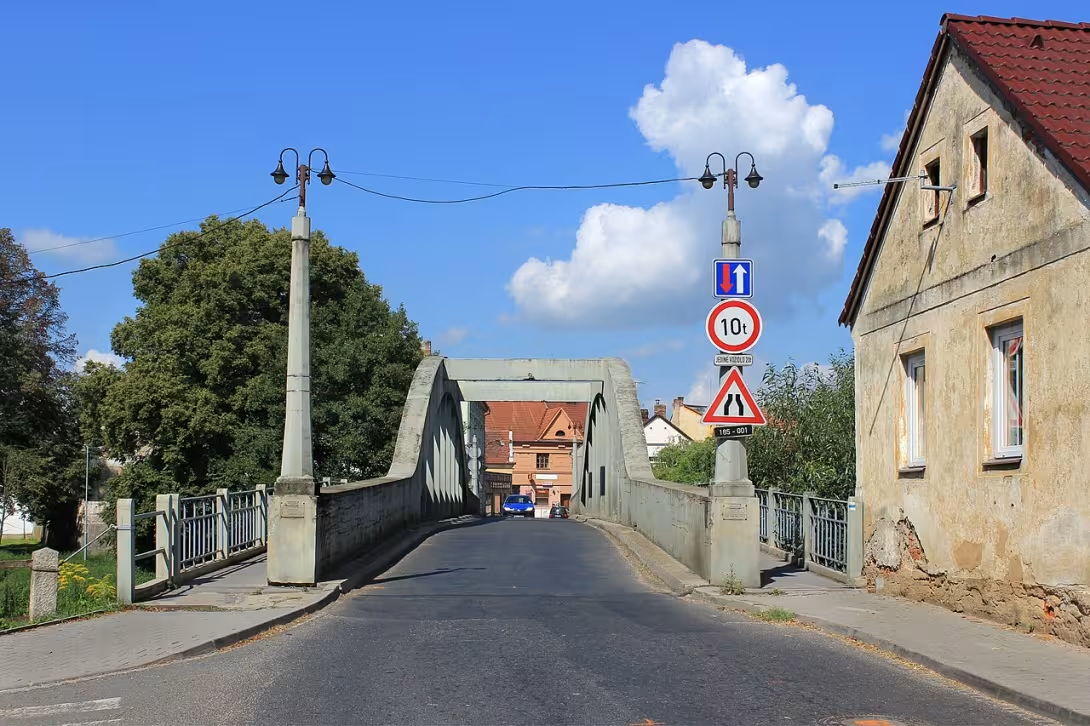
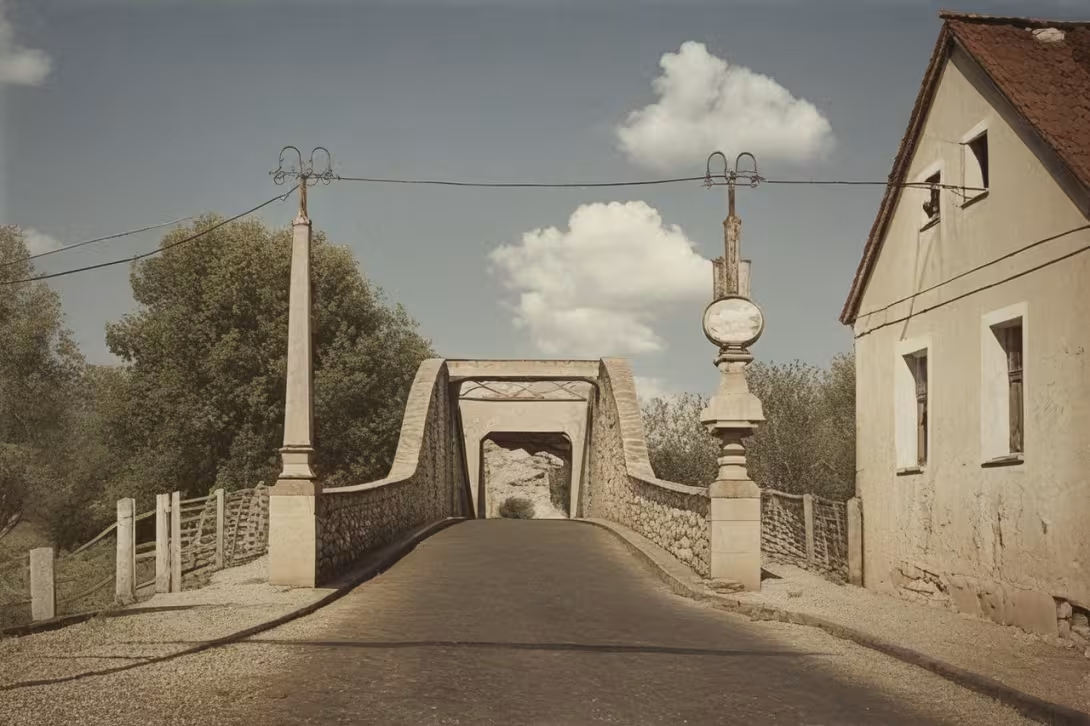
The historical appearance on the left is an AI-generated visualisation and serves as inspiration only.
Historical milestones
- 1845
- The position of the wooden bridge by the builder Matas.
- 1919
- The beginning of the construction of a new reinforced concrete bridge.
- 1921
- Finishing the construction of the current bridge.
- 2004
- Declaration of the bridge for cultural monument of the Czech Republic.
- 2017
- Implementation of bridge repair.
Architectural development
Originally there was a wooden bridge built by builder Matas. The current monolithic reinforced concrete bridge was built according to the project of engineer Viktor. The construction uses Langr's beam and is reinforced by transformers, the road being paved with granite cubes.
Historical events
In 1845 a wooden bridge was built in this place. In the years 1919-1921 a contemporary reinforced concrete structure was established. In 2004, the bridge was declared a cultural monument. In 2017 the building was repaired.
Points of interest
- It's one of the first iron concrete arc bridges in Pilsen. - In 2005 he obtained the status of cultural monument of the Czech Republic. - The current construction replaced the original wooden bridge from 1845. - The bridge connected two previously separate municipalities, Staňkov- cities and Staňkov-ves. - The construction uses a specific Langr beam and its pillars serve as leprosy.
Guide
Show guide text
This text was created by artificial intelligence and has not been editorially reviewed. It may contain inaccuracies.
Welcome to the village Staňkov. Right now, you're standing in front of a construction that at first glance can act as an ordinary road through water, but it's actually a fascinating testimony about technical progress and local history. In front of you is the 28th of October bridge that crosses the Radbuz River with grace. Feel its robustness and at the same time the elegance with which it floats above the surface of the river. It is a place where the practical purpose is combined with the aesthetic value of the time when completely new building materials started to be used.
Let us now come together to see how this building was built and why it is so important for this region. In order to understand the meaning of what you see today, we have to go back deep into the nineteenth century. The first link through Radbuza was created in 1845. It was built by a builder named Matas and it was a classic wooden bridge. Imagine what the way across the river at the time, how the wood was throwing under the hooves of horses and wagons. However, the wood is subject to rot and wear over time, so something more permanent and modern had to be built.
This happened at the turn of the first and second decades of the twentieth century. In 1919, the construction of a new bridge that you see before you began. It was a time of great change and technological optimism. The construction lasted two years and was completed in 1921. Müller and Kapse from Pilsen took care of the implementation, which were experts in their work from nearby surroundings. The whole project was designed by architect Eduard Viktora. It is thanks to his vision and precise work of the company from Pilsen that a work has been created that has survived for decades and still serves its community.
Now pay attention to the architecture and construction itself. Look carefully at the shape of the bridge. This is a reinforced concrete arc bridge. Notice these characteristic arches that bear the entire weight of the structure. It was a very modern approach at the time of its creation. Iron concrete was the material of the future at the time because it associated the strength of concrete with the elasticity of steel. It is this element that makes the bridge at Staňkov unique. It is one of the first concrete arches ever built in Pilsen.
If you look at the total size, you'll find that the structure is more than 60 meters long. For the construction to be stable and functional, it is divided into three fields. Try to see in your mind how these fields alternate and form a harmonious whole over the Radbuza trough. It's a beautiful example of how engineering can be turned into art. Even though we walk through similar bridges on a daily basis and do not see them, in 1921 the completion of such a work for the locals had to be a real experience.
The key to understanding this place is not just concrete and steel, but above all human relationships and connections. This bridge was not only connected by two banks of the river, but essentially connected two previously separate municipalities. On one side was Staňkov-town and on the other Staňkov-ves. Imagine what a vital role this bridge played in people's lives. He abolished the barrier, facilitated trade, communication and meeting people from both parts of the village. He became a symbol of unity and common development. The bridge stopped being just a transport element and became the heart of the village through which life flowed.
You may be wondering if this building is recognized today as something special. The answer is clearly yes. In 2004, the bridge was officially declared a cultural monument to the Czech Republic. This means that the State recognises its historical, technical and aesthetic value. It's not just a short walk, it's a historical document written in concrete. In order to keep this monument in good condition for future generations, a thorough repair was carried out in 2017. Thanks to this you can stand safely in this place today and admire the work before a more than century-old date.
Now let's think about one interesting thing. If we had returned to 1921, we would have witnessed the birth of something that was essentially news at the time in Pilsen. Imagine the contrast between the old 1845 wooden bridge and this modern arc of iron concrete. It was a leap into the future. It is fascinating that even after so long, despite all changes in modes, technology and transport, this bridge still stands and performs its function. He's a silent witness to history who's seen everything that's happened in Staňkov in the last century.
Now, if you look again at the Radbuzu River running beneath you, feel the calm of this place. The bridge stands here as guardian of history. It is a reminder of how important it is to invest in quality and sustainability. Architect Eduard Viktora and builders from Pilsen created a work that did not just survive its time, but became part of the identity of the entire Staňkova.
Let's slowly end this short journey in time. I hope you enjoyed this bridge not only as a journey from one shore to another, but as a fascinating technical monument. It's where the history of wooden construction meets the courage of the first concrete structures.
Now invited to further explore the surroundings. Go over the bridge again, maybe from another angle, and feel the atmosphere of this unique place. Staňkov has many other stories waiting to be revealed. Thank you for spending a moment with us at this beautiful arch over Radbuza. We wish you a pleasant continued journey and many other discoveries in our region. Goodbye.
Tips for visitors
The best time to visit is spring or autumn, when the colors of nature around the Radbuza River are the most distinctive and the bridge construction excels in the natural environment. For transport to the village Staňkov use your own car or public transport, check the current connection in the travel search engines.
When you walk, we recommend taking with you an edge suitable for humid terrain, as you will move near the water and river bed. For photography we recommend morning or late afternoon light, which beautifully highlights the arc construction made of reinforced concrete. The best angles of images are obtained from the bank of the river, from where you can see the entire course of the construction.
In the immediate vicinity you can walk along the river Radbuza or observe the hydropower drain which is located next to the bridge. It is ideal for families with children to observe flowing water and explore the material from which the bridge is built, which may be an interesting introduction to the world of construction.
Frequently asked questions
Can the monument be visited?
This is a structure in a public space that can usually be seen from outside free of charge. We have not verified that this particular one is freely accessible.
Where is the monument?
Location: Staňkov. The map on this page shows the exact spot.
Why is the monument protected?
It is listed in the Central List of Cultural Monuments of the Czech Republic as a cultural monument (register no. 1935125591).
Businesses nearby
Do you run a restaurant, accommodation, shop, museum, rental, wellness or other visitor service near this monument? Show yourself directly to the people heading to it — this is how they will see you in the app and on the web:
Nearby
Řeka Radbuza a odpadní kanál hydroelektrárny.
Accommodation nearby
Themed route
Here is the design of the thematic route:
1. Waste channel hydropower (water construction) - Walk begins at the technical work where water flow towards the river can be monitored. 2. Radbuza River (natural flow) - Follow the path along the shore, which offers a quiet atmosphere and a view of the river bed. 3. Bridge of the street on October 28 via Radbuz in Staňkov (architectural monument) - The main destination of the trip, where visitors admire the construction of the bridge connecting both sides of the village.
Seasonal recommendations
In the spring, the surroundings of the bridge awaken to life, and the greenery around the Radbuza River is beginning to develop. The air is fresh, and the water in the stream gets stronger after the snow melts. For a walk it is best to choose the morning when the light is fine, and wear waterproof shoes, because the roads around you can be wet.
Summer brings hot days and bright sun that illuminates the details of the building. Nature is in full bloom and trees provide a pleasant shade. It is recommended to visit early morning or late evening to avoid the greatest heat. It's practical to bring a hat and plenty of water.
In autumn, the landscape around the bridge is painted in gold and red shades, creating a melancholy atmosphere. Fogs above the river surface add mystery to the place. The most suitable visit is during the October days when leaf colours are the most distinctive. It is advisable to choose layered clothes and a light wind jacket.
In winter, the bridge can be packed with snow and freeze, which gives it a calm and rough look. There is silence around Radbuza, and the landscape is dormant. A warm jacket, hat and gloves are necessary when visiting. It is best to come on a short winter day, so that there is enough light to observe the building from the outside.
Visualizations and artistic views


The visualisations are generated by artificial intelligence and serve as inspiration.
Photos from the area
Real photos taken near the monument


Zdroj a licence jsou uvedeny u každého snímku.
Tips from visitors
No tips yet. Be the first!
Log in and add your tip.
Sources and literature
Photos: This file is available under Creative Commons BY-SA license. Basically: You can use this picture for any purpose, provid / CC BY-SA 3.0 — Wikimedia Commons. The author and licence also appear when you hover over the image.
Faktickým podkladem tohoto textu byl článek na Wikipedii, jehož autory jsou přispěvatelé Wikipedie. Článek je dostupný pod licencí CC BY-SA 4.0.
Location on the map
Příběhy a pověsti
Legendy, pověsti a příběhy spjaté s touto památkou

Fotografie návštěvníků
Zatím žádné fotografie. Buďte první, kdo přidá fotografii z návštěvy!
Log in a přidejte svou fotografii nebo hodnoťte.
Za ověřenou návštěvu v aplikaci získáte víc bodů — poznáme podle GPS, že jste na místě.
Reviews and comments