



náhrobek Aloise Kalvody Tombstone
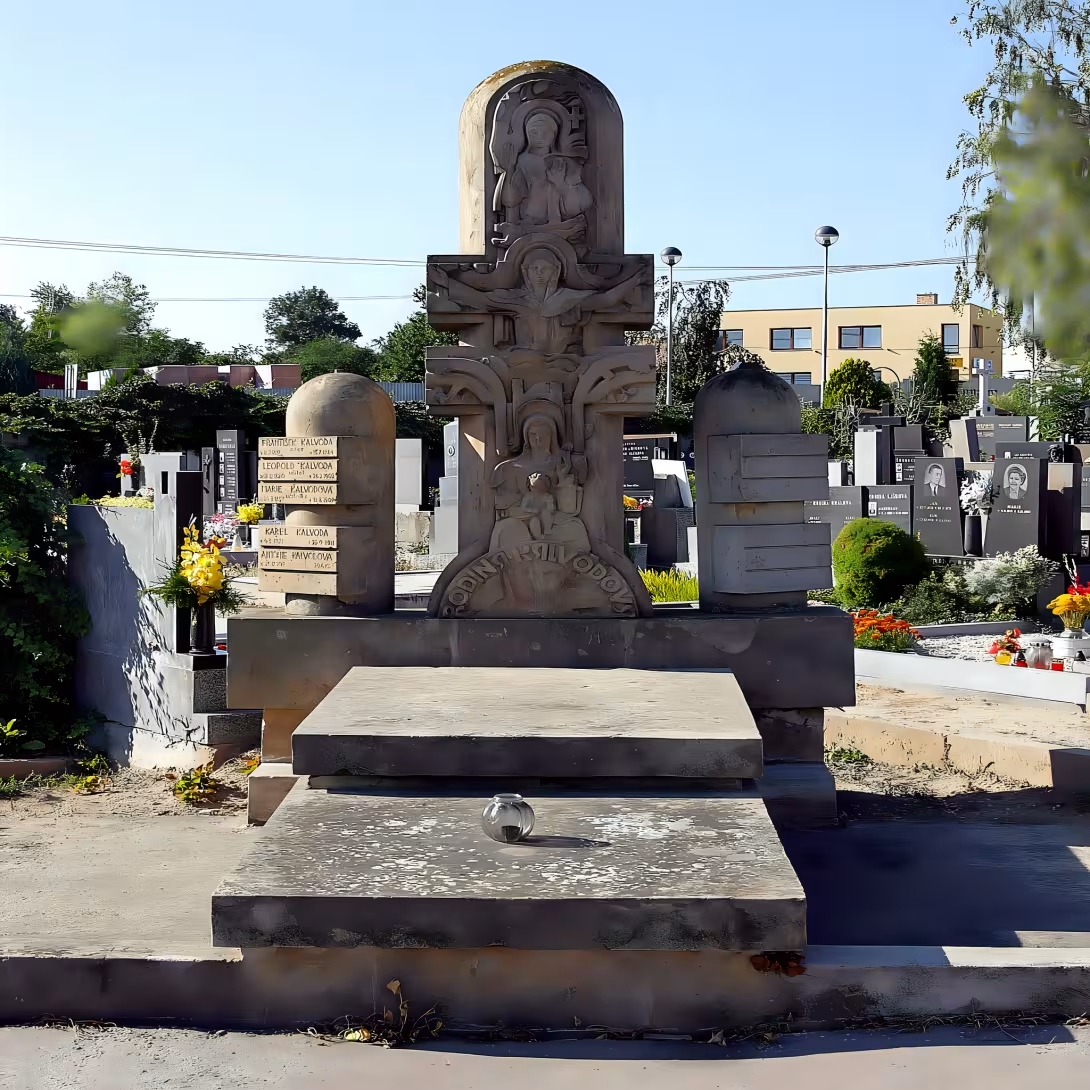
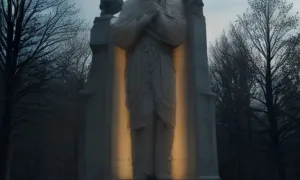
The tombstone Aloise Kalvoda, located in the oldest part of the cemetery in Šlapanice in the Brno-rural district, is protected as a cultural monument of the Czech Republic. This tombstone from 1929 represents one of the few art deco structures in the cemetery architecture in Šlapanice and its historical and aesthetic value attracts visitors. Created at the request of the painter Alois Kalvoda, who had built a family tomb in his lifetime, this monument represents an important example of the architectural trends of the 20th century.
The history of the tombstone dates back to 1929 when Alois Kalvoda was buried in the family tomb he had built. The design of the tombstone in the spirit of art deco belonged to Bohuslav Fuchs, while the sculpture implementation was carried out by Rudolf Březa. This period was a time between world wars for Czechoslovakia, when the country tried to stabilize after World War I and adapt to new political and economic conditions. In Europe, 1929 was also marked by the start of the Great Depression, which also affected cultural life.
The architecture of the tombstone is characteristic of art deco style, which at that time spread around the world. The tombstone consists of three rounded sandstone columns. The middle column is performed as a two-arm cross on which is the relief of Christ, the Virgin Mary and Saint Anne. The segment foot under the relief says "KALVoda Family." On side columns are mounted plates with names of deceased family members. The tomb cover consists of two tiered sandstone plates. Material and architectural style reflect aesthetic preferences of the time.
The tomb of Alois Kalvoda underwent reconstruction in the 1990s at the expense of the city, highlighting its cultural and historical value. This reconstruction was carried out in order to preserve the original appearance and ensure the durability of the monument for future generations.
The tombstone is now open to the public and is worth visiting not only because of its historical value, but also as an example of architectural art from the early 20th century. Its location in the cemetery in Šlapanice offers visitors the opportunity to become acquainted with local history and cultural heritage.
The tomb of Alois Kalvoda is therefore not only a monument to the cemetery in Šlapanice, but also a witness to the architectural trends of the 20th century and the personal story of the painter Alois Kalvoda. His tombstone is an important part of the cultural heritage of the Czech Republic, which is worth discovering and appreciating.
Then and now
Drag the slider to compare how the landmark may have looked when it was built with the view today.
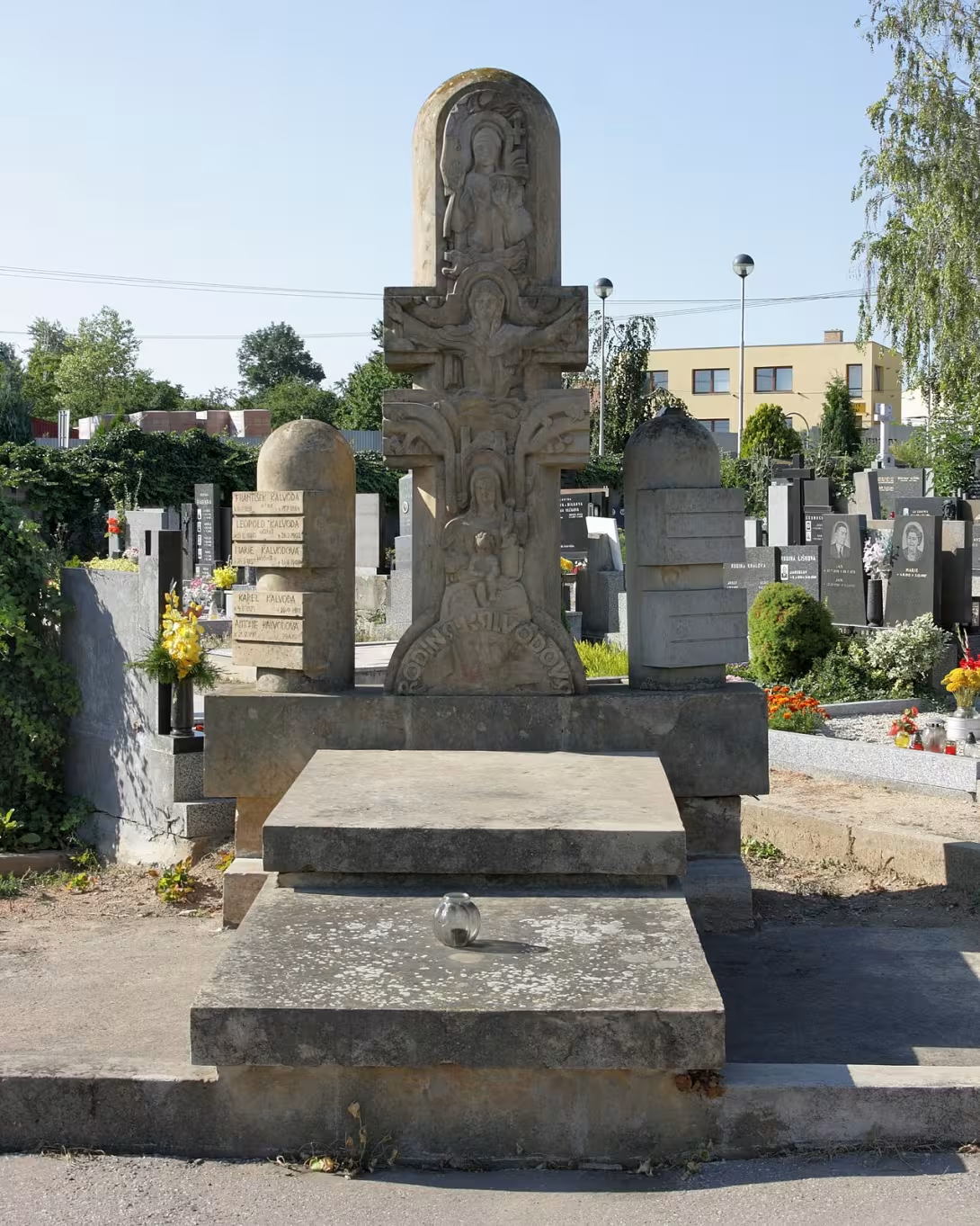
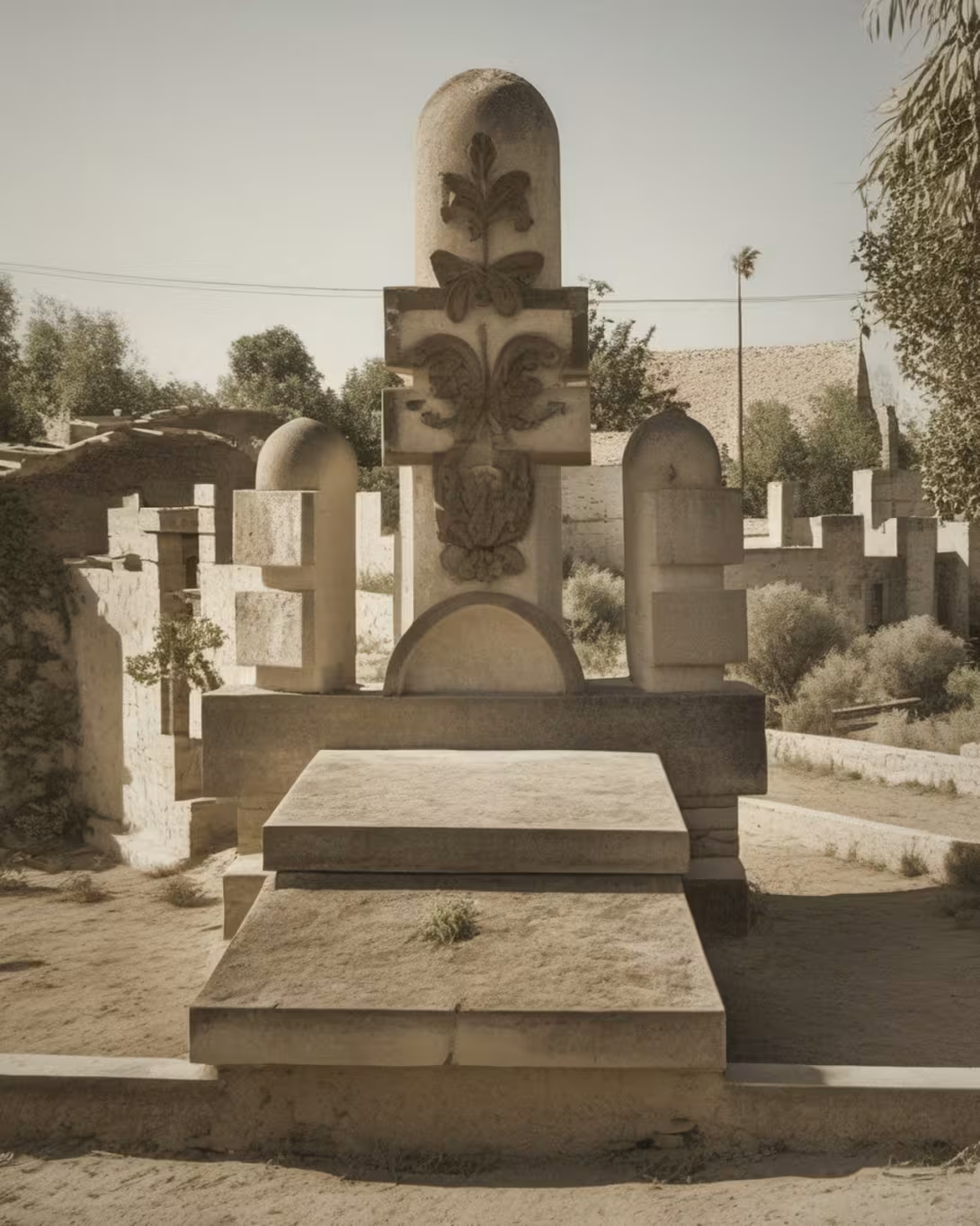
The historical appearance on the left is an AI-generated visualisation and serves as inspiration only.
Historical milestones
- 1929
- Creation of the tombstone Aloise Kalvoda in art deco style.
- around 1930
- The beginning of the Great Depression, affecting cultural life.
- 1990s
- Reconstruction of the tombstone at the cost of the city Šlapanice.
Architectural development
The tombstone was built in 1929 and reconstructed in the 1990s. It is made from sandstone with art deco elements, which reflects the architectural style of the time.
Historical events
- 1929
- The position of Alois Kalvoda's tombstone.
- 1990
- Reconstruction of the tombstone at the expense of the city.
Points of interest
- The tomb of Alois Kalvoda is protected as a cultural monument of the Czech Republic. - This tombstone from 1929 represents one of the few art deco structures in the cemetery architecture in Šlapanice and its historical and aesthetic value attracts visitors. - The tombstone consists of three rounded sandstone columns, the middle pillar is a two-arm cross with the relief of Christ, the Virgin Mary and Saint Anne. - The tombstone underwent reconstruction in the 1990s at the expense of the city, highlighting its cultural and historical value.
Guide
Show guide text
This text was created by artificial intelligence and has not been editorially reviewed. It may contain inaccuracies.
Welcome to the quiet and quiet environment of the oldest part of the cemetery in Šlapanice. Stop for a moment, soak up the air and let the atmosphere of this place take hold, which is dedicated to the memory of the deceased, but also to art and history. In front of you is náhrobek Aloise Kalvody, a work that deserves your full attention. Although cemeteries are often perceived as places of sadness and silence, this particular monument shows how sadness can be linked to aesthetic beauty and profound cultural significance. The tombstone is protected as a cultural monument of the Czech Republic, which shows its extraordinary value for our national heritage.
Look at him up close. What's likely to attract you first is its overall shape and proportion. The tombstone consists of three rounded sandstone columns which create a harmonious and stable composition. This material, sandstone, adds a warm, earthly tone to the whole piece, which is beautifully supplemented with the surrounding greenery and the stone surface of the cemetery. The columns are not only a supporting structure, they also perform an aesthetic function, their rounded shapes softer overall impression and give it a modern but dignified character.
The history of this work dates back to 1929 when the tombstone was created. This time period is very interesting for Czech architecture and art. It was the year in Europe, and also in our country, the new artistic direction that we now know as art deco. This style was characterized by geometric forms, symmetry and combination of traditional materials with modern design. The tomb of Aloise Kalvoda is one of the few examples where this avant-garde style was applied in the cemetery architecture in Šlapanice. It is a rare example of how modern artistic currents touched as intimate and personal spaces as burial sites.
The design of this tombstone was created by Bohuslav Fuchs. His vision was clear and courageous for his time. Fuchs understood that the tombstone may not only be a traditional cross or a simple stone block, but may be a full work of art that expresses the personality of the deceased and the time in which he lived. He collaborated with sculptor Rudolf Březa, who carried out a sculpture realization. The cooperation of the architect and sculptor in this case is crucial for understanding the overall impression. Fuchs proposed structure and proportions, while March added the human and spiritual dimension of the work through relief.
Now pay attention to the central part of the tombstone. On the middle column, or rather on the two-arm cross, which is part of this central composition, there are reliefs. There are three characters: Christ, the Virgin Mary and Saint Anne. These biblical figures are not random. Christ symbolizes salvation and hope, the Virgin Mary is the embodiment of maternal love and protection, and Saint Anne, the mother of the Virgin Mary, represents family ties and the passing of visions from generation to generation. This threesome creates a strong spiritual context that complements modern architectural forms. The reliefs are made so that they can be read, but at the same time they are harmonically connected to the overall shape of the columns.
Who was Alois Kalvoda whose memory is this tombstone dedicated? Although the materials do not contain detailed biography, the very fact that he was dedicated to such an artistically demanding and protected monument suggests that it was a personality that had a significant place in Šlapanice or in the wider surroundings. We can assume that his family or community was able and willing to invest in such a work, which at that time was a considerable investment. So the tombstone is not only a stone structure, but also an expression of honor and love that people showed him after his death.
The interest of this work is also his fate over time. After its creation in 1929, the tombstone lived through the Great Depression, which affected cultural life around the world. But even in such difficult times this work survived and remained preserved. It was reconstructed in the 1990s, which was financed by the city of Šlapanice. This fact is important because it shows that the village was aware of the value of this monument and wanted to preserve it for future generations. The reconstruction ensures that sandstone is in good condition and that reliefs are still readable.
Note the details they may have worn out over time, but thanks to the city's care they remain preserved. Sandstone is a soft stone that is prone to erosion, especially due to weather. It is therefore important that they do not touch it, so that there is no further damage to the surface. The reliefs of Christ, the Virgin Mary and Saint Anne are made with precision that requires respect. Their shapes are delicate and detailed, suggesting the skill of sculptor Rudolf Březa.
The location of the tombstone in the oldest part of the cemetery also has its meaning. This part of the cemetery probably contains other historical graves and monuments that together create a unique cultural and historical whole. Alois Kalvoda's tombstone does not disturb the atmosphere here, but enriches it with its modern but dignified appearance. It's a bridge between the past and the present, between tradition and innovation.
If you look at the tombstone from different angles, you'll see how its appearance changes. The rounded columns create a dynamic that is typical of art deco. Geometric shapes are combined here with organic forms, which creates an impression of movement and life, even if it is a monument to the deceased. This contrast is one of the reasons why this work is so fascinating.
The tomb of Aloise Kalvoda is also an example of how the cemetery can be a place of education and cultural experience. It's not just a place for sadness, it's also a place for admiration of art and history. For visitors who are interested in architecture, sculpture or history, this place is an irreplaceable source of inspiration.
Finally, I would like to remind you that this tombstone is protected as a cultural monument of the Czech Republic. This means that it is under special protection of the state and its preservation is a priority. Your visit and interest in this place help keep his memory alive. Thank you for your attention and for taking the time to get to know this unique work.
I hope you enjoyed your walk around the cemetery in Šlapanice and that you have noticed the beauty and dignity of this place. If you have the opportunity, continue the tour and discover other historical monuments that are here. Every grave has a story, every stone tombstone carries traces of time and human destiny.
Parting with this place should be peaceful and respectful. Leave
Tips for visitors
For the best experience visit the place in the morning or just before sunset. Soft light will highlight geometrical shapes and details of the artistic processing of the tombstone.
The road to the place is also possible by car through public transport. The current timetables and connections are best checked in internet search engines.
Take comfortable shoes suitable for uneven surfaces and water. Since this is a place of rest, we recommend keeping quiet mode.
Photography is suitable for the capture of artistic elements. The best angles for details can be found in the side lighting, which creates interesting shadows on the stone surface.
For families with children, this place is suitable for a short, quiet walk in history education if children follow the rules of conduct in the cemetery.
Frequently asked questions
Can the monument be visited?
Cemeteries and graves are usually accessible; please respect the dignity of the place. We have not verified the opening hours of this cemetery.
Where is the monument?
Location: Šlapanice, Jihomoravský kraj. The map on this page shows the exact spot.
Why is the monument protected?
It is listed in the Central List of Cultural Monuments of the Czech Republic as a cultural monument (register no. 1000126779).
Businesses nearby
Do you run a restaurant, accommodation, shop, museum, rental, wellness or other visitor service near this monument? Show yourself directly to the people heading to it — this is how they will see you in the app and on the web:
Events nearby


Zdroj akcí: otevřená data měst a obcí ČR (Národní katalog otevřených dat) a kalendář akcí Národního památkového ústavu.
Nearby
🏰 Historic sites (632)
- 1805 0.0 km
- sv. Jan Nepomucký 0.3 km
- Panna Maria 0.3 km
- sv. Florián 0.3 km
- Muzeum Brněnska 0.3 km
- sv. Florián 0.3 km
- sv. Juda Tadeáš 0.3 km
- František Sapák 0.3 km
- Plačící matka 0.4 km
- Pomník francouzským lékařům 0.4 km
- Bratři Páralové 0.6 km
- Josef Mazálek 0.6 km
- MUDr. Emanuel Zeisel 0.7 km
- Theodor Zeisel 0.7 km
- MUDr. Věra Zeiselová 0.7 km
- MUDr. Josef Zeisel 0.7 km
- Oldřich Zeman 0.7 km
- Oldřich Štěrba 0.8 km
- Rudolf Merhout 0.8 km
- Pomník osvobození Rudou armádou 0.8 km
🍽️ Restaurants and dining (1767)
- Cukrárna U Kostela 0.3 km Masarykovo náměstí 103/20
- Pizza & Kebab Atip 0.4 km
- Ellis café bar 0.4 km Na Poříčí 41/1
- Bistro Park 0.4 km web
- U Jana 0.5 km
- Cukrárna Vymazal 0.5 km
- Radnice 0.6 km
- Úplně jiná čajovna 0.6 km Brněnská 29/22
- Úlek 0.6 km +420703958056 web
- Sodi bistro 0.6 km
- Čmelín 0.7 km +420703958056 web
- Moravská chalupa 0.7 km
- Roci 0.8 km +420 725 046 373 web
- Obývák 1.0 km +420703958056 web
- U Ofučka 1.1 km
- U Hasičky 1.1 km
- Kulturni dum 1.1 km
- Sokec restaurant 1.2 km web
- SK Šlapanice 1.4 km
- Despite 1.4 km
🏨 Accommodation (173)
- Žlutý dům 0.1 km Pod Žurání 1697
- Roci 0.8 km
- Masarykova Univerzita 0.9 km Nádražní 465/58
- Elendris - Ubytování u kostela 2.8 km Krejčího 550/2
- Sluneční dvůr 3.4 km Přemyslovo náměstí 26
- Hotel Belcredi 4.5 km web
- Pension U Libušky 4.6 km náměstí Karla IV. 25/29
- Mezi stromy 5.5 km web
- ZKL, a.s. 5.5 km
- Varadero 5.6 km
- Penzion Colatransport 6.2 km Písníky 409 +420545229300 web
- Velká Klajdovka 6.2 km Jedovnická 7 +420 544 424 911 web
- Penzion Colatransport 6.2 km Písníky 409
- Penzion U Doležalů 6.8 km
- Albellus 7.1 km Rokycanova 21
- Máma 7.4 km Gebauerova 6
- Lucie 7.5 km
- Ubytování Šámalka 7.5 km Šámalova 1130/62
- Bed & Breakfast 7.7 km Hněvkovského 13 web
- Penzion MÁMA 7.8 km
🚲 Rentals and sport (327)
- Sportovni areal 0.1 km
- Kolo garáž 0.2 km Hřbitov 175/4
- F&F 0.7 km
- Cykloservis 1 1.0 km +420734589240 web
- Sokolovna 1.2 km Nádražní 706/87 web
- Sportega s.r.o. 1.3 km
- Tenisový klub Šlapanice 1.4 km
- Sportovní hala Sokol Šlapanice 1.4 km +420731188690 web
- Šneksport 1.5 km
- sportovní hala Podolí 1.9 km
- Cyklo best 3.3 km +420515548446 web
- Sport pro tebe.cz 3.4 km web
- Prima Outdoor 3.4 km
- Li-ning 3.4 km web
- Planteko 3.4 km
- MZ elektrokola 3.6 km +420 776336388 web
- SK Líšeň 4.2 km
- Tréninkové centrum mládeže SK Artis Brno 4.2 km
- Sokolovna 4.2 km
- BRuNO family park 4.6 km Kigginsova 2 web
🥾 Hiking and nature (365)
- Andělka a Čertovka 0.6 km
- Přírodní zahrada v Podolí u Brna 2.3 km
- Vinohrady 2.6 km
- Velatická slepencová stráň 3.0 km
- smírčí kámen 3.1 km
- Kaple Panny Marie Sněžné 3.1 km
- Santon 3.2 km
- Santon 3.2 km
- Velatická slepencová stráň 3.2 km
- Bunkr 4.0 km
- Areál s dětskými atrakcemi 4.0 km
- zahrada Orlovny 4.2 km
- Líšeňský vrt 4.2 km
- Stránská skála 4.4 km
- Bobovka Brno 4.5 km web
- 7 4.6 km
- Samostřípka 4.8 km
- pramen Romzy 5.4 km
- Pracký kopec 5.4 km
- Líšeňská rokle 5.4 km
Accommodation nearby
Trips and activities nearby
Guided tours, tickets and activities nearby from GetYourGuide
Affiliate link: if you buy from the partner, we may receive a commission. The price for you does not change.
Search tours and activities →Themed route
Thematic cruise route from the village Šlapanice
1. The tomb of Alois Kalvoda - Type: Historical landmark - Why is it worth a visit: This tombstone is an important historical monument that reminds of the life and work of Alois Kalvoda, one of the most famous Czech politicians. It is a place full of history and culture that offers a view of the past of the region.
2. St Anne's Chapel - Type: Religious object - Why is it worth visiting: The chapel is a small but distinctive architectural monument that attracts its history and beauty. It is a place of peace and shelter for visitors who want to understand more about local spiritual life.
3. Microregional Museum - Type: Museum exposition - Why is it worth visiting: This museum offers valuable information about the history and culture of the Šlapanice region. It is a great place for those interested in local traditions and historical development of the region.
4. Garden with historical trees - Type: Green Zone - Why is it worth a visit: This garden is home to old and rare tree species that attract both botanists and the general public. It is a place to relax in nature and enjoy the beauty of historic flora.
5. Local Traditional Market - Type: Cultural events - Why is it worth a visit: The market offers a chance to explore local products and traditions, which is a great way to immerse yourself in the life of the village. It is also an opportunity to meet local people and learn their customs.
This route offers a comprehensive view of the history, culture and nature of the Šlapanice area.
Seasonal recommendations
Spring: During the spring season náhrobek Aloise Kalvody is specially lit by sunlight, which creates attractive shadows and colors on historical reliefs. Nature is awakening from the snow breath, which increases the beauty of the overall impression. It is advisable to visit the memory at noon when the sun is most visible and assigns the tombstone to life. Although the first crowds of tourists may appear, it is the perfect time for a quiet walk between the flowering bush.
Summer: In summer náhrobek Aloise Kalvody gains its full shine under long-term sunlight. The atmosphere is warm and warm, which creates ideal conditions for a long walk around the monument. It is recommended to visit it early in the morning or late in the evening to avoid heat and crowds that may be large in the main summer season. Don't forget the sun protection and enough drinking.
Autumn: In autumn days, Kalvoda's tombstone is surrounded by a colourful palette of leaves, creating impressive footage. The sun quickly hides behind the clouds and the impressions are slightly melancholy, yet beautiful. This time is ideal for a quiet visit when the crowd is no longer as much as in the summer. Dress according to temperature and don't forget the umbrella - winter can come quickly.
Winter: The winter visit to Aloise Kalvoda's tombstone is unique when reliefs are marked against the pale background of snow. Sun rays create fine shadows and increase the dramatic nature of the tombstone. The monument is usually less visited, which allows a peaceful walk. It is important to come up with warm clothes and suitable shoes for snow or ice, because the monument can be partially closed in the winter months.
Visualizations and artistic views


The visualisations are generated by artificial intelligence and serve as inspiration.
Photos from the area
Real photos taken near the monument


Zdroj a licence jsou uvedeny u každého snímku.
Tips from visitors
No tips yet. Be the first!
Log in and add your tip.
Sources and literature
Photos: RomanM82 / CC BY-SA 3.0, rozlišení zvýšeno umělou inteligencí — Wikimedia Commons. The author and licence also appear when you hover over the image.
Faktickým podkladem tohoto textu byl článek na Wikipedii, jehož autory jsou přispěvatelé Wikipedie. Článek je dostupný pod licencí CC BY-SA 4.0.
Location on the map

Příběhy a pověsti
Legendy, pověsti a příběhy spjaté s touto památkou
Fotografie návštěvníků
Zatím žádné fotografie. Buďte první, kdo přidá fotografii z návštěvy!
Log in a přidejte svou fotografii nebo hodnoťte.
Za ověřenou návštěvu v aplikaci získáte víc bodů — poznáme podle GPS, že jste na místě.
Reviews and comments