



Náměstí Míru Other
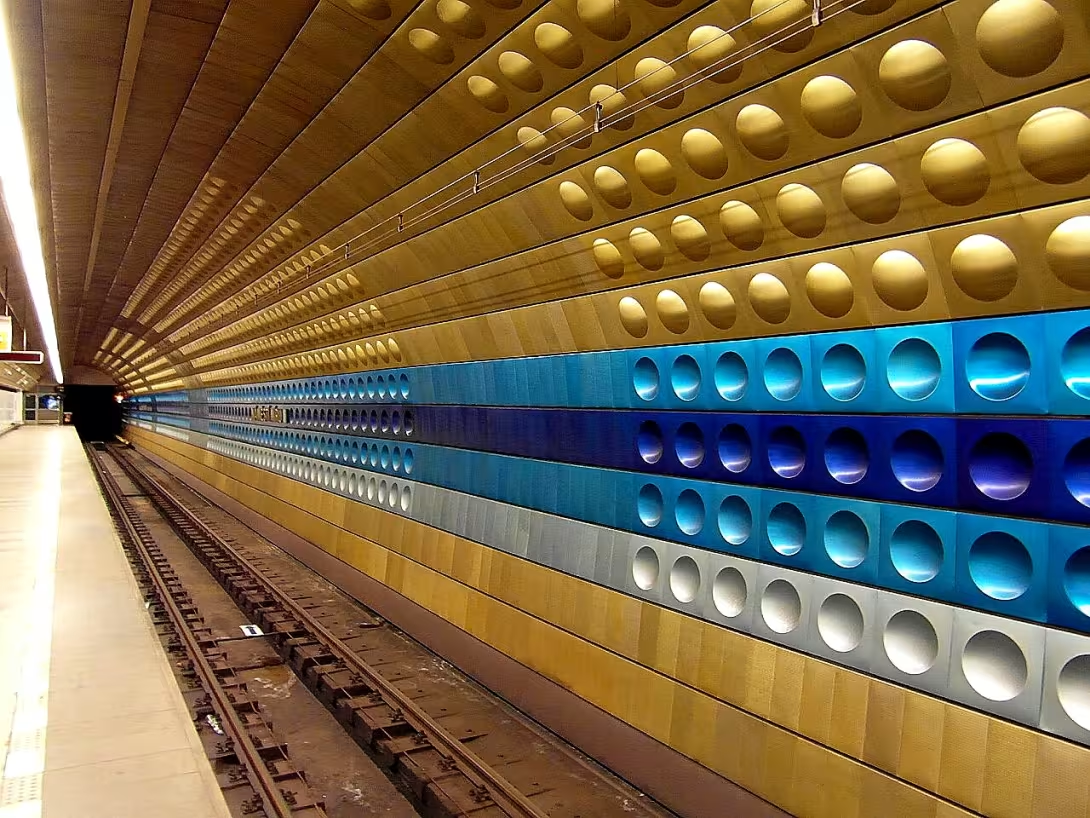
Náměstí Míru is a Prague metro station on line A in Prague 2, in the District of Vinohrady. Opened in 1978 as a terminal station, it represents the peak of architectural and engineering efforts during the socialist era. Its deep location makes it the deepest place in the Prague metro network, which contributes to its unique position.
The development of Náměstí Míru was related to the development of Prague Metro in the 1970s, the period of intensive urban and infrastructure development in socialist Czechoslovakia. The station was part of wider plans to increase the availability of public transport, which corresponded to European trends at the time. It was built between 1973 and 1978 as a terminal station with subsequent connection of another section II. And late 1980.
It is architecturally characterised by an embossed construction and a three-boat platform. The station has a shortened middle boat of 68.8 metres long and seven pair passes. The construction required an investment of CZK 303 million. The original light object by Václav Cigler, which responded to the number of people passing through the lighting of various patterns, was removed during the reconstruction in the 1990s.
The station is located at a deep level of 53 metres underground, making it the deepest station in the Prague metro network. Its disposition allows future development, such as the construction of another escalator tunnel connection with a vestibule in Vinohradska class and possible transfer to the designed line D. Behind the station towards the Museum of mouth station in both tracks the line A with line C allows efficient train turns.
In the area there are several important objects such as the Basilica of Saint Ludmila, the Theatre of Vinohrady and the National House of Vinohrady. These institutions contribute to the cultural and historical wealth of the Vinohrady district.
Today, the station is going to become a transfer state after the construction of the planned line D, which means that it will have the Petrograd type and the pressed construction of the NRTM for more efficient transfers between different metro lines.
Náměstí Míru is an important place for everyday transport, but also a witness of historical changes and urban development of Prague. Its architectural features and deep location make it interesting for visitors who want to understand both the current state of urban infrastructure and its history. Visiting Náměstí Míru means exploring both the past and the future of Prague Metro.
Historical milestones
- 1978
- Opening the station as an end.
- 1980
- Activation of another section of II.A.
Architectural development
The station was built in 1973- 1978 and is embossed with a tripod platform. It originally contained a light object from Václav Cigler, which was later removed during reconstruction in the 1990s.
Historical events
- 1978
- Opening the station as an end.
- 1980
- Activation of another section of II.A.
Points of interest
- Náměstí Míru is a Prague metro station on line A in Prague 2, in the District of Vinohrady. - Open in 1978 as a terminal station, represents the peak of architectural and engineering efforts during the socialist era. - Its deep location makes it the deepest place in the Prague metro network, which contributes to its unique position. - The station has a shortened midship of 68.8 meters and seven pairs of passes. - Its disposition enables future development, such as the construction of another escalator tunnel connection with the vestibule in Vinohradska class and possible transition to the designed route D.
Guide
Show guide text
This text was created by artificial intelligence and has not been editorially reviewed. It may contain inaccuracies.
Welcome to Náměstí Míru, a unique metro station in Prague, which awaits you with rich history and architectural surprises. You are standing in Prague 2, in the well-known district of Vinohrady, where the history of the city is intertwined with modern life.
Náměstí Míru was opened in 1978 and originally served as a terminal station. This moment was the peak of subway development during the socialist era, when they tried to improve the city's transport infrastructure. Another section of the II.A. was opened in 1980, which allowed the station to be transferred to an intertrack and further expanded the metro network.
Look around you and see how the architecture of this station tells its own story. Its deep location makes it the deepest place in the Prague metro network. Although specific architects remain unknown, their work is evident in the unique design and engineering solutions that distinguish this station. Notice how the space extends beneath the surface of the city, offering a view of the past and the present.
Although there are no specific historical personalities associated with this site, its significance is obvious. The station Náměstí Míru represents the peak of the architectural and engineering efforts of its time, which makes it not only a transport hub, but also a monument to the history of the city.
Interesting is its deep location. This characteristic contributes to the feeling of immersion in the underworld of Prague, which allows you to feel like part of something big and mysterious.
Let's move on and explore more of this fascinating place. Náměstí Míru awaits you with many other surprises that you will discover on your travel page through the history and architecture of Prague. Thank you for your visit and we hope you enjoyed your stay.
Tips for visitors
The best time to visit Náměstí Míru is in the early afternoon or early evening when there are fewer people and the atmosphere is quieter. This time allows you to enjoy a beautiful light for shooting the architecture of the square and surrounding monuments.
The Náměstí Míru Metro Station is easily accessible and offers a comfortable way to get to the centre of Vinohrad.
When visiting, keep in mind water, umbrella and eye protection. Náměstí Míru is large and during the summer months can become really hot.
For photography are ideal places around St. Ludmila's Basilica, where it is possible to capture a wonderful architectural detail. The best light for photos appears in the early afternoon or evening.
In the vicinity of Náměstí Míru there are interesting places such as the Basilica of Saint Ludmila, the Theatre in Vinohrady and the National House in Vinohrady. These monuments offer a rich cultural program and are suitable for families with children.
Frequently asked questions
Can the monument be visited?
We have not verified whether this monument is accessible. Please ask the owner or operator, or the local municipal office.
Where is the monument?
Location: Praha 2, Hlavní město Praha. The map on this page shows the exact spot.
Why is the monument protected?
It is listed in the Central List of Cultural Monuments of the Czech Republic as a cultural monument (register no. 2000007065).
Businesses nearby
Do you run a restaurant, accommodation, shop, museum, rental, wellness or other visitor service near this monument? Show yourself directly to the people heading to it — this is how they will see you in the app and on the web:
Events nearby

Zdroj akcí: otevřená data měst a obcí ČR (Národní katalog otevřených dat) a kalendář akcí Národního památkového ústavu.
Nearby
Náměstí Míru
Bazilika svaté Ludmily
Divadlo na Vinohradech
Národní dům na Vinohradech
Arcibiskupské gymnázium
Accommodation nearby
Trips and activities nearby
Guided tours, tickets and activities nearby from GetYourGuide
Affiliate link: if you buy from the partner, we may receive a commission. The price for you does not change.
Search tours and activities →Themed route
Thematic cruise route from Náměstí Míru
1.Náměstí Míru (others)
Type: Public space, monument square
Why is it worth a visit: This place is the centre of historical events and architectural pearls of Prague. Here is a monument of Victory to Nesval, who attracts artists and literature lovers.
2. Saint Ludmila's Basilica
Type: Religious building, basilica
Why is it worth visiting: This Baroque basilica is not only an important religious monument, but also a beautiful example of architecture with a rich history. Her interior and frescoes are great examples of art.
3. Theatre in Vinohrady
Type: Theatre building, cultural center
Why is it worth visiting: This theatre is one of the oldest and most famous theatres in Prague. It offers a wide range of performances, ranging from classical repertoire to modern productions.
4. National House in Vinohrady
Type: Cultural and educational centre
Why is it worth visiting: This complex is home to various cultural events, exhibitions and concerts. It's a meeting place for artists and the general public.
5. Archbishop Grammar School
Type: Historical school building
Why is worth a visit: This educational institution has a long history and is known for its architecturally interesting elements. It is a place where visitors can learn more about the history of education in Prague.
This route offers visitors the opportunity to explore the historical and cultural wealth of the Náměstí Míru area and its surroundings.
Seasonal recommendations
Spring - On Náměstí Míru a fine light is spread over winter sleep, which is reflected from freshly washed stone tiles and flowering trees. In late March and May, the scent of flowering flowers and the light noise of leaves appear. We recommend arriving in the early morning, when fewer tourists and the sun are already warming up, and wearing a light jacket or sweater, because the weather can be variable.
Summer - In the summer months, the square is covered with sun, which creates contrasts between the shadow along historic buildings and clear tiles. High temperatures and long days attract visitors to sit in outdoor cafes where the smell of coffee with fresh leaves is mixed. Come best early in the morning or late in the afternoon when the crowds disperse and you can enjoy the atmosphere in peace.
Autumn - In autumn, Náměstí Míru will be wrapped in golden and red shades of leaves that fall on the tile and create autumn carpet. The weaker sunlight and cooler air provide a quiet, slightly melancholy atmosphere. It is best to visit the afternoon when the sun still appears on the horizon and the crowds are smaller. Get dressed in layered clothes - sweater under your jacket so you don't get caught by the sudden wind, and have an umbrella handy because autumn rains are common.
Winter - In winter, Náměstí Míru turns into a quiet scene under a white snow coat that reflects urban lighting and creates magical shine. Short days and cold temperatures require warm clothes - coat, hat, gloves and tight shoes to avoid slipping on frozen surfaces. We recommend to come in the late morning when the sun sometimes appears and the crowds are the smallest; evening visits are limited due to earlier closing.
Visualizations and artistic views


The visualisations are generated by artificial intelligence and serve as inspiration.
Photos from the area
Real photos taken near the monument


Zdroj a licence jsou uvedeny u každého snímku.
Tips from visitors
No tips yet. Be the first!
Log in and add your tip.
Sources and literature
Photos: IngolfBLN / CC BY-SA 2.0 — Wikimedia Commons. The author and licence also appear when you hover over the image.
Faktickým podkladem tohoto textu byl článek na Wikipedii, jehož autory jsou přispěvatelé Wikipedie. Článek je dostupný pod licencí CC BY-SA 4.0.
Location on the map
Příběhy a pověsti
Legendy, pověsti a příběhy spjaté s touto památkou

Fotografie návštěvníků
Zatím žádné fotografie. Buďte první, kdo přidá fotografii z návštěvy!
Log in a přidejte svou fotografii nebo hodnoťte.
Za ověřenou návštěvu v aplikaci získáte víc bodů — poznáme podle GPS, že jste na místě.
Reviews and comments