



Nová radnice (Prachatice I) Town hall
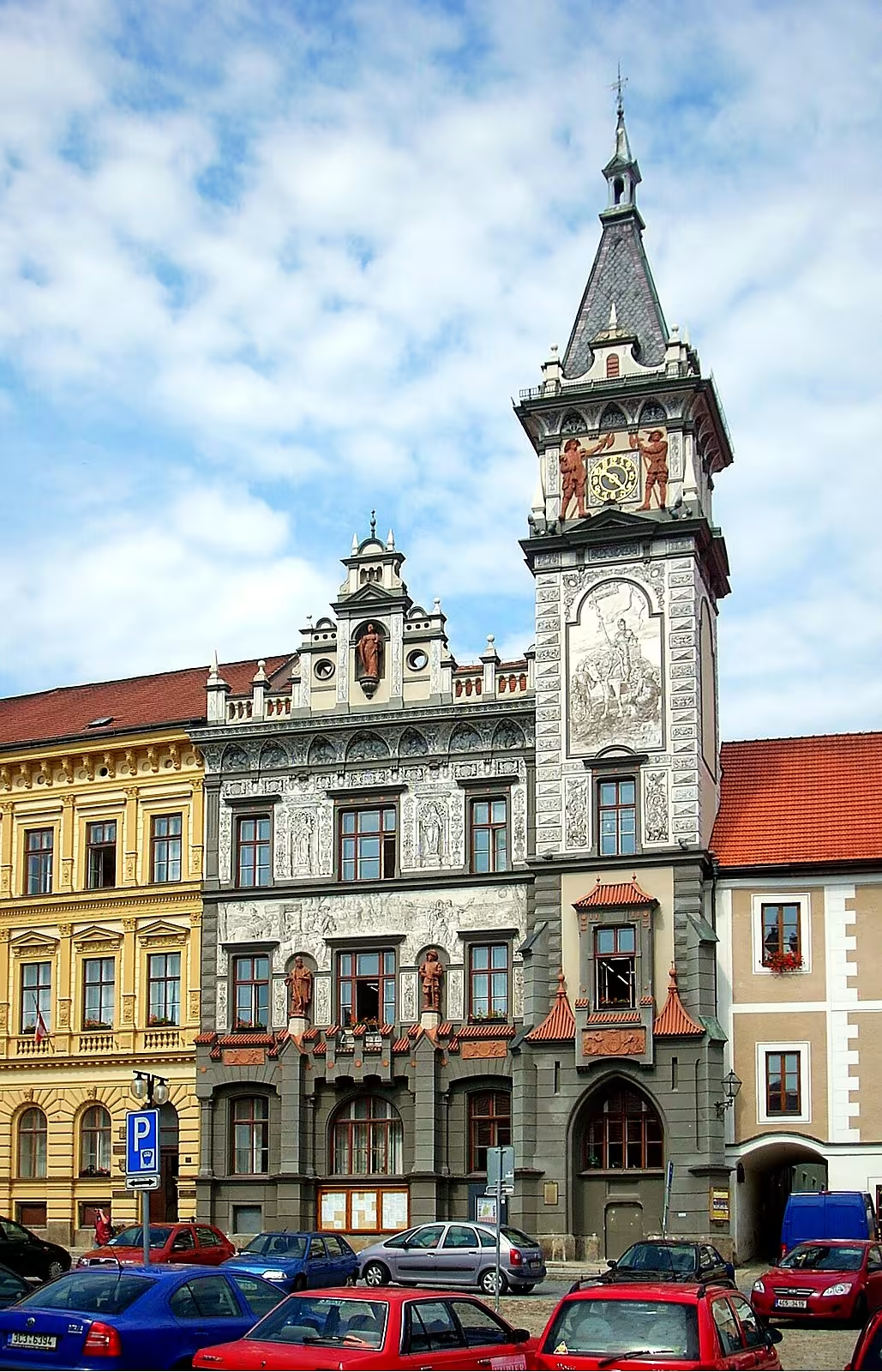
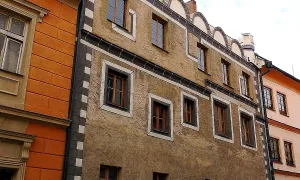
The new town hall in Prachatice is a representative neo-Renaissance building from 1903, located on the west side of the Grand Square. It serves as a seat of the city administration and is a key part of the city conservation.
The need for a new building arose after 1848, when the decentralisation of the government in Vienna strengthened local authorities and prompted the need for new offices. First, they built the Municipal House, which proved to be insufficient. Therefore, on June 12, 1901, the city management decided to buy a Meerwald house whose purchase price was approved for CZK 14,000 on April 5, 1902. The original design of the local architect Rudolf Zobel was rejected as insufficiently prestigious and reached out to Viennese architect Anton Knights von Schurd, who was involved in the construction in 1903.
The building is performed in German Neo-Renaissance style, reflecting the original Czech Renaissance present in the city. They form a common complex with the Municipal House, through which it enters the Town Hall because it does not have its own entrance. The original Gothic cellars are preserved in the basement. The facade is decorated with sgraffiti and dominated by a high prism tower with a roof in the shape of a needle and bell, symbolizing the importance of self-administration. This tower replaced the clock tower from Old Town Hall, which was removed in 1884.
The ground-floor facade is decorated with stuccative bazaar imitating stone diorite and closed with a cordon ledge in the shape of cimburi. In this ledge there is a rhetorical balcony, while on the first floor there is a bay with city emblem. The tower is decorated with stucco bossages with letter sgraffiti and double spalet windows have Art Nouveau creations.
The visual form of the facade consists of a sgraphite by Viennese painter Johann Viertelberger and sculptures by George Leisek. Above the windows on the ground floor are reliefs with laurel wreaths whose medium content is unknown. On the first floor there are two statues: a buyer symbolizing the business and wealth of the city, and a lancknecht reminiscent of the need to protect the city and trade routes. The whole facade is closed with an atics with balustrations.
The town hall was originally a Gothic house, later rebuilt in mannerist style. After the fire in 1832, he lost his attics and the facade was killed. During the demolition in 1902, an oppressive prayer house with a 15th-century mural was discovered, which depicts Christ on the cross, the Virgin Mary and Saint John. The stone human head from the original ledge is today in the city museum.
The building belongs to the town of Prachatice and since 2003 it has been protected as a cultural monument. During the renovation of the facade in the years 2003-2004 it was found that plastic elements changed colour. The restoration returned the original dark grey color designed by Anton Schurda, imitating the local diorite.
The new town hall is an example of the ambitions of the city administration from the beginning of the 20th century and a valuable example of historical architecture. Its detailed decoration and connection to the history of the previous building makes it an important sightseeing attraction of the center of Prachatic.
Historical milestones
- 1585
- rebuilding the original house into mannerist form
- 1832
- fire of the original Meerwald house
- 1903
- completion of construction of new town hall
- 2003
- inclusion of the object in the list of protected cultural monuments
Architectural development
The building was built in a Neo-Renaissance style at the site of the original Renaissance house. The facade is decorated with sgraffiti decoration and sculptures. The facade was renovated between 2003 and 2004.
Historical events
1902: purchase of land and house, 1903: completion of construction of new town hall, 2003: publication of cultural monuments
Owners
The City of Prachatice
Points of interest
- The building is neo-Renaissance and serves as a seat of the city administration. - The original Gothic cellars are preserved in the basement. - The high prism tower with the needle roof replaced the clock tower from Old Town Hall. - In the demolition, probably an attractive prayer house was discovered with paintings from the 15th century. - The facade is decorated with sculptures of buyer and lancknecht.
Guide
Show guide text
This text was created by artificial intelligence and has not been editorially reviewed. It may contain inaccuracies.
Welcome to the heart of Prachatic. You are standing right in the middle of the Grand Square and right in front of your eyes is the impressive building of the new town hall. Before we explore its history in depth, let yourself stand for a moment and perceive the atmosphere of this place. You can be absorbed by the overall impression of this representative building, which, by its size and dignity, dominates the whole square. It is a place that carries the weight of the city administration, and the power with which this building rises to the sky must remind you how important this place was to the lives of all the people for many decades. Feel the harmony here as the neo-Renaissance shapes connect with the surrounding space and how this object forms a solid part of the monument reservation in which you are currently moving.
Let us now move together in time and understand what this building really means. This building is not just a wall and a roof, it is the result of a long process of transformation that has passed through this square. To understand its present form, we must look deep into the past. In the year one thousand and five hundred and eighty five important events took place here, when the original building was rebuilt into a mannerist style, which gave this place a completely different character. But history wasn't always about beauty and bloom. In a thousand and eight hundred and thirty-two, a difficult test came for this place when the fire destroyed an original house belonging to the Meerwald family. But this tragedy also carried a grain of hope, because it was from the ashes and ruins of the old world that later began to give birth to a new, more modern picture of the city.
Now, if you look at the building you see, you see the peak moment of this recovery process. The year one thousand nine hundred and three was the key year when the construction of this new town hall was completed. It was not just an ordinary construction act, it was an expression of the pursuit of a modern and representative face of the city. The project that you admire today was developed by an important Viennese architect Anton Schurda. It is his vision and his ability to work with the form that has brought the influence of the German Neo-Renaissance, a style that you can perceive in this building in its overall balance and dignity.
Now pay attention to architecture and try to see the details surrounding you. Notice how the building looks firm and elegant at the same time. Look up, to that tall prism tower that rises to the sky. Her head roof is an absolutely distinctive element that immediately captures your vision. This tower is not a random addition, but it has its profound meaning. It replaced the older clock tower that the old town hall had. It's a symbolic transition from old to new, from past to future. Look at the facade and see how the Neo-Renaissance elements create a sense of stability and order. Although the building seems to be a firm and stationary object, its shapes carry the dynamics of the time when it was formed, when people tried to build worlds that would last for centuries.
In view of this construction, it is not possible to forget the names of the people who were or were closely associated with it. Architect Anton Schurda put his expertise and Viennese attention to detail in this place. But the history of the city is much more than just building plans. Names such as Johann Viertelberger or Georg Leisek are names that reflect in this context and remind us that every large building is the result of the collaboration of many personalities who at that time shaped life in this city. These figures were part of a complex network of social and political life that took place in these areas.
However, if you are looking for something that really surprises you and that is not visible at first sight, we must look below the surface. If you have a desire for secrets, know that this building hides layers of history that are hidden deep beneath your steps. In the basement of the new town hall the original Gothic cellars are still preserved. Imagine the depth of time when people from a completely different era moved around in these areas. These connections between the neo-Renaissance superstructure and the Gothic foundation are fascinating. And when this town hall was built and the old house had to retreat, something completely unexpected was revealed in his demolition. They may have found a very attractive prayer house, which was decorated with paintings from the 15th century. Imagine the excitement when this old and sacred place revealed itself beneath the layers of dust and time. It's a reminder that under every modern facade, the heart of the old world could be hidden, waiting hundreds of years for it to be found again.
This town hall is not just the headquarters of the city administration, it is not just a building where public matters are decided. He's a living chronicler of the city who carries traces of fires, reconstructions, religious changes and architectural advances. It's a place where the gothic darkness of the cellars collides with the neo-Renaissance clarity of the tower.
I hope that this short journey through time has pleased you and has helped you to see much more than a stone structure in this building. Please continue your walk around the Great Square, see the beauty of other buildings and enjoy the atmosphere of Prachatic. Any next step can lead you to the next surprise that awaits you in this city. Thank you for your attention and I wish you a pleasant continuation in discovering our historical treasures. Goodbye.
Tips for visitors
Best time to visit The new town hall in Prachatice is the spring or autumn season when the weather is pleasant and the sun illuminates the architectural beauty of the building. This time of year is ideal for exploring the local square without excessive heat or cold.
Current information about routes and times can be found in the online search engine.
When visiting City Hall, bring a photo because the building is a great place for a photo. The best light for capturing details in the Neo-Renaissance architecture can be found in the afternoon, when the sun illuminates the facade from the side.
The Old Town Hall and the local theatre are located in the vicinity of the New Town Hall. These historical monuments are an ideal addition to visit, allowing a deeper view of the cultural heritage of Prachatic.
For families with children, the surrounding square is a suitable place to walk. Children can enjoy watching architectural details and the possibility of moving around the historical space.
Frequently asked questions
Can the monument be visited?
The building is in use (offices, a school, shops and the like). The interior is generally accessible only during operating hours and tours are not usually offered; we have not verified the details. You can see the exterior from the street.
Where is the monument?
Location: Prachatice I. The map on this page shows the exact spot.
Why is the monument protected?
It is listed in the Central List of Cultural Monuments of the Czech Republic as a cultural monument (register no. 1399283883).
Businesses nearby
Do you run a restaurant, accommodation, shop, museum, rental, wellness or other visitor service near this monument? Show yourself directly to the people heading to it — this is how they will see you in the app and on the web:
Nearby
Velké náměstí, Stará radnice, městské divadlo
Accommodation nearby
Themed route
1. Large Square (Square) - The spacious center of the city, which serves as an ideal starting point for walking. 2. Old Town Hall (building) - Historical administrative object that shows the earlier face of the city administration. 3. New Town Hall (Town Hall) - The main destination of the trip, where is the current center of village management. 4. City theatre (building) - The cultural roof of the city offers space for artistic experiences.
Seasonal recommendations
Spring: The new town hall in Prachatice offers a wonderful view during spring when green trees and shrubs begin to bloom and illuminate historical architecture with sunlight. The atmosphere is calm and welcoming, which creates ideal conditions for relaxed walks around the sights. It is recommended to visit the town hall at the beginning of the day when there are fewer visitors and enjoy a quiet atmosphere. Clothes should be mild as temperatures increase gradually.
Summer: In summer, the New Town Hall is full of life and light. Long days allow long tours, while warm sunlight emphasizes architectural details of the building. The atmosphere is full of energy and there are often various events around the town hall. We recommend visiting city hall early in the morning or later in the evening to avoid long lines of visitors during the day. Clothes should be light and appropriate to warm days.
Autumn: During the autumn it offers A new town hall in the Money Eyes full of colors when the leaves of trees turn yellow and red. The sunlight is warm and illuminates historical buildings in mild light. The atmosphere is calm and welcoming, which offers ideal conditions for relaxed walks. It is recommended to visit City Hall in the meantime, when we avoid crowds, and clothes should be mild because temperatures are beginning to drop.
Winter: In the winter months, the New Town Hall offers views full of silence and peace. The architectural details of the building are highlighted by snow cover or ice rays that appear during cold days. The atmosphere is mild and calm, which creates an opportunity for a relaxed visit. It is recommended to visit the town hall early in the morning or later in the evening when opening times are often shorter and warm clothes are crucial for comfort during cold days.
Visualizations and artistic views

The visualisations are generated by artificial intelligence and serve as inspiration.
Photos from the area
Real photos taken near the monument


Zdroj a licence jsou uvedeny u každého snímku.
Tips from visitors
No tips yet. Be the first!
Log in and add your tip.
Sources and literature
Photos: Elis J / CC BY-SA 3.0 — Wikimedia Commons. The author and licence also appear when you hover over the image.
Faktickým podkladem tohoto textu byl článek na Wikipedii, jehož autory jsou přispěvatelé Wikipedie. Článek je dostupný pod licencí CC BY-SA 4.0.
Location on the map
More monuments – Prachatice I
Show all in the municipality

Příběhy a pověsti
Legendy, pověsti a příběhy spjaté s touto památkou
Fotografie návštěvníků
Zatím žádné fotografie. Buďte první, kdo přidá fotografii z návštěvy!
Log in a přidejte svou fotografii nebo hodnoťte.
Za ověřenou návštěvu v aplikaci získáte víc bodů — poznáme podle GPS, že jste na místě.
Reviews and comments