



Novoměstská jezuitská kolej Monastery
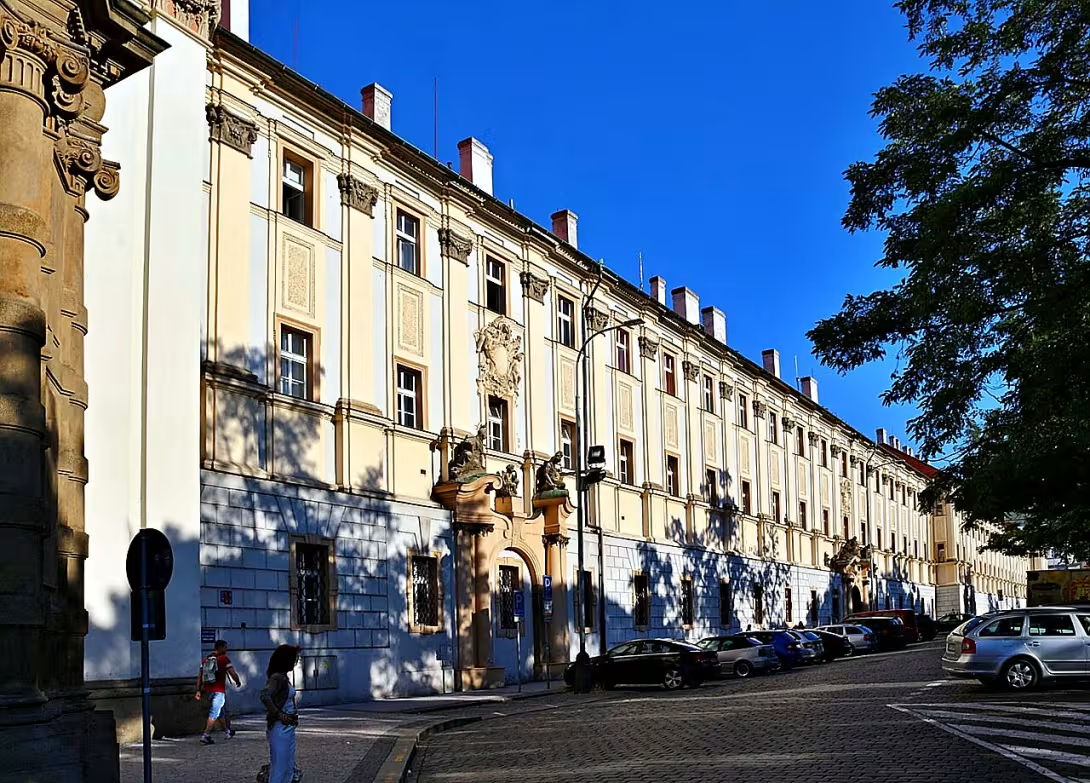
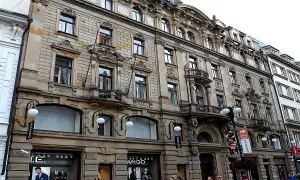
Novoměstská jezuitská kolej on the southeast side of Charles Square in Prague is a large Baroque-Classicist building no. 504 / II. Today he serves as part of the General University Hospital. Its western facade measures 200 meters without church. This is the largest Baroque building in Prague's New Town and the third largest Jesuit building in Europe. This object was created as a monastery of the Tovarishness of Jesus. Over the centuries, it has undergone significant building modifications and changes in its use.
The intention to build the Jesuit college near the chapel of God's body on the then Conquered Market was established with the consent of Emperor Ferdinand II as early as 1624. The Jesuits have managed this chapel since 1622. At first the Order wanted to build its monastery on the Horse Market, but this intention was not implemented. The construction of the track itself took place between 1658 and 1702 on the site of twenty-three older houses which had to be demolished. This falls into the period when Czech countries recovered from the consequences of the devastating 30-year war and the Habsburg monarchy with the Catholic Church strengthened their power and promoted reCatholisation.
The architectural design of the monastery was developed by Carlo Lurago. The construction was realized along with other masters, builders Martin Reiner and Pavel Ignác Bayer. From 1665 to 1678 the monastery church of St. Ignatius of Loyola was established on the north side of the building, whose author was also Carlo Lurago. The construction was closed by the port of Western Portics with the staircase Pavel Ignác Bayer according to its 1699 project. On the south side, the chapel of St. Francis Xaversky was attached as an organic part of the track. In the period around 1760, the western part was added to the church of St. Ignac in the next building phase according to the design of architect Jan Josef Wirch. At that time also portals with allegorical sculptures of science and art were added. In the nineteenth century, the object underwent classical modifications. The original monastery gardens occupied the whole block up to Lip Street. Later they were parked and built, creating a new Salmovska street and a new block.
Novoměstská jezuitská kolej served its original purpose until 1773. At that time, the Jesuit Order was abolished and the object was transferred to a special state fund. Subsequently, the barracks of the grenadir were established here. Of which the building was later modified to a military or division hospital. The church of St. Ignatius became parochial and was later returned to the Jesuit Order. The owners and administrators of the building were gradually Tovarysch Jesus, special state fund, military administration and general faculty hospital.
Key events in the history of the building include the year 1624 with the creation of a building project, the start of the main construction in 1658, the cancellation of the order in 1773 and also February 14, 1945. On that day, the building was damaged in the Allied bombing of Prague. Despite considerable damage, the building was repaired in the early 1950s. Since May 1958 it has been included in the list of cultural monuments in the complex of several buildings, which includes the church of St. Ignatius of Loyola.
Currently the former college is used as part of Prague's General Faculty Hospital. Specifically, there is the III Internal Clinic or Endocrine Clinic and Metabolism. The Institute of Hematology and Blood Transfusions with the Constitutional Library also resides in a later added side wing called company after reconstruction in the 1970s. In the immediate vicinity there is Charles Square and other mentioned health institutions.
This vast historical building represents an important proof of Baroque construction and development of Prague's New Town. Visiting this location offers an opportunity to recognize the unique connection of ancient architecture and modern health right in the centre of the metropolis.
Then and now
Drag the slider to compare how the landmark may have looked when it was built with the view today.
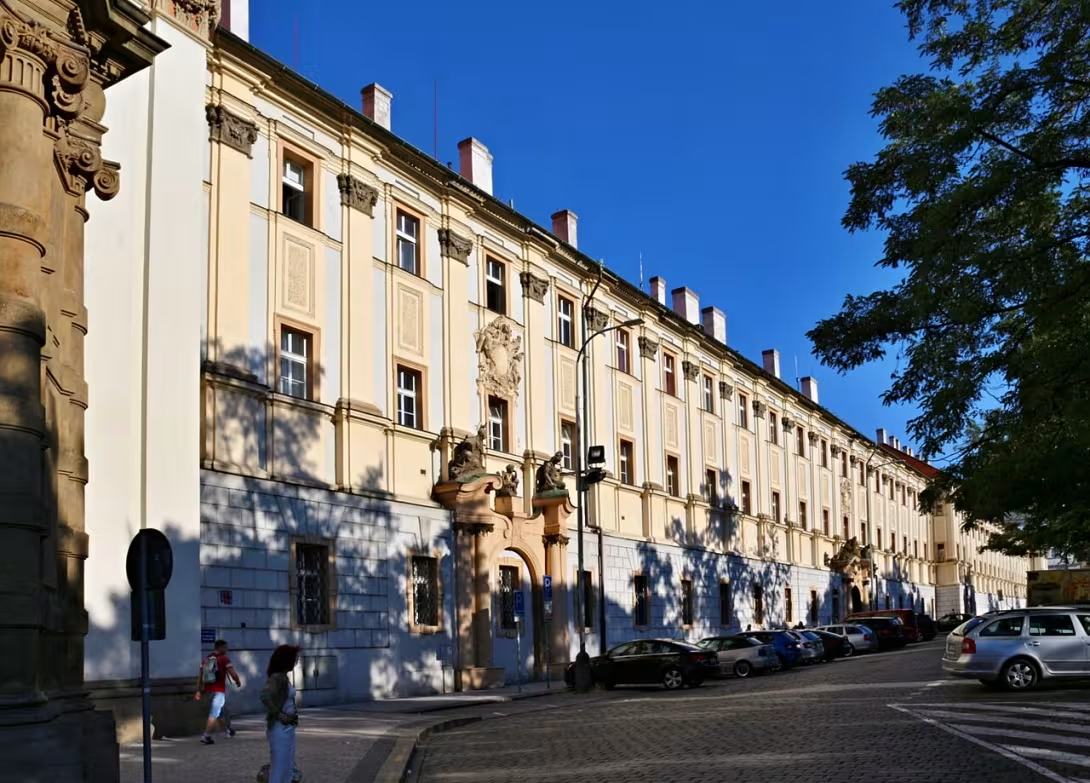
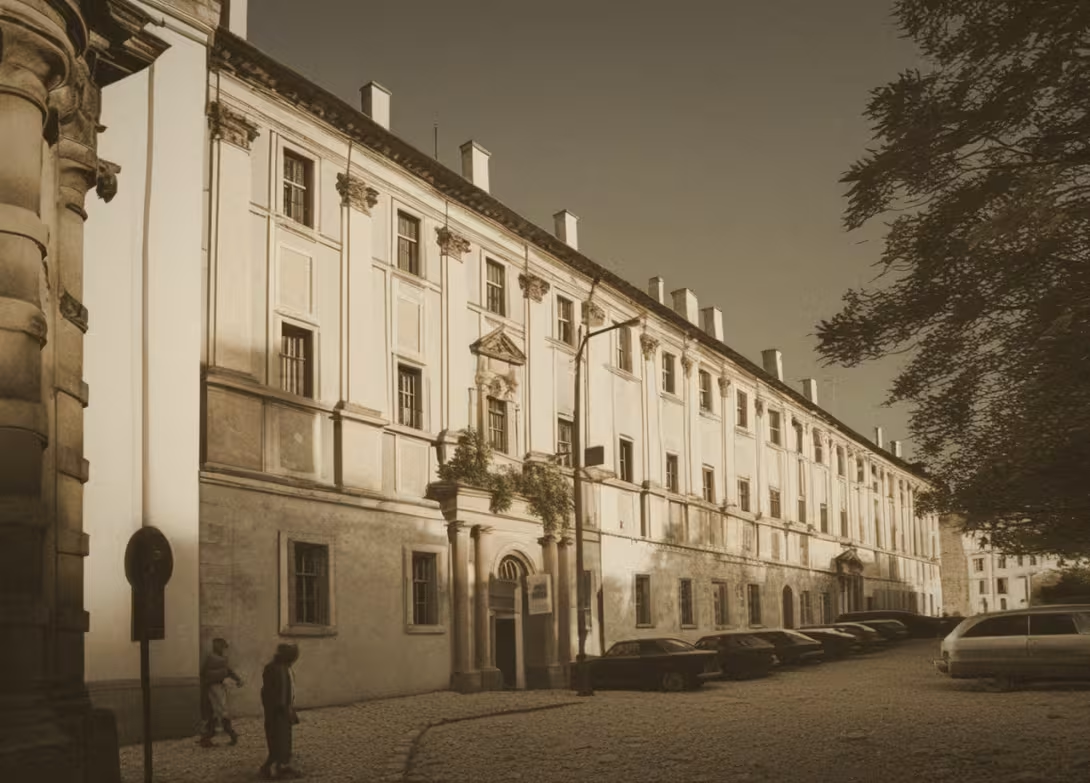
The historical appearance on the left is an AI-generated visualisation and serves as inspiration only.
Historical milestones
- 1624
- There was an intention to build a Jesuit college with the consent of Emperor Ferdinand II.
- 1658
- The construction of the track itself started at the site of demolished houses.
- 1773
- Novoměstská jezuitská kolej served its purpose until this year when the Jesuit Order was abolished.
- 1945
- The building was damaged in bombing Prague by allied aircraft.
Architectural development
The construction took place at the site of the older twenty-three houses that had to be demolished. The main Baroque form was created according to the design of architect Carl Luraga and his collaborators in the seventeenth and early eighteenth centuries. Around 1760, the western part was added to the church of St. Ignatius according to architect Jan Josef Wirch. In the nineteenth century, the object was classicically modified.
Historical events
In 1624, the intention was to build a Jesuit college. Between 1658 and 1702, the main construction phase of the track took place. In 1773, the Jesuit Order was abolished and the object was transferred to the State Fund and used for military purposes. On 14 February 1945 the building was damaged in the Allied bombing of Prague.
Owners
Tovarysch Jesus, special state fund, military administration, General faculty hospital
Points of interest
- The western facade of this building measures two hundred metres without the church, making it the largest Baroque building in Prague's New Town and the third largest Jesuit building in Europe. - The construction of the track itself took place between 1658 and 1702 on the site of twenty-three older houses which had to be demolished. - The original monastery gardens occupied the whole block up to Lip Street, but later they were parked and built, creating a new Salmovská street and a new block. - The building served its original purpose until 1773, when the Jesuit Order was abolished and the building was transferred to a special state fund, the barracks of the grenadir and later the military hospital were set up here. - On the 14th of February 1945, the building was damaged in the Allied bombing of Prague and was repaired in the early 1950s.
Guide
Show guide text
This text was created by artificial intelligence and has not been editorially reviewed. It may contain inaccuracies.
Welcome to one of the most important and extensive monuments of Prague's New Town. Stop for a moment, take a breath and hold the space in front of you with one look. You are standing in front of the New Town Jesuit college, which stands in the southeast part of Charles Square. The first impression that radiates from this building is the feeling of monumentality and power. It is a building which, both in its size and the way it dominates the surroundings, tells the story of ambition, faith and architecture of the time when Prague became one of the main centres of the European Baroque. Feel this atmosphere and imagine what this place looked like centuries ago, when the first foundations of this colossal complex began to emerge here.
To understand why this building is so special, we must return in time to the seventeenth century. It all began in the year one thousand six hundred twenty-four, when the first intention was to build the Jesuit college here. This plan was not random, but it was the product of careful planning and obtained the approval of Emperor Ferdinand himself. At that time, the Jesuit Order was one of the most influential organisations in Europe, focusing on education, the dissemination of faith and intellectual development. The Emperor's approval meant that the project would receive the necessary support and legitimacy. However, construction itself did not occur immediately. It must have been several decades before six hundred and fifty-eight actually started to build in the year one thousand. In order to create this vast complex, the area on which 23 older houses were originally built was clarified. These buildings had to be demolished in order to make room for a new, modern and representative construction, which was intended to reflect the importance of both the order and the period monarch.
Now pay attention to the architecture itself. Look at the western facade of the building that stretches in front of you. It's a truly stunning sight. If you measured this wall, you would find that its length without counting the church is 200 meters. This incredible size of the track makes the largest Baroque building of the entire Prague New Town. Note the rhythm and regularity of this facade, which carries all the features of the baroque style, namely the pursuit of grandeur and influence on the emotions of the viewer. Several important creators participated in this work. The main architect whose design laid the foundation for this construction was Carlo Lurago. His vision was to create a space that would not only be functional for the needs of study and prayer, but also serve as a visual symbol of power. During the time when the construction was gradually completed up to a year of a thousand seven hundred and two, other masters, such as Martin Reiner, Pavel Ignác Bayer and Jan Josef Wirch, joined the project. Each of them contributed to the building's ultimate, balanced and majestic appearance.
Now let's think about the fate of the people who lived and worked in these walls. The college served its original purpose, i.e. as a centre of education and the seat of Jesuits, for many decades. Imagine the everyday life here, the silence of libraries, the sound of steps in the corridors and deep discussion of philosophy and theology. But everything changed in a thousand seven hundred seventy-three. It was this year that the Jesuit Order was abolished, which meant the end of an era. The building lost its original inhabitants and had to adapt to new proportions and new functions. But the history of this place is full of contrasts. While the first centuries were marked by flourishing and construction, later history also brought tragic moments. If you look at the building today, you see its strength, but in its history, there is also pain. In the year one thousand nine hundred forty-five, in the end of World War II, the building was damaged in bombing Prague with allied planes. It was moments when this historical monument seemed to be irreparably lost, but thanks to subsequent repairs and the care of the heritage of the past, it stands before you today.
If you look at this building again, you might find one fascinating fact that gives the building a world dimension. I have already mentioned its length and importance for Prague, but Novoměstská jezuitská kolej is not only important within our city. If we compare it to similar buildings across Europe, we would find that they are among the absolute top. It is the third largest Jesuit building on the entire European continent. Imagine what it meant in the seventeenth century. To build such a complex required not only huge funds, but also incredible logistics and patience. The fact that 23 houses had to disappear to create it shows us the priority of creating this space. It was basically a new neighborhood within the neighborhood, a city in town that was supposed to affect the minds and hearts of thousands of students and visitors.
So this building is much more than just a pile of stones and layers of plaster. It is a stone that bears the fingerprints of architects like Carlo Lurago, the will of Emperor Ferdinand the second and the fate of thousands of people who have spent their lives here. It is a testament to the Baroque era, to the rise and fall of powerful orders and to the ability of architecture to survive even the hardest trials, such as war and bombing.
Now that you know the story of this monumental building, I suggest you slow down and try to perceive the building as a whole. Note how its large facade is inserted into the area of Charles Square and what contrasts it is surrounded by. Go through her timeline in spirit from the first intention in the year six hundred twenty-four to this time. I hope this short trip to history has helped you better understand the importance of the place you're standing with.
That concludes our stop at the New Town Jesuit College. Before you there is now room for self-reflection and admiration over the size of this baroque work. I invite you to continue your journey and discover other hidden and visible treasures of our beautiful city. I wish you a pleasant walk and many new experiences when exploring Prague monuments. Goodbye.
Tips for visitors
A tour of the historical building is best planned for the morning hours, where the surrounding area is quieter and the light falling on the facade from the south side is ideal for capturing baroque details.
Take with you comfortable shoes for walking on historic tiles and indoor areas, refreshments and in the case of sunny weather also a headgear.
The best places for photography can be found when looking from the park to the south-east side, where the extent of the whole building and adjacent sacral architecture in the best natural lighting will stand out.
In the immediate vicinity within ten minutes walk you can visit the adjacent church of St. Ignatius of Loyola or spend time in the park on Charles Square; Medical facilities such as General Faculty Hospital and Institute of Hematology and Blood Transfusions are also within reach.
Frequently asked questions
Can the monument be visited?
Religious buildings are usually open mainly during services; at other times a visit is normally arranged with the parish or the operator. We have not verified specific times.
Where is the monument?
Location: Nové Město, Hlavní město Praha. The map on this page shows the exact spot.
Why is the monument protected?
It is listed in the Central List of Cultural Monuments of the Czech Republic as a cultural monument (register no. 1000159896).
Businesses nearby
Do you run a restaurant, accommodation, shop, museum, rental, wellness or other visitor service near this monument? Show yourself directly to the people heading to it — this is how they will see you in the app and on the web:
Events nearby

Zdroj akcí: otevřená data měst a obcí ČR (Národní katalog otevřených dat) a kalendář akcí Národního památkového ústavu.
Nearby
V bezprostřední blízkosti se nachází kostel svatého Ignáce z Loyoly, Karlovo náměstí, Všeobecná fakultní nemocnice a Ústav hematologie a krevní transfuze.
Accommodation nearby
Trips and activities nearby
Guided tours, tickets and activities nearby from GetYourGuide
Affiliate link: if you buy from the partner, we may receive a commission. The price for you does not change.
Search tours and activities →Themed route
Novoměstská jezuitská kolej (monastery) Type: Historical monument, sacral and cultural area. Why is it worth a visit: This complex is proof of the rich history of Jesuits in Czech countries. Visitors can see preserved interiors, historical halls and the atmosphere of monastic life that has ruled here for centuries.
Church of St. Ignatius of Loyola Type: Sacral building, Baroque church. Why is it worth visiting: It is located in the immediate vicinity of the monastery and forms an architectural whole with it. Its interior decoration and history are closely related to the original purpose of the Jesuit college, allowing a comprehensive view of the spiritual history of the place.
Charles Square Type: City square, public space. Why is it worth a visit: It serves as an ideal place to relax after visiting historical buildings. It offers a pleasant environment for a short break where you can appreciate the urban development and atmosphere of the village Nové Město.
General University Hospital Type: Medical equipment, modern architecture. Why is it worth a visit: It represents a contrast to historical monuments and shows the current face of the site. For those interested in modern medicine and architecture, it is an interesting point that illustrates the dynamic development of this territory.
Haematology and blood transfusion Type: Specialized medical institution. Why is it worth a visit: It complements the image of modern health care in the surroundings. Together with the hospital, they form an important social and health pillar of the community, which is crucial for the local community.
This route logically links the historical core to modern institutions. It starts at the main destination, goes to the neighboring sacral monument and then leads through the square to modern medical facilities. All points are located in the immediate vicinity, which allows a comfortable walk without the need to use motor transport. The visitor gets a comprehensive picture of the place where history intersects with the present.
Seasonal recommendations
When spring rays begin to warm and snow melts, the historical walls of the New Town Jesuit college slowly awaken. The atmosphere in this period is calm and contemplative, because the surrounding nature is only just beginning to green and the trees in the surrounding gardens are only just throwing the first buds. The sunlight falls at a sharp angle and beautifully paints the details of the old stone facades. In spring you will not meet large crowds of visitors, so you can enjoy the tour in complete silence. The ideal time to visit is in the morning, when the city is still alive. Put on comfortable laminated clothes and solid shoes because the tiles in the surrounding alleys can be wet and uneven after winter.
During the main summer season the monastery offers a completely different face full of bright daylight and lively energy. The sun radiates the courtyard for a large part of the day and creates sharp contrasts between light and deep shadows in the loops. The air is usually warm and in nature around the monument there are full green vegetation. Since these are holiday months, it is necessary to count on a higher number of tourists flowing through the city. The best time to enter the premises is early morning after opening to escape the midday heat and the largest crowds. Take light clothes, sunglasses, headgear and a bottle of drinking water, because there is a limited possibility of refreshments in historical buildings.
With autumn coming, the color of the light turns to golden and the whole area of New Town gets a melancholy touch. The surrounding trees play all shades of yellow, orange and brown, which creates a wonderful scenery for lovers of photography. The atmosphere is quiet, deliberate and the air is fresh and cold. Visitors from the general public are running low, which guarantees an uninterrupted tour of the internal premises. The best time to arrive is in the afternoon, when the low autumn sun creates long shadows and magical reflections on the window tables. Don't forget to wear a warmer coat, scarf and waterproof shoes, as frequent rain showers and cold winds can make your stay outside uncomfortable.
In the winter period, Novoměstská jezuitská kolej is covered in silence and often also in a snow blanket that dampens the sounds of the surrounding city. The lighting is very specific, the days are short and it soon gets dark, while artificial lighting gives architectural details a mysterious character. In advent time and during freezing months, tourism is at a minimum, which is appreciated by all looking for deeper knowledge without disturbing influences. We recommend to leave around noon, when it is the hottest outside and the sun passes through the clouds for a while. The basis of the successful expedition is really warm winter clothes, hats, gloves and solid shoes with anti-slip soles, as the outdoor areas can freeze.
Visualizations and artistic views


The visualisations are generated by artificial intelligence and serve as inspiration.
Photos from the area
Real photos taken near the monument

Zdroj a licence jsou uvedeny u každého snímku.
Atmosphere of the place
This atmospheric visualisation of the place and period was generated by artificial intelligence. It is not real footage of the location.
Tips from visitors
No tips yet. Be the first!
Log in and add your tip.
Sources and literature
Photos: VitVit / CC BY-SA 4.0 — Wikimedia Commons. The author and licence also appear when you hover over the image.
Faktickým podkladem tohoto textu byl článek na Wikipedii, jehož autory jsou přispěvatelé Wikipedie. Článek je dostupný pod licencí CC BY-SA 4.0.
Location on the map
More monuments – Nové Město
Show all in the municipality


Příběhy a pověsti
Legendy, pověsti a příběhy spjaté s touto památkou

Fotografie návštěvníků
Zatím žádné fotografie. Buďte první, kdo přidá fotografii z návštěvy!
Log in a přidejte svou fotografii nebo hodnoťte.
Za ověřenou návštěvu v aplikaci získáte víc bodů — poznáme podle GPS, že jste na místě.
Reviews and comments