



Na Poříčí Church
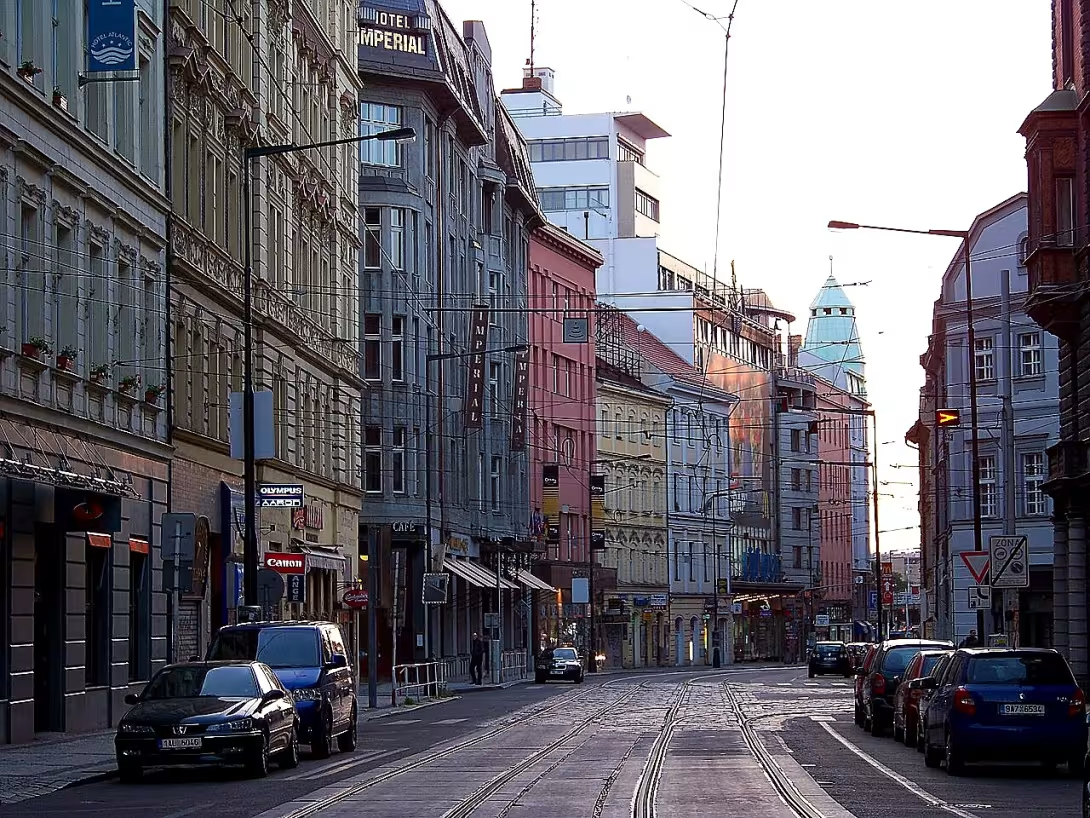
Na Poříčí is one of the oldest roads connecting Prague to the eastern suburbs, especially the Highlands and the Deputies. Its name is based on a position off the coast of Vltava, where the medieval settlement Poříčí was located for the first time mentioned in written records from 993. The street has gradually developed into an important artery of New Town. In the 14th century it was composed of two separate parts - it was called Slaměná near the Republic Square, while the second part was named Shilinkov according to the family of the new town express František Shilina. Since the second half of the 19th century the street has been called Poříčská, only since 1894 it bears its current name Na Poříčí.
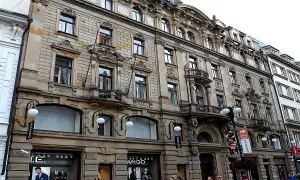
The architecture of the street tells the story of over half a millennium of construction. The oldest layer is the remains of the medieval chateau from the 2nd quarter of the 13th century, which we will recognize today as the Bishop Court. It was here that the originally fortified Spital Court of Cruisers stood; The classic rental house from 1846 by Josef Brenn occupies one of the oldest places on the street. The Baroque and Classicist Layer represents among others the Capucinese hospice at St. Joseph's, originally a Baroque building rebuilt in the Classicist style in 1795 and 1833. Similarly, there are two houses that were created by overlapping Gothic buildings - House U Volavků, where Josef Maličký modified facades in Classicism, and House U Golden Sun.
The second half of the 19th century brought other interesting buildings. Novaroký Labor's accident insurance company in Poříčí 7 (1894) from architect Alfonse Wertmüller. It was this building that became famous because Franz Kafka worked here in the early 20th century. The rental house with the corner of Poříčí 18, built in 1885-1886 according to plans by Antonín Wiehl and Karl Gemperle, comes from the time.
The beginning of the 20th century was carried in the spirit of increased comfort and modern design. Hotel Imperial built in 1913-1914 according to plans by Jaroslav Benedikt is a five-star hotel with plastics from Josef Drahonovský. Hotel Atlantic designed in Classicist style with New Year's Coconut details Johann Heinrich Frenzel already in 1844. A more puristic concept was brought to the architecture of the YMCA Palace from the 1920s, which was designed by Eduard Hnilička.
The highlight of the metamorphosis of the street was the creation of a series of functionalist structures in the 1930s and early 1940s. The White Swan of 1937- 1939, the work of the architects Josef Kittrich and Josef Hrubý, was considered the largest and most modern department store in Central Europe when opened in 1939. A functionalist house with brewery and restaurant U Rozvařilů (1937- 1939) from František Marko was born nearby, where the theatre hall is located on the ground floor and basement. The studio D 34 and Theatre E. F. Burian used to work under this ceiling, today the Arch Theatre resides here. Near is the Palace of the Ark from 1937-1939, designed by Josef Gočár. Hotel Axa with swimming pool and cafe, created by Václav Pilco in 1930-1932, represents a far more sophisticated functionalist interpretation of hotel architecture.
There's a tram track going through the street today. It seems a hidden gallery of those who stop to see the details of architectural styles from the Middle Ages to the modern era.
Then and now
Drag the slider to compare how the landmark may have looked when it was built with the view today.
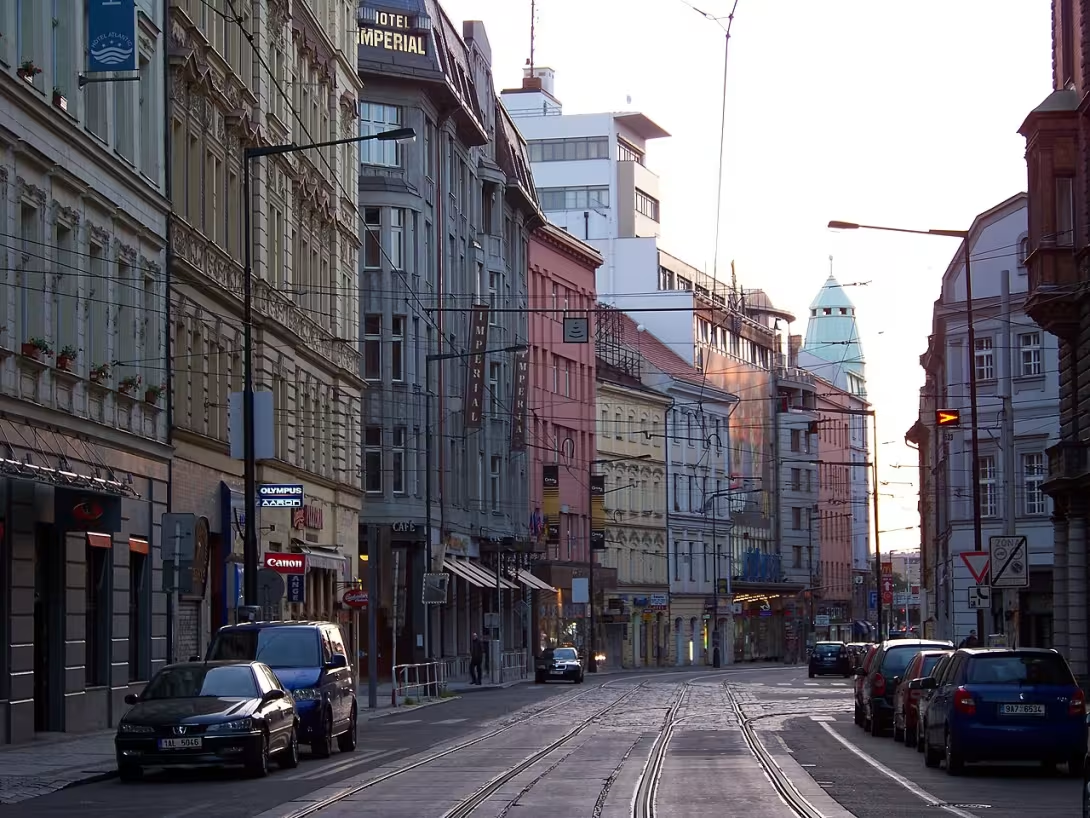

The historical appearance on the left is an AI-generated visualisation and serves as inspiration only.
Historical milestones
- 993
- The first written mention of the village of Poříčí.
- 14th Century
- Distribution of today's street Na Poříčí in two parts - Slammy and Shilinkov.
- 1894
- Change street name to Na Poříčí.
- 1937-1939
- A number of functionalist buildings were built, such as the White Swan, Palace of the Ark and Brewery U Rozovila.
Architectural development
The street Na Poříčí is architecturally diverse. It includes baroque and classicist buildings from the 18th and 19th centuries, such as the Capuchin hospice or Hotel Atlantic. At the turn of the 19th and 20th centuries, Neo-Renaissance and Historical buildings, such as the Bohumil Bondy family, were built here. In the 20th century, functionalist buildings were added, like the White Swan department store or Hotel Axa. Materials and stylish elements are thus reflected in various historical periods and architectural directions.
Historical events
- 993
- The first written mention of the village of Poříčí on the shore of Vltava.
- 14th Century
- The street was made up of two parts - Slammy and Shilina, named after the speedster František Shilinka.
- 1894
- The street has the current name Na Poříčí.
- 1928
- The destruction of the unfinished department store, where the Hotel Harmony was later founded.
Owners
The sequence of owners with years if available, otherwise zero.
Points of interest
- Na Poříčí is one of the oldest roads connecting Prague to the eastern suburbs, first mentioned in 993.
- In the 14th century the street consisted of two parts - Slamené near the square of the Republic and Shilinkov, named after the speedster František Šilinka.
- In the place of today's Bishop Court was the originally fortified Špital Court of Cruisers from the 2nd quarter of the 13th century.
- A writer Franz Kafka worked in the building of the Workers' Insurance Insurance Company in Poříčí 7 in the early 20th century.
- The White Swan department store from 1937- 1939 was the largest and most modern department store in Central Europe when opened in 1939.
Guide
This guide is narrated by a synthetic voice generated by artificial intelligence.
Show guide text
This text was created by artificial intelligence and has not been editorially reviewed. It may contain inaccuracies.
On Poříčí is a street in the New Town in Prague. It begins at Republic Square and ends at the street Ke Štvanici. Trams run in both directions along its entire length. It belongs to the oldest routes that connected Prague with eastern suburbs, and from here a road led to Vysočany and Hloubětín.
The name recalls the banks of the Vltava River and the medieval settlement Poříčí, first mentioned in writing in the year 993. In the 14th century, today's street consisted of two parts. Near today's Republic Square it was called Slaměná Street, the other part was named Šilinkova after the family of the New Town judge František Šilink. From the second half of the 19th century the street was called Poříčská, and it has had its current name since 1894. Colloquially it was called Poříč.
At the beginning of the street stands the Capuchin hospice of Saint Joseph. It is a Baroque building of a former Capuchin monastery, classically rebuilt in 1795 and 1833. Nearby is a neo-Baroque house with a dome from 1894, which housed the Workers' Injury Insurance Company for the Kingdom of Bohemia. At the beginning of the 20th century Franz Kafka worked there.
The street has preserved much architecture from the first half of the 20th century. The Hotel Imperial was built between 1913 and 1914 according to plans by Jaroslav Benedikt, and the sculptures in its interior were created by Josef Drahoňovský. The YMCA Palace was designed by Eduard Hnilička in the 1920s in the style of purism. Functionalism is represented here by the Hotel Axa by Václav Pilce from 1930 to 1932, which has a café and swimming pool.
Particularly fruitful were the years 1937 to 1939. The White Swan department store was built then by architects Josef Kittrich and Josef Hrubý. At its opening in 1939 it was designated as the largest and most modern department store in central Europe. In the same years Josef Gočár built the building of Legio Bank, today the Arch Palace, and František Marek built the passage house U Rozvařilů. In its theater hall today sits the Divadlo Archa.
Reaching further back into the past is the Bishop's Court. On its site stood a medieval hospital courtyard of the Knights of the Red Star, originally a fortified stronghold from the second quarter of the 13th century. The current classicist apartment building was built in 1846 by Josef Brenn. Also remarkable is the Kindl House, which architect František Kindl designed for himself. It has a dome and on the facade on the fourth floor there are 15 busts of personalities in construction.
Frequently asked questions
Is Na Poříčí open to the public?
Yes, the church is open to the public. The best time to visit the church is during the day when the light is ideal for photography.
How do I get to the place by car / public transport?
You can get by bus No. 91 or 99 from the centre of Prague. Parking is possible in nearby streets, but we recommend using the parking lot by the river.
How much is the entrance fee and is it paid on the spot?
The church entrance is free. If you want to contribute to the maintenance of the monument, you can make a donation in the cash register.
Is the tour suitable for children and seniors?
Yes, the church is accessible to all visitors regardless of age. However, we recommend taking off our hats and scarves so that you don't be prevented from seeing details of architecture.
How long does the tour take?
The church tour takes approximately 30 minutes. If you want to extend your tour, you can stop by the nearby park by the river.
What are the opening times and booking is required?
The church is open every day from 9:00 to 18:00. Reservation is not necessary, but if you want to ensure access for a large group, we recommend to contact the heritage manager.
What's interesting in the immediate vicinity?
In the vicinity of the church there is a park by the river where you can relax and observe the water flow. There is also a possibility to visit the nearby Staromestske Square.
For kids
Imagine going back to a time when there was a lot of life and energy in Old Town. It was the morning of the 16th century, and the city was like a living organism that evolved and changed with every day.
Na Poříčí stood a beautiful church which was the heart of this organism. It was a place where important events took place, where people gathered in services and important contracts were made. The church Na Poříčí stood by the river Vltava and its wings stretched to its shore.
Businesses nearby
Do you run a restaurant, accommodation, shop, museum, rental, wellness or other visitor service near this monument? Show yourself directly to the people heading to it — this is how they will see you in the app and on the web:
Events nearby


Zdroj akcí: otevřená data měst a obcí ČR (Národní katalog otevřených dat) a kalendář akcí Národního památkového ústavu.
Accommodation nearby
Trips and activities nearby
Guided tours, tickets and activities nearby from GetYourGuide
Affiliate link: if you buy from the partner, we may receive a commission. The price for you does not change.
Search tours and activities →Themed route
Thematic cruise route: Baroque and cultural trail around New Town
1. Na Poříčí - * street * Start by walking this historic street that connects Republic Square to Old Town Square. Its name refers to the former ford over Vltava and offers picturesque houses with Renaissance and Baroque elements.
2. Capucin monastery - * monastery * Then go to the Republic Square, where the preserved Baroque Capucin monastery from the 17th century stands. Its monastery church and monastery building are an example of Czech Baroque architecture.
3. National Theatre - * Theatre * Continue towards the Old Town Square where the iconic National Theatre is located. Its neoclassical facade and rich history associated with the Czech national renewal are an unforgettable experience.
4. Vltava - * river * Enjoy a short view of the Vltava from the bridge or from the Old Town Square. The river is not only a symbol of Prague but also offers picturesque views of historic bridges and surrounding architecture.
The route is short, approximately 1-2 km, and connects key cultural and historical points of the New Town.
Seasonal recommendations
Spring Na Poříčí in Prague will turn the spring visit into a magical walk between blooming trees and a waking city. The light of the sun, which is reflected from historical facades and freshly washed stone stairs, creates a gentle, golden touch. Nature is awakening - first flowers appear in the park near St. Nicholas' church, while the square has a quieter atmosphere than in the summer months. The soft, variable weather is also specific: one sunny, another temporary rain, which provides a romantic atmosphere. Practically best to visit the memory in the first half of spring (March-April) when you avoid the main tourist season. Comfortable shoes and light but warm clothes are recommended - the morning can be cold while the noon brings pleasant warmth. The ideal time is the afternoon when light becomes softer and shadows on historic buildings create interesting contrasts. Avoid weekends where tourists come from around here.
Summer In the summer months, Na Poříčí will turn into a vibrant center full of sunlight and urban activity, when historic streets are projected into warm, golden radiation. The main attraction is not only architecture, but also pleasant sitting in cafés under trees where the smell of coffee with the scent of summer flowers is mixed. In the main summer season (red-August), however, a crowd of tourists must be counted, especially around St. Nicholas' church and by the stairs to the Old Town. It is recommended to visit the memory early in the morning or late in the afternoon when the light is softer and the crowds are shrinking. Suitable is light, breathable clothes, sunglasses and hat - direct sun on stone stairs can be unpleasant. If you are planning photography, choose the time before noon when shadows extend and create dramatic effects on historical facades.
Autumn Autumn at Na Poříčí offers a unique atmosphere where the colours of the leaves and the sun, which is nearing below, are painted in window openings of historic houses with golden and orange shades. In September and October you will meet more calm visitors, while in November there is already a colder, but poetic mood, especially in advent time, when the first Christmas decorations appear in the square. A soft, scattered light is also specific, which highlights the details of stone reliefs and statues. Practically best to visit a monument in September or early October, when the weather is still pleasant and the crowds are minimal. It is recommended to layer clothes - the morning and evening can be cold while the afternoon pleasantly warm. The ideal time is the afternoon when light becomes warmer and shadows create interesting contrasts on historic buildings. Avoid rainy days when stone steps can become slippery.
Winter Winter Na Poříčí is a magical contrast to the summer rush - the white screen of snow covers stairs and historic facades, while the sun, which rarely appears, is reflected from the ice crusts on the windows. In advent time, the square will turn into a fairy tale scene, where a shining Christmas decoration is added to historic buildings. A short daylight light is also specific, which creates dramatic shadows and emphasizes architecture. In winter, however, shorter opening times for monuments and possible weather restrictions should be envisaged. It is recommended to visit the memory in December when there is the most magical light but avoid too cold days. Suitable is warm but comfortable clothing - layered sweaters, warm shoes and gloves because on the stone stairs the cold spreads quickly. The ideal time is the afternoon when light becomes softer and shadows create interesting effects. Avoid strong frost, when some parts of the monument may close.
Visualizations and artistic views


The visualisations are generated by artificial intelligence and serve as inspiration.
Photos from the area
Real photos taken near the monument

Zdroj a licence jsou uvedeny u každého snímku.
Tips from visitors
No tips yet. Be the first!
Log in and add your tip.
Sources and literature
Photos: ŠJů (cs:ŠJů) / CC BY-SA 3.0 — Wikimedia Commons. The author and licence also appear when you hover over the image.
Faktickým podkladem tohoto textu byl článek na Wikipedii, jehož autory jsou přispěvatelé Wikipedie. Článek je dostupný pod licencí CC BY-SA 4.0.
Location on the map
More monuments – Nové Město
Show all in the municipality


Příběhy a pověsti
Legendy, pověsti a příběhy spjaté s touto památkou
Fotografie návštěvníků
Zatím žádné fotografie. Buďte první, kdo přidá fotografii z návštěvy!
Log in a přidejte svou fotografii nebo hodnoťte.
Za ověřenou návštěvu v aplikaci získáte víc bodů — poznáme podle GPS, že jste na místě.
Reviews and comments