






Gorazdova Monastery
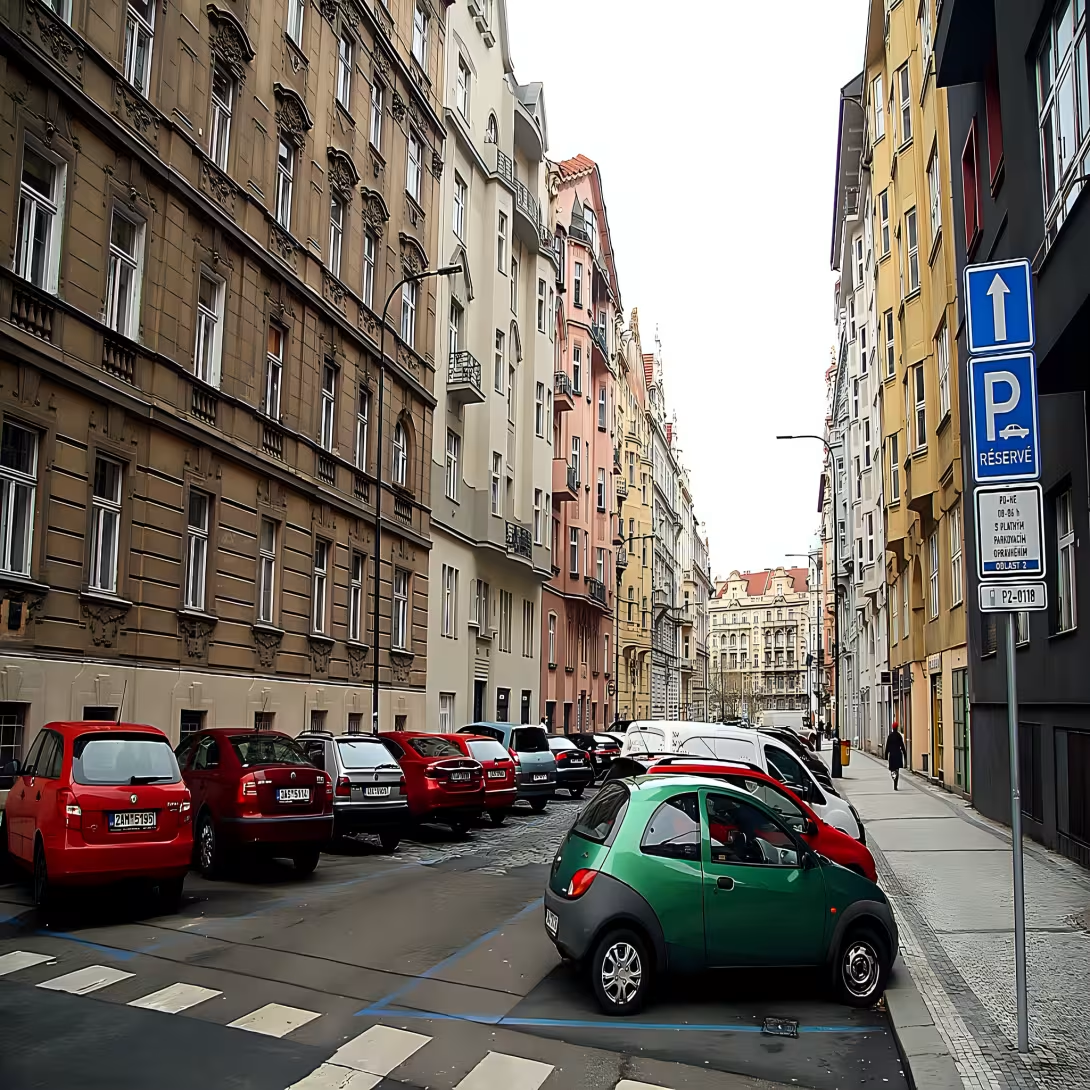
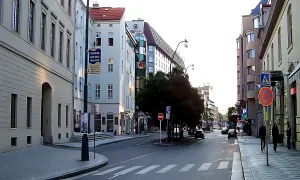
Gorazdova Street lies in New Town and connects Jirásek Square with Palacky Square. It is named in honor of Bishop Orthodox Church Gorazda, whose worldly name was Matěj Pavlík. This street has deep roots in the history of Prague's quote - it was established in the Middle Ages as the main axis of communication under the Emauscan Rock. After the founding of the New Town in 1348, the swimmers and fishermen, whose professional group was called Podskalí, gradually settled there. The houses were built in the second front along the waterfront of Vltava, taking turns with small gardens and wooden warehouses.
From the 18th century until 1947, the street was actually called Podskalská. During the 19th century, especially after the landscaping of the Zítek orchards in 1896 and later in the construction of buildings of the Ministry of Construction and the Ministry of Labour in the 1930s, the street was divided into two parts. The upper part received the current name Gorazdova in 1947, the lower part remained Podskalská street. About half the length, she crosses at the right angle of Trojanov Street.
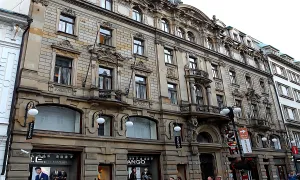
Around 1900, there was a fundamental rendering of old Podskalí, when all older houses were demolished. In their place, between 1896 and 1914, several rental houses grew up five to six floors. Many of them were financed by rich Jewish townspeople who moved here from a demolished Jewish town. The architecture is characterized by eclectic elegance - here we find a neoRenaissance corner of the house Pizhěk from 1897 with a motto on the facade "Persistence leads to the goal, surpasses even a long mile" but also Art Nouveau houses with rich stucco decoration and functionalist buildings. The functionalist house number 12 was designed by architect Petr Kropáček from 1928 to 1929. House number 11 in the style of historism decorated with Art Nouveau relief women; The natural scientist Václav Jan Staněk used to live here, who photographed his books from the balcony. House number 13 remains a symbol of the Art Nouveau period as a protected monument with a bust of a woman and painting on the facade.
The fate of the street was grossly marked in February 1945 by the bombing of the Emauscan monastery. Two of the four corner houses were completely demolished during the raid, the rest of the buildings suffered such static damage that repairs lasted until the early 1960s. The largest loss of the street was suffered in 1979 when a valuable Art Nouveau house number 4 by architect František Buriánek was demolished in connection with the construction of the Charles Square metro station. The new construction of Traffic Control was built in its place. The memorial record dedicated to the bombing victims from 1945 disappeared.
The street has preserved its historical functions - there was a famous restaurant in house 17, which was visited by city personalities. Gorazdova thus remains a testament to the various epoch of Prague architecture and the ball, where the craft tradition combines with the urban interventions of the decade.
Then and now
Drag the slider to compare how the landmark may have looked when it was built with the view today.
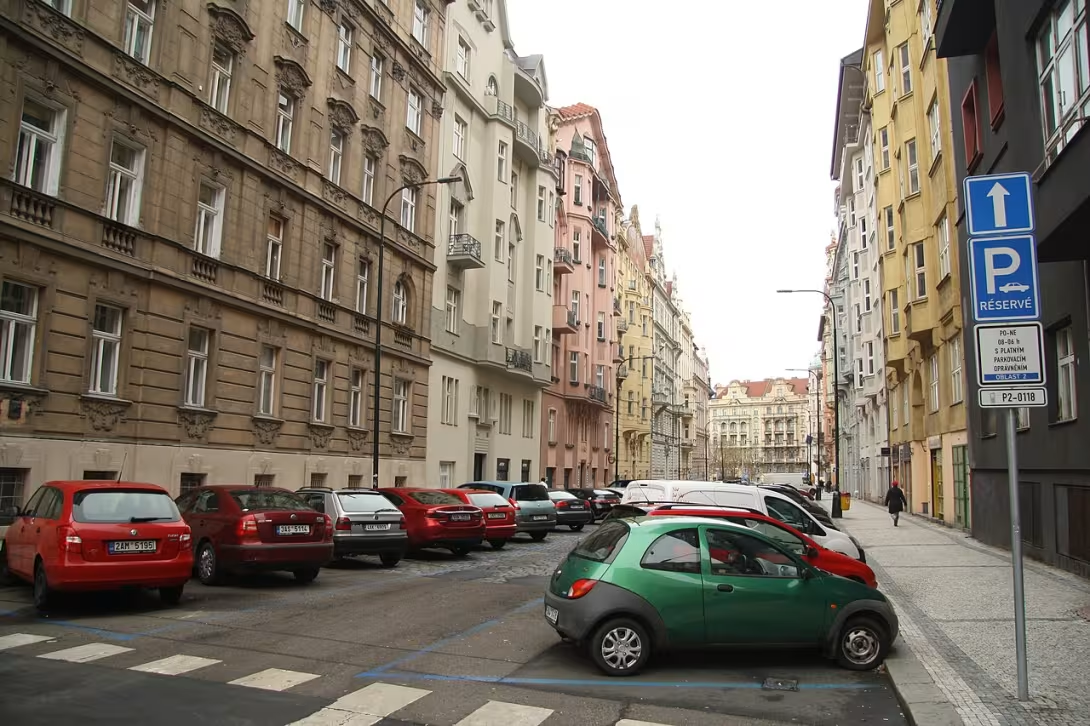

The historical appearance on the left is an AI-generated visualisation and serves as inspiration only.
Historical milestones
- 1348
- The New City of Prague and the establishment of the Podskalí settlement.
- 1896
- Field modifications for the Zetka sets.
- 1945
- Bombardment of the Emmazi monastery and damage to a part of the street.
- 1979
- The demolition of architect Burian's model Art Nouveau house.
Architectural development
The street has undergone transformation from medieval houses to terraced houses from the period of history and Art Nouveau. In the 20th century it was stopped by functionalist structures and subsequently modernized.
Historical events
1348: The New City of Prague and the creation of the Podskalí settlement. 1945: Bombing the area in World War II. 1979: The demolition of the Art Nouveau building for the construction of the subway.
Points of interest
- The street is named in honor of Bishop Gorazd, whose worldly name was Matěj Pavlík. - It originated in the High Middle Ages and there were settled swimmers of wood and fishermen, hence the name Podskalí. - The natural scientist Václav Jan Staněk lived in house 11, who photographed animals from the balcony for his publications. - In 1979 a valuable Art Nouveau house number 4 was demolished by architect František Buriánek for construction of the metro station. - There was a famous restaurant in house 17 for years.
Guide
This guide is narrated by a synthetic voice generated by artificial intelligence.
Show guide text
This text was created by artificial intelligence and has not been editorially reviewed. It may contain inaccuracies.
Welcome to one of those paths that carries the deep breath of history that constantly reminds you of how quickly the world around us changes. You are standing right on Gorazd Street, in the heart of Prague's New Town. If you look around you now, you will see a space that is not just an ordinary path for pedestrians or vehicles, but it is an important connecting element that leads from Jirásek Square to Palacký Square. Can you feel the strange atmosphere? It's a mixture of urban hustle and bustle that every historical neighborhood carries. Now that your headphones are on, allow me to guide you through the layers of time that lie beneath your feet and around you.
Let's go back deep into the past together to understand why this place looks like it does. Imagine the year thirty-four and eight centuries. That was the time when the Nové Město of Prague was just starting to build. But at that time, there was nothing you could see around you. This area was called Podskalí. It was not an elegant urban neighborhood with wiped out facades, but a place where life was closely linked to water and nature. Notice the name of this area. Underground. That name tells us who once lived here and how it was done. It was the people who used to feed on fishing and wood. Imagine those noisy, but hardworking people transporting raw materials along the river that were absolutely necessary for the growth of the whole city. This street was created in the period of the Middle Ages as an important communication for these needs. From a simple settlement of swimmers and fishermen, over the centuries, over many generations, it has turned into the elegant urban street that you are now walking through.
Now pay attention to what you see around you in the form of buildings and their appearance. You may notice that architecture here is not entirely unified. Every facade and every detail can tell a different story about how Praha changed over hundreds of years. This street has undergone many fundamental changes that have irrevocably changed its face. One of the largest was the so-called sanitation, a process when old, often inappropriate parts of the city turned into modern urban buildings. Notice the details on the facade of the buildings that stand here. You can see here traces of the hands of prominent creators who have tried to give this part of the city its present face. These include Emil Pištěk or Petr Kropáček, as well as Jan Petrák. Their work shaped the character of this place.
However, this street was not just shunned by progress and modernization. We must also look at the shadows of history that have left a difficult time. In a thousand and nine hundred forty-five, Praha was hit by bombing. Even these streets and nearby surroundings, including the Emmausia monastery, have suffered damage. This has fundamentally affected what today's space looks like and what buildings are standing here. Later came the construction of the metro, which again changed the rhythm and appearance of this place and brought new dynamics to the area. It is also sad that we have lost some beauty as a result of these changes. In the year one thousand nine hundred seventy-nine had to tear down one of the model Art Nouveau houses designed by architect František Buriánek. Even if you don't see him here anymore, his absence in architecture still resonates and reminds us how fragile the city can be.
Now let's focus on people whose names are inextricably linked to this place. The first thing you realize is the street name itself. Gorazdova. So who was Gorazd? He was a bishop whose name today bears this path. His worldly, I mean human name, was Matěj Pavlík. This man has left a trail in history that leads us here. Another figure that's good to know is Václav Jan Staněk. If you look at house 11, you can imagine how this great scientist once lived there. That brings us to something very human and beautiful. The tent was not just a scientist who studied the world only in books. He observed this world right here in this environment. He often used his balcony to photograph the animals and nature around him in peace and quiet. Imagine him, in the silence of morning or evening light, capturing moments of life while the streets around him were awake or asleep. There were people on this street trying to understand the world, whether through faith, science or simple craft.
Before you go further, let me stress one interesting point that will help you better understand the name of the place where you are. The name Podskalí we talked about is not random. It's a direct reference to the first residents who built their lives here. Wood swimmers and fishermen were pillars of this place. Every step you take is in some sense a step after the history of people who have adapted to the flow of water and the slope of the terrain. So this street is a fascinating bridge between the wild nature that once ruled here and the modern metropolis that you see today.
Now it's time to continue your journey. Gorazdova Street offers you many more details waiting for your eye. Look at the facade of the houses, feel the atmosphere of this place, which connects the old Podskalí with the modern centre of Prague. Every house, every facade and every field change you can perceive here is proof of the constant movement of time. I hope this brief insight into the past has helped you better understand what you're walking after and what stories are hiding behind these walls. I wish you a nice walk through the city and enjoy every moment of your discovery. Goodbye.
Tips for visitors
The best time to visit Gorazd Street is early morning or late afternoon. In these hours, the light is softer, highlighting the details of the facade houses and the overall atmosphere of the historic Podskalí.
The location is easily accessible by car and public transport. The current connection, stops and parking possibilities in the surrounding area are recommended in the internet search engine or in the application for transport.
For the visit we recommend taking especially comfortable shoes because it is a pedestrian zone in the historical centre. For families with children the area is suitable for walking with prams, especially near the river.
For the best photos look for views of street architecture and light play on the walls of buildings. Within a short walk within 30 minutes you can visit Jiráskova Square, Palacký Square, Emauska Monastery, Zetka orwalk along the Vltava.
Frequently asked questions
Is Gorazdova open to the public?
Yes, she's open to the public. Admission is free.
How do I get to the place by car / public transport?
The best option is to park in a nearby town and continue on foot. Public transport is not available.
How much is the entrance fee and is it paid on the spot?
Admission is free, but it is possible to contribute to the collection for maintenance of the monument.
Is the tour suitable for children and seniors?
Yes, the tour is also suitable for families with children. It is advisable for seniors to have good physical condition for steep steps.
How long does the tour take?
The tour can take place within 30-60 minutes, depending on the individual speed and interest of visitors.
What are the opening times and booking is required?
The monument is accessible by prior agreement with the owner. We recommend contacting the owner in advance to ensure accessibility.
What's interesting in the immediate vicinity?
In the vicinity of Gorazdova there are several other historical monuments and natural beauties. We recommend visiting a nearby village where traditional Czech architecture can be seen.
For kids
Imagine going back to the past, when this beautiful island was full of life and religious worship. Imagine you just got off the boat and you're standing in front of a big wooden bridge that leads to one of the most beautiful monasteries on the island - Gorazd.
Businesses nearby
Do you run a restaurant, accommodation, shop, museum, rental, wellness or other visitor service near this monument? Show yourself directly to the people heading to it — this is how they will see you in the app and on the web:
Events nearby

Zdroj akcí: otevřená data měst a obcí ČR (Národní katalog otevřených dat) a kalendář akcí Národního památkového ústavu.
Nearby
Jiráskovo náměstí, Palackého náměstí, Emauzský klášter, Zítkovy sady, Vltava.
Accommodation nearby
Trips and activities nearby
Guided tours, tickets and activities nearby from GetYourGuide
Affiliate link: if you buy from the partner, we may receive a commission. The price for you does not change.
Search tours and activities →Themed route
Thematic cruise route: Gorazdova and surrounding New Town
1.Gorazdova (others)
Type: Historical monument
Why is worth a visit: This monument is an important historical building that reminds of important figures and events from the past. It is an ideal place for those who like history and architecture.
2. Jirásek Square
Type: Square
Why is it worth visiting: Jirásek Square is the centre of cultural life in New Town. There are many theatres and cafes here, making it an ideal place to relax and explore.
3. Palacky Square
Type: Square
Why is worth a visit: Palacký Square is famous for its beautiful architecture and historical buildings. It is a starting point for walking around New Town where you can enjoy the view of ancient houses.
4. Emausian monastery
Type: Historical monastery
Why is it worth a visit: Emausian monastery is one of the oldest and most famous monastery complexes in Prague. Its history, architecture and art treasures make it an attractive destination for visitors.
5. Tomorrow sets
Type: Park
Why is worth a visit: The Zetka sets are slightly wooded and offer a quiet space for relaxation. They are ideal for a moment of rest after walking through the city streets.
This route will allow you to discover the historical and cultural wealth of the New Town and its surroundings, while only moving between selected attractions.
Seasonal recommendations
Spring: In the spring period, the Gorazdova monument in New Town will be transformed into a flowering sanctuary where nature is revived by a new life. Sun rays illuminate architectural elements more beautifully than in other times of the year, allowing them to capture their beauty in light and shading. At this time more people may appear for a walk, therefore it is advisable to visit the memory early in the morning or later in the afternoon to avoid a larger crowd. Thanks to the warm weather you can be dressed lightly, but do not overlook the protective cap against sunlight.
Summer: Summer brings Gorazd's memory of light in full glory. Long days and warm air create ideal conditions for a long tour, even if you need to be careful of the sun. In this season the largest number of visitors may appear, so we recommend to come as early as possible in the morning and avoid the middle of the day when winter is more pronounced. It is advisable to wear light clothes and plenty of fresh drinks. Also remember to use UV protective sun cream.
Autumn: In the autumn period, Gorazdova receives a memory of melancholic tone when leaves of falling trees create a coloured palette. Sunshine days are more beautiful and the atmosphere is calmer with fewer visitors compared to winter. It is advisable to visit the memory on bright days when the sun illuminates the architecture and the colours of the leaves are the most lively. Wear a warming layer and prepare for a cool wind, especially in the afternoon.
Winter: The winter season offers Gorazd's memory in a completely different light. Freezing weather and snow sheets add magic, while shorter days limit time for tours. Visitors must be prepared for warmer clothing and protection against cold wind. This season it is recommended to visit the memory early in the morning because its opening hours may be shorter due to winter conditions. On the contrary, the attendance rate is usually lower than in other times of the year, which allows for a calmer tour.
Visualizations and artistic views


The visualisations are generated by artificial intelligence and serve as inspiration.
Photos from the area
Real photos taken near the monument


Zdroj a licence jsou uvedeny u každého snímku.
Atmosphere of the place
This atmospheric visualisation of the place and period was generated by artificial intelligence. It is not real footage of the location.
Tips from visitors
No tips yet. Be the first!
Log in and add your tip.
Sources and literature
Photos: Jiří Sedláček / CC BY-SA 4.0, rozlišení zvýšeno umělou inteligencí — Wikimedia Commons. The author and licence also appear when you hover over the image.
Faktickým podkladem tohoto textu byl článek na Wikipedii, jehož autory jsou přispěvatelé Wikipedie. Článek je dostupný pod licencí CC BY-SA 4.0.
Location on the map
More monuments – Nové Město
Show all in the municipality


Příběhy a pověsti
Legendy, pověsti a příběhy spjaté s touto památkou
Fotografie návštěvníků
Zatím žádné fotografie. Buďte první, kdo přidá fotografii z návštěvy!
Log in a přidejte svou fotografii nebo hodnoťte.
Za ověřenou návštěvu v aplikaci získáte víc bodů — poznáme podle GPS, že jste na místě.
Reviews and comments