



NW Präsident Car
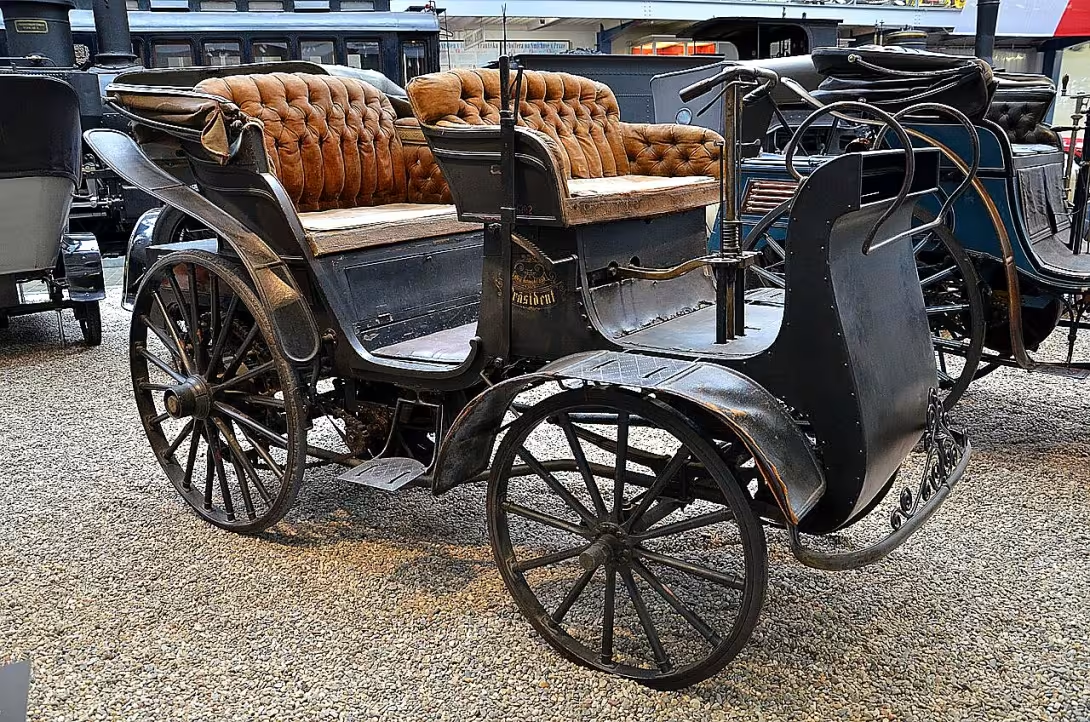
When Nesselsdorfer Wagenbau-Fabriks-Gesselschaft decided to make a car in 1897, it faced a huge challenge. The car, which was later named Präsident, became the first factory produced by a car in the Czech Republic and the entire Austrian-Hungarian monarchy. In Czech countries, only the experimental car of the designer Marcus, built between 1888 and 1889, never reached regular production. The spiritual father of the project was Leopold Sviták, around which was grouped a team involving engineers Rumplera, Sagea and young Hans Ledwink, the future creator of the so-called Tatra Concept.
The designers did not go the way of complete originality. The vehicle was partly based on a car called "Instructor" in Kopřivnik called Benz Phaeton, which was built by the famous Mannheim designer Karl Benz. The Liberec industrialist Theodor von Liebieg, who was friends with Benz, deserved the engine. In Kopřivnik, however, the team significantly modified the construction, added its own elements and improvements so that a completely different car was created. The new feature was, for example, a protective lining around the front wheels, which was used for the first time on cars.
The first big test was a promotional ride in early June 1898. The four-passenger vehicle went from Kopřivnice to Vienna to present itself at the exhibition on the occasion of the 50th anniversary of the reign of Emperor Franz Joseph I. The route measured 328 kilometres and the car completed it in 24 and a half hours, while the net time of the journey was 14 and a half hours. The average speed was 22.62 kilometers per hour - a very impressive performance for a machine whose maximum speed was only 22 kilometres per hour. After reaching Vienna, the Austrian car club won it, and it is after its president that the vehicle still carries its name.
The car installed the factory with technical solutions that were in advance of its time. A two-cylinder engine with a capacity of 2.7 liters and a power of approximately five kilowatts was located in the rear, under the rear seats. The luggage compartment of the traditional carriage thus served as a motor compartment. The fuel tank fit under the front seats. The gearbox was two-stage and belt-mounted, the rear axle drive provided two independent chains. The vehicle had a complex brake system consisting of a foot belt brake on the gearbox and a hand friction brake on the wheels.
The original Präsident, gradually modified during its operation, finally returned to Czechoslovakia as a museum exhibit and today you will find it in the National Technical Museum in Prague, where it is protected as a national cultural monument since 2006. The functional replica from the 1920s, built according to the original documents, is part of the collection of the Tatra Personal Car Museum in Kopřivnik. The success of the vehicle prompted the production of other improved versions, which in 1899 received their own names - Meteor, Nesselsdorf, Wien and others. NW Präsident remains proof of how the Czech industrial tradition participated in the birth of the car age.
Then and now
Drag the slider to compare how the landmark may have looked when it was built with the view today.
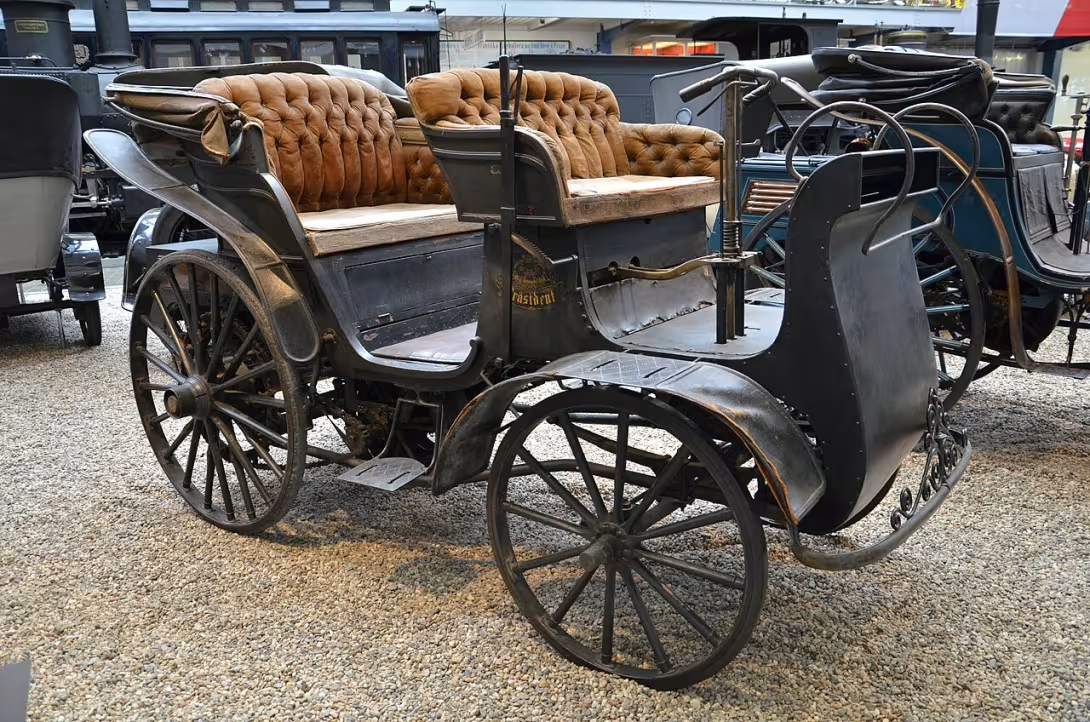

The historical appearance on the left is an AI-generated visualisation and serves as inspiration only.
Historical milestones
- 1897
- Start of production of car NW Präsident in Kopřivnik.
- 1898
- Successful car ride from Kopřivnice to Vienna on occasion of 50 years of reign of Franz Joseph I.
- 2006
- The car was declared a national cultural monument along with other collection items.
Architectural development
The car was built on a chassis with a phaeton-type bodywork that was based on a proven nettle carriage by Mylord. Beneath the rear seats was placed a two-cylinder flat Benz engine and the car used a two-stage belt gearbox. During its operation it has undergone a number of modifications and changes including engine replacement.
Historical events
1897-1898: Production of the first car Präsident in Kopřivnik. 1898: Ride on your own axis from Kopřivnice to Vienna. 2006: Declaration for a national cultural monument.
Owners
Nesselsdorfer Wagenbau-Fabriks-Gesselschaft, Austrian Automotive Club, National Technical Museum in Prague
Points of interest
- The Präsident car became the first factory produced by a car in the Czech Republic and the entire Austrian-Hungarian monarchy. - The new thing on the car was the protective lining around the front wheels, which was used for the first time on cars. - On a promotional ride from Kopřivnice to Vienna, a car took a route of 328 kilometers in 24 and a half hours. - After arriving in Vienna, he won the vehicle with a gift from the Austrian car club and it is after his president that he bears his name. - The original Präsident has been protected since 2006 as a national cultural monument at the National Technical Museum in Prague.
Guide
This guide is narrated by a synthetic voice generated by artificial intelligence.
Show guide text
This text was created by artificial intelligence and has not been editorially reviewed. It may contain inaccuracies.
The NW Präsident was the first factory-made automobile in the territory of Czechia and the entire Austro-Hungarian Empire, and at the same time one of the first automobiles in the world. It was created in 1897 and 1898 in Kopřivnice, in the factory of the Nesselsdorfer Wagenbau-Fabriks-Gesellschaft, which later became the Tatra automobile company. Before it, only the experimental Marcus automobile from 1888 and 1889 had been built in the Czech lands.
The spiritual father of the car was Leopold Sviták. The construction was partly based on the Benz Phaeton, and the Präsident was fitted with an original engine from the Mannheim automobile factory. This was thanks to the efforts of the Liberec industrialist Baron Theodor von Liebieg, a friend of designer Karl Benz. However, the Kopřivnice team introduced a number of their own elements and improvements into the construction, so a completely different automobile was created. Engineers Rumpler and Sage, as well as the young Hans Ledwinka, also contributed to its construction.
The Präsident was an experiment. The plans were drawn only afterwards and many improvements came about directly during construction. Both the chassis and the body were based on the Kopřivnice carriage called Mylord. The two-cylinder horizontal engine with a displacement of about 2.7 liters and a power of approximately 5 kilowatts was placed under the rear seat, that is, where carriages carried luggage. The gearbox had two speeds and shifting was done by tilting the steering column. For the very first time on an automobile, ornamentally shaped bumpers protected the front wheels.
On May 21st and 22nd, 1898, the vehicle set out from Kopřivnice to Vienna with four passengers on its own power for an exhibition commemorating the fiftieth anniversary of the reign of Francis Joseph the First. It covered the route of 328 kilometers in 24 and a half hours, with the actual driving taking 14 and a half hours. The average speed exceeded 22 kilometers per hour.
After this journey, the vehicle was given as a gift to the Austrian automobile club. According to its president, the Präsident received its name and was used for driver training. It underwent a series of modifications and even received a new engine. In the nineteen twenties, it returned to Czechoslovakia as a museum exhibit. Today it is displayed in the National Technical Museum in Prague and since 2006 it has been protected as a national cultural monument. Its functional replica from the nineteen seventies, built according to the original documentation, belongs to the collection of the Tatra Personal Automobile Museum in Kopřivnice.
Tips for visitors
For an optimal visit experience we recommend planning your trip in the morning, where it is calmer in the exhibition and you will have more time for a detailed tour of this unique jewel. Bring comfortable shoes for walking on the inner areas of the exhibition and a smaller backpack for personal items. Photography of the historic car NW Präsident is allowed, the best lighting conditions for capturing its details and the shine of the bodywork exist in spaces with scattered daylight; we recommend consulting the operator. Since there are no other specific locations in the surrounding area, focus fully on the tour of the car itself and the related exposure. For families with children, the visit is a great opportunity to become acquainted with the full beginnings of the automotive industry in our country; we recommend adapting the pace to younger visitors to enjoy technical history.
Frequently asked questions
Can the monument be visited?
We have not verified whether this monument is accessible. Please ask the owner or operator, or the local municipal office.
Why is the monument protected?
It is listed in the Central List of Cultural Monuments of the Czech Republic as a national cultural monument (register no. 113840726_1). It is protected as part of a larger listed ensemble.
For kids
Imagine going back 127 years and jumping right into the late nineteenth century. Where Kopřivnice stands today, there was a small town full of secrets and new finds. And in this town appeared the first factory-made car in the territory of the Czech Republic and Austria-Hungary, which is as if the first skateboard had entered the village! This historic vehicle was called NW Präsident.
Businesses nearby
Do you run a restaurant, accommodation, shop, museum, rental, wellness or other visitor service near this monument? Show yourself directly to the people heading to it — this is how they will see you in the app and on the web:
Accommodation nearby
Themed route
Thematic cruise route around NW Präsident
1.NW Präsident - * Type: * Historical building - * Why is it worth visiting: * NW Präsident is a fascinating example of architecture from previous years, which offers a view of the history and culture of the local area. It's a starting point for regional heritage.
2. Park at NW Präsident - * Type: * City park - * Why is it worth a visit: * Park offers quiet moments to walk between the green, which is an ideal break after exploring the historic building. It's a place where you can enjoy nature and relaxation.
3. Local Market - * Type: * Market - * Why is it worth visiting: * The local market is full of life with a variety of food, works of art and craft products. It's a great way to dive into local culture and support local businessmen.
4. Café at the Market - * Type: * Café - * Why is it worth a visit: * After the market tour you can relax here and look at local life. It offers quality tea, coffee and sweets, an ideal place for a short break.
5. History Museum NW Präsident - * Type: * Museum - * Why is it worth a visit: * This museum provides a deeper insight into the historical importance of NW Präsident and its role in the development of the region. It's a great way to expand knowledge of local heritage.
This route offers a comprehensive view of history, culture and everyday life in the NW Präsident area.
Seasonal recommendations
Spring awakens surrounding natural scenery into fresh colors, when the surrounding green slopes slowly awaken from winter sleep. The lighting is very clean and soft in this period, which creates ideal conditions for observing architectural details without sharp shadows. The atmosphere is calm and thoughtful. From a practical point of view, you will appreciate a smaller number of visitors, so you will enjoy the tour in peace. Due to the variable spring weather and the morning cold, it is recommended to dress onion in layers and choose fixed shoes because the terrain may be wet after rain. The best time for a visit is in the morning, when the sun warms pleasantly, but there is still no noon.
Summer brings sunny days full of bright light, which in the morning creates sharp contrasts on ancient walls. The surrounding landscape is full of greenery and the overall atmosphere is lively and energetic. Since this is the main tourist season, more people must be counted on, especially on weekends. To maximize the experience and avoid the biggest crowds and afternoon heat is the best arrival right after the morning opening of the complex. Put on light, breathable clothes, don't forget the headgear, sunglasses and a sufficient supply of drinking water, as the shade is in some parts of the monument ablaze.
Autumn offers an absolutely unique spectacle where the surrounding forests and trees turn into warm shades of yellow, orange and red. The low sun creates dramatic, long shadows and gives the memory a melancholy and romantic atmosphere. The crowds of tourists will be greatly thinner during this period, which guarantees a more intimate tour experience. The practical board is particularly concerned with warmer clothing, because autumn winds can be cold, and waterproof footwear due to fallen leaves. The ideal time for visiting is around noon and in the early afternoon when temperatures are most favourable and the light is most suitable for photography.
Winter covers the whole memory in silence and often also in a snow blanket, which creates a fabulous and peaceful atmosphere. The lighting is usually muted and the days are significantly shorter, which limits the time for the search. Visitors are minimal, so you'll enjoy maximum privacy. The key to a successful winter visit is high-quality, highly warm clothes, winter hats, gloves and solid footwear with anti-slip soles, because the roads can freeze.
Visualizations and artistic views


The visualisations are generated by artificial intelligence and serve as inspiration.
Tips from visitors
No tips yet. Be the first!
Log in and add your tip.
Sources and literature
Photos: Hakjosef / CC BY-SA 4.0 — Wikimedia Commons. The author and licence also appear when you hover over the image.
Faktickým podkladem tohoto textu byl článek na Wikipedii, jehož autory jsou přispěvatelé Wikipedie. Článek je dostupný pod licencí CC BY-SA 4.0.
Příběhy a pověsti
Legendy, pověsti a příběhy spjaté s touto památkou
Fotografie návštěvníků
Zatím žádné fotografie. Buďte první, kdo přidá fotografii z návštěvy!
Log in a přidejte svou fotografii nebo hodnoťte.
Za ověřenou návštěvu v aplikaci získáte víc bodů — poznáme podle GPS, že jste na místě.
Reviews and comments