



nýtovaný ocelový most přes Bělou v Jeseníku Road bridge
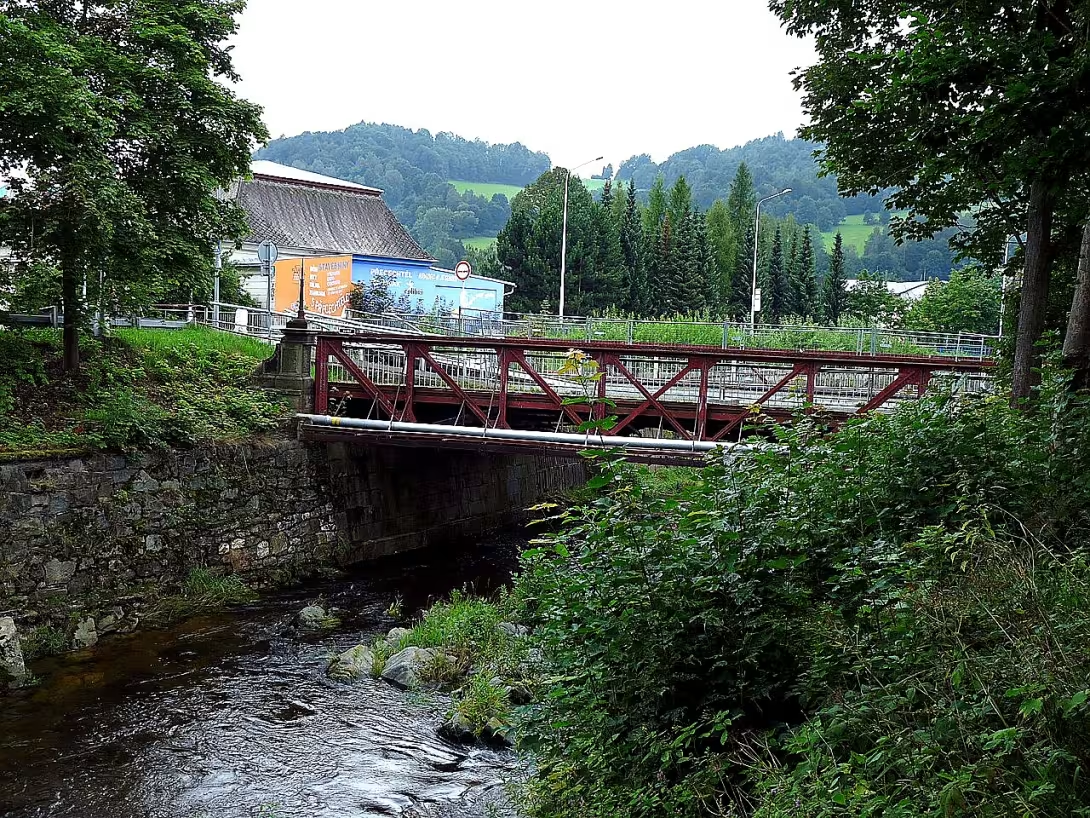
The riveted steel bridge over the river Belou in Jeseník is the oldest technical object in the area and the first steel riveted bridge in Jesenick. It is located in the Jeseník district of Olomouc, where it connects the banks of the river Bělé between the streets Horova and Husova. This historical building was declared a cultural monument of the Czech Republic in 2005, which underlines its importance as an heritage.
Bridge replaced original wooden The sheep's bridge, which was used to transport the bishop's sheep to pasture. Its construction was motivated by the need to upgrade and strengthen road routes in the area. In 1901 the construction was manufactured by Vítkovický upper and metallurgical mining companies in Vítkovice, while the building support was built by builder Franz Gröger. The bridge was completed in November 1901 and its approval took place at the end of 1902.
The architectural bridge is a steel riveted lattice construction with straight belt beams. The construction has a length of 16,942 metres and a margin of 15,43 metres in one field. The beams are reinforced with diagonals and in the middle of the garden there is an Ondřej cross. The bridge structure with a width of 9,15 metres is based on steel bearings with cast iron plates which are stored on stone supports made of carved blocks. The railing is made of steel rods and the bridge bridge has been modified in 2015 with a ramp for better accessibility.
The bridge structure, which consumed more than 45 tonnes of beach steel and other materials, was subject to extensive reconstruction and reconstruction in 2015. SART Šumperk performed work as riveting of new connections, replacing corroded rivets by the original method, painting construction and other modifications. The cost of repair amounted to CZK 5 million, some of which was financed by the Cultural Heritage Programme and contemporary art, EEA grant and Norwegian funds.
Today the bridge is accessible to visitors and serves as a monument to the technical innovations of its time. Its history and architectural value make it an important cultural monument that attracts the attention of not only local residents, but also tourists interested in history and technology. The riveted steel bridge over Bela is therefore not only an important element of infrastructure, but also a witness to the past and innovative spirit of the time.
Visiting this bridge offers an opportunity to explore not only its technical features, but also to understand the historical context in which it originated. It is a noble example of how innovation and traditions can form our cultural heritage together.
Then and now
Drag the slider to compare how the landmark may have looked when it was built with the view today.
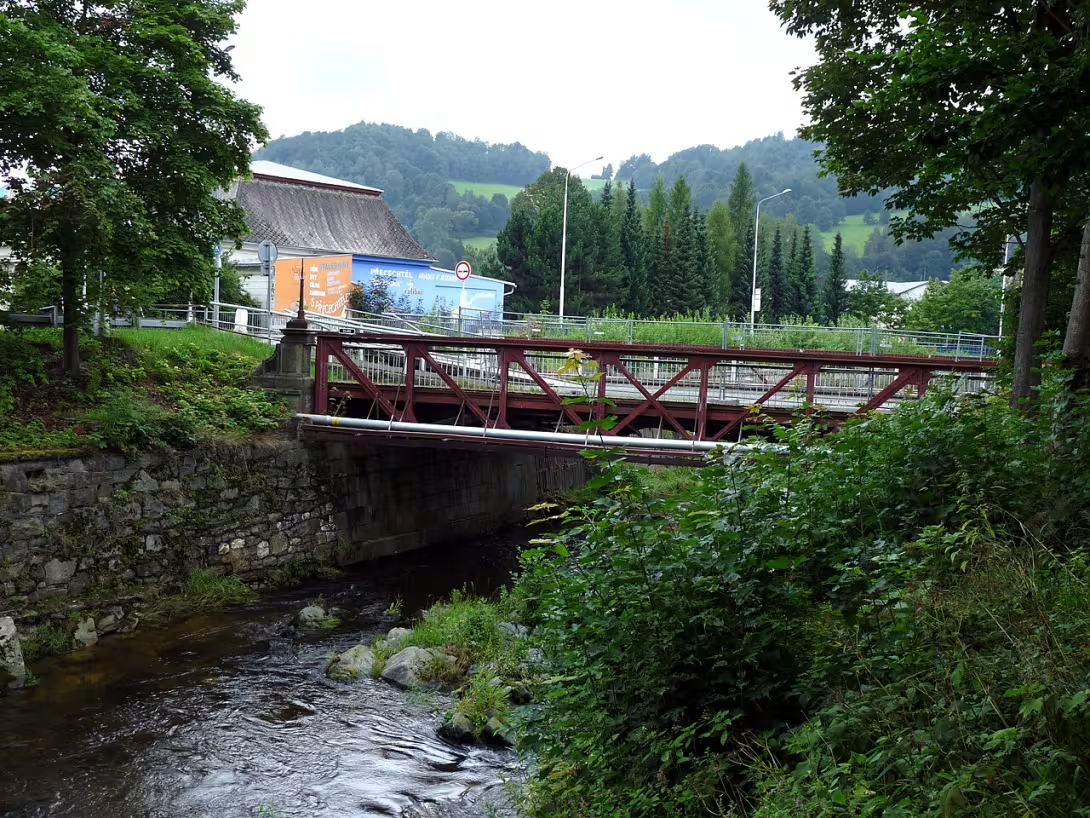

The historical appearance on the left is an AI-generated visualisation and serves as inspiration only.
Historical milestones
- 1901
- Construction of steel riveted bridge.
- 1902
- Completion of all completion work and final approval.
- 2005
- Declaration of the bridge for cultural monument of the Czech Republic.
- 2015
- Reconstruction and reconstruction of bridge construction.
Architectural development
In 1901 a steel riveted construction was built at the site of the original wooden bridge. The bridge uses steel bearings and stone supports made of carved blocks. The reconstruction took place in 2015 including riveting of new connections.
Historical events
September 2, 2005: Declaration of the bridge for the cultural monument of the Czech Republic. 2015: Implementation of extensive reconstruction and reconstruction of construction.
Points of interest
- The riveted steel bridge over Bela is the oldest technical object in the area and the first steel riveted bridge in Jesenick. - The bridge was declared a cultural monument of the Czech Republic in 2005. - Its construction was motivated by the need to upgrade and strengthen road routes in the area. - The bridge structure has consumed more than 45 tonnes of strip steel and other materials. - Today the bridge is accessible to visitors and serves as a monument to the technical innovations of its time.
Guide
Show guide text
This text was created by artificial intelligence and has not been editorially reviewed. It may contain inaccuracies.
Welcome to Jeseník, a place where history is bound to nature and where today we will stop at one of the most important technical works of this city. You're standing in front of a riveted steel bridge across the river Bela. Stop for a moment, take a breath and look at this building. In front of you is a structure that, with its strength and precision, speaks of a time when the world began to rush forward in the rhythm of the industrial revolution. Feel the contrast between the smooth flow of water below you and the firm, firm steel that forms its geometric net over the river. It's a place where functionality meets the aesthetic value of an old craft. Let us now return together in time to understand why this bridge was created and what it meant to the city of Jeseník. At the beginning of the twentieth century, namely in the year one thousand nine hundred first, it was decided that it was time for change. At that time, there was an old wooden bridge called the Sheep Bridge. As you can imagine, wood offered a natural look, but in the conditions of increasing traffic and the need to strengthen road routes in this mountain region was no longer enough. It needed something more resilient, stronger and more modern. It is this need to modernise and ensure a safer connection in the region that has become the main motive for building a new bridge. The construction began in the year one thousand nine hundred first and it was a very ambitious matter at that time. The whole project was handled by architect Franz Gröger, who designed this precise steel construction. The production of parts itself was entrusted to one of the most important industrial centres at the time, the company from Vítkovice. Imagine the huge ironworks, the heat of the blast furnaces and the thousands of workers who formed the skeleton of this bridge away from Jeseník, so that it is then brought here and carefully assembled together. All the finishing works were completed and the bridge was officially colluded in the year one thousand nine hundred second. Since then, it has become a key point in the city's transport network and a symbol of technological progress. Now I would like to ask you to pay attention to the architecture itself and the details that you see right in front of you. Take a close look at the steel beam connections. Notice these little, protruding heads. Those are rivets. Nowadays we are used to welding or screwdriving, but then riveting was used. Imagine the process: the hot metal nail was inserted into the holes of two overlapping steel sheets and then, from the other side, it was beaten with the force of the hammer until it closed and when it cooled together both parts of the structure. It's a job that required tremendous precision and physical strength. It is these rivets that give the bridge its specific, rhythmic appearance and are evidence of craftsmanship from the beginning of the last century. Notice also the overall shape of the bridge. It's a so-called lattice bridge. This means that its supporting structure consists of a system of triangles that effectively distribute weight and pressures so that the bridge remains stable even under heavy loads. This geometry is not only practical, but it has some strict beauty in it. If you look up and you look at the lines of steel bars, you'll see the order and logic of engineering thinking mirror them. It's a fascinating view of how people managed to tame metal over a century ago and turn it into a useful path through water. Although we do not need to talk today about the specific personalities that walked on this bridge, the figure of architect Franz Gröger himself is a silent witness of that time. His vision was so successful that the bridge survived for decades in almost original condition. The bridge was not just an ordinary transport link, but it became part of the Jeseník identity. In the year two thousand and five, this building was officially declared a cultural monument of the Czech Republic. This is a very important recognition because it is not a monument in the form of a church or a castle, but a technical monument. This means that the state recognized the value of human genius engineering and the need to preserve for future generations proof of how bridges were built at the turn of the century. In order for the bridge to continue to serve and remain safe, in the year two thousand fifteen it was necessary to rebuild and rebuild it. The repairs focused mainly on the bridge structure itself to remove corrosion and ensure stability of steel elements. Thanks to this care, we can stand before a construction that looks almost the same as on the day of its housewarming over a hundred years ago. It's basically a steel machine that still performs its function, and it emits nostalgia during a time when it was believed in the endless progress of technology. The interesting thing that may interest you is that this riveted steel bridge is the oldest technical object in the entire Jeseník. Imagine how many things have been created and destroyed in this city, while this steel structure is standing still here. It was the very first steel bridge of this type in all of Jesenick. At the time of its creation, it had to act on the locals with an absolutely fascinating, possibly terrifying impression. The transition from the wooden Sheep Bridge to the rigid, cold and unwavering metal had to be seen as a leap into the future. It's fascinating to think that something that was once the peak of modern is now a protected historical monument. Now, if you look again at the river Belou and the bridge that surpasses it, try to imagine the noise that existed here during the construction in the year one thousand and nine hundred first. The sound of hammering rivets, the call of workers and the smell of freshly applied steel coatings. This bridge is like an open book on the industrial history of our regions. It reminds us that even practical things like crossing a river can have their deep history and aesthetic value if they are made with care and vision. Now that you have learned more about the origin, construction and importance of this riveted steel bridge, I suggest you go around it again slowly. Note the details in every connection, perceive the texture of steel, and think about how many thousands of people have already passed this bridge and how many stories have happened here. He's a silent witness to history that connects us to the past. Thank you for your attention and for spending time with me on this unique technical work. I hope you are interested in this short trip to history and that you will perceive the surrounding architecture of Jeseník with new curiosity. We now invite you to explore the beauty of this city. We wish you a pleasant continued journey and enjoy all the details that Jeseník will reveal to you. Goodbye.
Tips for visitors
The best time to visit this historic steel bridge is in summer when the weather and light are ideal for exploring the construction. Clear days can be enjoyed without obstacles to rain or snow, which ensures better visibility of bridge details.
Transport to the place is available both by car and public transport. We recommend checking the current connection before departure so you can plan your travel mode effectively.
When visiting, take with you suitable shoes and clothes. The bridge construction is located in the natural environment, so it may be useful to wear clothes matching the current weather. In addition, we recommend introducing water and sun protection products to visitors.
The best place for photography is on the bridge itself, where you can enjoy a panoramic view of the river Belou. Best to embark on photo expeditions in the morning or in the evening when light is softer and shading more favourable to capture details of the bridge.
In the vicinity of the monument you can visit the Cross Hill, which offers beautiful views of Jesenice Mountains. Golden hair is another popular destination for those who want to explore the natural beauty of the region. For families with children it can be interesting to visit an amusement park or visit a nursery in nearby municipalities.
Frequently asked questions
Can the monument be visited?
This is a structure in a public space that can usually be seen from outside free of charge. We have not verified that this particular one is freely accessible.
Where is the monument?
Location: Jeseník, Olomoucký kraj. The map on this page shows the exact spot.
Why is the monument protected?
It is listed in the Central List of Cultural Monuments of the Czech Republic as a cultural monument (register no. 1936730745).
Businesses nearby
Do you run a restaurant, accommodation, shop, museum, rental, wellness or other visitor service near this monument? Show yourself directly to the people heading to it — this is how they will see you in the app and on the web:
Nearby
Řeka Bělá, Křížový vrch, Zlatý chlum.
Accommodation nearby
Themed route
Thematic cruise route from Jeseník
1. Riveted steel bridge over Bela
Type: Historical monument
Why it is worth a visit: This unique bridge is the only one of its kind in the Czech Republic and its construction made of steel with riveting attracts technical curiosity. It's the perfect place to understand the history of engineering in Central Europe.
2. Cross Hill
Type: Historical and religious monument
Why is worth a visit: This high peak is home to the historical cross, which offers not only a view of the surrounding landscape but also an opportunity to explore local traditions and spiritual heritage. It's a short walk from the bridge, which makes it the ideal next step on the route.
3. Golden Hair
Type: Historical site
Why it is worth a visit: This place is connected with the legends and history of the region, offering past views and an opportunity to explore the cultural heritage of the Jeseník. It is the ideal conclusion of the route where you can relax the mind and appreciate the beauty of the surrounding environment.
Route order: - Start on the riveted steel bridge through Bela, see its historical structure. - Go to the Cross Hill for a view and a visit to the sights. - Close the route on Golden Hair where you can relax your mind and appreciate the landscape.
This route offers a combination of technical wonder, history and natural beauty in a small area of Jeseník.
Seasonal recommendations
Spring: In the spring season nýtovaný ocelový most přes Bělou v Jeseníku is surrounded by flowers and young leaves of trees, giving the atmosphere fresh. The sun illuminates the memory more gently than in summer, which increases aesthetic attraction for photography. Nature begins to awaken from winter sleep and provides a beautiful background for visitors. We recommend visiting at dawn or in the evening when there are fewer people, and to be dressed so as to avoid surprising cold winds that are typical of this time of year.
Summer: Summer brings the best conditions to visit the bridge, where the sun is in the highest place and ensures a long time of lighting. The atmosphere is full of vitality, with warm days and a possibility for picnics near the Bělá stream. It is advisable to arrive in the early afternoon or early evening to avoid a midwinter crowd of tourists. We recommend the clothes suitable for the sun and short shoes that allow you to walk comfortably through the terrain.
Autumn: In autumn, the trees in Jeseník acquire golden and red shades, giving the bridge a romantic atmosphere. The sun illuminates the area for longer than in winter, with a short clear day to be observed. Nature offers a beautiful view and a quiet atmosphere because the number of visitors is decreasing. We recommend clothes suitable for colder temperatures and the possibility to bring an umbrella with you in case of short springs that are common during this period.
Winter: Winter Jeseníks offer a unique view of the bridge covered with snow and surrounding forests. The sunlight joins the landscape more diverse, creating a dramatic background for photography. The conditions can be difficult due to cold temperatures and snow, so it is important to visit with adequate clothes. The days are briefly illuminated, so we recommend that you arrive soon and take advantage of the opportunity to explore the surroundings covered with snow.
Visualizations and artistic views


The visualisations are generated by artificial intelligence and serve as inspiration.
Photos from the area
Real photos taken near the monument


Zdroj a licence jsou uvedeny u každého snímku.
Tips from visitors
No tips yet. Be the first!
Log in and add your tip.
Sources and literature
Photos: Czeva / CC BY-SA 3.0 — Wikimedia Commons. The author and licence also appear when you hover over the image.
Faktickým podkladem tohoto textu byl článek na Wikipedii, jehož autory jsou přispěvatelé Wikipedie. Článek je dostupný pod licencí CC BY-SA 4.0.
Location on the map

Příběhy a pověsti
Legendy, pověsti a příběhy spjaté s touto památkou

Fotografie návštěvníků
Zatím žádné fotografie. Buďte první, kdo přidá fotografii z návštěvy!
Log in a přidejte svou fotografii nebo hodnoťte.
Za ověřenou návštěvu v aplikaci získáte víc bodů — poznáme podle GPS, že jste na místě.
Reviews and comments