



Obchodní dům Olympic Commercial building
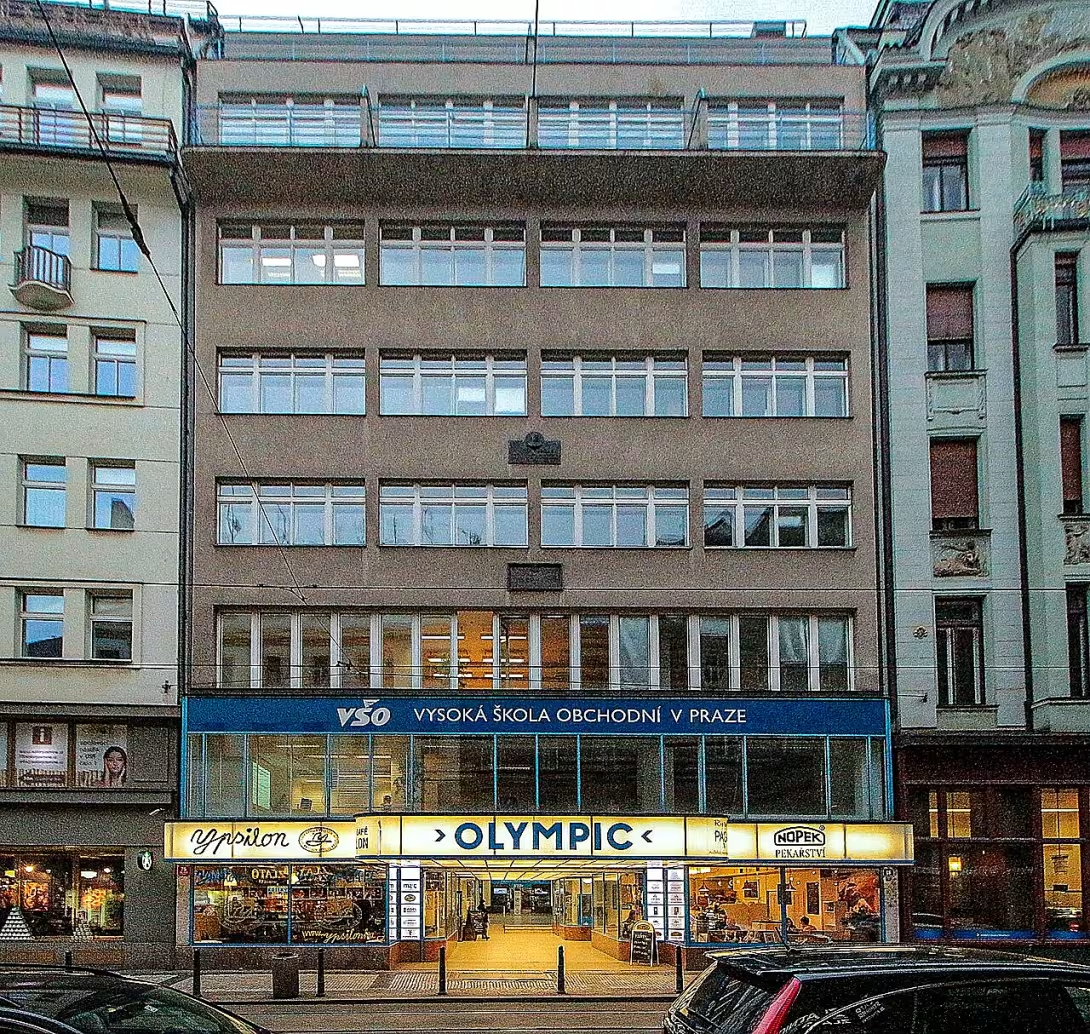
Commercial and rental house Olympic is a functionalist building from 1926-1928 in Prague 1 in Burnt Street. The building is protected as a cultural monument and represents an important representative of the Czech avant-garde.
The construction was built in 1926-1927 by Czech architect Jaromír Krejcar. It was created during the period of the Interwar Republic, when it culminated in the boom of modern architecture in Prague. At that time, functionalism was characterised by a shift from historical styles to practical and use of new materials. The building replaced an older two-story classical house where the painter Josef Mánes lived and died. The Gothic building on this site is documented from 1488 or earlier.
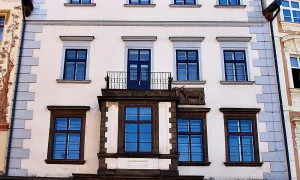
From an architectural point of view, it's a three-wing object on a reinforced concrete skeleton. The building has a flat roof and is covered with two-storey basements throughout the floor plan. The typical element is graduated terraces in upper floors with tubular railing. Jaromír Krejcar's original proposal was more extensive than the construction was eventually implemented.
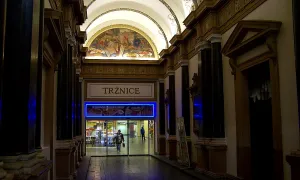
After the completion of the main part in 1928, modifications of the interiors followed in 1929. For them was the Berlin architect Paul Sydow, who designed an art deco cinema hall in the basement, a wine bar on the ground floor and a facade adjustment. At that time, the house was also equipped with strong advertising. Part of the complex was the arcade and cinema, which created a modern centre of culture and shops.
Currently, the building is based in the University of Business and other entities. Studio Ypsilon has its permanent scene in the premises of the former cinema hall in the basement.
Obchodní dům Olympic is a valuable example of successful functionalist construction. It is recommended to visit it as an example of the courage and modernism of Czech interwar architecture.
Then and now
Drag the slider to compare how the landmark may have looked when it was built with the view today.
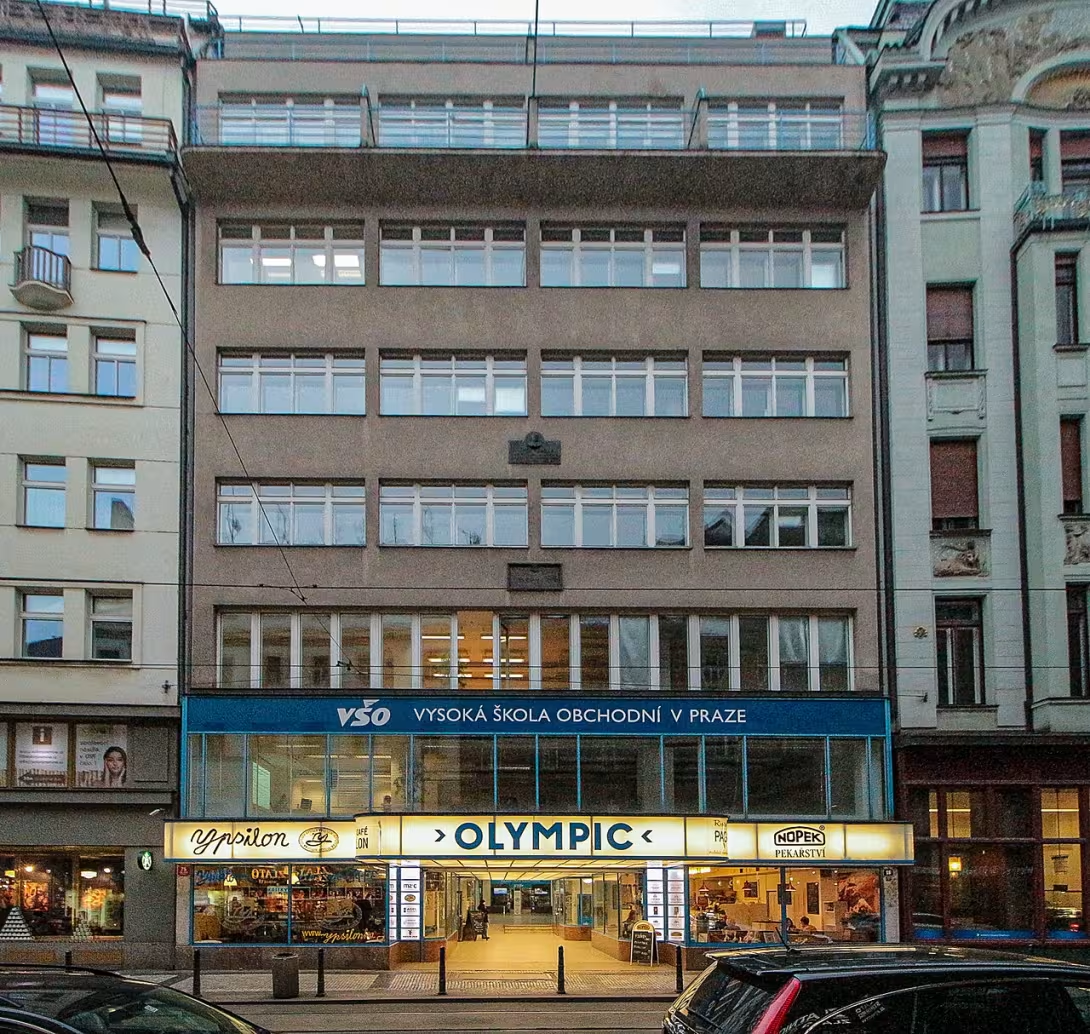
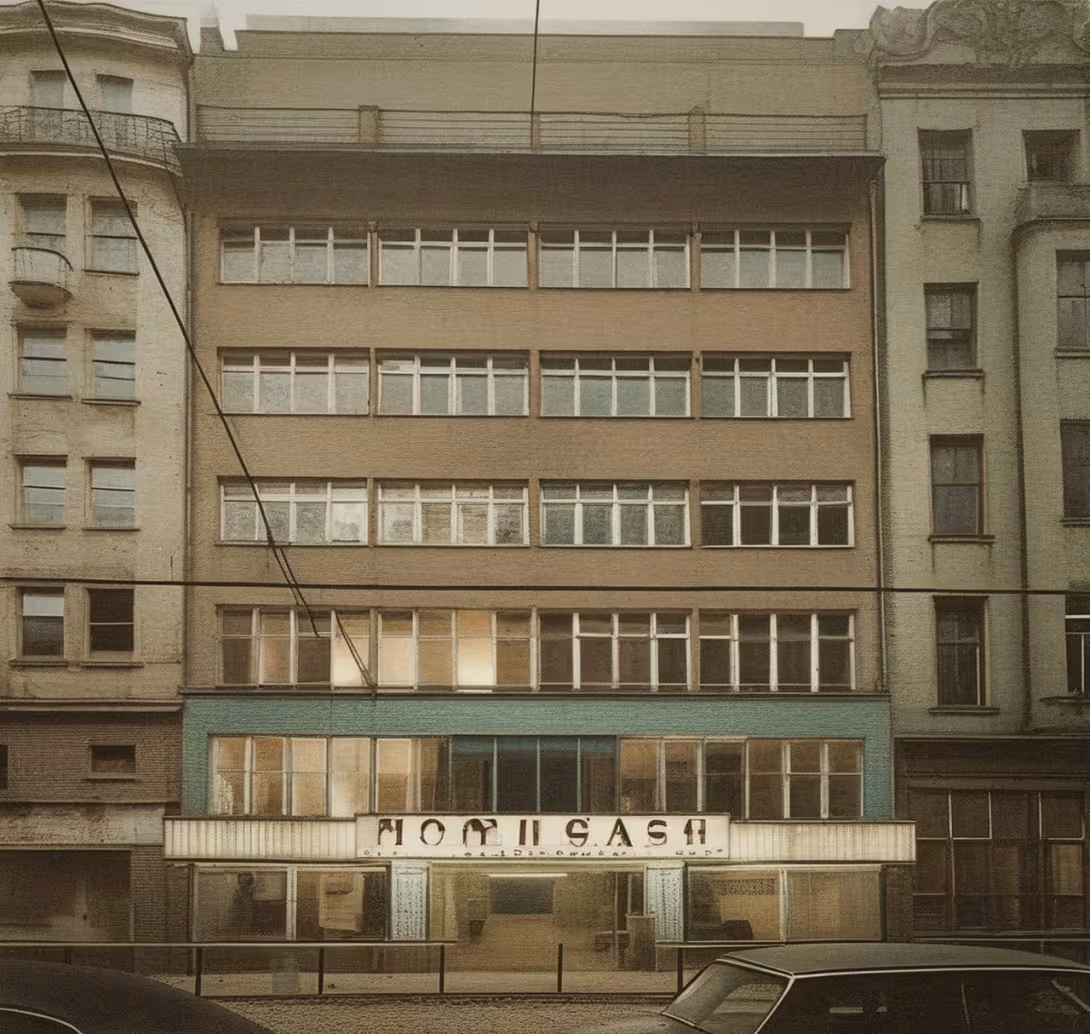
The historical appearance on the left is an AI-generated visualisation and serves as inspiration only.
Historical milestones
- 1926
- The start of building the house according to the project Jaromír Krejcar.
- 1928
- Building completion.
- 1929
- Implementation of interiors of the cinema hall and winery by architect Paul Sydow.
Architectural development
The construction was built on a reinforced concrete skeleton with a three-wing plan and two-storey basements. Jaromír Krejcar's original project was supplemented in 1929 with art deco-style interiors by Paul Sydow. It is among the most prominent representatives of functionalism with flat roof and terraces.
Points of interest
- The building from 1926-1928 is an important representative of Czech avant-garde and functionalism. She replaced the older house where the painter Josef Mánes lived and died. - The building has a reinforced concrete skeleton, flat roof and graduated terraces with tubular railing. - In the basement, ground floor and facade worked Berlin architect Paul Sydow in art deco style. - Studio Ypsilon is currently active in the premises of the former cinema hall in the basement.
Guide
Show guide text
This text was created by artificial intelligence and has not been editorially reviewed. It may contain inaccuracies.
Welcome to the heart of Prague in New Town. You are standing in front of a building that is a real symbol of courage, modernity and belief in progress. Look before you at this formidable business and rental house, which bears the name Olympic. At first glance, you may be interested in its purity, its straight lines, and the feeling of lightness that radiates from the building, even though it's a massive building. It is a place where business life meets culture and where in every detail there is a story about how the perception of beauty and utility in the early twentieth century changed.
Let us now stop a little bit at how this construction was created and at what time it happened. Imagine Prague over a century ago. The city was developing rapidly, and old houses were no longer enough for the needs of modern citizenship. That is why in the year one thousand nine hundred twenty-six decided to build this complex. The project was taken by the architect Jaromír Krejcar who wanted to create something completely new. The construction took a short time and the building was completed in the year one thousand nine hundred twenty eight. It was a time of great optimism when architects tried to meet the new needs of the time. The goal was not just to build a house with apartments and business premises, but to create a modern centre that would serve as a hub of culture and trade for the whole neighborhood.
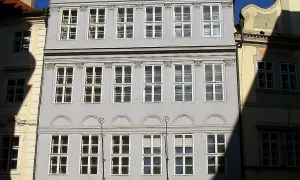
Now that we know about history, pay attention to the architecture itself. Look carefully up. What you see is an important representative of so-called functionalism and Czech avant-garde. Note that the building does not have unnecessary ornaments that you know from much older houses. Instead, logic and purpose rule here. One of the most significant elements you can observe right now are graduated terraces. These terraces with their tubular railing provide the building with dynamism and airspeed. It's a detail that was very brave and modern at the time.
Try to realize that underneath that smooth surface layer there is a real technical novelty of its time. The whole house is built on a reinforced concrete skeleton structure. This means that the building is not held on thick walls, but on a system of columns and supporting elements, which allowed you to create more open spaces and a roof area that you also see. This approach to construction was at the time the highlight of technical progress.
But if we look deeper, we'll find that this place has much older roots than the appearance of the building could lead us to. Under the feet of this modern complex, there once was an older house in a classical style. One of the most important names of Czech painting is connected to this old house. It was in the older construction that he lived and later the painter Josef Mánes died here. It is fascinating to think that at this one point there are two completely different ages. On the one hand, the softness and tradition of the painter Mánes, and on the other hand, the bold, sharp and transparent world of functionalism. It's like a dialogue between the past and the future that takes place in a space of several meters.
Now let's focus on the inner space and the details that may not be visible from the outside, but that form the soul of this house. In the year one thousand nine hundred twenty-nine another architect, Paul Sydow, joined the project. It focused on the inner spaces, specifically on the implementation of the cinema hall and wine bar. Imagine what an experience it was for the visitors back then. They entered the passage that was part of the complex and found themselves in an environment that looked like the future. Cinema and wine bar from the building were the real center of social life. People came here not only to buy, but above all to meet culture and society.
Note also that experts from Berlin worked on the basement, ground floor and the facade itself. This shows how international the approach to architecture in Prague was then. The city was open to new influences and wanted to be at the heart of European action. This building is not only a local product, but the result of cooperation and exchange of ideas between Prague and one of the largest centres of modern times.
You might wonder why this building is so important now that you see so many other beautiful houses around it. The secret is that this house was in its time a manifesto of the new era. He refused everything old and useless. Everything you see has its practical meaning. The pipe railing is not only an ornament but a functional element. The flat roof is not just an architectural decision but an expression of a new way of using space. It's a building that says the world has changed and that architecture must go with it.
It is also interesting how the building presented itself in times of its greatest fame. Imagine these terraces filled with people watching the streets of Prague from above, surrounded by modern materials and clean lines. It was a sense of freedom and openness that was in contrast to the closed doors of the older city.
Now that you have looked at the outside appearance and learned about the fate of the people who were involved in this place, I suggest you take a moment in silence to perceive the atmosphere of this place. Try to imagine the transition from the classical house of the painter Manes to this iron concrete colossus. It's a path from romance to technology, from canvas to concrete.
Even today, this Olympic trading house remains a reminder of a time when we believe that architecture can change the way we live and feel in urban space. It is a monument to the Czech avant-garde, which was not afraid to go upstream and seek new ways.
Thank you for stopping by this fascinating building. I hope you're interested in her story, and that now you see more than just an ordinary house in these lines and terraces. I invite you to another walk in New Town, where you will have many other hidden stories and architectural pearls. I wish you a pleasant rest of the day and an inspiring discovery of Prague. Goodbye.
Tips for visitors
The best time to visit is in the morning or late afternoon when the sun hits the facade at an angle that best excels the clean line of functionalist architecture. The building is available by car and public transport; Check the current connection in the search engine.
When visiting, we recommend taking only light clothes and comfortable shoes, because it is mainly a tour from outside within the city walk. Since the building serves as an office and a school, we recommend keeping calm and respecting the privacy of people inside.
The best places for photo lovers are the surrounding pavements, where the overall shape of the construction and details of the Czech avant-garde can be captured. The best light for façade images is during the golden hour before sunset.
Since there are no other monuments in the immediate surroundings, we recommend focusing on detailed observations of the architecture of the house itself. It is advisable for families with children to explain the difference between older decorated houses and the simple style of this building.
Frequently asked questions
Can the monument be visited?
The building is in use (offices, a school, shops and the like). The interior is generally accessible only during operating hours and tours are not usually offered; we have not verified the details. You can see the exterior from the street.
Where is the monument?
Location: Praha 1. The map on this page shows the exact spot.
Why is the monument protected?
It is listed in the Central List of Cultural Monuments of the Czech Republic as a cultural monument (register no. 1000151896).
Businesses nearby
Do you run a restaurant, accommodation, shop, museum, rental, wellness or other visitor service near this monument? Show yourself directly to the people heading to it — this is how they will see you in the app and on the web:
Events nearby

Zdroj akcí: otevřená data měst a obcí ČR (Národní katalog otevřených dat) a kalendář akcí Národního památkového ústavu.
Nearby
🏰 Historic sites (1686)
- Galerie České pojišťovny 0.0 km +420 224 054 368 web
- Emil Hartmann 0.1 km
- Ilsa Hartmannová 0.1 km
- Helga Hartmannová 0.1 km
- Anita Hartmannová 0.1 km
- Franz Kafka 0.1 km web
- Památník židovského hřbitova 0.1 km
- Ing. Emil Rabínek 0.1 km
- Josefa Rabínková 0.1 km
- Franci Rabínek Epsteinová 0.1 km
- svatý Jan Nepomucký 0.2 km
- Galerie Václava Špály 0.2 km Národní 30 web
- Schirdingovský palác 0.2 km
- 17. 11. 1989 0.2 km
- Galerie ART+UM 0.2 km Ostrovní 22 +420 224 934 355 web
- Museum of Bricks Praha 0.2 km Národní 31 +420 777 869 777 web
- Dr. Karel Prager 0.2 km
- Ida Pragerová 0.2 km
- Tomy Prager 0.2 km
- Eva Pragerová 0.2 km
🍽️ Restaurants and dining (5505)
- Ypsilon 0.0 km
- Sisters 0.0 km Spálená 75/16 +420220960499 web
- Starbucks 0.0 km Spálená 74/18 +420 235 013 550 web
- dobro&dobro cafe 0.0 km Purkyňova 74/2
- Pagana 0.0 km Spálená 14 web
- Wokin 0.0 km Purkyňova 74/2 +420 725 523 573 web
- Srdcovka Spalena 0.0 km
- Kebab Spálená & Daddy's Burger 0.0 km +420 731 014 389
- Prahaggogi 0.0 km
- Slámovka 0.0 km
- Poke House 0.0 km
- Wokin 0.1 km
- Fior di Pizza 0.1 km Ostrovní 102/34 +420 777 044 434 web
- Mia Mi 0.1 km Spálená 29 +420 725 575 299
- Ultramarin 0.1 km Ostrovní 32
- Burrito Loco 0.1 km +420 725 833 523 web
- The Glass 0.1 km
- Costa 0.1 km
- Bistreet 0.1 km Spálená 105/45
- Élite Garden 0.1 km
🏨 Accommodation (819)
- The Madhouse Hostel 0.0 km Spálená 39 +420 222 240 009 web
- U dvou zlatých klíčů 0.1 km Spálená 31 +420 224 932 010 web
- Hotel Elite Prague 0.1 km Ostrovní 32
- Q Aurea 0.1 km
- Michelangelo Grand Hotel 0.1 km Vladislavova 1477/20 +420 222 500 177 web
- Golden Crown 0.1 km
- Ragtime hostel 0.1 km +420 724 879 687 web
- Safestay Hostel 0.1 km Ostrovní 131/15 +420 222 540 012 web
- Garden Court 0.1 km
- Old Town Apartments 0.2 km Národní 24
- Church Pension Husův Dům 0.2 km Jungmannova 22/9 +420 603 554 785 web
- Hotel Adler Praha 0.2 km V jirchářích 13 web
- Jerome House 0.2 km V Jirchářích 13
- Le Papillon 0.2 km Jungmannova 5 web
- Travek&Joy 0.2 km
- Hostel Daniela 0.2 km Jungmannova 5 +420 736 279552 web
- Bonvolon 0.2 km
- Design Metropol 0.2 km Národní 33 +420 246 022 100 web
- Hotel Koruna 0.2 km Opatovická +420222541750 web
- Downtown 0.2 km Národní 19 +420 739 343 863 web
🚲 Rentals and sport (542)
- Honzovy 0.1 km +420 777 493 182
- Fitness Vagon 0.2 km Národní 25
- Contours Fitness 0.2 km Národní 25
- Centrum Služeb Pre 0.2 km web
- Rock Point 0.2 km Martinská 360/2 +420 224 228 045 web
- Rossignol 0.3 km +420 733 626 382
- Finebike 0.3 km web
- HUDYsport 0.3 km Na Perštýně 355/14 +420 224 218 600 web
- Husky 0.4 km Žitná 669/1 +420 222 220 950 web
- World Class Fitness Center Wenceslas 0.4 km Václavské náměstí 22
- Oasis City 0.4 km Václavské náměstí 36
- A3 SPORT 0.5 km +420 222 240 690 web
- U Kotvy 0.5 km
- S.P.L.A.V. 0.6 km
- Slovanka 0.6 km +420 777 870 511;+420 777 800 003 web
- 11 Teamsports 0.6 km
- Ski & Surf 0.7 km
- Tělocvičná jednota Sokol Pražský 0.7 km Žitná 1438/42 +420 221 965 311 web
- Kieser Training 0.8 km
- Přístaviště Rašínovo nábřeží 0.8 km
🥾 Hiking and nature (480)
- Novoměstská radnice 0.3 km
- České loutky 0.4 km web
- Thrill Park 0.6 km Provaznická 11 +420 774 413 313 web
- Staroměstský orloj 0.7 km
- Staroměstská radnice 0.7 km
- Radniční věž 0.7 km
- Barokní knihovní sál 0.7 km web
- Charles Bridge and Castle Viewpoint 0.7 km
- Křižovnické náměstí 0.7 km
- Zrcadlová kaple 0.7 km
- Dancing House viewpoint 0.7 km
- Pražský poledník 0.7 km
- Celetná 0.8 km
- Na Příkopě 0.8 km
- Národní muzeum věž 0.8 km
- Čelakovského sady 0.8 km
- Celetná 0.8 km
- Celetná 0.8 km
- Čelakovského sady 0.8 km
- Celetná 0.9 km
Accommodation nearby
Trips and activities nearby
Guided tours, tickets and activities nearby from GetYourGuide
Affiliate link: if you buy from the partner, we may receive a commission. The price for you does not change.
Search tours and activities →Themed route
Obchodní dům Olympic
1. Obchodní dům Olympic (Business Center) - The main destination of the trip where you can admire architecture and visit various stores. 2. Walk in the area (outdoor area) - Walk through the immediate surroundings of the building for better perception of its size and location in space. 3. Internal corridors and spaces (interior) - Exploring internal floors and commercial premises of the house itself.
Seasonal recommendations
In the spring, the surrounding streets awaken to life, and the sun begins to illuminate the façade of the building. It is advisable to choose a light spring dress and visit the place in the morning when the air is fresh and transport in the city centre even slightly quieter.
In summer the area is dominated by intense light and hot asphalt. It is recommended to come in the early morning to avoid the greatest heat and the largest number of tourists around. The practical choice of breathable clothes and sun hat is practical.
Autumn will bring golden colours of leaves and specific, softer light to the centre of Prague, which will highlight the details of architecture. In this period, it is best to have a waterproof jacket with you and to visit the memory in the afternoon when the atmosphere of the city is quieter.
Zimą works in contrast to freezing air and short day. In advent time the surroundings are lit and full of people, so it is advisable to choose warm winter clothes with layers. The best part is the outside tour of the hotel, where the city lights stand out.
Visualizations and artistic views


The visualisations are generated by artificial intelligence and serve as inspiration.
Photos from the area
Real photos taken near the monument


Zdroj a licence jsou uvedeny u každého snímku.
Tips from visitors
No tips yet. Be the first!
Log in and add your tip.
Sources and literature
Photos: VitVit / CC BY-SA 4.0 — Wikimedia Commons. The author and licence also appear when you hover over the image.
Faktickým podkladem tohoto textu byl článek na Wikipedii, jehož autory jsou přispěvatelé Wikipedie. Článek je dostupný pod licencí CC BY-SA 4.0.
Location on the map
Příběhy a pověsti
Legendy, pověsti a příběhy spjaté s touto památkou
Fotografie návštěvníků
Zatím žádné fotografie. Buďte první, kdo přidá fotografii z návštěvy!
Log in a přidejte svou fotografii nebo hodnoťte.
Za ověřenou návštěvu v aplikaci získáte víc bodů — poznáme podle GPS, že jste na místě.
Reviews and comments