






Obytný dům bývalého hospodářského družstva House
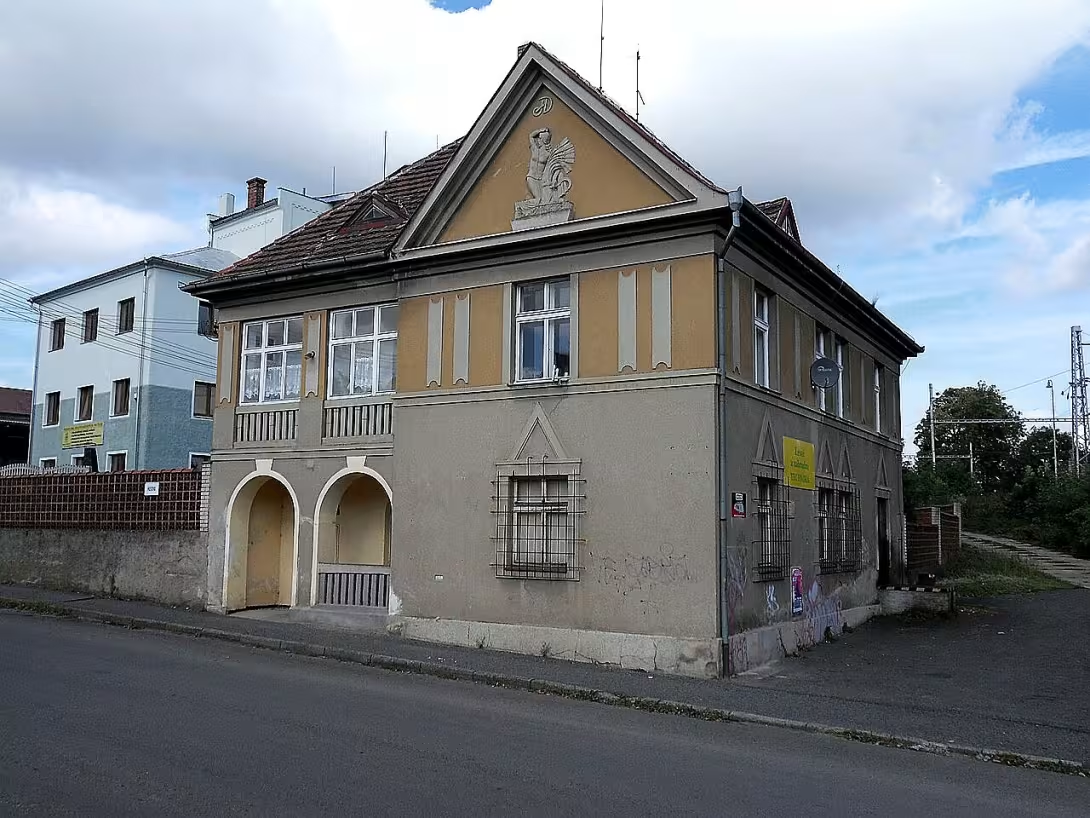
Obytný dům bývalého hospodářského družstva in Přeštice is a villa from 1924, which represents a good example of interwar architecture with elements of cubism and rondocubism. Since 2005 the building has been registered as a cultural monument of the Czech Republic.
The villa was established as a seat for the Director of the Preštice branch of the Economic Cooperative Plzeň. The project was designed by architect Hanuš Zápal and the construction was carried out by the company Josef Špalka.
The building is two-storey with a valb roof covered by bags of bobbies, in which three triangular skylights are located. The facade is drawn in a brisolite plaster of two grains, with a grey colour, supplemented with an ochre shade on the first floor. The villa stands on a slightly sloping terrain towards the southeast. On the north and west side there is an economic court, which is situated half a floor above the street level and is accessible by a side entrance from the intermediate platform.
The main entrance from Hus Street on the south facade is decorated with two arches with a folded, partially glazed two-wing door. The east side serves as an entrance to the business premises. The facade is divided into two parts according to the structural and functional distribution of the floor plan. The right side is dominated by a triangular shield whose tympanone is decorated with a relief of a woman with a sheaves of grain, inspired by a single crown coin motif. The HD letters referring to the Economic Cooperative are placed above the relief.
In 1993, the house underwent modifications in which the ground floor apartment was adapted to the business room. As part of this change, a small supply ramp was attached to the eastern facade and the windows on the first floor were locked.
Today, the villa is located on the corner parcel near the railway line and serves combined for residential and commercial purposes. Its architectural value was officially recognised in January 2005 by the declaration for the cultural monument of the Czech Republic.
The building is a valuable testament to period architecture and shows detailed craftsmanship. Her visit offers insight into the aesthetics of the first republic in Přeštice.
Historical milestones
- 1924
- The position of the Villa for the Director of the Preštice branch of the Economic Cooperative Plzeň
- 1993
- Adaptation of the ground floor apartment to the commercial premises and connection of the supply ramp
- 2005
- Declaration of the house for cultural monument of the Czech Republic
Architectural development
The construction was carried out by Josef Špalek in 1924. The architecture uses a brisolite plaster and a valb roof with a big bag. In 1993, the ground floor was adapted to the commercial premises including the supply ramp.
Historical events
In 1924 the villa was built for the Director of the Economic Cooperative Pilsen. In 1993, the ground floor apartment was adapted to business premises. In January 2005 the house was declared a cultural monument of the Czech Republic.
Points of interest
- The 1924 villa presents an example of interwar architecture with elements of cubism and rondocubism. - The building was established as a seat for the director of the prestigious branch of the Plzeň Economic Co. - The project was designed by architect Hanuš Zápal and the construction was carried out by the company Josef Špalka. - Tympanon shield decorated with relief of women with grain sheaves inspired by the motif of one crown coin and HD letters. - Since 2005 the building has been registered as a cultural monument of the Czech Republic.
Guide
Show guide text
This text was created by artificial intelligence and has not been editorially reviewed. It may contain inaccuracies.
Welcome to Přeštice. You've just stopped at a construction site that dominates this corner of town with its presence and unmistakable appearance. You're standing on the corner, in a place where urban architecture meets the rhythm of a railway line that passes just nearby. You may have already noticed how this house works - it is not just an ordinary object, but a monumental quite that tells the story of ambition, aesthetics and changes of time. Look around you and feel the atmosphere of this place. This house is not just a part of the street, he is its pillar.
Let us now return to the time when the building hammers first sounded here. Imagine 1924. Czechoslovakia is a young, prosperous state and architecture is going through a fascinating period of searching for its own identity. This year, the villa was completed as a prestigious residence for the director of the prestigious branch of the Plzeň Economic Cooperative. At that time these functions and positions in the community were of great importance. The house was not only built as a place to live, but as a symbol of stability, success and modern approach to life. It was the home of a man who held the economic engine of local agriculture and farming. This building was supposed to emit the dignity and quality that society expected from its representatives at the time.
Now pay attention to the construction itself and to what you see right in front of you. If you look at the overall composition of the house, you will immediately be interested in its rich facade. This object is an excellent example of the architecture of the interwar period, which was not afraid to experiment with shapes and lines. Welcome to the world of cubism and rondocubism. These styles that you can see in the details of this building were revolutionary at the time. Cubism brought dynamism into architecture, angulated shapes and a game of light and shadow on surfaces, while rondocubism brought into design finer, round and ornamental elements that were meant to reflect national character and elegance.
Note how architect Hanuš Zápal worked with space and how the house adapted to its corner position. The building wasn't designed to fit into the street, it was designed to interact with it. The whole project carried out by Josef Špalek was proof of precise craft and high ambitions. If you look up now, you will find one of the most beautiful details of the entire building. Look at the tympanone shield. Do you see women's relief? This fine work of the artist gives the building a human dimension and elegance. This figure, carved into the facade, acts as the guardian of the house, which gives the whole appearance of grandeur and artistic value, which you will not find in ordinary houses from that time.
It was this richness and uniqueness of architecture that caused the fate of the house to change not only in terms of utility but also in terms of importance over the decades. While the world was changing around, this house retained its importance. In 1993, one of the most important adaptations occurred when the ground floor apartment was converted into a commercial space and a supply ramp was installed. This change shows how the building has managed to adapt to the modern way of life and the economic needs of the city without losing its historic soul. Today it serves not only as a housing, but also for business purposes, thereby remaining a living and functional part of a transformative society.
You may wonder how this house has sat in the eyes of history. From his inception in 1924 to the present time he passed many stages, but his most important recognition came in 2005. This year, the house was officially declared a cultural monument to the Czech Republic. This is proof that its value is not only local but has national significance. It is a recognition of the quality of Hanuš Zápala's work and proof that the interwar architecture you see here is one of the most valuable cultural treasures of our country.
The interesting thing that you might find interesting when looking at a building is the constant game between geometry and ornamentationon. If you look at the facade from different angles, you'll see how the appearance of those angle and rounded elements changes depending on how the sunlight hits. It's like a living organism that changes during the day. This dynamic was the intention of architects who wanted the building not to be static, but to communicate constantly with its surroundings.
Now that you have looked at the history, architecture and transformation of this house, I suggest you continue your walk around. Přeštice offers many other attractions, but this house should remain in your memory as a symbol of beauty that arose on the frontier of art and craft. You're standing in front of a piece of history that has endured centuries and is still standing here to remind us of an era where architecture was trying to define a new, modern identity.
Thank you for spending this moment with us and paying attention to this memory. We wish you a beautiful continued journey through the city and hope that other discoveries will fascinate you as much as this house. Goodbye.
Tips for visitors
The best time to visit this historic house is in the spring or autumn season when the weather is pleasant and the sun illuminates the architectural details of the building. This time of year offers ideal lighting conditions for photography, especially in the early morning or late afternoon when light is soft and welcoming.
Parking and transport: The place can be reached by car and public transport. Parking nearby can be found in the center of Přeštice, where it is possible to park in public places. For those travelling by bus or tram, we recommend checking the current connection before the trip.
What to take with you: When visiting, choose comfortable clothes and shoes. Also remember the camera or mobile phone for shooting, especially if you are interested in capturing architectural details of the building in different lighting conditions.
Photography: The best places for photography are primarily the back of the house where it is possible to understand its architectural style with elements of cubism and rondocubism. If you are looking for the best illuminated times, consider visiting in the early morning or late afternoon.
What to visit in the surrounding area: In the vicinity of the house you can quickly visit the historical hall Přeštice, located in the same city. It is an ideal place for those who are interested in further exploring cultural monuments in the region.
Tips for families with children: For families with children it is advisable to visit the surrounding parks and gardens where children can play in the open. Preštice castle, located nearby, also offers interesting views and historical information.
Businesses nearby
Do you run a restaurant, accommodation, shop, museum, rental, wellness or other visitor service near this monument? Show yourself directly to the people heading to it — this is how they will see you in the app and on the web:
Events nearby
Zdroj akcí: otevřená data měst a obcí ČR (Národní katalog otevřených dat) a kalendář akcí Národního památkového ústavu.
Nearby
XXXHistorical monuments (79)
- sv Jan Nepomucký 0.5 km
- Marian Columns 0.5 km
- Jakub Jan Ryba 0.6 km
- sv Kilián 0.6 km
- Josef Hlavka 0.6 km
- House of History 0.6 km + 402377897176; + 402722793359 web
- Memorial to the fallen in World War I and World War II 1.7 km
- Saint Jan Nepomucký 1.7 km
- Castle in Příchovice 1.8 km
- Castle of Josef Heads in Lužanech 2.9 km
- sv. Petr 3.2 km
- Lower Lukavi 3.5 km
- 1.sv. 4.8 km
- Skala 5.0 km
- Hradiště Jindrn 5.5 km
- sv. Martin from Tours 5.7 km
- Jaroslav Štěpáková 6.0 km
- Saint Jan Nepomucký 6.2 km
- Roupov 6.3 km
- 1. St. War 6.3 km
Restaurant and catering (67)
- U Rysu 0.2 km
- Café Volf 0.6 km
- Club _ 0.6 km
- Restaurant and brewery U Overcoat 0.6 km Masaryk to us. 311 + 420736111133 web
- Restaurant Preštice Svine 0.7 km 1. May 1094 + 420 777 620 560 web
- Spolák 0.7 km T. 1st May
- Preštice barn - music color 0.9 km + 420 777 574 476
- Restaurant Na Hřistiš 0.9 km + 420 777 139 764 web
- U Tity 4.5 km
- U Trnko 4.7 km
- Guesthouse Spa 4.8 km + 420724905052
- Restaurant 6.3 km
- Czech korona 8.3 km
- Refreshments 8.3 km
- Hoda u Kaiserů 8.9 km + 420 773 446 161; + 420 773 830 940 web
- Confectionery, bistro 9.1 km
- U Josefa 9.1 km
- Hotel Kohout 9.2 km
- Besa 9.3 km
- Kebab house 9.3 km
Accommodation (10)
- U Franty 0.3 km Poděbradova 393 web
- Václav King - ARVEX 0.5 km + 420 602 421 866
- Hotel Volf 0.6 km
- Guesthouse U Jezu 0.7 km + 420 603 252 249
- U Josefa 9.1 km
- Blue stars 9.4 km
- Švihov Court 10.6 km nami. Dr E. Beneš 200
- Centre Letiny 10.6 km + 420 775 552 922 web
- Švihov Court 10.6 km nami. Dr E. Beneš 200
- Guesthouse Green Haj 13.9 km web
› Rental and Sport (8)
- Biotop Kotynka 8.4 km
- Tennis Hall Dobřany 8.4 km
- Table tennis 9.4 km
- Velovis 10.6 km
- Water tank Ptenín 12.3 km
- swimming pool 14.3 km
- Football Park Plzeň 14.6 km
- Body unity 14.8 km + 420731185637 web
Tourism and Nature (115)
- Bethlehem, Mrs Andrlíková 1.7 km web
- Na Horce 2.2 km
- Na Chřenci 2.5 km
- Jump bare top 2.6 km
- Ticholovec 2.7 km
- Řipec 3.0 km
- Lužany 3.1 km
- V Lomu 3.5 km
- Sížov 3.5 km
- Jump Myth 4.1 km
- Húrka 4.2 km
- Tanecek (Lužanska Hora) 4.3 km
- Kozlice 4.8 km
- Zlin 4.9 km
- VVVR 5.2 km
- Vrshek 5.3 km
- Húrka 5.3 km
- Na Homolce 5.4 km
- Black les 5.4 km
- Jindrn 5.4 km
Accommodation nearby
Trips and activities nearby
Guided tours, tickets and activities nearby from GetYourGuide
Affiliate link: if you buy from the partner, we may receive a commission. The price for you does not change.
Search tours and activities →Themed route
1. Obytný dům bývalého hospodářského družstva (villa), building, represents the main architecture of the building and its historical character. 2. The hall, outdoor area, offers a view of the overall scope and layout of the building from the outside. 3. Interior space, interior part, allows you to see the history of the use of this residential house.
Seasonal recommendations
Spring: In the spring period, the former economic cooperative villa in Přešice is revived by flowers and young tree leaves, giving the surrounding environment a sense of renewal. The sunny morning brings warm light, which emphasizes historical architecture and creates a welcoming atmosphere for walking around the monument. During this period there may be more tourists who want to enjoy the beautiful weather and natural wonders of spring. It is recommended to visit early afternoon time to avoid the largest crowds. The good idea is to take with you warm clothes for the morning colder hours and sunglasses to protect your eyes from dawning.
Summer: In summer, the former economic cooperative villa in Přešice offers an unforgettable atmosphere full of sounds of birds and fragrant floral perfume. The sun day illuminates the historical house, which allows you to see the details of architecture clearly. In the main summer season, visitors can be visited very often by a monument, so we recommend to come up with morning afternoon or evening time. It is convenient to take with you sunscreen and light clothes for comfort during warm days.
Autumn: During autumn, the house in Přeštice offers a unique atmosphere when tree leaves turn into hot colours and are lit by the sun. This season brings more peaceful visitors compared to the summer season, allowing you to spend more time exploring the sights. Wet and cold autumn days require warm clothes and a suitable hat to be able to comfortably spend time walking around the historic place. The best is to visit at noon, when the sun still provides sufficient lighting.
Winter: In winter the former economic cooperative villa in Přešice offers a view of the covered snow architecture, which adds a romantic atmosphere to the place. Winter Dawn is beautiful and illuminates the memory in a special way. Less people visit the memory during this season, which allows a peaceful walk without obstacles to crowd pressure. However, it is important to bring warm clothes and protective equipment against cold, because winter day can be very cold. The opening hours of the monument are usually shorter, so it is advisable to check in or visit at the beginning of the day.
Visualizations and artistic views

The visualisations are generated by artificial intelligence and serve as inspiration.
Photos from the area
Real photos taken near the monument


Zdroj a licence jsou uvedeny u každého snímku.
Tips from visitors
No tips yet. Be the first!
Log in and add your tip.
Sources and literature
Fotografie: Jik jik / CC BY-SA 3.0 — Wikimedia Commons. The author and licence also appear when you hover over the image.
Faktickým podkladem tohoto textu byl článek na Wikipedii, jehož autory jsou přispěvatelé Wikipedie. Článek je dostupný pod licencí CC BY-SA 4.0.
Location on the map
More monuments – Přeštice
Show all in the municipality
Příběhy a pověsti
Legendy, pověsti a příběhy spjaté s touto památkou
Fotografie návštěvníků
Zatím žádné fotografie. Buďte první, kdo přidá fotografii z návštěvy!
Přihlaste se a přidejte svou fotografii nebo hodnoťte.
Za ověřenou návštěvu v aplikaci získáte víc bodů — poznáme podle GPS, že jste na místě.
Reviews and comments