






Olšanské hřbitovy Cemetery
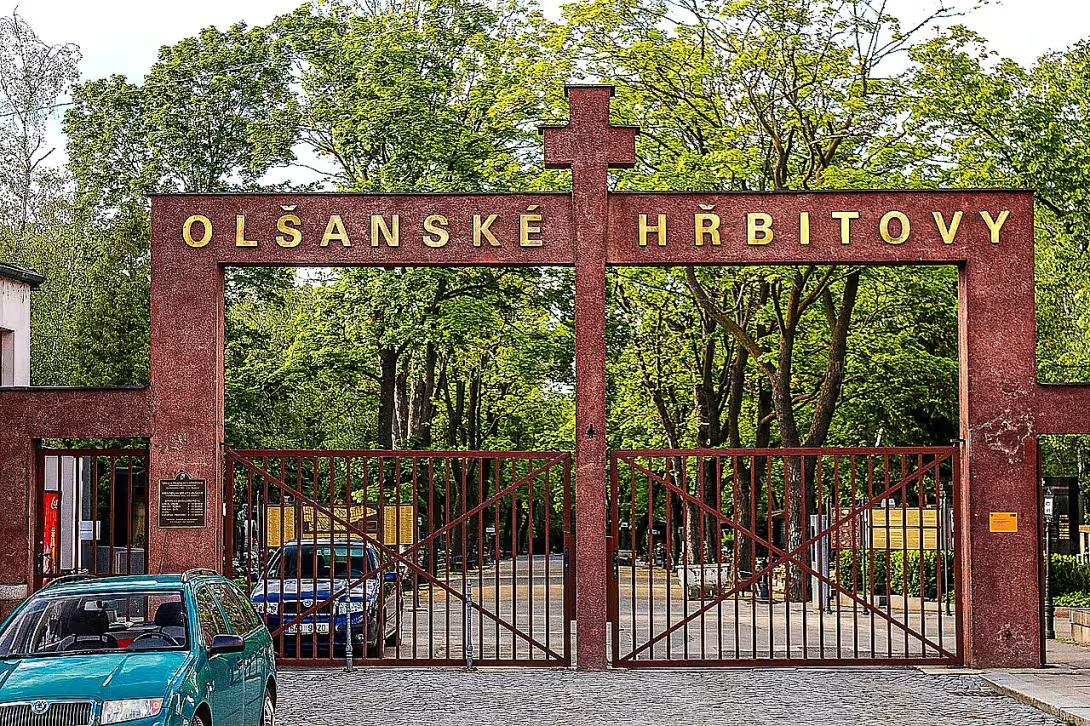
The oldest of the Olšanské cemeteries was established directly during the plague epidemic in 1680 on a small area of just 1131 square fathoms. His consecration took place on 29 January 1680 by St. Martin's priest Jan Václav Olomoucký. Soon after, in 1682, the church of St. Rocha was built here, dedicated to three saints - patrons of protection against the plague of St. Roch, St. Shebastian and St. Rosalie. This first cemetery served its purpose until 1860 when it was abolished.
The fatal break came with the Josephine reforms, when burial in the middle of cities was prohibited in 1786. Olšanské hřbitovy became the main burial ground for Old Town and New City of Prague. The second cemetery was consecrated on 16 September 1786 by Bishop Erasmus Krieger. Since then, the cemetery complex has been gradually expanded - the third cemetery was founded in 1835 and consecrated in 1839, the fourth one followed in 1841, the fifth one was consecrated in 1862. At the turn of the 19th and 20th centuries, there were other parts - the sixth and seventh cemetery in 1886, the eighth and ninth in 1889. The first municipal cemetery was founded in 1896, the tenth cemetery opened in 1910, and finally the second municipal cemetery was built from land which was purchased in 1917.
The cemeteries are named after the extinct village of Olšana, which once stood in the territory of today's Žižkov. Today they are divided into two parts by the street of Jana Numievsky, consisting of a total of twelve cemeteries. On their area of 50.17 hectares there are approximately 25 000 tombs, 65 000 common tombs, 20 000 urn graves, 200 chaple tombs, six Colombian walls and two scattered meadows. Many of these monuments were designed by important Czech architects and sculptors. The oldest preserved tomb is Zelenka's tomb founded in 1799, while the largest monument is Hrdliček's tomb with an area of 98 square meters, located at the main entrance.
In the ninth section of the cemeteries grows the most powerful tree of the entire complex - the warm ash, which is the rest of the original forest from before the cemetery was founded. It's estimated to be approximately 150 years old. The new ceremonial hall is also an interesting part of the complex, which was created by the reconstruction of the original crematorium. This first Prague crematorium operated cremation from 1921 to 1932, originally a neo-Renaissance interconfessional shrine built in 1898 according to plans by František Velich.
Each year there are around 200 funerals, 800 dispersions and 1500 urenes, which shows the continued importance of Olšanské cemeteries in the life of the capital. The cemetery's contribution organization is managed by Olšana Cemetery Administration. This place is not only a place of peace and memory, but also an architectural and historical monument that reflects more than three centuries of development and transformation of Prague.
Then and now
Drag the slider to compare how the landmark may have looked when it was built with the view today.
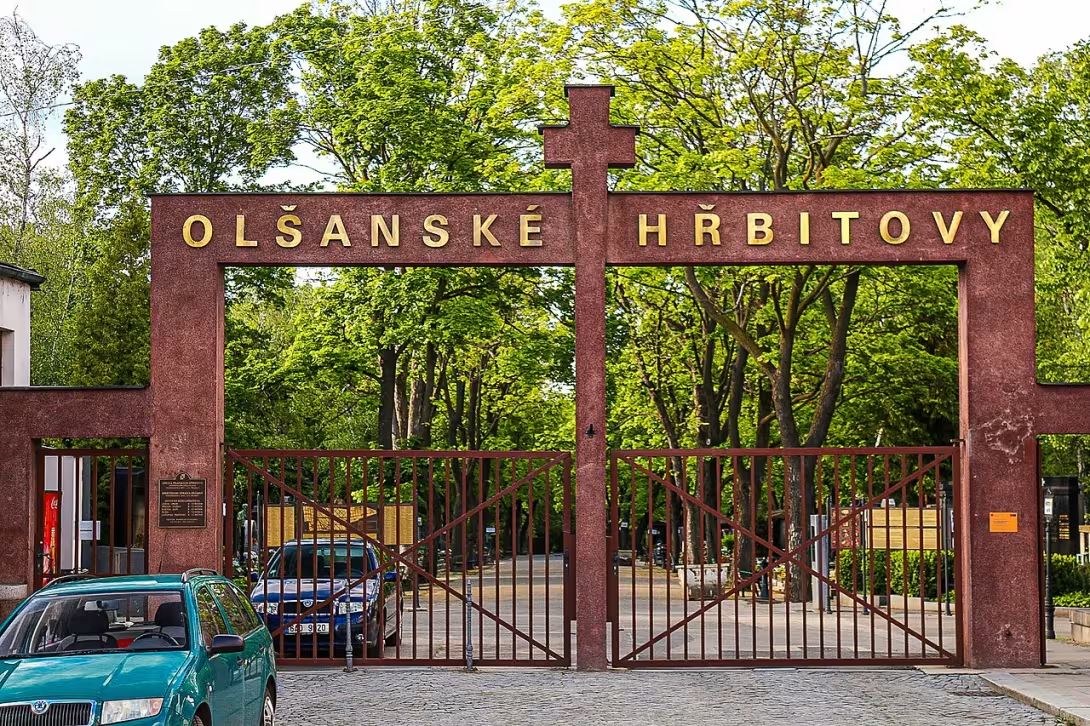
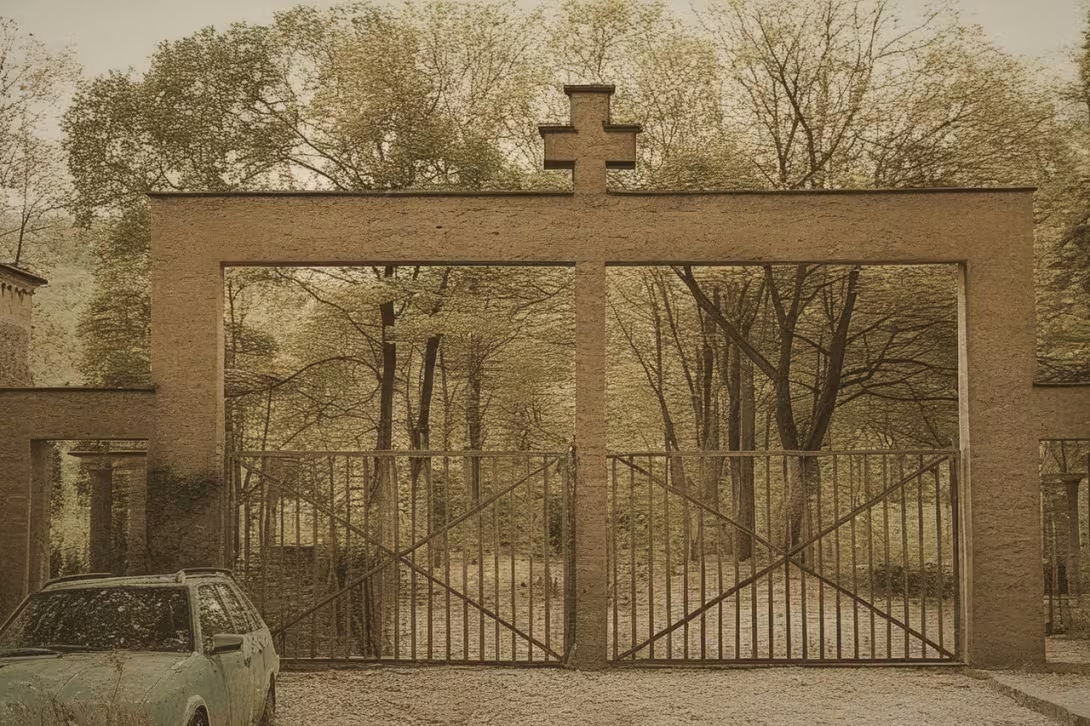
The historical appearance on the left is an AI-generated visualisation and serves as inspiration only.
Historical milestones
- 1680
- The founding of the First Cemetery during the plague epidemic.
- 1786
- Olšanské hřbitovy became the main burial ground for Old and New Town.
- 1860
- Cancellation of the First and Second Cemetery.
Architectural development
Olšanské hřbitovy has undergone several stages of development with the construction of new units from 1835 to the beginning of the 20th century. Architectural elements include various tombs and chapel graves, some designed by prominent architects.
Historical events
- 1680
- The founding of the First Cemetery during the plague epidemic.
- 1786
- Olšanské hřbitovy became the main burial ground for Old and New Town after the ban on urban funerals.
- 1860
- Cancellation of the First and Second Cemetery.
Points of interest
- The oldest cemetery was established in 1680 during a plague epidemic on an area of 1131 square fathoms. The cemeteries are named after the extinct village of Olšana, which once stood in the territory of today's Zizkov. The oldest preserved tomb is Zelenka's tomb founded in 1799. - The biggest monument is Hrdliček's tomb with an area of 98 square meters, located at the main entrance. - The ninth section grows the most powerful tree of the complex, a warm ash tree, which is the rest of the original forest.
Guide
This guide is narrated by a synthetic voice generated by artificial intelligence.
Show guide text
This text was created by artificial intelligence and has not been editorially reviewed. It may contain inaccuracies.
Welcome, distinguished visitors. Stop for a moment, take a breath and feel the silence that surrounds you now. You are standing at the gates of the Olšanské cemeteries, a place that is not just a burial ground, but the largest cemetery in Prague City and Czech Republic. In front of you, you see a vast space that stretches to a distance over 50 hectares. It's a real city of the dead where time flows slower and where every meter of land tells its own irreplaceable story. Imagine the incredible area that now surrounds you, and realize that you're going through one of the most important monuments of our ancestors' memory.
To understand why this place is even here, we need to go back to the past in our minds, namely six hundred and eighty years. At that time, Praha, like many other European cities, was affected by a devastating plague epidemic. Death was everywhere, and the existing burial ground downtown was no longer enough for the number of victims. It was from this tragic need that the first section of the Olšanské Cemetery was created. It was set up as a place outside the walls where the victims of the plague could be safely buried to prevent further spread of the disease. At that time, this space was much smaller, exactly a thousand hundred and thirty-one square fathoms, which is a small fraction of what you see today on today's scale.
But the history of this place didn't stop at the plague burial ground. In time, the meaning of the cemeteries expanded. In the year seven hundred and eighty-six, Olšanské hřbitovy became the main burial ground for the inhabitants of Old Town and New Town. This meant that thousands of people from different social classes began to come here, from poor craftsmen to rich townspeople. Later, in the year one thousand eight hundred sixty, the first and second cemetery were abolished, which further confirmed the position of this complex as the main resting place in Prague. A total of about two million buried here since then, making this place a huge archive of human lives, hope and loss.
Now, as you slowly move forward, pay attention to the overall layout of this space. Note that cemeteries are not one continuous total, but are divided by the street of Jan Želivský into two main sections. This street serves as a border but also as a link between different parts of this vast area. If you look around you, you'll see different elements mixed here. In one of the divisions you can see the Orthodox Temple, which gives the place a special spiritual atmosphere and reminds us of the religious diversity of Prague. In this part there are also honorary burial grounds, where people who have left a deep mark in the history of the city rest.
When you walk between tombs and monuments, don't just look for big names, but listen to the details. Even though the particular architects of the entire complex are not known, the structure of the cemetery itself reflects the changes of the time. Look at the facade of the tomb and feel the atmosphere of peace and respect. One of the most important points you should not miss is Zelenka's tomb. It was founded in the year seven hundred and ninety-nine and represents the oldest preserved tomb in the entire area. He's a silent witness for centuries who survived regime changes, war, and natural time decay. The next item that is likely to interest you in its size is the Proud Memorial, which is considered the largest within the cemetery. Look at its dimensions and think about how people in the past wanted to express their respect and memory for their loved ones.
You may now wonder where the name Olšanské hřbitovy comes from. The answer will lead us to a time when there was no cemetery, but there was a small village called Olšany. This village was located in the area where the Prague district of Žižkov now lies. With the gradual growth of Prague and the expansion of the village Olšany gradually disappeared, but its name remained in the name of this burial ground. It is a fascinating fact that the place we see today as a place of silence and death was once the home of the living people who cultivated the fields and lived their simple rural life.
This transformation from a village to a plague burial ground and then to the largest cemetery in the republic carries a certain mystery and melancholy. If we could hear the voices of the two million people who are resting here, how much they would tell us about old Prague, its triumphs and its tragedies. Olšanské hřbitovy are like an open book where every tomb is one word and every aisle is an entire chapter.
Now invited to further explore. Let yourself be guided by paths that extend in front of you. Take your time. Feel the contrast between the noise of the city, which is still falling from the surroundings, and the deep room that rules within these gates. Watch as the light moves through the trees and hits the old stones. Stop by Zelenka's tomb, find the Proud Memorial, and try to imagine what Olšana's village looked like hundreds of years ago.
This space teaches us humility and reminds us that we are only part of a long chain of generations. Olšanské hřbitovy is not only a place of sadness, but above all a place of memory and a deep historical context that helps to understand who we are today.
Thank you for spending these first moments with us. Now it's time for you to take your own path. Walk through the cemeteries at your own pace, perceive their silence and be inspired by the history that is carved into the stone. We wish you a peaceful and inspiring walk. Goodbye.
Tips for visitors
Best time to visit Olšanski Cemetery is early spring or late autumn when vegetation is full of blood and light is not very strong. These periods offer a peaceful atmosphere and beautiful experiences.
Parking in Olšanské cemeteries can be challenging, so we recommend using public space for parking near Jana Želivský Street. For the arrival of public transport it is advisable to use metro station Railway station Holešovice or South Town and then reach by bus or tram.
When visiting, remember shoes suitable for long walking, because cemeteries have a large area. Also remember the protective clothing and the umbrella, especially in the summer months.
For photography it is best to wait for the golden hour in the morning or in the evening when the light is softer. The most significant places for images are in the central areas of the cemeteries and at the memorial graves.
In the vicinity of the Olšanské cemeteries there are several attractions such as the Museum of Architecture in Prague or the Krematorium in Žižkov. These places are easily accessible by bus or pavement.
For families with children, visiting Olšanské cemeteries can be an interesting experience if you focus on historical and cultural aspects. You can plan a walk with a children's break in a nearby park.
For kids
Imagine going back 346 years to Prague and finding an amazing, almost magical place full of stories and secrets. It's like a children's game with many hidden treasures waiting to be discovered. This place is called Olšanské hřbitovy, the largest burial ground in Prague, where thousands of people rest throughout history.
Businesses nearby
Do you run a restaurant, accommodation, shop, museum, rental, wellness or other visitor service near this monument? Show yourself directly to the people heading to it — this is how they will see you in the app and on the web:
Events nearby

Zdroj akcí: otevřená data měst a obcí ČR (Národní katalog otevřených dat) a kalendář akcí Národního památkového ústavu.
Nearby
ITEX Show interactive overview of the surroundings - restaurants, accommodation, rentals and other places within a 15 km radius.
Data: OpenStreetMap contributors, 15 km radius.
‡ Historical monuments
- Gallery Troba (1.2 km - Velehradská 1320 / 24)
- Military Historical Institute Praha (2.0 km - U Memorial 1600 / 2)
- Emil Bay (2.7 km)
- Clam-Gallas Palace in Praze (3.8 km - Husova 156 / 21)
- House U Kohouta (3.8 km)
- Gorlice (3.9 km)
- Brick gate (4.0 km - In strength 46 / 1)
- Hlavkova railway (4.0 km - Gorazdova 1994 / 9)
Restaurant and catering
- LegendA (3.0 km)
- Yi Xiang Ge (3.0 km)
- Švejk restaurant U Brážek (3.2 km - U Libertariv 18)
- Pizzeria Cerreto (3.2 km)
- Šnyt (3.3 km - Blacksmith 16)
- McDonald 's (3.4 km - Vodičkova 736 / 15)
- Restaurant River's smokelab (4.4 km - Lidická 2)
- Pizzeria U Penguin (4.6 km - square 14 October 1)
Accommodation
- Hotel Olšanka (1.0 km)
- EA Hotel Tosca (2.3 km - Blanická 718 / 10)
- Hotel AXA (2.7 km - Na Poříčí 40)
- Carol (3.0 km)
- Arlington (3.1 km)
- Siesta (3.2 km)
- Plaza Prague Hotel (3.4 km)
- Plus Prague (3.5 km)
› Rental and sports
- Pavvy Cycles (1.5 km - Chvalova 1577 / 12)
- Virus Sport (1.9 km - Black Sea 235 / 5)
- Kieser Training (2.9 km)
- VM-SPORT (3.1 km)
- Velox Sport (3.3 km)
- Harfa sport (3.3 km)
- JUN (3.7 km - Haškova 629 / 7)
- Free Time Centre Botič (3.9 km)
© Tourism and nature
- Outboard Railway station Vysočany (3.8 km - Sokolovská 202 / 314)
- Information and booking center (3.9 km - Maiselova 38 / 15)
- Excursion Emy Destinnova (4.2 km)
- Vyšehrad (4.2 km)
- ÚAMK, a.s. (4.9 km - On the Union 1837 / 9)
- Prague Castle (5.2 km)
- Petrinka (5.2 km)
- Masaryk prospect (5.5 km)
Accommodation nearby
Trips and activities nearby
Guided tours, tickets and activities nearby from GetYourGuide
Affiliate link: if you buy from the partner, we may receive a commission. The price for you does not change.
Search tours and activities →Themed route
1. Main Gate (Type: Architecture) - Monumental entrance to the premises, which will immediately bring you to visit historical gates and statues. 2. National cemetery (Type: Monumental zone) - This section offers a view of the most important tombs and monumental monuments of historical personalities. 3. Jewish section (Type: Historical area) - Unique space with rich history and a specific, quiet atmosphere. 4. Cemetery park (Type: Green area) - A quiet walk between grown trees and historical architecture within the whole area.
Seasonal recommendations
Spring: In the spring season, Olšanské hřbitovy becomes a living flower paradise when emerging shrubs and trees start to green. Sunshine days bring a warm atmosphere full of sweet flowers, which enriches every step of the cemetery pavement. This time of year is ideal for visiting because the crowds have not yet appeared in full scope and nature offers quiet moments for reflective walks. It is recommended to wear clothes suitable for mild weather, with the possibility of adding a warm vest or raincoat to a cooler morning or evening. The best time to visit is in the afternoon when the sun illuminates historical monuments in attractive lights.
Summer: During the summer season Olšanské hřbitovy offers a special atmosphere with long days and warm sunny lights that illuminates historical tombstones. This time of year is popular between tourists and locals, which means a higher number of visitors. In order to avoid long fronts at entrances and stress from excessive crowds, it is advisable to visit the cemetery in the morning or evening. They watch out for warm clothes with ties and enough water to avoid fatigue caused by sunlight. It is also advisable to avoid the hottest time of the day when temperature can be challenging.
Autumn: In autumn the Olšanské hřbitovy melancholic beauty takes place when tree leaves turn into living colors from gold to red. This season brings a calm and calm atmosphere, ideal for relaxing in the air full of moonlight. Despite slightly falling temperatures, this time of year is still good enough to be used outside without the constant threat of rain. It is recommended to wear layered clothes with a warm shirt and the possibility to add a coat if necessary. The best time to visit is usually the afternoon when the sun is still high enough to illuminate historical monuments.
Winter: Winter Olšanské hřbitovy offers unique experiences with covered snow tombstones and a quiet, quiet atmosphere. The cold temperature may be a challenge, but it also brings a sense of complete disconnection from everyday life. The opening hours of the cemetery may be shortened, which means it is important to plan a visit within the available hours. Hot clothes, including shirts, hat and hats, are essential for comfort during cold days. Visiting the cemetery early in the afternoon may be ideal because sunlight illuminates the sights in a quiet and quiet environment.
Visualizations and artistic views


The visualisations are generated by artificial intelligence and serve as inspiration.
Photos from the area
Real photos taken near the monument


Zdroj a licence jsou uvedeny u každého snímku.
Tips from visitors
No tips yet. Be the first!
Log in and add your tip.
Sources and literature
Photos: VitVit / CC BY-SA 4.0 — Wikimedia Commons. The author and licence also appear when you hover over the image.
Faktickým podkladem tohoto textu byl článek na Wikipedii, jehož autory jsou přispěvatelé Wikipedie. Článek je dostupný pod licencí CC BY-SA 4.0.
Location on the map
Příběhy a pověsti
Legendy, pověsti a příběhy spjaté s touto památkou
Fotografie návštěvníků
Zatím žádné fotografie. Buďte první, kdo přidá fotografii z návštěvy!
Log in a přidejte svou fotografii nebo hodnoťte.
Za ověřenou návštěvu v aplikaci získáte víc bodů — poznáme podle GPS, že jste na místě.
Reviews and comments