






Palác Adria Administrative building
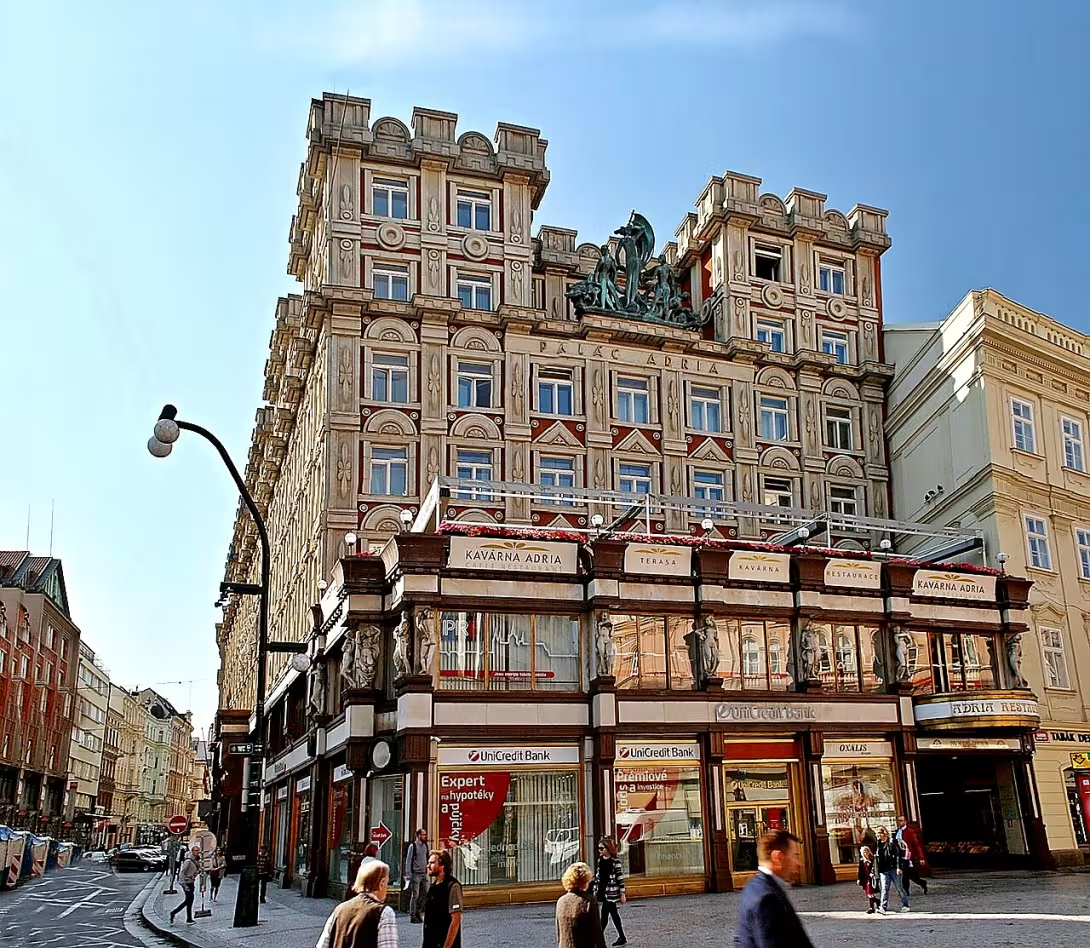
Palác Adria stands as a remarkable architectural monument in Prague's New Town at the junction of Jungmannova náměstí and Národní třída. Built between 1922 and 1925 by the Italian insurance company Riunione Adriatica di Sicurtà, it is celebrated for its rondokubist style, showcasing early 20th-century architectural innovation. Architects Josef Zasche and Pavel Janák led the design effort, with sculptural contributions from artists like Otto Gutfreund and František Anýž. Over time, Palác Adria has hosted various cultural functions, including cinemas and theaters, reflecting its dynamic role in Prague's urban landscape.
The construction of Palác Adria occurred during a period when Czechoslovakia was establishing itself as a new nation after World War I and the dissolution of the Austro-Hungarian Empire. This era marked significant cultural and architectural development as the country sought to define its identity. Completed in 1924, the building embodies this transformative time.
Architecturally, Palác Adria is distinguished by its rondokubist style, characterized by rounded forms combined with cubist elements. Designed by Josef Zasche and Pavel Janák, it features sculptural decorations by artists such as Otto Gutfreund and František Anýž. Notably, Adolf Mayerl contributed ten dancing figures between the first-floor windows, adding a unique artistic flair to the facade.
Ownership of Palác Adria has seen dramatic changes over time. Originally owned by Riunione Adriatica di Sicurtà, it was confiscated as a German-owned enterprise after World War II. It then became property of various Czech institutions and cultural entities, reflecting its evolving role in Prague's social and cultural fabric.
Palác Adria has been the site of several key events and curiosities throughout its history. In 1925, the Bio Adria cinema opened with a screening of 'Zvoník od Boží matky', marking an important moment in Czechoslovakia's cinematic history as one of the first venues to screen sound films using the Phonofilm system. The building also hosted the premiere of the first sound film 'C. a k. polní maršálek' in October 1930, further cementing its place in cultural history.
Today, Palác Adria continues to be an important cultural landmark. It is home to Divadlo Bez zábradlí, established by Karol Heřmánk in 1998, and has hosted various other institutions over the years, including cinemas and theaters. The building's rich history and architectural significance make it a must-visit site for those interested in Prague's cultural heritage.
Palác Adria remains a testament to early 20th-century architectural innovation and cultural dynamism. Its historical significance and artistic contributions continue to draw visitors, offering a glimpse into the vibrant cultural landscape of Prague during its formative years. This monument invites exploration and appreciation from all who are curious about the intersection of architecture and history in one of Europe's most storied cities.
Then and now
Drag the slider to compare how the landmark may have looked when it was built with the view today.
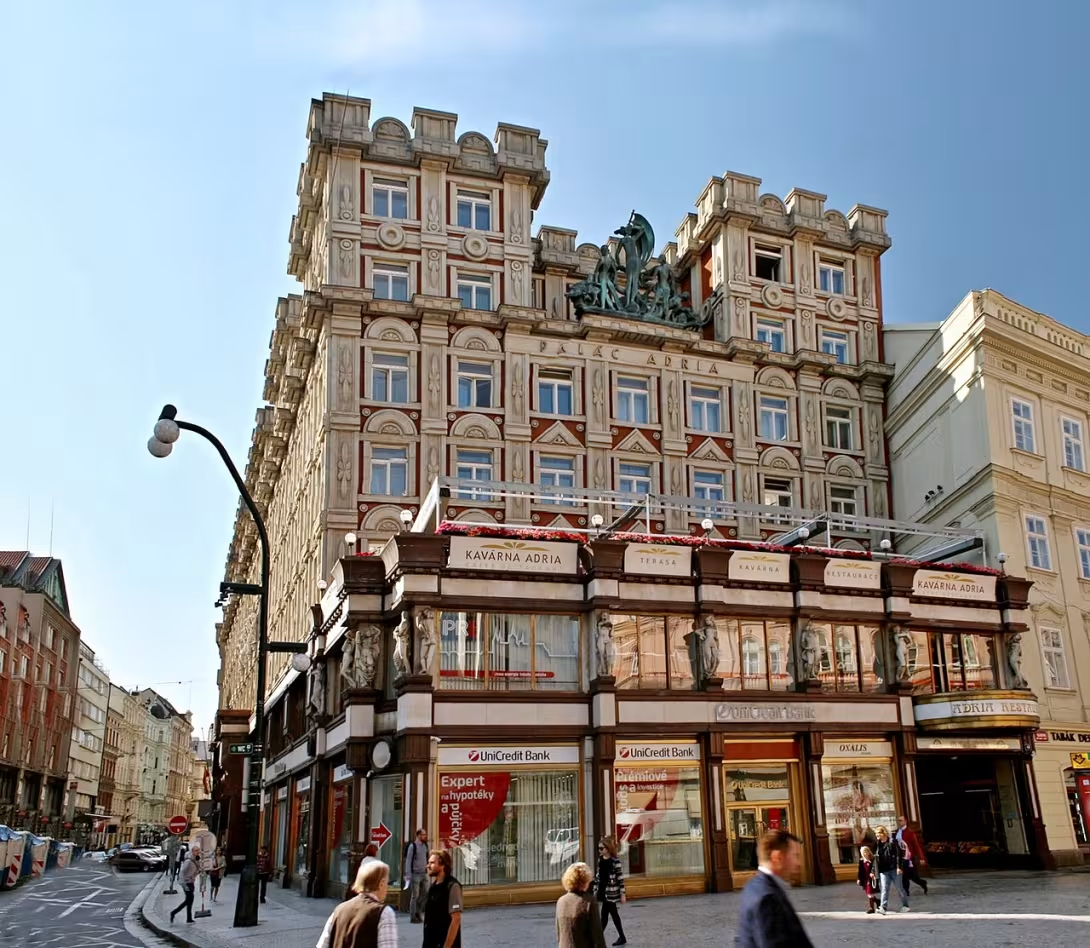

The historical appearance on the left is an AI-generated visualisation and serves as inspiration only.
Historical milestones
- 1924
- Construction of Palác Adria completed.
- 1925
- Opening of Bio Adria cinema with the film 'Zvoník od Boží matky'.
Architectural development
Palác Adria was constructed between 1922 and 1925, showcasing the rondokubist style. The building underwent significant modifications from 1958 to 1959 to accommodate theatrical productions, reflecting its adaptive reuse over time.
Historical events
Inauguration of Bio Adria cinema in 1925 with the screening of 'Zvoník od Boží matky'.
Premiere of the first sound film 'C. a k. polní maršálek' in October 1930.
Reconstruction for Laterna magika performances in 1959.
Owners
Originally owned by Riunione Adriatica di Sicurtà, a prominent Italian insurance company. After World War II, it was confiscated as a German-owned enterprise. Subsequently, it became the property of various Czech institutions and cultural entities.
Points of interest
- Palác Adria's rondokubist style is a unique architectural blend that combines rounded forms with cubist elements, making it one of the few buildings in Prague to showcase this innovative design approach from the early 20th century.
- Adolf Mayerl contributed ten dancing figures between the first-floor windows of Palác Adria, adding an artistic flair uncommon among contemporary office buildings and highlighting the building's cultural significance beyond its architectural style.
- In a dramatic shift post-World War II, Palác Adria was confiscated from Riunione Adriatica di Sicurtà due to its German ownership status, reflecting broader geopolitical changes in Europe that affected property rights and ownership during this period.
- The Bio Adria cinema within the building premiered one of Czechoslovakia's first sound films using the Phonofilm system with 'Zvoník od Boží matky' in 1925, marking a significant moment in the history of film technology in the region.
- Palác Adria has served as a dynamic cultural venue over the decades, hosting various institutions such as cinemas and theaters, which illustrates its ongoing role in Prague's evolving social and cultural landscape.
Guide
This guide is narrated by a synthetic voice generated by artificial intelligence.
Show guide text
This text was created by artificial intelligence and has not been editorially reviewed. It may contain inaccuracies.
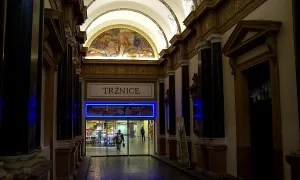
The Adria Palace stands in Prague in the New Town, at the corner of Národní Avenue and Jungmannova Square. It was built between 1922 and 1925 by the Italian insurance company Riunione Adriatica di Sicurtà. It was designed by architect Josef Zasche in collaboration with Pavel Janák, in the rondocubist style. The sculptural decoration was created by Otto Gutfreund, Jan Štursa, František Anýž, Karel Dvořák, Bohumil Kafka, and Adolf Mayerl. Mayerl created ten dancing figures between the windows of the first floor. The Adria passage runs through the building from Jungmannova Street to Národní Avenue.
The Bio Adria cinema began operating in the large underground hall on March 18th, 1925. It opened with the American silent film The Hunchback of Notre Dame. The opening ceremony was attended by the Minister of Commerce, and the invitations specified evening dress. The hall had a capacity of 999 spectators. From November 1927, the Phonofilm sound system films were screened here for several weeks for the first time in Czechoslovakia. This was the invention of an American, Lee de Forest, who recorded sound directly onto the film strip. The sound quality was very poor. Contemporary press therefore identified animal sounds as the most welcome subject matter. The cinema had its first true sound film premiere in October 1930 with the film Cé a ká polní maršálek.
The cinema operator Osvald Kosek Czechified the name to Adrie after the Munich Agreement. He then fled to the United States because of his Jewish origin. In 1939, the cinema received a confidant, the collaborator Bohumil Smol, and later passed into German hands. After the war, it was confiscated and bore the name Moskva until 1958.
Following the success of Laterna Magika at the World Expo in Brussels in 1958, the hall was reconstructed for its needs. Architects František Cubr, Josef Hrubý, and Zdeněk Pokorný adapted the building for theatrical use. Laterna Magika performed here from May 1959 to November 1990. Between 1965 and 1972, the Divadlo za branou of Otomar Krejča was also based here. His company returned to this space after 1990 as Divadlo za branou II. Until 1996, the Black Theatre of Jiří Srnec also had guest performances here. After reconstruction, the hall capacity was reduced to 308 spectators. Since 1998, it has been the home stage of Divadlo Bez zábradlí, which was founded by Karel Heřmánek.
The palace also housed a café, Hugo Feigl's gallery, and for decades the Czechoslovak Film Institute. In 1989, the Civic Forum also had its main headquarters here.
Frequently asked questions
Can the monument be visited?
The building is in use (offices, a school, shops and the like). The interior is generally accessible only during operating hours and tours are not usually offered; we have not verified the details. You can see the exterior from the street.
Where is the monument?
Location: Praha 1, Hlavní město Praha. The map on this page shows the exact spot.
Why is the monument protected?
It is listed in the Central List of Cultural Monuments of the Czech Republic as a cultural monument (register no. 1000151885).
Businesses nearby
Do you run a restaurant, accommodation, shop, museum, rental, wellness or other visitor service near this monument? Show yourself directly to the people heading to it — this is how they will see you in the app and on the web:
Events nearby

Zdroj akcí: otevřená data měst a obcí ČR (Národní katalog otevřených dat) a kalendář akcí Národního památkového ústavu.
Nearby
Palác Adria is situated near other notable structures such as Palác ARA and the New Palace of Riunione Adriatica, now known as Palác Zlatý Kříž. The area also hosts the Rakouské kulturní fórum v Praze.
Accommodation nearby
Trips and activities nearby
Guided tours, tickets and activities nearby from GetYourGuide
Affiliate link: if you buy from the partner, we may receive a commission. The price for you does not change.
Search tours and activities →Themed route
Palác Adria Walking Tour
This 3-stop walking tour takes you through the historic center of Prague 1, showcasing notable administrative buildings and cultural institutions.
1. Palác Adria (Main Attraction) Start your tour at the stunning Palác Adria, a beautiful example of Art Nouveau architecture. Admire its intricate details and take a moment to appreciate its history as a former insurance company headquarters.
2. Palác ARA (approx. 5-minute walk) From Palác Adria, head to Palác ARA, another impressive Art Nouveau building located just a short stroll away. Take note of its unique design and architectural style.
3. Rakouské kulturní fórum v Praze (approx. 2-minute walk) Continue to the Rakouské kulturní fórum v Praze, a cultural institution that hosts various events and exhibitions. Explore its premises and learn about the cultural exchange between the Czech Republic and Austria.
Seasonal recommendations
Jaro In the spring season, Palác Adria is surrounded by blooming trees and flowers, creating a pleasant atmosphere and a photogenic backdrop. The ideal time to visit is in the morning when there are fewer people, allowing you to explore the building calmly and without crowds. Wear clothing suitable for hiking and don't forget your camera to capture the beauty of spring nature.
Léto The main summer season brings many visitors to Palác Adria, so it's a good idea to arrive early to avoid crowds. Clothing should be light and comfortable, suitable for strolling through the historic part of the city. Summer is also an ideal time for photographing the exterior of the palace when sunny weather offers beautiful lighting and colorful effects.
Podzim In autumn, Palác Adria is surrounded by beautifully colored foliage, creating a pleasant atmosphere and a photogenic backdrop. The best time to visit is in the afternoon when sunlight is ideal for photography. Wear clothing suitable for an autumn walk in nature and don't forget your camera to capture the beauty of autumn scenery.
Zima In winter, Palác Adria is enveloped in a quiet blanket of snow, creating a calm and romantic atmosphere. Clothing should be warm and well-insulated to avoid the cold.
Visualizations and artistic views


The visualisations are generated by artificial intelligence and serve as inspiration.
Photos from the area
Real photos taken near the monument


Zdroj a licence jsou uvedeny u každého snímku.
Tips from visitors
No tips yet. Be the first!
Log in and add your tip.
Sources and literature
Photos: VitVit / CC BY-SA 4.0 — Wikimedia Commons. The author and licence also appear when you hover over the image.
Faktickým podkladem tohoto textu byl článek na Wikipedii, jehož autory jsou přispěvatelé Wikipedie. Článek je dostupný pod licencí CC BY-SA 4.0.
Location on the map
Příběhy a pověsti
Legendy, pověsti a příběhy spjaté s touto památkou
Fotografie návštěvníků
Zatím žádné fotografie. Buďte první, kdo přidá fotografii z návštěvy!
Log in a přidejte svou fotografii nebo hodnoťte.
Za ověřenou návštěvu v aplikaci získáte víc bodů — poznáme podle GPS, že jste na místě.
Reviews and comments