



Palác Letná House
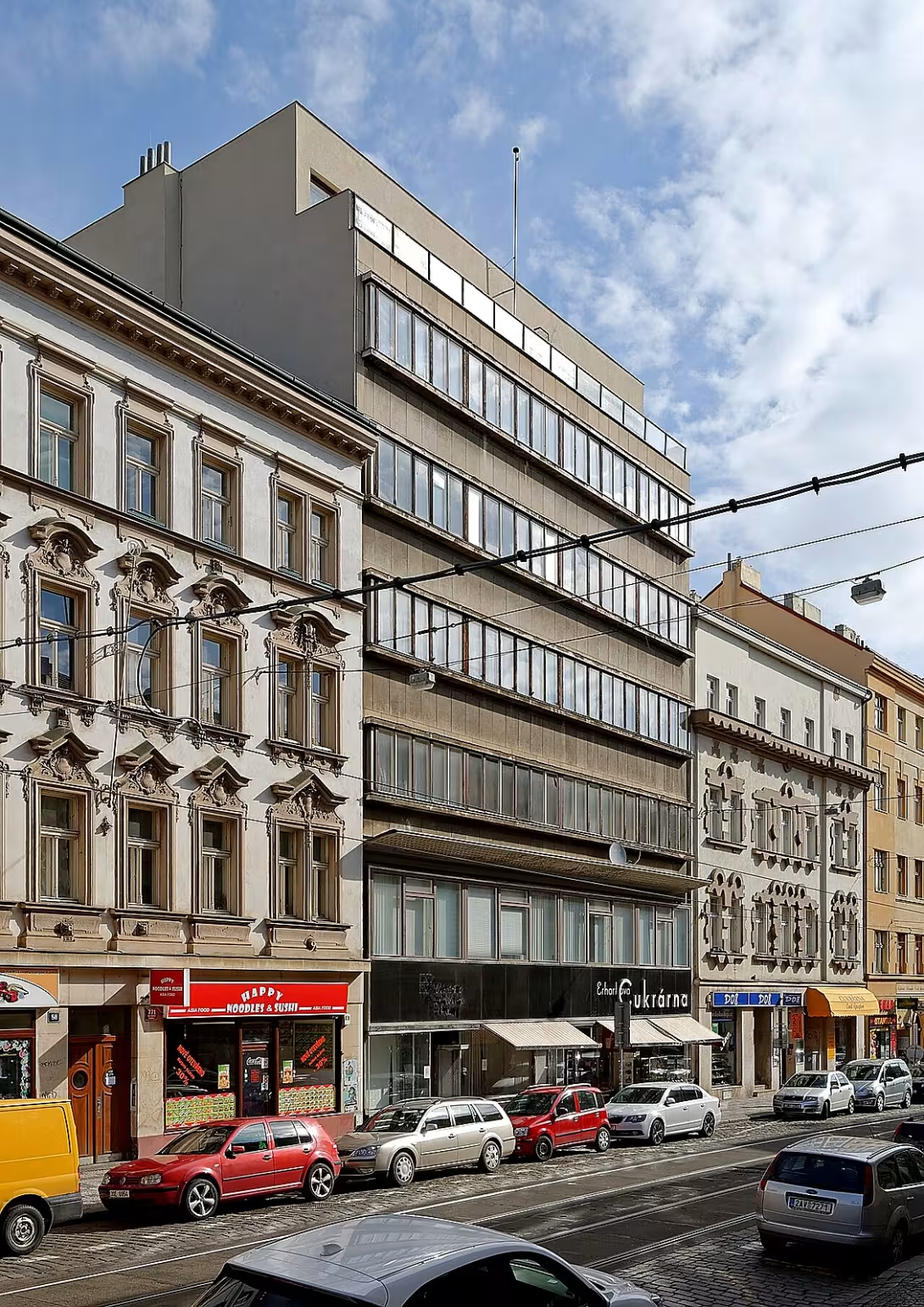
Palác Letná is a remarkable functionalist house in Prague 7, which was built in 1936-1937. It is the only café from the first republic with preserved functionalist and functional interior. Located in Milady Horáková street no. 387 / 56 in Holešovice.
Palác Letná was created when functionalism developed in Prague, which was also reflected in the architecture of this house. It was designed by architect Eugene Rosenberg as a standard rental house with a shop and cafe on the ground floor and commercial premises in 1st and 2nd floor. It was built in the years 1936-1937 by Českomoravská zástavská stavka a.s. and the investor was Bohuslav J. Hanák.
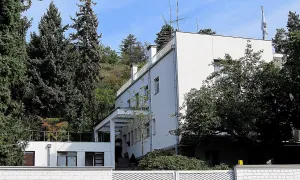
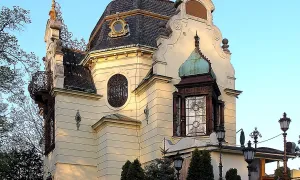
Palác Letná is characterized by the smooth face of the seven-storey house, which is separated from 1st floor by horizontal belts of windows. At 7th NP there is a facade terrace throughout the entire width, respecting its line. The continuous reinforced concrete awning separates commercial spaces from residential spaces on the facade. On the ground floor there is a shop on the left side of the entrance to the house and on the right side Erhart's confectionery shop with coffee shop. The other two floors were set aside as a department store. There was a library in NP 1 that was later moved.
On the ground floor of the staircase there is a metal memorial plate with text: "Palác Letná / Built in 1937 Bohuslav J. Hanák / Projected by academic architect Evžen Rosenberg / Stavbu by Českomoravská stavská a.s." The interior of the confectioner with the café was also designed by architect Rosenberg. It consists of the front room with a sales counter, the rear "lounge," the guest and preparation toilets, and there are storage and production rooms in the basement. It is the only café from the first republic with preserved functionalist and functional interior.
In 2002, Letná Palace was listed as a cultural monument of the Czech Republic and is protected as a real estate monument. In 2007, the town part of Prague launched 7 reconstruction of the interior of the confectionery shop with a café. The original preserved parts of the equipment were supplemented by replicas of the mobiliary, lighting, switches, forging and other accessories, reminiscent of the 1930s.
Palác Letná is today a protected monument and is worth a visit in order to become familiar with the unique functionalist interior and remarkable architectural solutions.
Then and now
Drag the slider to compare how the landmark may have looked when it was built with the view today.
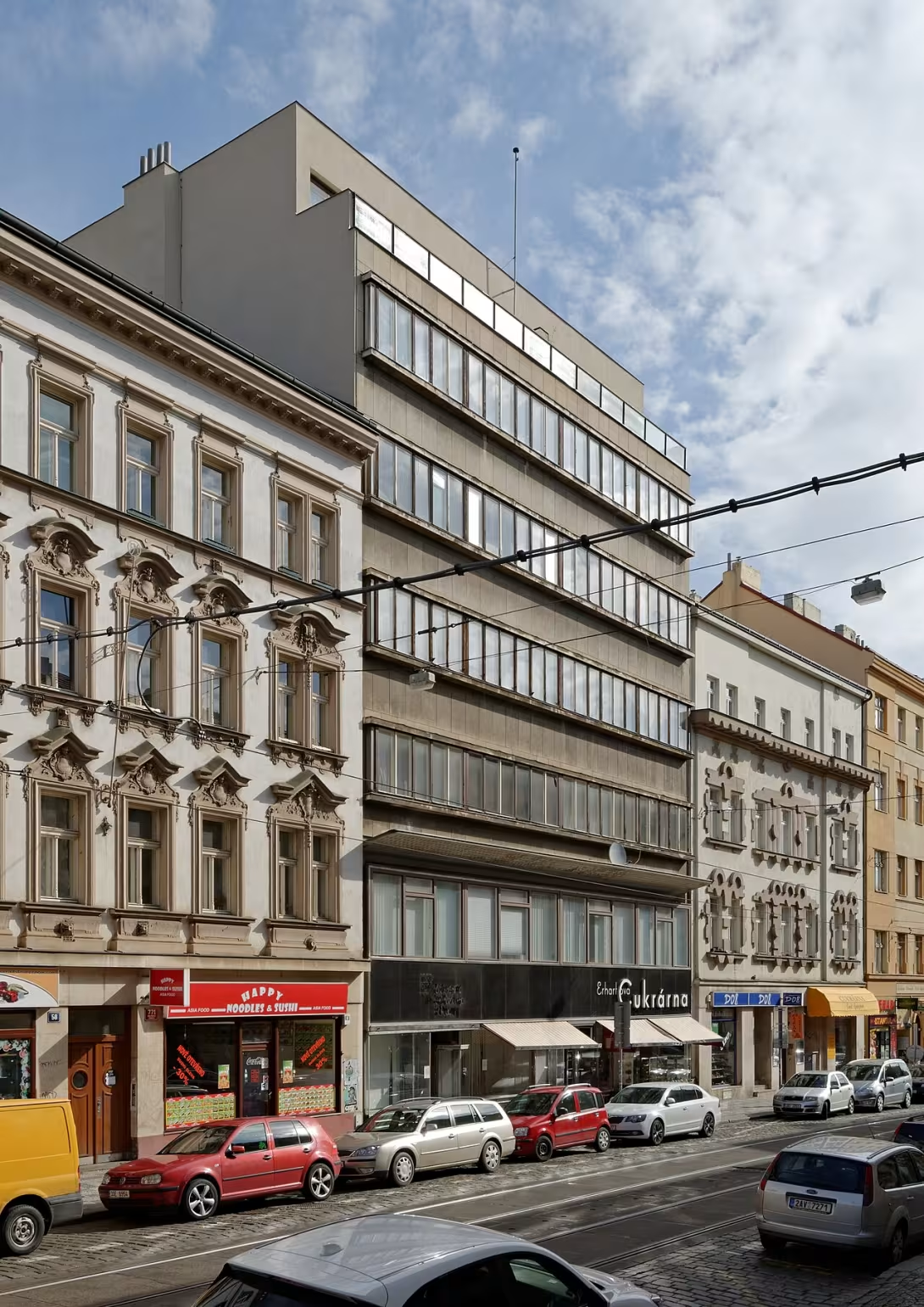
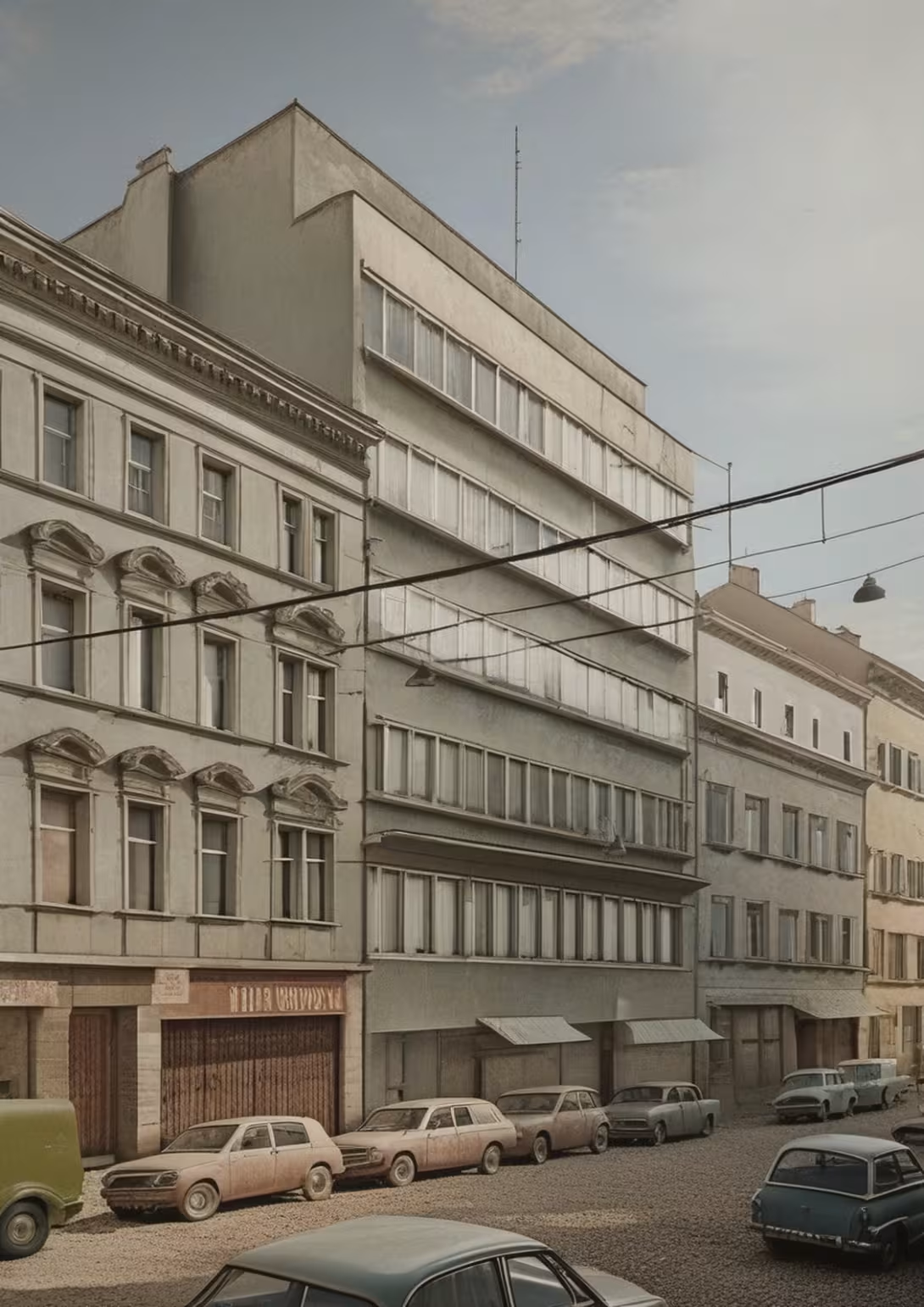
The historical appearance on the left is an AI-generated visualisation and serves as inspiration only.
Historical milestones
- 1936
- Beginning of construction of the Palace Letná
- 1937
- Completion of the building of the Palace Letná
- 2002
- Listed in the list of cultural monuments of the Czech Republic
- 2007
- Reconstruction of the interior of the confectionery shop with cafe
Architectural development
Palác Letná was built in 1936-1937. On the ground floor there is a shop and cafe, in 1st and 2nd floor are business premises. There's a terrace at 7th floor.
Owners
Bohuslav J. Hanák
prague 7 city area
Points of interest
- Palác Letná is a remarkable house in Prague 7, which was built in 1936-1937. - Palác Letná is the only café from the first republic with preserved functionalist and functional interior. - Palác Letná is a protected monument and is worth visiting so that you can become familiar with the unique functionalist interior and remarkable architectural solutions. - On the ground floor there is a metal memorial plate with text: "Palác Letná / Built in 1937 Bohuslav J. Hanák / Projected by academic architect Evžen Rosenberg / Stavbu by Českomoravská stavská a.s." - In 2007 the town of Prague started 7 reconstruction of the interior of the confectionery shop with a café.
Guide
Show guide text
This text was created by artificial intelligence and has not been editorially reviewed. It may contain inaccuracies.
Welcome to Prague seven, where the history of everyday life meets great architecture. You are standing in front of one of the most important building units in this neighborhood, which bears the name Palác Letná. Look at him. It may not act at first glance as a monumental fortress with high towers or richly decorated columns, but in its purity, its simplicity and its adaptation to the surrounding urban space, its true strength. Feel the atmosphere, feel the calm yet very clear energy this building emits. It's a building that doesn't try to scream, but instead it wants to tell you a story about the modern world and how people started to organize in it.
In order to fully understand why this house is standing right here and why it has that look, we need to go back in time together. Let us move on to a time when our country was building up in the form that we still love so much today. This was an era of great hope and rapid progress. It was in these years, namely between the year one thousand nine hundred thirty-six and one thousand nine hundred thirty-seven, that this building was born here. Behind this ambitious project was a man with a great vision, architect Eugen Rosenberg. He was the one who put his idea of what modern urban life should look like in these walls. The construction was carried out by the company Českomoravská building a.s., which at the time played an important role in the development of our city. It wasn't just an ordinary house built for a few families. It was an elaborate whole with the integrity of the entire city block. He had business spaces in him, he had a cafe in him, and at the same time he had homes for residents who could live here in close proximity to all services.
Now pay attention to what you see right in front of you. Notice the lines, the clean edges and the overall geometry of the building. What you're seeing right now is pure functionalism. This direction of architecture, which was a huge shift at the time, believed in one fundamental thing: that every thing must have a clear purpose. No ornament shall be for decoration only if it serves no purpose. Everything must be based on utility and practicality. Look at the layout of the floors. On the ground floor there are premises for shops and cafés, allowing people in the vicinity easy and direct access to the necessary services. On the first and second floors you will find other business premises and rooms for living. This whole building is a perfect example of how work, business and private life were thought of in one place at the time. It's an architecture that serves man and his needs.
Now when you look at these facades and the overall form of the palace, remember the people who breathed life into this place. Architect Eugen Rosenberg has put his expertise in every detail and his faith in a new, functional way of life. He was the one who defined this space. And we must not forget the other names associated with this place, such as Bohuslav J. Hanák. These people were part of the era that this palace was born, and their presence in this place is still echoing.
And now I'm going to tell you something that makes this place really special and what makes it a real treasure. You may think it's just another historical house in Prague, but Palác Letná is hiding something incredible. It's the only coffee shop from the time of the first republic that managed to preserve its original, functional and very specific interior. That's absolutely rare in today's world. Most of these areas have been somehow changed, rebuilt or completely destroyed by new scales over the years. But here, in this palace, you have managed to find a piece of history that remains preserved in all its glory. In the year two thousand seven, this confectionery and coffee shop was restored very carefully again so that this unique spirit could continue to preserve itself and that people could reexperience the strange atmosphere of the time when it was believed in progress and the pure beauty of utility.
This building is not just an ordinary house. Since the year two thousand and two, this monument has been included in the list of cultural monuments of our country and is protected as a real estate monument. This means that its value is recognised by the whole state and its appearance and essence must be preserved for future generations. It's an inheritance we have in common.
Now, I'm going to sound you in order to be invited into this space. Explore it, see its details and let it drift through the history that still lives here in every corner. Look at its premises, perceive its peace and energy and try to imagine how it was lived and done almost 100 years ago. Thank you for your time and for taking this short journey of history with me. I wish you a beautiful and inspiring tour of the whole Palace Letná.
Tips for visitors
The best time to visit the Palace Letná is early morning or late evening when there are fewer people and you can enjoy the quiet surroundings. The sunlight in these hours highlights the unique architecture of the palace.
The best connection with the Palace Letná can be found using the online route search engine. The location is also available for pedestrians and cyclists.
When visiting take a hat or umbrella with you if you plan to spend your trip outside. You will also want to take photos inside the palace, so you can bring your camera or mobile phone.
Photography is best possible from the side of Milady Horáková street, where you can see the whole building. At noon, sunlight highlights simple lines of functional design.
In the vicinity of the Palace Letná it is possible to visit the Letenská orchards, which are ideal for relaxation and picnic. For families with children, the park and playground offer wide space for running.
Frequently asked questions
Can the monument be visited?
This is a residential or farm building, not a museum with opening hours. Please view it from public space and respect the owners' privacy. We have no information about access to the interior.
Where is the monument?
Location: Praha 7, Hlavní město Praha. The map on this page shows the exact spot.
Why is the monument protected?
It is listed in the Central List of Cultural Monuments of the Czech Republic as a cultural monument (register no. 1903342366).
Businesses nearby
Do you run a restaurant, accommodation, shop, museum, rental, wellness or other visitor service near this monument? Show yourself directly to the people heading to it — this is how they will see you in the app and on the web:
Events nearby

Zdroj akcí: otevřená data měst a obcí ČR (Národní katalog otevřených dat) a kalendář akcí Národního památkového ústavu.
Nearby
Palác Letná se nachází v Praze 7, v ulici Milady Horákové.
Accommodation nearby
Trips and activities nearby
Guided tours, tickets and activities nearby from GetYourGuide
Affiliate link: if you buy from the partner, we may receive a commission. The price for you does not change.
Search tours and activities →Themed route
Thematic cruise route Palác Letná
1. Palác Letná (Palace) Type: architecture and history Why is it worth visiting: This palace is an icon of modern design created by the famous architect K. Im. Its unique form and position on the Leten orchards offer views of the whole city of Prague.
2. Flight sets (park) Type: green area for relaxation Why is worth a visit: Letenské sets are an ideal place to relax and walk. Here you will find sports ground, swimming pools and beautiful green areas that create a quiet space in the middle of the city.
3. Letenská beach (beach) Type: leisure place for leisure activity Why is it worth a visit: Letenska Beach is a popular place for an afternoon spent in the sun. It offers the possibility of relaxation, sport or just fun moments with family and friends.
4. Letenian orchard (tree) Type: historical monument Why is it worth a visit: The Letenské orchard is the oldest and highest oak in Prague. Its history dates back to the 17th century, making it an interesting monument to nature with a rich past.
5. Summer pool (swimming pool) Type: recreational and sports equipment Why is it worth a visit: The Letenské pool is one of the oldest public pools in Prague. It offers both bathing and relaxation on the terrace, making it a popular destination for water lovers.
This route offers a combination of architectural theatre, nature and recreational activities that are ideal for a full day tour.
Seasonal recommendations
Spring: In the spring season Palác Letná is surrounded by flowers and trees in full, which increases the beauty of the environment. The sun illuminates the architecture of the palace with long rays that highlight its historical details. Despite this, visitors may appear who want to enjoy the first heat and flowers, so it is good to come early into the day.
Summer: The Palác Letná is the most popular place to visit. The sun illuminates the architectural beauty of the palace in full strength and the garden terraces offer a comfortable place to relax. Because of the higher temperature, it is recommended to come early to avoid the biggest crowds that can be in the main summer season. Don't forget the protective clothing and enough drinking power. Since this is the period with the largest number of tourists, it may be appropriate to choose a trip at the end of the day.
Autumn: Autumn brings color change in surrounding vegetation around the Palace Letná, which creates a unique atmosphere. The sun illuminates the palace at the end of the day with long rays and the climate is usually pleasant. It is advisable to wear light clothes because temperatures may decrease rapidly.
Winter: During winter Palác Letná is surrounded by ice and snow, creating a magical view. The sun illuminates the palace with shorter rays that highlight its elegant lines. In winter it is important to wear warm clothes and suitable shoes because the surfaces can be sticky or cold. Despite this, visitors may be limited due to cold weather, which means smaller crowds.
Visualizations and artistic views


The visualisations are generated by artificial intelligence and serve as inspiration.
Photos from the area
Real photos taken near the monument

Zdroj a licence jsou uvedeny u každého snímku.
Tips from visitors
No tips yet. Be the first!
Log in and add your tip.
Sources and literature
Photos: Gampe / CC BY-SA 4.0 — Wikimedia Commons. The author and licence also appear when you hover over the image.
Faktickým podkladem tohoto textu byl článek na Wikipedii, jehož autory jsou přispěvatelé Wikipedie. Článek je dostupný pod licencí CC BY-SA 4.0.
Location on the map
More monuments – Praha 7
Show all in the municipality
Příběhy a pověsti
Legendy, pověsti a příběhy spjaté s touto památkou
Fotografie návštěvníků
Zatím žádné fotografie. Buďte první, kdo přidá fotografii z návštěvy!
Log in a přidejte svou fotografii nebo hodnoťte.
Za ověřenou návštěvu v aplikaci získáte víc bodů — poznáme podle GPS, že jste na místě.
Reviews and comments