



Palác Smiřických Palace
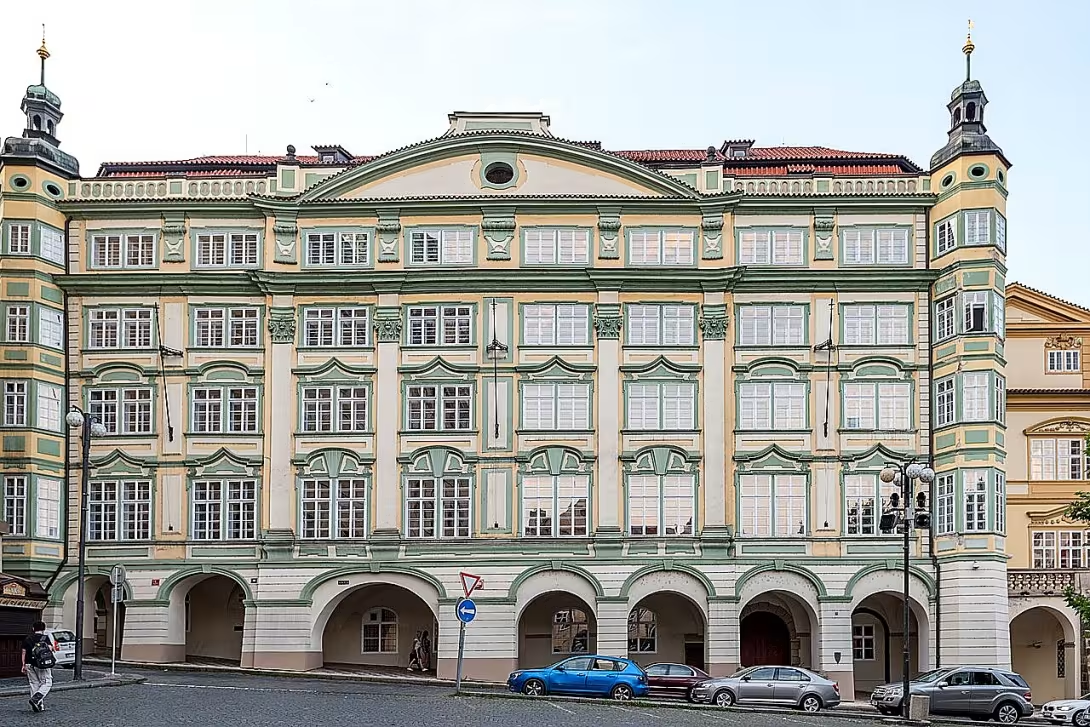
Palác Smiřických, also known as U Montágů, is a Renaissance palace with Baroque modifications located at Malostranské náměstí in Prague's historic district of Malá Strana. Constructed on the sites of medieval houses and originally built in 1573, this palatial structure stands out for its architectural evolution and historical significance. It forms part of the complex housing the Chamber of Deputies, with parliamentary sessions held at the nearby Thunovský Palace. The palace is notable not only for its architectural features but also for its role in pivotal historical events.
The origins of Palác Smiřických trace back to a parcel that once housed several medieval homes destroyed by a great fire in Prague. In 1554, this land was acquired by Jan rytíř z Kelče and later entered the ownership of Jaroslav I. Smiřický ze Smiřic in 1572. The palace's initial form is not well-documented, but it underwent significant transformations over the centuries. By the early 17th century, Zikmund Smiřický expanded the structure with a round tower and an arcade loggia, enhancing its architectural complexity.
Architecturally, Palác Smiřických showcases a blend of Renaissance foundations and Baroque embellishments. The palace features four wings surrounding a central courtyard, complemented by corner polygonal towers that add to its grandeur. A significant transformation occurred in the late 18th century when Pavel Montág acquired the building in 1763. Under his direction, architect Josef Jäger executed extensive renovations between 1764 and 1765, adding another floor and infusing Baroque stylistic elements into the structure.
Ownership of Palác Smiřických has seen a series of notable transitions. After the Montág era, it passed through various hands including the Valdštejnové, Pernštejnové, karmelitky, and Sinzendorfové during the post-White Mountain period. In 1895, the Zemský sněm Království českého acquired the palace, adapting it for parliamentary use. This transition marked a new chapter in its history as it became integral to Czech legislative functions.
The palace is historically significant due to key events that unfolded within its walls. In 1618, Albrecht Smiřický convened a secret meeting of the anti-Habsburg opposition, an event that contributed to the escalating tensions leading up to the Thirty Years' War. This moment underscores the building's role as more than just a residence; it was a focal point for political maneuvering during a tumultuous period in Bohemian history.
Today, Palác Smiřických stands as both a cultural and historical monument, protected as part of Prague’s architectural heritage. It is accessible to visitors who wish to explore its rich past and appreciate its architectural beauty. The palace's integration into the parliamentary complex adds contemporary relevance, making it an essential site for those interested in Czech history and governance.
Palác Smiřických offers a unique glimpse into the historical tapestry of Prague, blending architectural elegance with significant political narratives. Its enduring legacy invites visitors to delve into its storied past while appreciating its role in shaping modern-day Czech institutions. Whether drawn by its architectural splendor or intrigued by its historical events, Palác Smiřických is a must-visit landmark that continues to captivate and educate.
Then and now
Drag the slider to compare how the landmark may have looked when it was built with the view today.
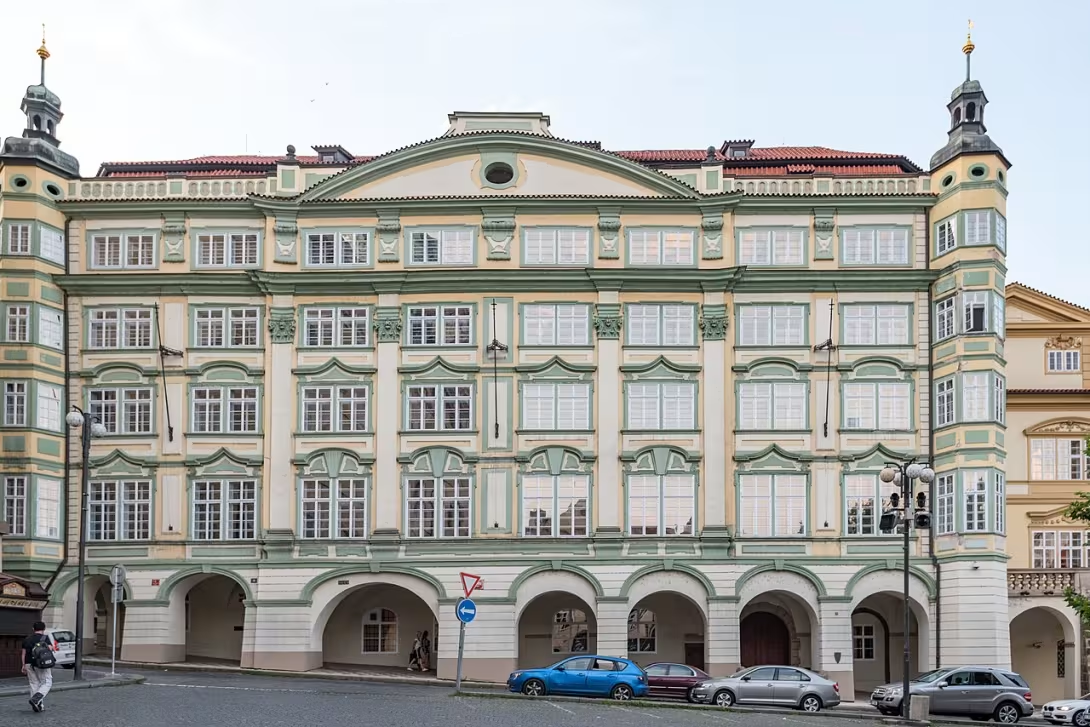

The historical appearance on the left is an AI-generated visualisation and serves as inspiration only.
Historical milestones
- 1618
- A secret meeting of the anti-Habsburg opposition was convened by Albrecht Smiřický.
Architectural development
Originally built on sites of medieval houses, Palác Smiřických has undergone several architectural transformations. In the early 17th century, it was expanded with a round tower and an arcade loggia. The Baroque renovation by Josef Jäger in the late 18th century added another floor and further stylistic changes.
Historical events
In 1618, Albrecht Smiřický convened a secret meeting of the anti-Habsburg opposition in the palace.
The building was acquired by Pavel Montág in 1763 and underwent significant Baroque renovations between 1764-65.
Owners
Jan rytíř z Kelče (1554)
Jaroslav I. Smiřický ze Smiřic (1572)
Zikmund Smiřický (1603)
Valdštejnové, Pernštejnové, karmelitky, Sinzendorfové (pobělohorské období)
Pavel Montág (post-1763)
Zemský sněm Království českého (1895)
Points of interest
- The palace's name "U Montágů" is derived from Pavel Montág, who acquired the building in 1763 and commissioned significant Baroque renovations that enhanced its architectural style.
- In 1618, Albrecht Smiřický hosted a clandestine meeting of anti-Habsburg opposition figures within the palace walls, contributing to the events leading up to the Thirty Years' War, highlighting its role as a hub for political intrigue during a critical period in Bohemian history.
- Originally built on the site of medieval houses destroyed by a great fire in Prague, Palác Smiřických's construction began in 1573 after being acquired by Jaroslav I. Smiřický ze Smiřic, marking it as an evolution from its earlier structures and reflecting the architectural transitions of its era.
- The palace underwent significant changes under Zikmund Smiřický in the early 17th century when he added a round tower and an arcade loggia, showcasing how successive owners contributed to its evolving design and complexity over time.
- After serving various noble families post-White Mountain period, Palác Smiřických was acquired by the Zemský sněm Království českého in 1895, marking a shift from private ownership to public use as it became part of the parliamentary complex and integral to Czech legislative functions.
Guide
This guide is narrated by a synthetic voice generated by artificial intelligence.
Show guide text
This text was created by artificial intelligence and has not been editorially reviewed. It may contain inaccuracies.
Welcome to the historic site of Palác Smiřických, also known as U Montágů, nestled in the heart of Prague on Malostranské náměstí. As you stand here, imagine yourself stepping into a time capsule that blends Renaissance elegance with Baroque grandeur. The palace forms part of an impressive complex housing the Chamber of Deputies and is characterized by its four wings surrounding a central courtyard, complemented by corner polygonal towers that catch your eye.
The origins of this remarkable structure date back to 1618 when Albrecht Smiřický convened a secret meeting within these walls. This clandestine gathering was pivotal in the anti-Habsburg opposition movement, marking an important moment in Czech history. The Smiřický family, including notable figures like Jaroslav I. Smiřický ze Smiřic and Zikmund Smiřický, played significant roles throughout its storied past.
As you take a closer look at the architecture, notice how the Renaissance foundation has been enhanced by Baroque modifications. These changes were commissioned in 1763 by Pavel Montág, whose influence is immortalized in the palace's nickname "U Montágů." The transformation under his guidance added layers of complexity and beauty to the building’s design.
Now, let your imagination wander through the corridors where key historical figures once walked. Albrecht Smiřický’s secret meeting here was not just a political maneuver but a catalyst for change during turbulent times in Bohemia's history. The palace has witnessed both private intrigue and public significance, standing as a silent witness to the unfolding of events that shaped the nation.
One intriguing aspect of this site is how it seamlessly blends its historical roots with modern functionality. While parliamentary sessions are held at the nearby Thunovský Palace, Palác Smiřických continues to serve as office space, bridging centuries of history with contemporary use.
As you conclude your visit, I invite you to explore further and immerse yourself in the rich tapestry of stories this palace has to offer. Whether it's delving into its architectural nuances or reflecting on its historical significance, there is always more to discover here. Thank you for joining us today at Palác Smiřických, a true gem in Prague’s historic landscape.
Tips for visitors
The best time to visit Palác Smiřických is during the late spring or early fall when the weather is pleasant, and the crowds are smaller compared to peak tourist seasons. This timing allows you to enjoy the palace's architecture without the hustle of summer tourists. Additionally, visiting in these months provides better lighting for photography, as the softer sunlight enhances the details of the Renaissance and Baroque elements.
Transportation to Palác Smiřických is convenient via public transit or by car. The palace is accessible by several tram lines and buses that serve the Malá Strana district. Using public transport not only eases your travel but also allows you to explore other parts of Prague more easily.
When visiting Palác Smiřických, consider bringing a camera or smartphone with a good camera function to capture the intricate details of the palace's architecture. Comfortable walking shoes are recommended as you'll likely be exploring on foot. Additionally, carrying a light jacket is wise due to variable weather conditions in Prague.
For photography enthusiasts, some of the best spots around Palác Smiřických include its front façade and the courtyard, which offer excellent views of the architectural details. The morning light is ideal for capturing the palace's features with minimal shadows. Nearby, you can also find picturesque scenes along the Charles Bridge, especially during sunrise or sunset when the lighting adds a magical touch to your photos.
Nearby attractions within a 30-minute walk include Thunovský Palace and the iconic Charles Bridge. These sites provide additional historical context and beautiful views of Prague's skyline. For families with children, consider visiting Letná Park, which is also close by and offers ample space for kids to play and enjoy outdoor activities.
Frequently asked questions
Can the monument be visited?
Some buildings of this kind are open for guided tours, others serve another purpose or are privately owned. We have not verified whether and when this monument is open – please ask the operator.
What are the opening hours and admission?
We have not verified the opening hours or admission. Current information is published by the operator.
Where is the monument?
Location: Malostranské nám. 6/18, Malá Strana, Praha, Hlavní město Praha. The map on this page shows the exact spot.
Why is the monument protected?
It is listed in the Central List of Cultural Monuments of the Czech Republic as a national cultural monument (register no. 38946/1-505). It is protected as part of a larger listed ensemble.
Businesses nearby
Do you run a restaurant, accommodation, shop, museum, rental, wellness or other visitor service near this monument? Show yourself directly to the people heading to it — this is how they will see you in the app and on the web:
Events nearby

Zdroj akcí: otevřená data měst a obcí ČR (Národní katalog otevřených dat) a kalendář akcí Národního památkového ústavu.
Nearby
The palace is situated in Prague's Malá Strana district, close to other historical sites like Thunovský Palace and within walking distance of the iconic Charles Bridge.
Accommodation nearby
Trips and activities nearby
Guided tours, tickets and activities nearby from GetYourGuide
Affiliate link: if you buy from the partner, we may receive a commission. The price for you does not change.
Search tours and activities →Themed route
Tematická výletní trasa: Historická cesta po Malé Straně
1. Palác Smiřických
Typ: Historický palác
Proč stojí za návštěvu: Palác Smiřických, umístěný v srdci Prahy 1, je krásným příkladem renesanční architektury. Jeho historie sahá do 16. století a sloužil jako sídlo vlivného šlechtického rodu Smiřických. Je známý svými bohatě zdobenými interiéry a působivou zahradní terasou, která nabízí panoramatický pohled na Prahu.
2. Thunovský Palace
Typ: Historický palác
Proč stojí za návštěvu: Nachází se pouhých minutách chůze od Paláce Smiřických a je známý svou elegantní renesanční architekturou. Thunovský Palace byl postaven v polovině 16. století pro Jiřího z Lobkovic, ale později přešel do rukou rodu Thuna. Jeho interiéry jsou skvělým příkladem barokního umění a architektury.
3. Charles Bridge
Typ: Historická most
Proč stojí za návštěvu: Charles Bridge je ikonický průchod spojující Staré Město s Malou Stranou. Postavený v 14. století, je zdoben řadou sochařských děl a nabízí jedinečný pohled na Prahu z jeho mostních oblouků. Je to nejen historická památka, ale také živá ulice plná umělců a prodejců.
4. Kostel svatého Mikuláše
Typ: Historický kostel
Proč stojí za návštěvu: Tento barokní kostel, nacházející se na konci Charles Bridge, je známý svou výraznou zvonici a bohatou historií. Byl postaven v 18. století jako součást rekonstrukce po požáru v roce 1689. Jeho interiér obsahuje důležité umělecké prvky, včetně obrazu "Nejsvětější Trojice" od Josefa Mánesa.
5. Kostel svatého Petra a Pavla
Typ: Historický kostel
Proč stojí za návštěvu: Tento barokní kostel, nacházející se nedaleko Paláce Smiřických, je známý svou impozantní zvonnicí a působivým interiérem. Postaven v 17. století, byl navržen architektem Giovanniem Orsiho. Jeho kostel se stává centrem pozornosti díky svému bohatému uměleckému vybavení a historickým událostem, které zde probíhaly.
Tato trasa nabízí pohled na bohatou historii a architekturu Prahy 1, přičemž každý bod přináší jedinečný vstřebávající se do historie města.
Seasonal recommendations
Jaro: Visiting Palác Smiřických in the spring offers a unique experience as nature awakens and the gardens around the palace begin to bloom. Sunny days provide ideal lighting for photography that highlights the historical architectural style of the palace. During this time, visitors are still relatively few, allowing for a more comfortable tour without the obstruction of large crowds. We recommend wearing warm clothing for cooler mornings and evenings, while cotton or light materials are suitable for sunny days.
Léto: Summer brings full summer atmosphere to Palác Smiřických with long days and warm sunshine that accentuates the architectural details of the palace. This time of year is popular among visitors, meaning a higher number of people and potential crowds at the peak of the season. We recommend coming early in the morning or later in the evening to minimize exposure to crowds. Wearing light clothing and considering protective sunglasses and UV cream are key for a comfortable experience.
Podzim: In autumn, Palác Smiřických offers a melancholic yet enchanting atmosphere with colorful foliage and milder weather. Shorter sunny days can create romantic lighting for photographing the palace. This period is ideal for visiting as there is often less of a crowd than in summer. Wearing outerwear with built-in layers and protective boots for cooler weather is advisable, while sunny days require light clothing.
Zima: A winter visit to Palác Smiřických offers an entirely different feel, with a calm and quiet atmosphere that allows you to see the palace under snow. Lighting can be more pronounced due to winter light, and some parts of the palace may be closed or open only for limited hours. This time of year is ideal for those seeking a quieter experience without large crowds.
Visualizations and artistic views


The visualisations are generated by artificial intelligence and serve as inspiration.
Photos from the area
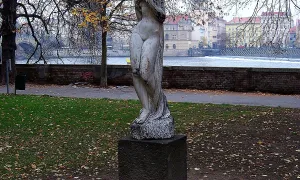
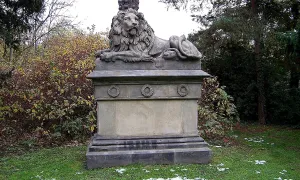
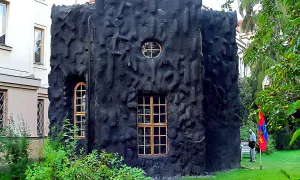
Real photos taken near the monument


Zdroj a licence jsou uvedeny u každého snímku.
Tips from visitors
No tips yet. Be the first!
Log in and add your tip.
Sources and literature
Photos: Tilman2007 / CC BY-SA 4.0 — Wikimedia Commons. The author and licence also appear when you hover over the image.
Faktickým podkladem tohoto textu byl článek na Wikipedii, jehož autory jsou přispěvatelé Wikipedie. Článek je dostupný pod licencí CC BY-SA 4.0.
Location on the map

Příběhy a pověsti
Legendy, pověsti a příběhy spjaté s touto památkou

Fotografie návštěvníků
Zatím žádné fotografie. Buďte první, kdo přidá fotografii z návštěvy!
Log in a přidejte svou fotografii nebo hodnoťte.
Za ověřenou návštěvu v aplikaci získáte víc bodů — poznáme podle GPS, že jste na místě.
Reviews and comments