



Palác YWCA Building
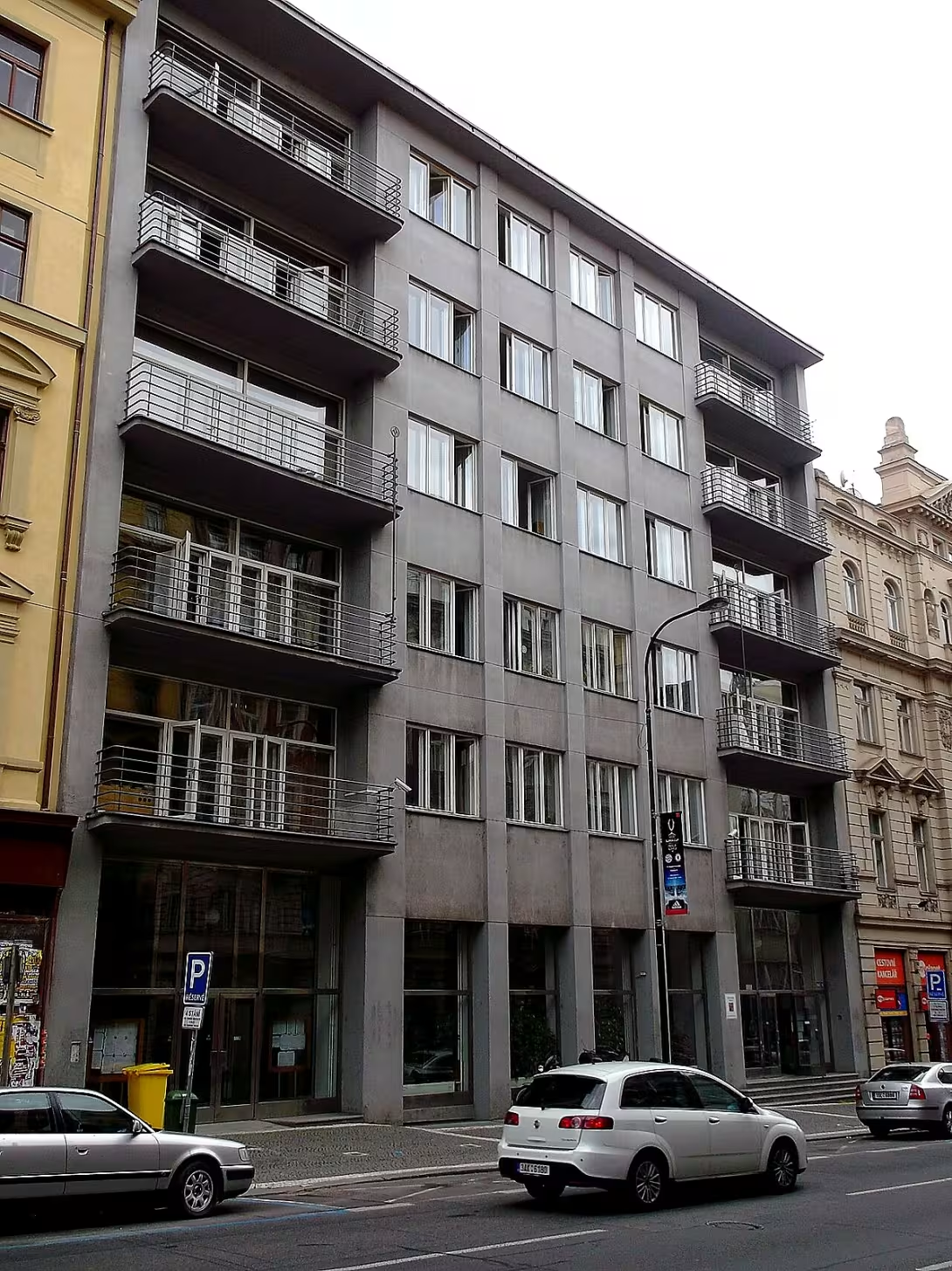
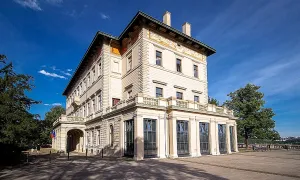
Palác YWCA is a functionalist building in Prague 2 in Žitná street, which was established in 1926-1929. It is registered as a real-estate cultural monument of the Czech Republic and represents an important example of modern architecture in the centre of New Town.
The palace was built for the Christian Young Women's Association in a place where a two-storey stump house was built. The project was developed by the architect Oldřich Tyl, who prepared the first purist design in 1923 and reworked it into a functionalist style in 1925. The construction work took place between 1926 and 1929, while the approval took place in 1927.
The building is six-storey and three-winged, with an inner courtyard and a receding sixth floor. The main facade to the street is six-axis; the extreme axes are made up of ships at all heights. The middle four axes are divided by horizontal belts. The facade to the yard is smooth and there are balconies in the middle of the wings. In 1932, there were static modifications in which pillars were added on the front, which abolished the original belt windows. The original equipment preserved glass walls with doors, selected interior doors, tiles, handrails and metal railing.
After the demise of the organization in 1943, the Gestapo settled in the palace. Since 1951 the Czechoslovak Youth Union has been working here, for whose central school the house was adapted in 1953. In the years 1983- 1984 the building served as a youth hotel Junior. After the restoration of activity in 1990, the original organisation failed to return to its headquarters.
A major event was the visit of French architect Le Corbusier in 1928. The building reflects the development of modern architecture in Bohemia in the first half of the 20th century as well as the subsequent political changes associated with the advent of communism after World War II.
Currently (towards 2024) the Financial Office for the Central Bohemia Region is located here.
Palác YWCA remains a valuable witness to the functionalist era in Prague. Its architecture and history make it an interesting target for anyone interested in modern urban planning.
Then and now
Drag the slider to compare how the landmark may have looked when it was built with the view today.
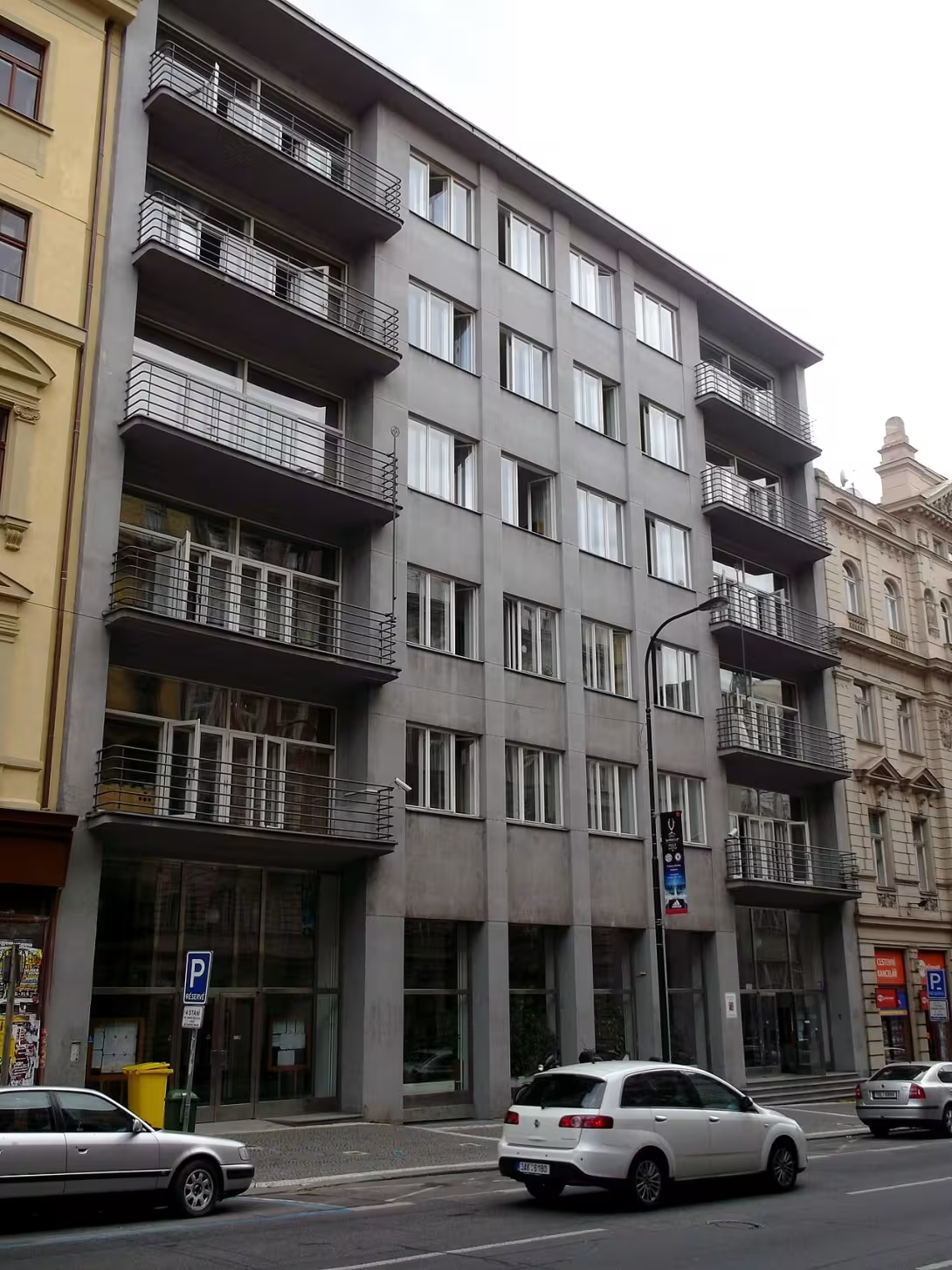

The historical appearance on the left is an AI-generated visualisation and serves as inspiration only.
Historical milestones
- 1926-1929
- Construction of a functionalist palace in Prague.
- 1928
- A visit from the famous French architect Le Corbusier.
- 1932
- Static modifications of the facade and attachment of pillars.
- 1943
- The demise of the original organization and the seat of the Gestapo.
- 1953
- Adaptation of the building for the Central School of the Czechoslovak Youth Association.
- 2024
- The seat of the Financial Office for the Central Bohemia Region.
Architectural development
The palace was originally designed in purist style, but later redesigned into functionalism. During the static modifications in 1932, pillars were added on the front, which changed the original facade.
Historical events
- 1926
- The start of construction according to Oldřich Tyl's plans.
- 1932
- Adding pillars on the front during static adjustments.
- 1953
- Adaptation for the Central School of the Czechoslovak Youth Association.
Owners
- 1926
- 1943
- 1951
- 1990
- 2024
Points of interest
- Palác YWCA is a functionalist building in Prague 2 in Žitná street, which was established in 1926-1929. - It is registered as a real-estate cultural monument of the Czech Republic and represents an important example of modern architecture in the centre of New Town. - In 1928 the French architect Le Corbusier had a visit to the building, which underlines its importance for the development of modern architecture in Bohemia. - After the demise of the original organization in 1943, the Gestapo was based in the palace and later used by various institutions, reflecting the political changes associated with the advent of communism. - The Financial Office for the Central Bohemia Region is currently located here (towards 2024).
Guide
Show guide text
This text was created by artificial intelligence and has not been editorially reviewed. It may contain inaccuracies.
Welcome to the heart of our city, right in Žitná Street, where history meets the modern rhythm of today. You are standing in front of a building that is not just an ordinary house, but a real symbol of the transformation that Prague went through in the first half of the last century. Before you go any further, stop for a moment and perceive this present. Before your eyes, there is a palace that immediately distinguishes itself from the surrounding buildings by its purity, scope and unusual way of working with space. It's a building that doesn't seem cumbersome, even if it's massive. Instead, it carries the lightness and order that are typical of the direction that changed the face of the world at the time.
Let's take a deeper look at how this palace came into being. This building was built between 1926 and 1929. At that time Prague was the center of new ideas, experiments and courage. The palace was intended for an international organisation for women and was intended to serve as a meeting place, education and social life. The main creator of this work was architect Oldřich Tyl, a man who was able to transfer modern visions into the reality of our streets. His intention was not to build a building full of unnecessary ornaments, but to create a space where the form would directly match its purpose. This is why you see what you see here - clean lines, clear geometric shapes and emphasis on functionality.
Now pay attention to what you see right in front of you. Take a look at the main facade facing the street. Notice his rhythm. The facade is divided into six axes, creating a sense of stability and balance. If you look at the individual floors, you'll see an interesting element that gives the building dynamics. These are horizontal belts that guide your eye along the entire length of the building and highlight its width. On both sides of the main part you will find lodjie, i.e. open spaces that bring depth and shadow into the facade. This game of light and darkness is a key element of the whole look.
If you could look behind the walls of the building, into its inner court, you would see another world. While the side of the street is richer for details and rhythm, the facade towards the yard is deliberately smooth and calm. However, balconies appear in the middle of the wings, bringing a finer structure into this smooth area. The whole building has three wings and six floors high. Note, however, the most interesting part - the sixth floor is deliberately retreating from the rest of the building. This retreat creates a more open atmosphere over the inner space and gives the palace its unmistakable profile. Although time was changing, some elements remained preserved, such as glass walls or some original interior doors that allow us to touch history.
Now let's move on to one of the greatest attractions that this place has. Imagine 1928. This palace was so modern and fascinating that it was visited by one of the most important architects of all time, a man whose name belongs to the absolute top of world construction - French master Le Corbusier. Although he was only in the building briefly, his presence here left an invisible print of recognition for what Oldřich Tyl had created. It's a fascinating thought that a man who defined the modern world could move here.
But the history of this place has not always been a celebration of beauty and progress. The building went through dramatic twists that reflected the dark times of our country. Some static adjustments had to take place in 1932, when pillars were added to ensure the stability of the facade. But the most painful time was 1943. This year, the original organization disappeared and the building became the seat of a secret police force known as the Gestapo. Instead of light and meeting, there were shadows of fear and control. It's a reminder of how even the most beautiful buildings can be controlled by the dark forces of the time.
But after the war, the atmosphere changed again. In 1953 the building was adapted to new needs and served as a central school for the Youth Union. The place that once hosted intellectual and social debate became the place of education for young people who formed a new society. And so the palace was constantly adapting, changing its face and function, but still held as a solid part of Prague's architecture.
Today, in 2024, this building serves as a seat of the Financial Office for the Central Bohemia Region. Even though her function today is quite different from the original, the palace still retains its dignity. It is registered as a cultural monument of the Czech Republic, which means that its value is recognised and protected for future generations.
Now, if you look at these lines, the glazed surfaces and the unusual sixth floor retreat, try to imagine all the people who went through them. Architects who sought beauty in them, world celebrities who admired them, even those who sought power in the dark times. This palace is like a book whose pages are made of stone, glass and concrete.
Thank you for stopping by and paying attention to this special place. We hope that this view of the YWCA Palace helped you better understand its meaning and beauty. Continue to walk through the streets of New Town and be inspired by other stories that are hidden in every building and street. We appreciate the pleasant continuation of your journey.
Tips for visitors
The best time to visit YWCA Palace is in the early afternoon when the sun lights up the building from both sides and the shadows are less. This increases the aesthetic effect of the photograph.
The best option is to use buses or trams that can approach the centre of Prague 2.
When you visit, remember the picture with warm clothes and protective glasses. The building has historical elements that can be interesting for interested people for detailed photography.
For families with children it is advisable to visit the inner courtyard of the palace where children can move and enjoy the space. In addition, it is possible to take a short walk along Žitná Street, which shortens the time spent in one place.
Frequently asked questions
Can the monument be visited?
The building is in use (offices, a school, shops and the like). The interior is generally accessible only during operating hours and tours are not usually offered; we have not verified the details. You can see the exterior from the street.
Where is the monument?
Location: Praha 2, Hlavní město Praha. The map on this page shows the exact spot.
Why is the monument protected?
It is listed in the Central List of Cultural Monuments of the Czech Republic as a cultural monument (register no. 1000153437).
Businesses nearby
Do you run a restaurant, accommodation, shop, museum, rental, wellness or other visitor service near this monument? Show yourself directly to the people heading to it — this is how they will see you in the app and on the web:
Events nearby

Zdroj akcí: otevřená data měst a obcí ČR (Národní katalog otevřených dat) a kalendář akcí Národního památkového ústavu.
Nearby
🏰 Historic sites (1684)
- Antonín Dvořák 0.0 km
- Betty Kleinerová 0.1 km
- Otto Kleiner 0.1 km
- Irma Kischová 0.1 km
- Etalon pražského lokte 0.2 km
- svatý Josef 0.2 km
- Jaroslav Hašek 0.2 km
- Invisible exhibition 0.2 km Karlovo náměstí 1/23 +420 777 787 064 web
- Jan Levit 0.2 km
- Vítězslav Hálek 0.2 km
- Mučedníkům této země 20.století 0.2 km
- Galerie Leica 0.2 km Školská 693/28 +420 222211567 web
- Rámovaní 0.2 km
- Rudolf Götz 0.2 km
- Marie Götzová 0.2 km
- Raoul Götz 0.2 km
- Harry Götz 0.2 km
- Christian Doppler 0.2 km
- Božena Němcová 0.3 km
- Eliška Krásnohorská 0.3 km
🍽️ Restaurants and dining (5503)
- Lost and Found 0.0 km Žitná 11
- U Pravdů 0.0 km Žitná 1701/15 +420 222 233 915 web
- Chillout Bar 0.0 km Žitná 17
- Brasserie Délice 0.1 km
- Aspendos 0.1 km
- Čekárna 0.1 km +420 733197173
- Hangar 0.1 km +420 797 996 359 web
- Příčný řez 0.1 km +420 222 233 283 web
- Midnight Bar 0.1 km Žitná 4
- Duha 0.1 km
- Jiná krajina 0.1 km +420 222 231 148 web
- Pelmeňárna 0.1 km Štěpánská 538/11
- Gossip Bar 0.1 km Štěpánská 538/11 +420773685510 web
- Karlův hostinec 0.1 km web
- Pizzeria di Carlo I - Giardino 0.1 km web
- Bar Nota 0.1 km Štěpánská 539/9 +420 775 396 456 web
- TimiuTea 0.1 km Žitná 560/2 web
- Londoners 0.1 km
- The Pub and Grill No.1 0.1 km Karlovo náměstí 28 web
- Le Xin 0.1 km Štěpánská 23 +420 222 233 898
🏨 Accommodation (821)
- Radisson Blu 0.1 km Žitná 8 +420 225 999 999 web
- Hotel Praga 1 0.1 km Žitná 5 web
- Antik City 0.1 km web
- PurPur 0.1 km Řeznická 1360/15 +420 731 118 113 web
- Crystal Palace 0.1 km web
- Numa Prague Root 0.1 km Malá Štěpánská 13
- Mojo Inn Hostel 0.1 km Řeznická 662/17 web
- EA Hotel Crystal Palace 0.1 km Malá Štěpánská 17
- Amarilis Hotel 0.2 km +420 222 748 111-2 web
- Hotel Majestic Plaza Prague 0.2 km Štěpánská 33 +420 221 486 100 web
- Pension Alabastr 0.2 km Školská 20 +420 296 325 016 web
- Majestic Plaza 0.2 km
- Artharmony Hostel 0.2 km Ječná 12 +420222542931 web
- Hotel Andante 0.2 km Ve Smečkách 4
- Archibald City 0.3 km Žitná 1319/33 +420 234 652 800 web
- Mamaison 0.3 km +420 221 022 102 web
- Hotel Prague Star 0.3 km
- Bonvolon 0.3 km
- Hostel Daniela 0.3 km Jungmannova 5 +420 736 279552 web
- Atlas Hostel 0.3 km Ve Smečkách 603/13
🚲 Rentals and sport (543)
- Husky 0.1 km Žitná 669/1 +420 222 220 950 web
- 11 Teamsports 0.2 km
- Ski & Surf 0.3 km
- Rossignol 0.3 km +420 733 626 382
- Tělocvičná jednota Sokol Pražský 0.4 km Žitná 1438/42 +420 221 965 311 web
- Honzovy 0.5 km +420 777 493 182
- Centrum Služeb Pre 0.5 km web
- Oasis City 0.5 km Václavské náměstí 36
- A3 SPORT 0.5 km +420 222 240 690 web
- World Class Fitness Center Wenceslas 0.6 km Václavské náměstí 22
- Fitness Vagon 0.7 km Národní 25
- Contours Fitness 0.7 km Národní 25
- Rock Point 0.7 km Martinská 360/2 +420 224 228 045 web
- Přístaviště Rašínovo nábřeží 0.8 km
- Kieser Training 0.8 km
- Finebike 0.8 km web
- HUDYsport 0.8 km Na Perštýně 355/14 +420 224 218 600 web
- U Kotvy 0.8 km
- Slovanka 0.8 km +420 777 870 511;+420 777 800 003 web
- S.P.L.A.V. 0.8 km
🥾 Hiking and nature (481)
- Novoměstská radnice 0.2 km
- Čelakovského sady 0.5 km
- Národní muzeum věž 0.6 km
- Čelakovského sady 0.6 km
- Dancing House viewpoint 0.7 km
- Mind Maze 0.8 km
- Zítkovy sady 0.8 km
- České loutky 0.8 km web
- Thrill Park 0.9 km Provaznická 11 +420 774 413 313 web
- Na Příkopě 1.0 km
- Staroměstský orloj 1.1 km
- Dienzenhoferovy sady 1.1 km
- Staroměstská radnice 1.1 km
- Radniční věž 1.1 km
- Celetná 1.1 km
- Celetná 1.1 km
- Celetná 1.1 km
- Celetná 1.1 km
- Pražský poledník 1.1 km
- Na Příkopě 1.1 km
Accommodation nearby
Trips and activities nearby
Guided tours, tickets and activities nearby from GetYourGuide
Affiliate link: if you buy from the partner, we may receive a commission. The price for you does not change.
Search tours and activities →Themed route
1. Palác YWCA, building: Start at the main entrance so you can see the impressive architecture of the entire building. The construction offers interesting views from different angles. 2. Internal courtyard, area: Continue to the central space between the wings of the building. This place offers a quiet and unique view of the inner walls of the palace. 3. Internal spaces and exposition, interior: End the route by visiting the inner rooms. Here you can discover historical details and current cultural programs.
Seasonal recommendations
Spring: During the spring period Palác YWCA in Prague receives 2 stunning glitter due to the sunlight which penetrates through its windows and adorns the interior with freshness. Flowers are beginning to bloom around the palace, which adds a colorful mood to the atmosphere. For the visit it is advisable to equip yourself with clothes corresponding to warm weather with the possibility to pull out a cooler because temperatures can be variable. The best time to visit is on the middle of the day when the sun is strongest and the palace offers full of its radiance.
Summer: In summer Palác YWCA is transformed into a place where it is possible to enjoy heat and light. The sun shines long until evening, allowing extended visits without fear of early lighting. At this time, however, large public tourists must be counted on, especially on the middle of the day and during summer holidays. It is recommended to arrive at the palace early in the morning or later in the afternoon when places are less visited. Clothes should be light and light, with sun protection.
Autumn: In autumn, the surroundings of YWCA Palace are gaining a special atmosphere due to changes in nature. The leaves of trees are colored and dropped, which creates coloured wallpaper around the historical object. The sun sets early, so it is advisable to visit the palace before evening to enjoy the rest of the daylight. The temperatures are colder and therefore the clothes should be warm with the possibility to add layers as needed.
Winter: During the winter months Palác YWCA gets a quiet and quiet atmosphere. Sun rays are weaker, which gives the palace a certain mysterious mood, especially when surrounded by snow or ice rain. It is recommended to visit the palace with warm, protective clothes and the possibility of keeping your hands and feet warm. The best time to visit is on the middle of the day when the sun is strongest and can provide a little heat comfort.
Visualizations and artistic views


The visualisations are generated by artificial intelligence and serve as inspiration.
Photos from the area
Real photos taken near the monument


Zdroj a licence jsou uvedeny u každého snímku.
Tips from visitors
No tips yet. Be the first!
Log in and add your tip.
Sources and literature
Photos: JiriMatejicek / CC BY-SA 3.0 — Wikimedia Commons. The author and licence also appear when you hover over the image.
Faktickým podkladem tohoto textu byl článek na Wikipedii, jehož autory jsou přispěvatelé Wikipedie. Článek je dostupný pod licencí CC BY-SA 4.0.
Location on the map
Příběhy a pověsti
Legendy, pověsti a příběhy spjaté s touto památkou
Fotografie návštěvníků
Zatím žádné fotografie. Buďte první, kdo přidá fotografii z návštěvy!
Log in a přidejte svou fotografii nebo hodnoťte.
Za ověřenou návštěvu v aplikaci získáte víc bodů — poznáme podle GPS, že jste na místě.
Reviews and comments