






Palladium Barracks
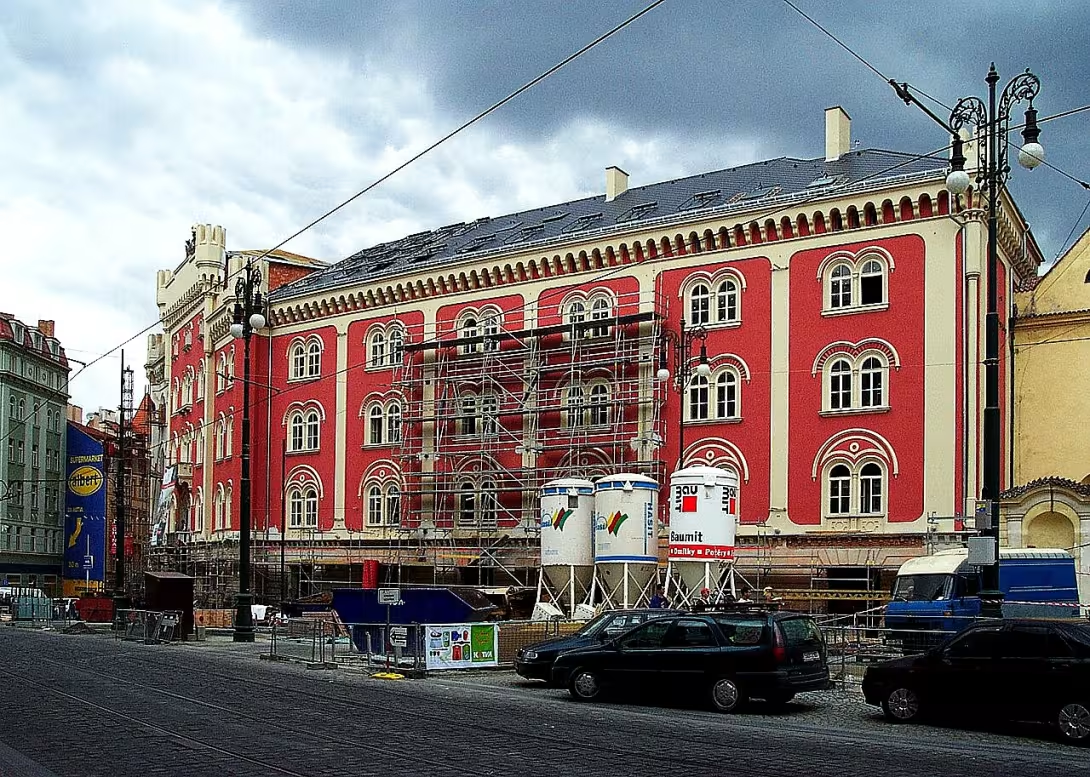
Palladium is a multifunctional complex located in the centre of Prague, specifically in New Town in the Republic Square. Open October 25, 2007, this object represents a fascinating blend of history and modernity. It was created by rebuilding a pair of historical buildings - Jiří's barracks from Poděbrad (originally Josefa barracks) and a new structure, which created a complex with commercial premises, underground garages and office spaces. Despite the modernization, historical ceilings were preserved in the riding hall, making Palladium a unique monument connecting the past to the present.
The history of this place dates back to the 12th century, when there was a Romanesque development. Archaeological surveys revealed the foundations of woodland houses, which suggest a large settlement with urban planning. In the second half of the 12th century, the remains of three stone Romanesque buildings, including the palace, were found, which illustrates the historical importance of this place.
In 1630, Gerhard of Questenberg founded a Capuchin monastery here. This monastery was built between 1633 and 1641, but in 1689 it was destroyed by a great fire. After recovery, it lasted until 1795 when it was abolished by court decree.
In the 1890s, the building was taken over under the administration of the military accommodation office and the Votak barracks were built, which replaced conventional buildings in 1857-1861. At this time there was also a memorable song "Where is my home?" written by Josef Kajetán Tyler.
During World War II, the barracks were one of the outbreaks of the Prague Uprising and bombed. After the war, the building became part of the history of the city, also influenced by privatization in 1993, when the army left the barracks.
In 1996, the building was purchased by the European Property Development company, which led to controversial discussions on monument protection. Despite some restrictions, the main building and the riding hall were declared cultural monuments in 1999, allowing the preservation of historical elements.
Modern reconstruction took place in the years 2005-2007, which led to the creation of the current multifunctional Palladium complex. This reconstruction involved the partial closure of the square and extensive archaeological surveys which revealed the medieval development.
Today Palladium is not only a business centre with office spaces and underground garage, but also a witness to the rich history of Prague. Its multifunctionality and preservation of historical elements make this complex an important monument, worth visiting both local residents and tourists.
Palladium represents a unique combination of past and present, where historical elements harmoniously associate with modern design. Its importance is not only architectural but also cultural, which makes this complex an important part of the Prague Monument Reserve. Visitors can appreciate both history and modern lifestyle here, which makes Palladium a necessary place for anyone who would like to discover Prague in its full diversity.
Historical milestones
- 1633
- The beginning of the building of the Capuchin monastery at the site of later barracks.
- 1795
- The abolition of the Capuchin monastery by court decree.
- 1857
- The beginning of the construction of new Votai barracks replacing the conventions.
- 1993
- Privatization and departure of the army from the barracks.
- 2007
- Opening of the Palladium multifunctional complex after reconstruction.
Architectural development
The site of today's Palladia was located various historical buildings, including Romanesque buildings, hospital and Capuchin monastery. In the 19th century, Joseph's barracks were built in the style of romantic Tudor neo-Gothic. After 2007 a modern reconstruction took place, which created the current multifunctional complex.
Historical events
- 1630-1641
- The founding of the Capuchin monastery by Gerhard of Questenberg.
- 1857- 1861
- Construction of Josef barracks in romantic Tudor neogotry.
- 1939-1945
- The Prague uprising, during which the barracks were the focus of fighting and bombed.
Owners
- 1993
- 1996
Points of interest
- Palladium is a multifunctional complex located in the centre of Prague, specifically in New Town in the Republic Square. - It was created by rebuilding a pair of historical buildings - Jiří's barracks from Poděbrad (originally Josefa barracks) and a new structure, which created a complex with commercial premises, underground garages and office spaces. - The history of this place dates back to the 12th century when there was a Romanesque development. In 1630, Gerhard of Questenberg founded a Capuchin monastery here, which lasted until 1795 when it was abolished by the court decree. - During World War II, the barracks were one of the outbreaks of the Prague insurgency and bombed.
Guide
Show guide text
This text was created by artificial intelligence and has not been editorially reviewed. It may contain inaccuracies.
Welcome to the very heart of Prague, the New Town area, where you are currently located in the Republic Square. Stop for a moment and look ahead. You stand in front of a building that at first sight acts as a modern symbol of the present city, instead of meeting and shopping, where thousands of travelers from around the world intersect. It's a space that we perceive as dynamic and open, but under his present face is a fascinating layer of time. What you see is not just a modern building, but a complex organism that carries echoes of several centuries of Prague history.
Let us go back in time together to understand how we have come to this place today. Imagine you're standing in the same place, but it's seventeen hundred thirty-three. At that time, the hustle and bustle of the modern city does not rule, but the silence and humility. It was this year that the building of the Capuchin monastery began. It was a space intended for prayer, contemplation and spiritual seclusion in the middle of the growing Prague. The monks of Capuchins lived their devoted life here, while the city slowly changed around them. The monastery served here as a spiritual anchor for many decades, until the end of the eighteenth century.
The break came in seventeen hundred ninety-five. At that time, a court decree was issued, which abolished the Capuchin monastery. This event has completely changed the fate of this place. Spiritual silence was replaced by new needs of the state and city administration. The monastery buildings stopped fulfilling their original function and space began to transform. The transition period followed, until in the year one thousand eight hundred and fifty-seven the construction of a completely new Votai barracks began. It was these barracks that later got the name Jiří of Poděbrad, but were also known as Josefa barracks, which defined the character of this place for the next century and a half.
Now try to imagine the atmosphere the Pražans perceived here in the nineteenth century. Instead of shopping, there were stables, military training grounds and soldiers' dormitories. The echoes of horses, the sound of marching shoes and the strict military discipline formed the daily rhythm of this space. The barracks were a symbol of power and order, a massive structure that separated the military world from the civilian life of the square. This era lasted until the end of the twentieth century, when the world around us changed again radically.
In the year one thousand nine hundred ninety-three, there was a major step. The army has left the barracks and the area has undergone a privatisation process. The buildings that served military purposes for decades remained empty and waited for their new role in democratic and market society. It was clear that such a large space in the centre of the metropolis could not be used. So there was a vision of creating a multifunctional complex here that would link history to the modern needs of the city.
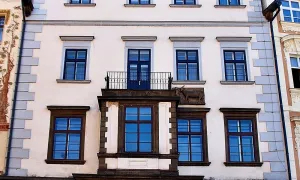
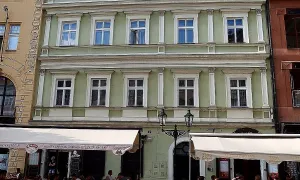
Now pay attention to the architecture itself and to what you see before you. The current form of the complex we know as Palladium is the result of the work of architects Achill Wolf and K. Pricks. Their job was to create something that would serve thousands of people a day, but at the same time respect the place they were building. The result is a combination of two approaches. On one side you can see a newly built structure that brings light, airspeed and modern functionality to space. On the other hand, the architects were able to integrate and rebuild the historical buildings of Jiří z Poděbrad barracks.
If you're going to walk inside later, I suggest you look for details that link the past to the present. One of the most important elements that has been preserved are historical ceilings in the area of the former horseman. It's a fascinating contrast. While there will be modern business spaces, offices and underground garages around you, the ceilings that once saw military horses and officers in uniforms remain above your heads. It's like a window into the past that reminds us that even in the most modern city centre, we're still standing on the foundations of history.
This complex is now defined as multifunctional for good reason. It's not just a place to shop. It is a space where trade zones, administrative offices and technical facilities are interconnected in the form of a large underground garage. The whole project was officially opened in the year two thousand seven and has since become one of Prague's most visited points.
You might find one interesting thing that carries a certain paradox. This place has gone through three completely different lives. It began as a place of absolute silence and prayer in the Capuchin monastery, continued as a place of strict military discipline and rumour of the Votai barracks, and today it is a place of constant movement, consumption and urban hustle. It's basically a mirror to the history of our city and society. From faith to army to business.
Now, if you look at the facade and feel the atmosphere around you, remember that you are standing in a place where two periods are colliding. Modern facades and internal disposition are designed to serve today's man, but in their core still warm history of Jiří z Poděbrad barracks. It is a reminder that Prague cannot only build new ones, but it can also transform old ones and give them new meaning without completely erasing its memory.
Now invited to further explore. You can enter and try to search for the mentioned historical ceilings in the riding hall, or let the energy of the modern centre consume you. Feel the contrast between what you see on the surface and what's hidden in the history of this place. I hope this brief insight into the past helped you see Palladium not only as a shopping centre but as a lively book of Prague history.
Thank you for your attention and I wish you a pleasant continuation in discovering the beauty and mystery of our city. We will say goodbye, but Prague still offers you thousands of other stories waiting to be revealed. Have a good trip.
Tips for visitors
The best time to visit Palladia is early morning or evening when there are fewer people and the atmosphere is quieter. This complex offers a unique combination of history and modernity, making it an ideal place for anyone who likes architecture.
Parking in the centre of Prague can be difficult. We recommend to use public transport or parking near the Square of the Republic. For accurate information about availability and connections, it is advisable to check the current conditions online.
When visiting Palladia, take with you comfortable shoes because exploring all its sections can be physically challenging. Also remember the camera or mobile phone for shooting, especially if you like architectural details.
Photo in Palladium offers many possibilities thanks to a combination of historical and modern elements. The best light is usually in the afternoon when the sunlight lights up the facade of a new building. For the best views, find high places inside the complex.
In the vicinity of Palladia it is possible to visit the Old Town Business House, which offers a wide range of shopping and gastronomic services. It is ideal for families with children for short rest or baths.
Businesses nearby
Do you run a restaurant, accommodation, shop, museum, rental, wellness or other visitor service near this monument? Show yourself directly to the people heading to it — this is how they will see you in the app and on the web:
Events nearby

Zdroj akcí: otevřená data měst a obcí ČR (Národní katalog otevřených dat) a kalendář akcí Národního památkového ústavu.
Nearby
Náměstí Republiky
Staroměstský obchodní dům Kotva
Accommodation nearby
Trips and activities nearby
Guided tours, tickets and activities nearby from GetYourGuide
Affiliate link: if you buy from the partner, we may receive a commission. The price for you does not change.
Search tours and activities →Themed route
Palladium (barracks) Type: Historical building Why is it worth a visit: This iconic building in the Republic Square is a symbol of industrial architecture and today serves as a cultural and commercial centre. Its massive facade and historical context make this place a unique dominant part of the Prague road.
Republic Square Type: City square Why is it worth a visit: The space right in front of the barracks offers a view of other historic buildings and serves as a key transport hub. Here you can appreciate the urban solution of the centre and the atmosphere of the capital.
Old Town Business House Type: Business house Why is it worth a visit: Although located near the Old Town, its modernist architecture and historical importance as one of the first large business houses in Czechoslovakia is worth paying attention. It represents the era of development of urban commercial infrastructure.
The route starts at the main destination, where you can see the exterior and interior of the barracks. You will then move to Republic Square to understand the location of the building in connection with the surrounding city. The last item is the Křítě department store, which complements the picture of historical Prague business and architecture. The entire route is compact and focused on architectural and historical values of selected sites.
Seasonal recommendations
Spring: In the spring season Palladium (barracks) is transformed into a place full of life and new impressions, when nature begins to come to life. The presence of light is extremely impressive; The sun's rays flow through the windows, illuminating the interior in extraordinary beauty. The atmosphere is full of hope and new beginnings, which attracts many visitors seeking peace and culture. To ensure a comfortable visit we recommend visiting a monument at dawn, which allows avoiding excessive crowds and enjoying a quiet tour. Due to the warm weather, it is advisable to dress slightly, but do not forget to wear sun glasses.
Summer: Summer brings with it long days and lively atmosphere around Palladia (barracks), where it is possible to enjoy most of the interiors under the open sky. The sun illuminates every bend of the monument, making it an ideal place for photography and relaxation on the outside areas. Although this is the most popular period for visiting, we recommend to come in early in the morning or in the evening when the crowd is relieved and you can listen more fully to history and architecture. Remember sun protection - cream with high SPF, wide hats and light clothes are necessary.
Autumn: In autumn, Palladium (barracks) is transformed into a place full of peace and a fabulous atmosphere. The colours of leaves add a unique beauty to the interior, while the soft sunlight brings fine tonality inside. This period is ideal for those who are looking for quiet and introspective experiences without excessive crowds of visitors. The best time to visit is at noon, when the light is the most beautiful and the temperature is pleasant. We recommend to dress in several layers - considering the possible cold morning and evening.
Winter: Winter Palladium (barracks) offers a unique experience where peace and quiet surround every visitor. The light turns into a warm, soft atmosphere that gives the interior magic. While opening hours are shorter due to winter conditions, the visit in this period offers a peaceful and intimate tour. We recommend visiting the memory at noon when the light is the best and the temperature is the lowest. Remember warm clothes - fur coats, hats and glass shoes are the key to comfort during the visit.
Visualizations and artistic views

The visualisations are generated by artificial intelligence and serve as inspiration.
Photos from the area
Real photos taken near the monument

Zdroj a licence jsou uvedeny u každého snímku.
Tips from visitors
No tips yet. Be the first!
Log in and add your tip.
Sources and literature
Photos: I would appreciate being notified if you use my work outside Wikimedia. More of my work can be found in my personal gall / CC BY-SA 3.0 — Wikimedia Commons. The author and licence also appear when you hover over the image.
Faktickým podkladem tohoto textu byl článek na Wikipedii, jehož autory jsou přispěvatelé Wikipedie. Článek je dostupný pod licencí CC BY-SA 4.0.
Location on the map
Příběhy a pověsti
Legendy, pověsti a příběhy spjaté s touto památkou
Fotografie návštěvníků
Zatím žádné fotografie. Buďte první, kdo přidá fotografii z návštěvy!
Log in a přidejte svou fotografii nebo hodnoťte.
Za ověřenou návštěvu v aplikaci získáte víc bodů — poznáme podle GPS, že jste na místě.
Reviews and comments