



Podhrázský mlýn Mill
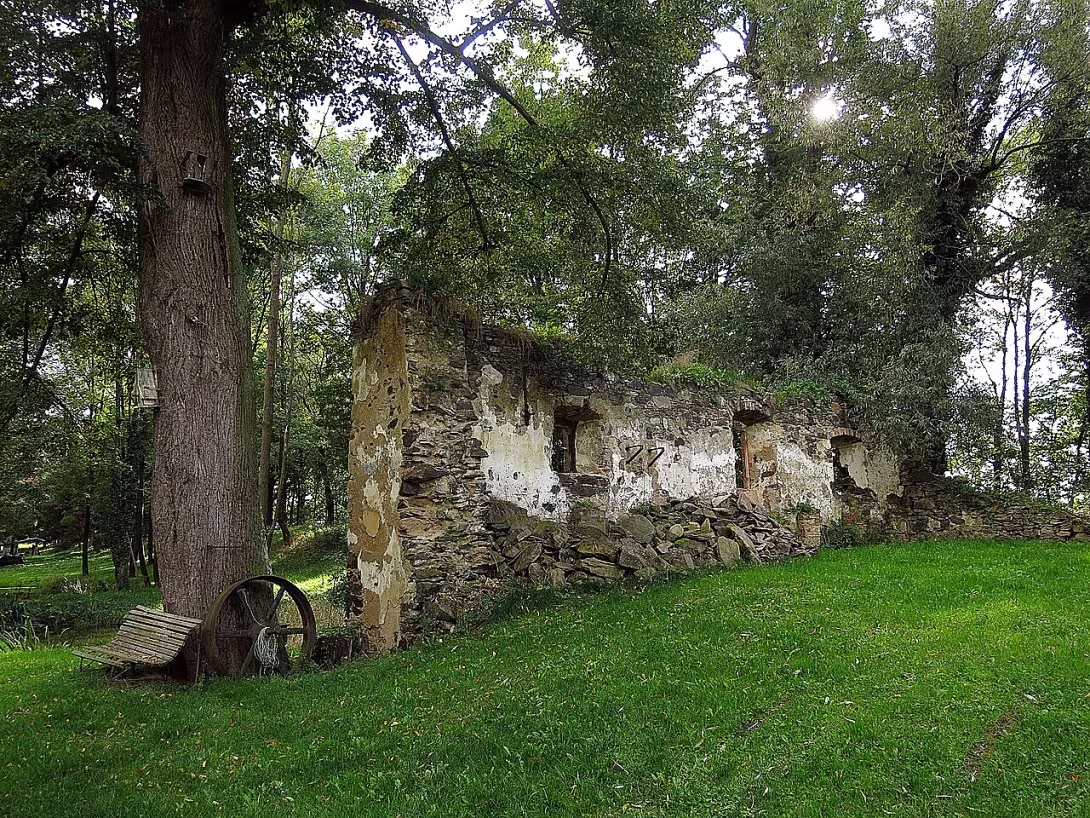
Podhrázský Mlýn, also known as Fryčův Mlýn, is a historical water mill located in Bezděkov within the Klatovy District of the Czech Republic. The ruins are situated along a field path leading to Poborovice near an unnamed stream that flows into the Úhlava River. Documented on military maps from 1764-1768, this site reflects rural milling practices of its time and was recognized as a cultural monument until 2011.
The mill's existence is confirmed by its depiction in I. vojenského mapování (Josefského) maps during the mid-18th century when Bohemia was part of the Habsburg Monarchy. This era saw extensive military and administrative mapping efforts across Europe, capturing significant sites like Podhrázský Mlýn. The detailed Josefského maps provide valuable insights into the site's historical context, highlighting its role in rural water management practices.
Architecturally, Podhrázský Mlýn was a complex of buildings centered around a courtyard. The residential building with a mill room stood on the northwestern side, constructed from mixed materials. To the east lay an agricultural wing primarily built using quarry stone, while a barn occupied the southern side. A notable feature of the site was its water channeling system, which directed water via a large embankment to concrete troughs and wheel mechanisms, showcasing historical engineering techniques.
Ownership details or specific administrators of Podhrázský Mlýn are not documented in available sources. However, its recognition as a cultural monument from 1958 until 2011 underscores its significance within the region's heritage landscape.
Today, the site stands as ruins along a field path, offering visitors a glimpse into historical milling practices and rural life. While no dramatic events or notable figures are associated with Podhrázský Mlýn in documented history, its architectural remnants provide insight into past construction techniques and water management systems. The mill's location near the Úhlava River adds to its appeal as a site of natural beauty and historical interest.
Visiting Podhrázský Mlýn offers an opportunity to explore a piece of Czech rural heritage. Its ruins serve as a testament to the region's milling history and provide a tangible connection to past practices in water management and architecture. For those interested in history, engineering, or simply enjoying the serene landscape, this site is worth a visit.
Historical milestones
- 1764-1768
- Mlýn zobrazen na vojenských mapách.
- 1958-2011
- Uznán jako kulturní památka.
Architectural development
The site consisted of a residential building with a mill room on the northwestern side, an agricultural wing to the east, and a barn on the southern side. The main structure was built from mixed materials, while the agricultural buildings were primarily constructed using quarry stone. A significant feature was its water channeling system, which directed water via a large embankment to concrete troughs and wheel mechanisms.
Historical events
The mill is depicted in I. vojenského mapování (Josefského) maps from 1764–1768, indicating its existence during that period.
Points of interest
– Despite its recognition as a cultural monument from 1958 to 2011, the specific reasons for Podhrázský Mlýn's delisting in 2011 remain undocumented. This absence of information adds an element of mystery regarding changes in historical or administrative perspectives on the site.
– The mill's water channeling system is particularly notable for its use of concrete troughs and wheel mechanisms, a detail that reflects advanced engineering techniques for its time. Such systems were crucial in optimizing milling efficiency by harnessing natural water flow, illustrating early innovations in rural technology.
– Podhrázský Mlýn’s inclusion on the I. vojenského mapování (Josefského) maps highlights its significance during a period when Bohemia was part of the Habsburg Monarchy. These maps were not only military tools but also served to document and manage resources, indicating that the mill played an important role in local infrastructure.
– The architectural design of Podhrázský Mlýn, featuring mixed materials for construction and a strategic layout with residential and agricultural wings, reflects adaptive building practices tailored to both functional needs and available resources. This adaptability is indicative of broader trends in rural architecture during the era.
– Although no specific owners or administrators are documented, the mill's long-standing presence until its recognition as a cultural monument suggests it was an integral part of local community life. Its role likely extended beyond milling, serving as a focal point for social and economic activities within Bezděkov.
Guide
This guide is narrated by a synthetic voice generated by artificial intelligence.
Show guide text
This text was created by artificial intelligence and has not been editorially reviewed. It may contain inaccuracies.
The Podhrázský Mill, also called Fryčův, is a defunct water mill in Bezděkov in the Klatovy region. Its ruins stand by a field path to Poborovic, on an unnamed stream that flows into the Úhlava not far from there. Between 1958 and 2011, the mill was protected as a cultural monument.
The mill is already depicted on the map of the first military survey, called the Josephine survey. The map was created between 1764 and 1768, and the mill on it lies to the east below the dam of the Mlýnský fishpond, which no longer exists today.
The complex consisted of several buildings grouped around a square courtyard. On the northwest side stood a residential house with a mill house, on the east a farm building, and on the south an oblong barn. The residential building was made of mixed masonry, the farm buildings predominantly of quarried stone.
The residential building was one-storey, had a rectangular floor plan and a mansard roof. Entry was through a simple entrance in the middle of the side facade, which faced into the courtyard. Behind the entrance was a space with a wooden ceiling, and beyond it a room with a barrel vault with lunettes, from which stairs led to the upper floor. The rear, southern part of the building was occupied by the mill house, which had flat ceilings on the upper floor.
The house was connected to the farm building by an entrance gate. It had a wide semicircular opening with small niches on either side. Above the arch was a low attic that ran almost across the entire width of the gate.
Water was brought to the mill from the south by a channel led along a massive embankment. It emptied onto concrete troughs, that is gutters, which directed the water onto two overshot wheels.
Tips for visitors
The best time to visit Podhrázský mlýn is during late spring or early autumn when the weather is mild, and the surrounding landscape is lush with greenery. This period offers pleasant temperatures for exploring the ruins and enjoying a picnic in the nearby fields. Additionally, visiting outside of peak tourist seasons can provide a more serene experience, allowing you to appreciate the historical site without large crowds.
For those preferring public transport, local buses serve the area, though specific routes should be checked in advance using a travel planner or app. The site's location along a field path makes it easily reachable on foot from nearby areas.
When planning your visit to Podhrázský mlýn, consider bringing comfortable walking shoes as you will likely walk across uneven terrain among the ruins and surrounding fields. A hat, sunscreen, and water are recommended due to exposure to the sun. Additionally, a camera is advisable for capturing the picturesque views of the rural landscape and historical structures.
For photography enthusiasts, the best spots at Podhrázský mlýn include areas where you can capture the contrast between the ruins and the natural beauty of the surrounding fields and stream. Early morning or late afternoon light provides a soft glow that enhances the textures of the stone ruins. The unnamed stream near the site also offers opportunities for capturing reflections and water features in your photographs.
Nearby, within 30 minutes, you can explore additional attractions such as the Úhlava River, which flows close to the mill. This area is ideal for a leisurely walk or picnic, offering scenic views and a chance to experience local flora and fauna. The proximity of Poborovice also allows visitors to discover more about the region's history and culture.
Frequently asked questions
Can the monument be visited?
This is a technical monument. Some are open as exhibitions, others are out of use or on private land. We have not verified whether this one is accessible.
What are the opening hours and admission?
We have not verified the opening hours or admission. Current information is published by the operator.
Where is the monument?
Location: Bezděkov, Plzeňský kraj. The map on this page shows the exact spot.
Why is the monument protected?
It is listed in the Central List of Cultural Monuments of the Czech Republic as a cultural monument (register no. 1000149906).
Businesses nearby
Do you run a restaurant, accommodation, shop, museum, rental, wellness or other visitor service near this monument? Show yourself directly to the people heading to it — this is how they will see you in the app and on the web:
Events nearby

Zdroj akcí: otevřená data měst a obcí ČR (Národní katalog otevřených dat) a kalendář akcí Národního památkového ústavu.
Nearby
Located near an unnamed stream that flows into the Úhlava River, the site offers a glimpse of rural Czech landscape and historical water management practices.
Accommodation nearby
Themed route
Tematická výletní trasa: Podhrázský mlýn a jeho okolí
1. Podhrázský mlýn (Mlýn) - Proč stojí za návštěvu: Tento historický mlýn je představitelem tradičního využívání vodní energie v České republice. Je umístěn u potoka, který se vlévá do řeky Úhlavy a nabízí návštěvníkům pohled na klasickou českou venkovskou krajinu i historii vodního hospodaření.
2. Potok u Podhrázského mlýna (Přírodní prvek) - Proč stojí za návštěvu: Procházka podél potoka poskytuje klidnou a odlehčující zkušenost, kde si můžete užít přírodního prostředí. Zajímavé je sledovat, jak voda proudí a jak byla historicky využívána pro pohonnou sílu mlýnů.
3. Úhlava (Řeka) - Proč stojí za návštěvu: Úhlava je klíčová část místní hydrografie a její blízkost k Podhrázskému mlýnu ukazuje na důležitost řeky pro regionální vodní systém. Je to příležitost si uvědomit, jak se voda stává životodárnou silou pro místní komunitu.
4. Lesní oblast poblíž potoka (Přírodní prvek) - Proč stojí za návštěvu: Tato lesní oblast nabízí možnost prozkoumat přírodu a uvolnit se v klidné prostředí. Je to ideální místo pro krátké procházky nebo pikniky, kde si můžete užít zeleně a ticha venkovského prostředí.
5. Výhledové místo poblíž potoka (Přírodní prvek) - Proč stojí za návštěvu: Toto místo nabízí krásný výhled na okolní krajinu a řeku Úhlavu. Je to ideální místnost pro fotografování nebo jen pro relaxaci, kde si můžete užít panoramatického pohledu a klidné atmosféry.
Tato trasa vás provede historickým i přírodním prostředím okolo Podhrázského mlýna, nabízející kombinaci kultury, historie a přírody.
Seasonal recommendations
Spring: Visiting the Podhrázský Mill during spring offers a unique experience as nature begins to awaken around this historic ruin. The surrounding landscape is adorned with blooming wildflowers and fresh greenery, creating a picturesque setting that complements the mill's historical ambiance. As daylight lengthens, visitors can enjoy more time exploring the site in natural light. It's advisable to wear comfortable walking shoes for navigating uneven terrain and bring layers as temperatures can vary throughout the day.
Summer: Summer is an ideal time to explore Podhrázský Mill due to longer days and warm weather, which enhance the beauty of its ruins amidst lush surroundings. The area becomes particularly vibrant with life, making it a popular spot. To avoid crowds, consider arriving early in the morning or later in the afternoon. Sun protection, such as hats and sunscreen, is recommended, along with plenty of water to stay hydrated during your visit.
Autumn: Autumn transforms the Podhrázský Mill into a serene and colorful haven, with foliage painting the landscape in shades of red, orange, and gold. The cooler temperatures make for comfortable exploration without the summer crowds. As daylight decreases, it's wise to plan your visit earlier in the day to fully appreciate the site under natural light. Layered clothing is recommended to adapt to changing weather conditions throughout the day.
Winter: Winter offers a quiet and atmospheric setting at Podhrázský Mill, with snow potentially adding a mystical charm to its ruins. Shorter days mean that visitors should plan their visit during daylight hours for safety and enjoyment. The site may be less accessible if heavy snowfall occurs, so checking conditions ahead of time is advisable. Dress warmly in layers, including thermal wear and waterproof outer garments, to stay comfortable while exploring the historic site.
Visualizations and artistic views


The visualisations are generated by artificial intelligence and serve as inspiration.
Photos from the area
Real photos taken near the monument

Zdroj a licence jsou uvedeny u každého snímku.
Tips from visitors
No tips yet. Be the first!
Log in and add your tip.
Sources and literature
Photos: Tlaskalv / CC BY-SA 3.0 — Wikimedia Commons. The author and licence also appear when you hover over the image.
Faktickým podkladem tohoto textu byl článek na Wikipedii, jehož autory jsou přispěvatelé Wikipedie. Článek je dostupný pod licencí CC BY-SA 4.0.
Location on the map





Příběhy a pověsti
Legendy, pověsti a příběhy spjaté s touto památkou

Fotografie návštěvníků
Zatím žádné fotografie. Buďte první, kdo přidá fotografii z návštěvy!
Log in a přidejte svou fotografii nebo hodnoťte.
Za ověřenou návštěvu v aplikaci získáte víc bodů — poznáme podle GPS, že jste na místě.
Reviews and comments