



Přádelna Karla Bienerta Factory
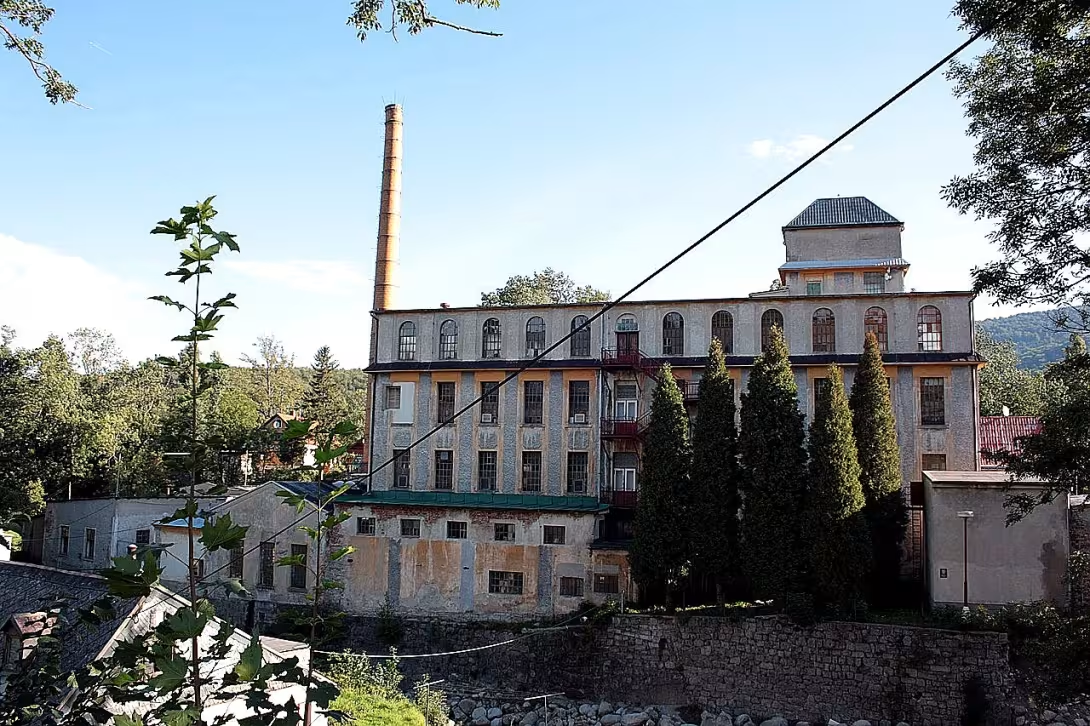
Přádelna Karla Bienerta is a former industrial enterprise in the municipality of Bílý Potok in the Frýdlanta district of Liberec. The object was used primarily for yarn production. It represents an important example of the development of the textile industry in northern Bohemia, especially in the area of export of carpet yarn to oriental markets.
The factory was built in 1852 by Ignaz Lange near the Confluence of the Sheepwater. For the needs of traffic and employees, the neighbouring guest house was converted into offices and apartments. In 1860, the Cordell brothers bought the race. It was bought from them in 1882 by the Liberec businessman Karl Bienert junior, owner of Karl Bienert & Sohn.
The original drive was a water wheel with a diameter of 10.8 meters. According to some sources, in 1884 the Cordell brothers replaced it with a steam engine of 130 horsepower. By doing so, they uncovered a lower flow rate of the River Výdé, although hydropower was still used to save coal. Karl Bienert subsequently had the building rebuilt according to plans of Josef Niesser from 1882. In 1902 there was modernization for the processing of Vigo and combed yarn. In 1907 a new water turbine with a power of 130 horsepower was installed to eliminate the need for angular transmission. In exchange, there was also a steam engine whose performance increased to 180 horsepower.
On the night of the 5th to 6th February 1913, the factory was destroyed by a fire. It was caused by the agitation of cotton dust and insufficient fire-fighting equipment, which consisted only of sands and buckets. In an accident, five workers lost their lives, in whose honor five of them are planted outside the building. While Karl Bienert planned to leave the site, his grandson Emil Bienert built the factory again for loans from Swiss banks. He used the potential to export carpet yarn to India and the Middle East.
The new construction was designed by Heinrich Ziegler from Zitava. It was created as a four-story mill with a skeleton reinforced concrete structure. The bricks from the burned-out building were used to save costs. The area includes a turbine hall at the south wall, a engine room with a boiler room in the west and a stairwell tower with a tank of 30,000 liters in the north. The tank was protected from freezing with a heat exchanger. There are warehouses north of the mill and east of the shredder. In 1926, the steam boiler of the company Breitfeld-Danek was supplemented by two Francis turbines of the Voith brand.
The object had an advanced sprinkler system. When reaching a temperature of 98 degrees Celsius, a tin mold melted in the heads, releasing water from the tank. At the same time, the water flow was powered by a small Pelton turbine that activated the fire siren. Air-pressurised pipes were protected from corrosion and freeze.
During the economic crisis in the 1930s, production was stopped. During World War II, an air radio communication device was installed for the Wehrmacht. Over 60 Russian and Belarusian prisoners of war worked in the company. There was also part of the textile production from front waste. At the end of the war, the Bienerts' daughters had been hiding in the former watershed for two weeks.
After the war, national administration was imposed on the company and Emil Bienert was postponed even though it had to repay the construction loan for 18 years. After 1948, the mill was part of the national businesses of Fry and Bytex. In 1984, the water turbine was deliberately destroyed by supporters of the Brontosaurus, who were thus trying to overcome metal collection quotas. Mykana was active here between 1990 and 2001, but it went bankrupt.
Pavel Šercl has been the owner since 2002. There is a workshop for repairs of historical technology and Jizerskomountain technical museum, which in cooperation with the Military Historical Institute presents air motors. In 2010 and 2024, the buildings were damaged by floods on the river Mědé, which subdued the supporting walls. A public collection on the Donio platform was established to repair the costs of which exceeded CZK 3 million.
This object is a unique testament to industrial flourishing and technical development in the border region. Visiting the mill allows you to look into the history of the textile industry and appreciate the architecture of early iron concrete construction.
Historical milestones
- 1852
- construction of the factory by Ignaz Lang
- 1882
- purchase of the race by Karel Bienert junior
- 1907
- installation of water turbine and production of carpet yarn
- 1913
- factory fire at night from 5th to 6th february
Architectural development
The original construction from 1852 was later rebuilt according to the plans of Josef Niesser. After the fire in 1913, Heinrich Ziegler built a new four-story mill with a skeleton reinforced concrete structure. In building a new building, bricks from a burned-out factory were used for cost savings.
Historical events
1884 installation of steam engine Ringhoffer, 1913 destructive fire factory, 1926 addition of Francis turbine brand Voith.
Owners
Ignaz Lange (1852), Cordell brothers (1860), Karl Bienert junior (1882), Emil Bienert (after 1913)
Points of interest
- The company served for the production of yarn, especially carpet for export to oriental markets. - The original drive was a water wheel with a diameter of 10.8 meters. - In front of the building, five of them grow in honor of the five workers who died in the fire in 1913. - In building a new building, bricks from a burned-out building were used to save costs. - The fire control system used a tin mold that released water at high temperature while activating the siren.
Guide
Show guide text
This text was created by artificial intelligence and has not been editorially reviewed. It may contain inaccuracies.
Welcome to the White Cove, in the heart of the Frydlant Corner. You're standing in front of a building that carries echoes of ancient industrial good and the hard work of thousands of hands. In front of you is Karl Bienerto's former mill. When you look at it today, you may see the calm of this place, but more than a century ago, this space was filled with the noise of machines, the smell of wool and the constant movement of people. It is a place that tells us a story about how Northern Bohemia has become an important centre of textile processing and how a small community has turned into a place with global reach.
Let us now return in time to understand how this journey began. It all started in a thousand and eight hundred fifty-two. It was this year that a man named Ignaz Lange built this factory. At that time, the textile industry was in bloom and the use of local conditions, especially water availability, was crucial to the success of any enterprise. Lange laid the foundations, which later allowed for a boom that is hard to imagine today. However, the company was constantly developing. The turning point was the year one thousand eight hundred eighty-two when Karl Bienert, younger, bought the race. Under his leadership, the company began to transform and expand to keep up with new technologies and increasing demand for high-quality textiles.
Now pay attention to the construction itself. Although the building was changing over the years, it still shows functionality and practicality, which was typical of the industrial objects at the time. When you look at the building, realize that its current form is the result of several stages of construction and modernization. The project involved architects Josef Niesser and Heinrich Ziegler, who had to solve not only aesthetics but mainly production logistics. Note the overall layout of the object, which should be effective for transporting raw materials and finished products. This is an example of the typical development of textile plants in our region, where architecture was subject to machine requirements.
In addition to Lange's founder, the Bienerts were the key figures that made up the history of this place, namely Karl Jr., and later Emil Bienert. These men were not just owners, but visionaries who knew where the market was going. A very important milestone was the year of the millennium when the water turbine was put into operation. It wasn't just technical news, it was an engine for a new direction of production. Thanks to this modernization, the mill started to specialize in the manufacture of carpet yarn. And here we come to a fascinating detail. This yarn was not intended only for local markets or neighbouring cities. The production of the White Potok has travelled far beyond Europe, specifically to oriental markets. Imagine the ways these threads traveled to end up in luxury carpets in the Far East. The small Czech village was thus directly connected to world trade and luxury craft.
But when you look at the building, you see not only a symbol of success, but also traces of tragedy. Let's stop for a detail that may be inconspicuous at first glance, but it carries deep sadness. Five of them grow in front of the building. These trees here are by no means a mere decoration of the landscape. They are a reminder of the events of February of the year a thousand nine hundred thirteen. The night of the 5th on February 6th, a devastating fire came to the factory. The fire at that time was the biggest enemy of textile factories, where there were flammable materials everywhere. Five workers lost their lives in this fire. Each of these five trees thus stands as a silent monument to human lives, which were sacrificed as part of industrial expansion. It is a strong reminder that every major business and economic growth has had a hard human destiny.
The interesting thing that links tragedy to a new beginning is the way the building was restored after the fire. At that time, it was not obvious to have unlimited funding for construction from completely new materials. In order to reduce the cost of recovery, the builders used bricks from the burnt-out parts of the original building. So if you look at the walls you see in front of you, you see in them the material that survived the fire. They are bricks that were once part of the older world, were cleaned of soot and ash and reassembled into new walls. It's a symbol of perseverance and the ability to start again, even if one has lost everything.
It's also fascinating to think about how the factory's drive was changing in time. Before the installation of the turbine, the drive was a huge water wheel. Imagine its dimensions, it had a diameter of nearly 11 meters. It was a colossal device that used the power of water from a local stream to stir up hundreds of rivets and weaving machines. The sound of the spinning wheel and the noise of the water must have been the dominant tones of this place for decades. The later transition to the turbine then meant greater efficiency and the possibility to expand into the production of the carpet yarn we talked about.
So you're standing in front of a building that's much more than just a bunch of bricks and mortar. It is a monument to ambition, technological progress, but also to human suffering. From Ignaz Lange to the Bienerts family to the unknown workers whose names may not be remembered today, but their work is encoded in these walls. Přádelna Karla Bienerta shows us how industry was built in northern Bohemia and how local businesses managed to become world players.
Now we invite you to take a moment to look around the building, to see the atmosphere of this place, and maybe look at the five of you again. Try to imagine the contrast between today's silence and the noise of thousands of spindles that once sounded here. We hope this short trip to history has helped you better understand the importance of this object for the whole region. Thank you for being with us, and we wish you a pleasant continuation in the discovery of the beauty of the White Potok and the Frydlant Corner. Goodbye.
Tips for visitors
The best time to visit is late spring or autumn, when the surrounding nature in the White Potoce excels beautifully and the air is fresh. We recommend that you travel by car or use available public transport to the premises of the former company, which we recommend to verify in the internet search engine.
To visit we recommend to wear comfortable shoes suitable for the field and plenty of water. Because it's an industrial object, the surroundings can be off-road. For photo lovers are the most interesting views of the architecture of the factory in the morning or late afternoon light, which will highlight the details of the facade.
During the walks, you can definitely visit the close confluence of the River Rye and Hážený creek where you can find peace and natural beauty. For families with children it is ideal to combine a tour of the building with a short trip to the water, allowing children to explore the surrounding landscape.
Frequently asked questions
Can the monument be visited?
Some buildings of this kind are open for guided tours, others serve another purpose or are privately owned. We have not verified whether and when this monument is open – please ask the operator.
What are the opening hours and admission?
We have not verified the opening hours or admission. Current information is published by the operator.
Where is the monument?
Location: Bílý Potok. The map on this page shows the exact spot.
Why is the monument protected?
It is listed in the Central List of Cultural Monuments of the Czech Republic as a cultural monument (register no. 1630335261).
Businesses nearby
Do you run a restaurant, accommodation, shop, museum, rental, wellness or other visitor service near this monument? Show yourself directly to the people heading to it — this is how they will see you in the app and on the web:
Nearby
Soutok řeky Smědé a Hájeného potoka.
Accommodation nearby
Trips and activities nearby
Guided tours, tickets and activities nearby from GetYourGuide
Affiliate link: if you buy from the partner, we may receive a commission. The price for you does not change.
Search tours and activities →Themed route
Here is the design of the thematic route:
1. Přádelna Karla Bienerta (industrial monument) - The main destination of the trip, where one can admire the unique architecture and technical heritage of the region. 2. The Confluence of the River of the Shift and Held Brook (Natural Place) - A short walk from the monument to where these two watercourses meet in a quiet environment.
Seasonal recommendations
In spring, the surroundings of the former mill awaken to life and the landscape around the White Creek green. The soft spring light highlights the details of the historical building. We recommend shoes suitable for humid terrain and light but warm layers of clothing because it can still be cold in the morning.
In the summer months the area is dominated by dense greenery and bright sun, which illuminates the facade of the object. It's the perfect time to visit in the morning before the hottest heat. Practical is to choose breathtaking clothes, a sun hat and plenty of fluids to go.
Autumn brings a colorful colour of leaves and a foggy atmosphere around the monument, which underlines the industrial character of the place. The light is golden and milder. It is suitable to wear clothes that protect against wind and waterproof shoes, as the roads can be connected to moisture.
In winter, the construction works more closely, especially if it is covered by snow and frost. The landscape is quiet and balanced with white. Warm shoes with anti-slip soles, a warm sweater and gloves are essential for comfortable field movement. The best thing is to plan the road in broad daylight.
Visualizations and artistic views

The visualisations are generated by artificial intelligence and serve as inspiration.
Photos from the area
Real photos taken near the monument

Zdroj a licence jsou uvedeny u každého snímku.
Tips from visitors
No tips yet. Be the first!
Log in and add your tip.
Sources and literature
Photos: Jan Polák / CC BY-SA 3.0 — Wikimedia Commons. The author and licence also appear when you hover over the image.
Faktickým podkladem tohoto textu byl článek na Wikipedii, jehož autory jsou přispěvatelé Wikipedie. Článek je dostupný pod licencí CC BY-SA 4.0.
Location on the map
More monuments – Bílý Potok
Show all in the municipality
Příběhy a pověsti
Legendy, pověsti a příběhy spjaté s touto památkou

Fotografie návštěvníků
Zatím žádné fotografie. Buďte první, kdo přidá fotografii z návštěvy!
Log in a přidejte svou fotografii nebo hodnoťte.
Za ověřenou návštěvu v aplikaci získáte víc bodů — poznáme podle GPS, že jste na místě.
Reviews and comments