



První nádvoří Pražského hradu Courtyard
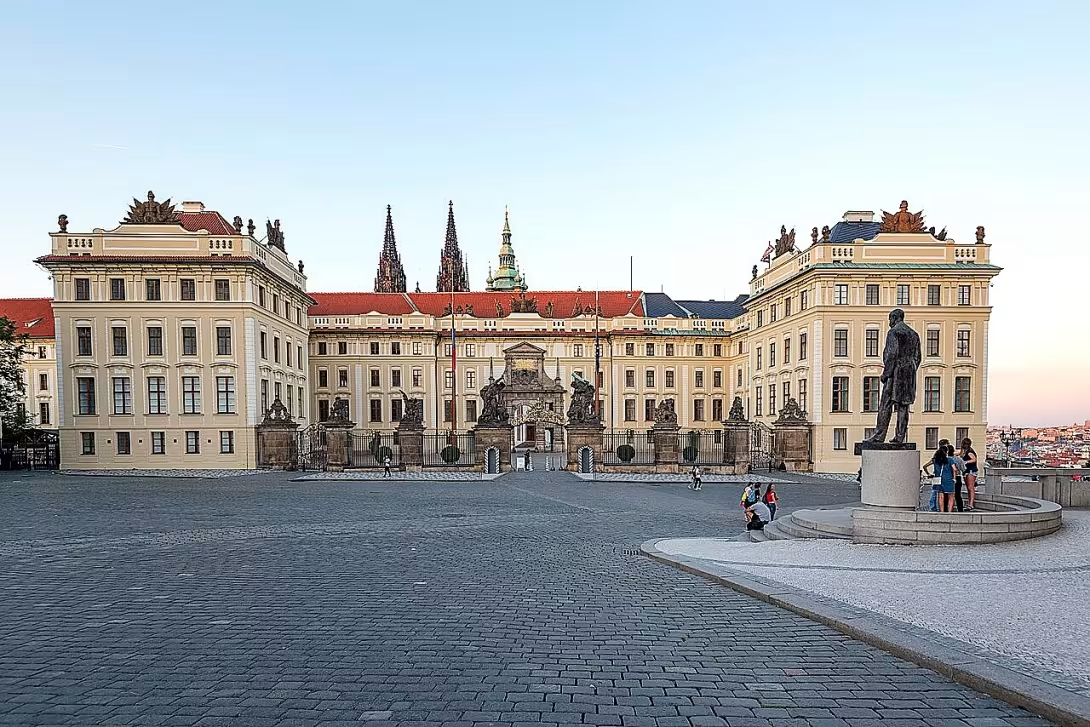
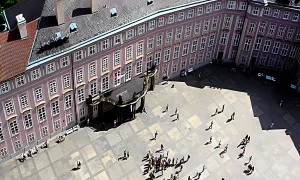
První nádvoří Pražského hradu consists of one of four courtyard in Castle and represents the main entrance space from Hradčanská Square. It is an honorary court in the form of a representative square, which welcomes visitors first by the Gate of giants with a distinctive rock grate and the sculpture of the Battle of the Titans on the pillars. From there, the road continues through the early Baroque Matthias' gate towards the Castle, on the second courtyard.
The place has a long history. In the early Middle Ages, expected around the middle of the 9th century, the castle settlement spread to the ravine that originally separated today's courtyard from the surrounding area. After the first wall fortification under Spytihrava I. (895-915), the space became part of the western front. Amicor Soběslav I. started the reconstruction of the castle into a stone castle in 1135, losing its original meaning. The area was converted into a massive fortification with two new ploughed moats. In late Gothic times, an artillery bastion was added to the south. The Rudolfin era brought a courtyard far different from the present state - the only document from that time is the preserved gate of Matthias from the beginning of the 17th century, which was lined by the house of the Supreme Chamber, a staircase to the Imperial Palace, an armory and other buildings.
Today's form was acquired by the courtyard between 1759 and 1769 during the Teresian reconstruction under the direction of Italian architect Nicolò Pacassiho. At that time it was surrounded by a newly built three-wing track and closed by an elegant lattice on the west side. The entrance wing was built symmetrically around the courtyard; Its roof is decorated with attics with statues of soldiers and military trophies from workshop I. F. Platzer. After the creation of the Republic, Josip Plečnik planned to transform the gate of Matyas, but only modifications to the surrounding buildings and new paving with flagstones were implemented.
The architectural elements of the courtyard are worth paying attention. Eight sandstone pillars form a free space - four extreme ones are fitted with a vase with putti, two neighbors carry an eagle with putti and a lion with a crown. The middle two stronger pillars support the arched attachment with the sculpture. The Rococo grate between the pillars contains two smaller gates in the outer fields. The sculpting decoration by Čenek Vosmík and Antonín Procházka was made according to the originals at the beginning of the 20th century.
The station is now fulfilling its functions. The visitors are millions of tourists per year as the main entrance to the Castle. It also serves as a venue for ceremonial welcome to official state visits and guests of the President of the Czech Republic. The castle guard provides a 24-hour guard for a pair of soldiers. Historical photographs document in the courtyard and uninvited visits to the personalities of world history. Today it is a harmonious blend of representation, history and everyday life of the centre of Czech power.
Then and now
Drag the slider to compare how the landmark may have looked when it was built with the view today.
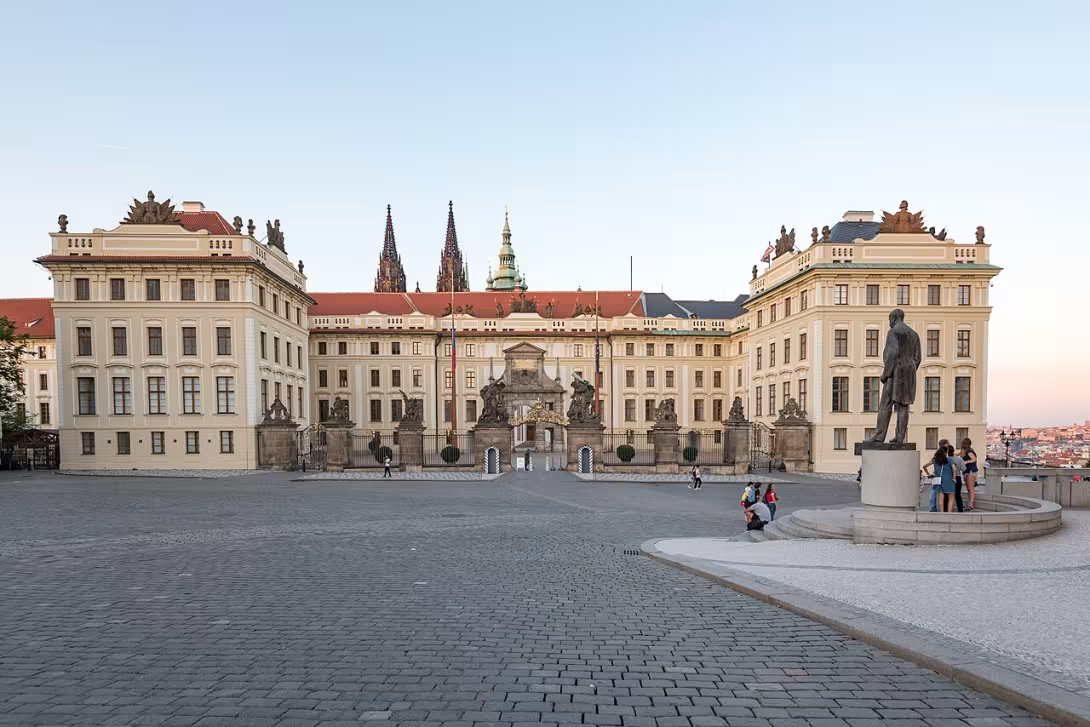
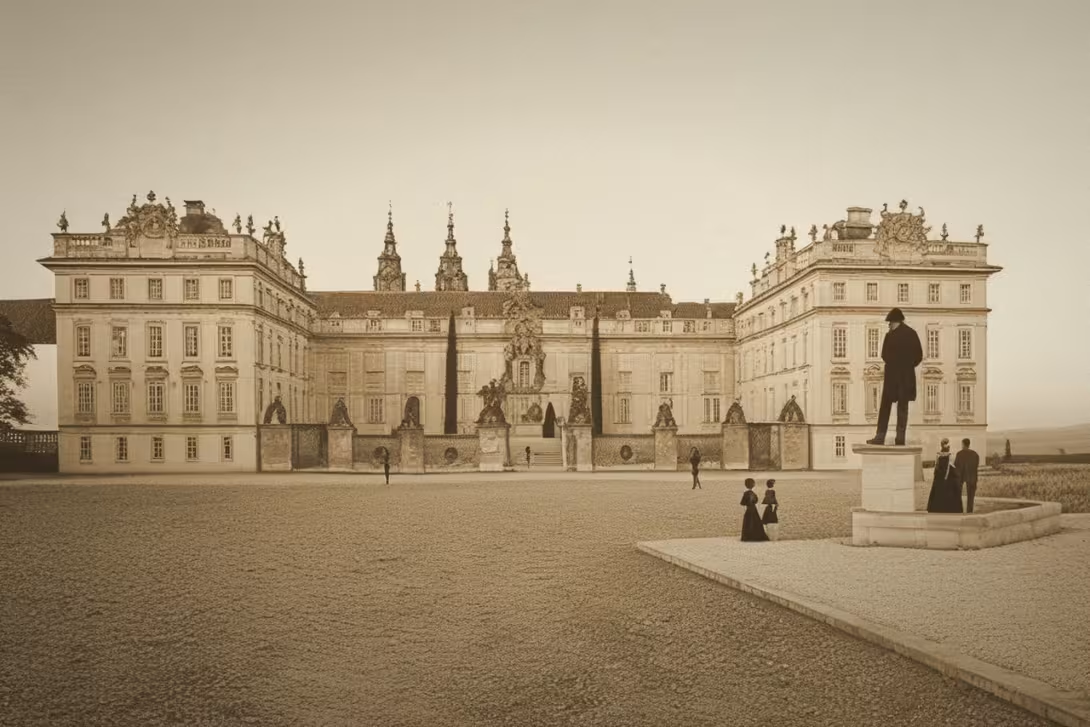
The historical appearance on the left is an AI-generated visualisation and serves as inspiration only.
Historical milestones
- around 850
- Extension of the castle settlement to the original gorge
- 895-915
- The creation of the first wall fortification under Spytihrava I.
- 1135
- Spoleslav I begins the reconstruction of the castle into a stone castle
- before 1278
- Overmind Otakar II transforms the area into a massive fortification
- early 17th century
- The creation of the Matthias Gate during the Rudolfin period
- 1759-1769
- Teresian reconstruction under Nicolò Pacassi
Architectural development
The tank gained its present form during the Teresian treatment in 1759-1769, when it was surrounded by a new track and closed with an decorative grate. An important part is the gate of Matyas from the beginning of the 17th century, which was built into the entrance wing.
Historical events
- 1939
- Adolf Hitler's admission to Prague Castle
- 1759
- Opening of the Teresian treatment of the yard of Nicolňm Pacassim
Points of interest
- The tank serves as the main entrance from Hradčanská Square and welcomes visitors to the Giants Gate. - In the early Middle Ages, around the middle of the 9th century, space separated from the vicinity of the gorge. - The current form was obtained between 1759 and 1769 during the Teresian reconstruction under the direction of Nicolò Pacassiho. - The roof of the entrance wing is decorated with attics with statues of soldiers and military trophies. - The space serves for the ceremonial welcome of official state visits and guests of the President of the Czech Republic.
Guide
This guide is narrated by a synthetic voice generated by artificial intelligence.
Show guide text
This text was created by artificial intelligence and has not been editorially reviewed. It may contain inaccuracies.
The First Courtyard is a ceremonial western entrance to Prague Castle from Hradčany Square. It takes the form of an honor court and is one of four castle courtyards. In addition to regular visitors, official state visits and guests of the president of the republic are welcomed here in the presence of the Castle Guard. They maintain a continuous honor guard at the entrance, composed of a pair of soldiers. Photographs from Adolf Hitler's uninvited visit are also well-known.
Originally, this area was separated from Hradčany Square by a ravine. The settlement of the promontory apparently reached here perhaps around the middle of the ninth century. Under Spytihněv the First, between the years 895 and 915, the first rampart fortifications were constructed and the courtyard area became part of the western outer bailey. The ravine strengthened its defense at that time. When Sobeslav the First began the conversion to a stone castle in 1135, the outer bailey ended up outside the walls and its significance declined. Přemysl Otakar the Second transformed it before 1278 into a mighty fortification with two bricked-in moats. In the late Gothic period, an artillery bastion was added to the south.
In the Rudolfian era, the courtyard had a completely different appearance. Today, only the early Baroque Matthias Gate from the early seventeenth century is visibly preserved from it. The courtyard received its present form between 1759 and 1769 from architect Nicolò Pacassi during the Theresian reconstruction of the Castle. He surrounded it with a symmetrical three-winged structure and closed it off on the west with a decorative grille. The Matthias Gate remained built in the middle of the entrance wing. The cornices on the roof are decorated with copies of figures with military trophies from Platzer's workshop.
After the establishment of the republic, Josip Plečnik wanted to close off the "Habsburg" Matthias Gate and direct the main routes elsewhere. In the end, however, only the surrounding buildings were renovated and the courtyard received new paving and flagpoles. In the southern projection of the wing is Plečnik's small glazed observation hall, where in 1996 the coffin of Olga Havlová was displayed. In the floor above it, Emperor Ferdinand the Fifth lived after his abdication, and today it is a suite for state visits. The Northern projection is used by the Castle Guard.
The open side of the courtyard is lined with eight sandstone pillars and between them is a wrought Rococo grille. The two central pillars bear the Gate of Giants with a sculptural group depicting the Battle of the Titans, the neighboring pillars an imperial eagle and a crowned lion. On the outer pillars stand vases with putti. The sculptures were created at the beginning of the twentieth century by Čeněk Vosmík and Antonín Procházka according to originals from Platzer's workshop.
Tips for visitors
Best time to visit The first splendor of Prague Castle is in the early morning or evening, when this place is less visited and offers an opportunity for quiet walks. In these hours, the sun's rays also bloom, which give historical architecture a stunning atmosphere.
Both a private vehicle and public transport can be used for access to the First List. You can check the current connection via the online search engine.
When you visit, take with you suitable shoes and clothes that allow you to walk comfortably through stone corridors. It is also important to carry an umbrella or umbrella according to the current weather and a drink drink, because in summer the courtyard can be very sunny.
The best place for photography is in front of the giant gate, especially when the sun appears behind the castle. Sunlight in the early morning or evening gives the picture nostalgic and dramatic effect. Matthias' gate is also an ideal place for taking photos, especially in sunny conditions.
Other parts of Prague Castle, such as Queen Anne's Castle and St George's Chapel, can be visited in the vicinity of the First Excellence. These places are available on foot and offer an interesting insight into the history and architecture of the castle.
Frequently asked questions
Can the monument be visited?
We have not verified whether this monument is accessible. Please ask the owner or operator, or the local municipal office.
Where is the monument?
Location: Hradčany, Hlavní město Praha. The map on this page shows the exact spot.
For kids
Imagine being a little adventurer and suddenly you find yourself in the shadow of the great wall of Prague Castle. It's a place full of secrets and beauty where every stone arch has its own story. And the best part is, all these stories start at the First Court, which seems like a door to the past.
Businesses nearby
Do you run a restaurant, accommodation, shop, museum, rental, wellness or other visitor service near this monument? Show yourself directly to the people heading to it — this is how they will see you in the app and on the web:
Events nearby

Zdroj akcí: otevřená data měst a obcí ČR (Národní katalog otevřených dat) a kalendář akcí Národního památkového ústavu.
Nearby
➜ Zobrazit interaktivní přehled okolí – restaurace, ubytování, půjčovny a další místa v okruhu 15 km.
Data: OpenStreetMap contributors, okruh 15 km.
🏰 Historické památky
- Jaroslav Vrchlický (0.5 km)
- Kolovratský palác ve Valdštejnské (0.8 km – Valdštejnská 150/4)
- Clam-Gallasův palác v Praze (1.4 km – Husova 156/21)
- Dům U Kohouta (1.5 km)
- Hlávkova kolej (2.1 km – Gorazdova 1994/9)
- Památník trolejbusové dopravy na Hanspaulce (2.7 km)
- Cihelná brána (3.1 km – V pevnosti 46/1)
- Gorlice (3.2 km)
🍽️ Restaurace a stravování
- Pizzerie U Tučňáka (2.0 km – náměstí 14. října 1)
- Restaurant River's smokelab (2.1 km – Lidická 2)
- McDonald's (2.1 km – Vodičkova 736/15)
- Legenda (2.9 km)
- Yi Xiang Ge (6.5 km)
- Pizzerie Giovanni (6.6 km – Střelničná)
- Švejk restaurant U Brázdů (6.7 km – U Svobodárny 18)
- Pizzeria Cerreto (6.7 km)
🏨 Ubytování
- The Mozart Prague (1.3 km – Karoliny Světlé 208/34)
- Old Town Jewel Apartments (1.5 km – Elišky Krásnohorské 10/2)
- Old Prague Hotel (1.6 km – Skořepka 421/5)
- Hotel AXA (2.7 km – Na Poříčí 40)
- EA Hotel Tosca (3.3 km – Blanická 718/10)
- Theatrino (3.9 km – Bořivojova 1216/53)
- Plaza Prague Hotel (4.2 km)
- Hotel Olšanka (4.2 km)
🚲 Půjčovny a sport
- Florbal expert (0.9 km)
- U Tyrše (1.0 km – Jaselská 464/38)
- JUN (2.4 km – Haškova 629/7)
- Kieser Training (2.4 km)
- Cykloservis Richard Eger (2.5 km)
- Bike Gallery (2.5 km – Kladenská 19)
- Velox Sport (2.6 km)
- Centrum volného času Botič (2.8 km)
🥾 Turistika a příroda
- Pražský hrad (0.1 km)
- Masarykova vyhlídka (0.3 km)
- Petřínka (0.7 km)
- Informační a rezervační centrum (1.4 km – Maiselova 38/15)
- Vyšehrad (3.1 km)
- Gabrielka (4.1 km)
- Šestákova studánka (5.8 km)
- Šárka (5.9 km)
Accommodation nearby
Trips and activities nearby
Guided tours, tickets and activities nearby from GetYourGuide
Affiliate link: if you buy from the partner, we may receive a commission. The price for you does not change.
Search tours and activities →Themed route
Thematic cruise route: První nádvoří Pražského hradu
1.První nádvoří Pražského hradu (courtyard) This courtyard is the oldest and most famous part of Prague Castle, known for its historical architecture. Here there are important monuments such as the Vladislav Hall and the Cřežovnická Chapel, which are evidence of the rich history of the Czech Přemyslovas.
2. St George's Chapel (Chapel) The chapel of St. George is located in the First courtyard and served as a burial ground of the Czech kings. Its Gothic interior and historic frescoes are attractive to lovers of history and art.
3. Vladislav Hall (Hall) This Renaissance hall is the largest in Prague and served as a room for the royal sitting and festive feasts. It is famous for its frescoes by Mikolas Ales, which illustrate Czech history.
4. Chapel of the Virgin Mary Snow (Chapel) This chapel is one of the oldest in Prague Castle and it served as a burial ground of the Přemyslálové family. It is known for its Gothic architectural style and historical reliefs.
5. St. Wenceslas Chapel (Chapel) The chapel of St. Wenceslas is located in the First courtyard and served as a burial ground of Czech kings. Its historical significance is that Saint Václav was buried here.
This route offers a deep immersion in the history and culture of the Prague Castle, each point connected with the rich past of the Czech Přemyslovů.
Seasonal recommendations
Spring - In the first half of spring, soft, golden light is spread over the courtyard of Prague Castle, highlighting detailed stone ornaments and flowering trees in the surrounding area. Nature wakes up, leaves turn into fresh green shades and air carries the smell of flowers. We recommend coming early in the morning when there are fewer visitors and the sun rays are pleasant but not overheated. Laminated clothing is ideal - light jacket or sweater under the umbrella if spring showers appear, and comfortable shoes on uneven stone.
Summer - In the summer months, the courtyard lights up with bright sun, creating contrasts between the shadows of the columns and the golden surface of the tiles. The surrounding gardens are full of flowering flowers and insects, which gives the place a lively atmosphere. Large crowds are piling up here in the main summer season, which is why it is convenient to arrive at the opening or late afternoon when visitors slowly disperse. We recommend light, breathable clothes, hat or sunglasses and plenty of water; It is also advisable to choose comfortable sandals with a good grip, because stone floors can be hot in the morning.
Autumn - In the autumn, soft, warm light stretches over the courtyard, highlighting golden and red shades of leaves in parks around the castle. The atmosphere is quieter, the crowds are shrinking, and the air carries the light smell of fallen leaves. The ideal time to visit is late afternoon when the sun still illuminates architecture, but temperatures are already pleasantly colder. Laminated clothes, such as a sweater under a light jacket, and firm shoes are suitable because autumn rain can cause slippery stones. Don't forget to bring an umbrella or a raincoat.
Winter - In winter, the first courtyard is covered in fine, cold light, which highlights the white snow cover and highlights historical details. It is best to arrive in the late morning when snow often melts and the light is brightest. We recommend warm, waterproof clothes, hat, gloves and tight shoes with anti-slip soles; also prepare your thermal drinks as the outdoor temperatures may be below zero.
Visualizations and artistic views


The visualisations are generated by artificial intelligence and serve as inspiration.
Photos from the area
Real photos taken near the monument

Zdroj a licence jsou uvedeny u každého snímku.
Tips from visitors
No tips yet. Be the first!
Log in and add your tip.
Sources and literature
Photos: Tilman2007 / CC BY-SA 4.0 — Wikimedia Commons. The author and licence also appear when you hover over the image.
Faktickým podkladem tohoto textu byl článek na Wikipedii, jehož autory jsou přispěvatelé Wikipedie. Článek je dostupný pod licencí CC BY-SA 4.0.
Location on the map

Příběhy a pověsti
Legendy, pověsti a příběhy spjaté s touto památkou
Fotografie návštěvníků
Zatím žádné fotografie. Buďte první, kdo přidá fotografii z návštěvy!
Log in a přidejte svou fotografii nebo hodnoťte.
Za ověřenou návštěvu v aplikaci získáte víc bodů — poznáme podle GPS, že jste na místě.
Reviews and comments