



Radegast Statue
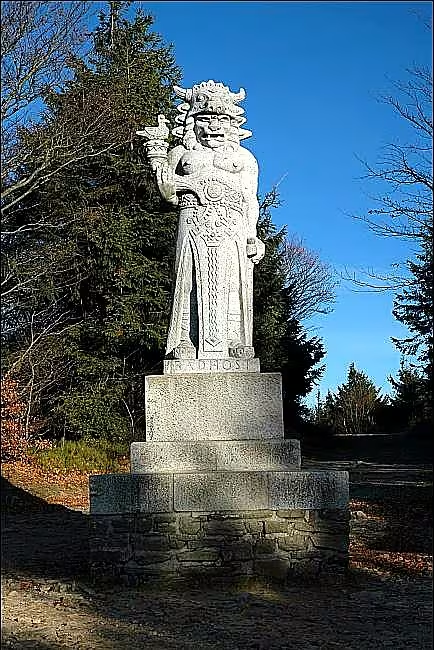
The statue of the pagan god Radegasta is a monumental representation of the sun god, abundance and crop. It stands on the ridge of Radhošt in the town of Lower Bečva. The work from 1931 was created by the academic sculptor Albín Polášek. Today it represents one of the most distinctive symbols of the Beskydy landscape.
Albín Polášek, native of Frenštát and professor of the Academy of Fine Arts in Chicago, began to work on the proposal in 1924. Originally planned to create a whole set of pagan gods from Slavic mythology. Radegast was the first and only realized of them. The final design of the statue was developed by the author in the Prague studio in Nusla around 1930. The project was created in the period of the first republic when national culture flourished in Czechoslovakia looking for Slavic roots. The implementation was supported by President T. G. Masaryk, while the funds were provided by Czech native people in America.
The statue depicts a figure with a male body and a lion's head with a smirk of the beast. He wears a helmet shaped like a bull's head with horns on it. The character is dressed in a decorated skirt with a wide waist, which closes the buckle in the shape of the sun. Underneath the skirts, the human legs stand out in the mantle. In his right hand, God holds the horn of abundance with the duck. With his left hand, he's leaning on an ax on a long stick that reminds him of the valac.
The original statue from 1931 was built in the Prague foundry of the company Maška. It was made of a mixture of concrete and granite crushes with reinforced iron skeleton. She was eight feet tall, weighing 1.4 tons. At that time two identical versions were produced under the personal supervision of the author. The first, of the white-black granite crushes, placed Radhost on the ridge. The second, in a red shade, was intended for the garden of the author who, at a later age, wanted to return to his native Beskyd. This version was hidden during World War II and later forgotten. It was found again in Prague at the turn of the 1950s and 1960s under a load of soil and leaves. Due to animal features, she was moved to the Prague Zoo in 1961. From 2014 to 2015 it passed through the restaurant and was supplemented by a missing duck.
The ceremonial discovery of the statue in Radhošt took place on 5 July 1931 during the Slavic pilgrimage. This event was organized by the Matrix Radhoštská and Pohorská unity Radhoště. The event was accompanied by tragedy. On the 4th of July, a 22-year-old Private Karel Than from the 8th Infantry Regiment was killed during the guard at the statue.
Since 1958, the statue has been listed on the list of statewide protected cultural monuments. The first extensive restaurant took place in 1980. The reason for this was severe weather effects, corrosion of the iron skeleton and lightning damage from 1938. The cracks were fixed by Olomouc sculptor Karel Horínek and his son. In 1994, however, they stated that erosion continued. It therefore decided to replace the original with a more durable replica. The original concrete object was taken to the studio in Leskovec in May 1996. On 4 July 1998, a new statue of vapenice granite was installed. It weighs 3.38 tons and measures 320 centimeters. The cost of its creation, which amounted to almost one million crowns, was paid by Nošovický brewery. The restored original was festively placed on November 6, 1998 in the hall of the town hall in Frenštát, under Radhošt.
The present statue stands approximately one kilometer southwest of Pusteven with its face turned to the top of Radhosti. The work combines the artistic vision of Albino Polášek with the mythology of Slavic ancestors and is an essential part of the Beskydy Massif. It is a place where history meets nature and therefore it is worth visiting every interested person in Czech culture.
Then and now
Drag the slider to compare how the landmark may have looked when it was built with the view today.
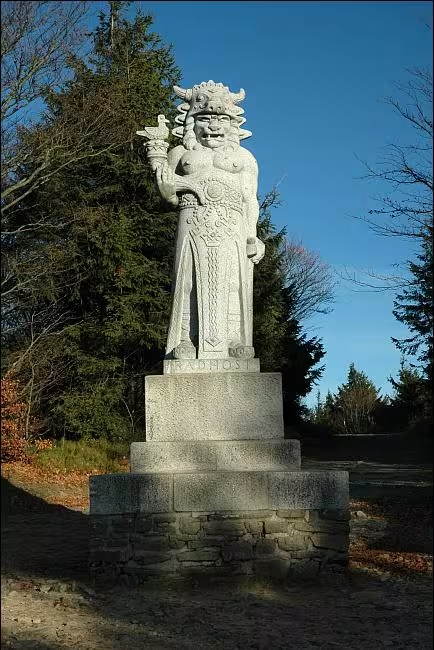
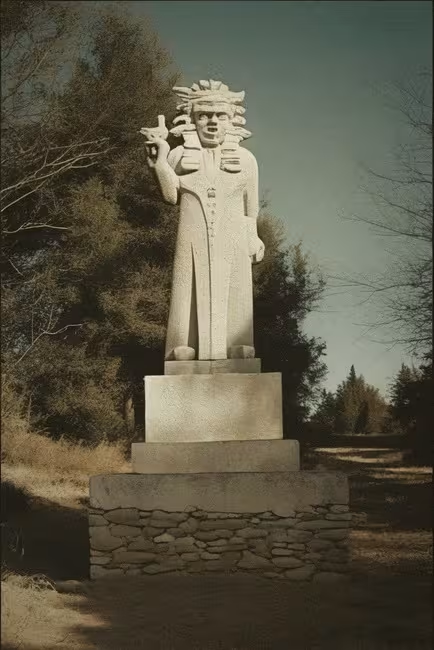
The historical appearance on the left is an AI-generated visualisation and serves as inspiration only.
Historical milestones
- 1924
- Albín Polášek starts working on the design of the statue.
- 1931
- The ceremonial unveiling of the statue on the Ridge Ridge.
- 1958
- The statue is included in the list of statewide protected cultural monuments.
Architectural development
The original statue from 1931 was made of a mixture of concrete and granite grits with iron skeleton. Due to severe weather effects and lightning damage, it was replaced by a contemporary statue of vapenice granite. The current object is 320 cm tall and weighs 3.38 tons.
Historical events
July 5, 1931: The ceremonial discovery of the statue within the Slavic pilgrimage. 1958: Writing the statue on the list of statewide protected cultural monuments.
Points of interest
The statue of the pagan god Radegast is a monumental depiction of the god of the sun, abundance and harvest. The work of 1931 was created by the academic sculptor Albín Polášek. - The ceremonial discovery of the statue in Radhosti took place on July 5, 1931 during the Slavic pilgrimage where 22-year-old Private Karel Than was killed by lightning. - Since 1958 the statue has been listed on the list of statewide protected cultural monuments and the first extensive restaurant took place in 1980. - In 1998, a new statue was installed from the Zapenice granite, the cost of which was paid by Nošovický brewery.
Guide
Show guide text
This text was created by artificial intelligence and has not been editorially reviewed. It may contain inaccuracies.
Welcome to Radhosti, one of the most famous places in Czech view, where history and mythology intersect into a unique monument. You stand before the statue of God Radegast, which is a symbol of the sun, abundance and harvest. This monumental figure greets you from the ridge of Radhošt, where a wonderful view of the surrounding landscape opens.
Let's dive into the history of this statue. In 1924 the academic sculptor Albín Polášek began to work on what would become one of the most significant works of Czech art. The statue was festively revealed on 5 July 1931 during the Slavic pilgrimage, an event full of national significance and celebrations. This day has also become a tragic experience for 20-year-old Private Karel Than, who was killed by lightning.
Look up at the statue with her male body and the lion's head with the bull's helmet. In his right hand, he holds the horn of abundance, stressing the connection between God and his power over the harvest and restoration. This detail is important for understanding the symbolism of the statue as the embodiment of solar energy and its vital influence.
Note that the original concrete version of this work was later replaced by the version of the limestone granite. This material added endurance and allowed its recognition as a state-protected cultural monument since 1958.
The key personality associated with this monument is of course Albín Polášek, the needle artistic talent and imagination have left lasting impressions on the Czech cultural landscape. This work was also linked to President T.G. Masaryk, which underlines his importance for national identity and history.
The interesting thing is that the festive discovery of the statue took place during the Slavic pilgrimage, which was an event of cultural significance. This tradition united various Slavic nations and highlighted their common heritage.
Now that you have approached the statue Radegasta, by inviting them to explore other parts of this historic place. Every angle of Radhosti offers new views and stories that will open your eyes.
Thank you for your attention and we hope that this place inspired you to explore again. Be sure the history of Radhošt has many stories waiting to be revealed. May your visit become the beginning of a deeper understanding of this rich cultural heritage.
Tips for visitors
For the best experience we recommend a visit during late spring or autumn, when nature around the ridge is the most colorful and the sun shines at an interesting angle. At these times, light is softer and ideal for observing the details of the statue.
You can reach the place by car or use public transport. Please check current information about connections and routes in available transport services or in internet maps.
If you travel with family and children, prepare to walk in nature. It is advisable to take with you enough drinking water, sofa refreshments and layers of clothing because the weather on the ridge can quickly change its character.
For photo lovers, the best moments around sunrise or sunset are when the statue creates interesting shadows. The best angles for images are located directly on the trails surrounding the ridge of Mount Radhosti.
In addition to the statue itself, you can explore nearby Pustevny or visit the village of Lower Bečva, which offer other attractions within this area.
Frequently asked questions
Can the monument be visited?
This is a structure in a public space that can usually be seen from outside free of charge. We have not verified that this particular one is freely accessible.
Why is the monument protected?
It is listed in the Central List of Cultural Monuments of the Czech Republic as a cultural monument (register no. 1000157811).
Businesses nearby
Do you run a restaurant, accommodation, shop, museum, rental, wellness or other visitor service near this monument? Show yourself directly to the people heading to it — this is how they will see you in the app and on the web:
Nearby
Hřeben hory Radhošť, obec Dolní Bečva a Pustevny.
Accommodation nearby
Themed route
1. Municipality of Lower Bečva (municipality) - The perfect place to start the journey. Here you will prepare to climb the hills. 2. Pustevny (settlement) - A famous place with beautiful architecture. It offers rest before the final climb. 3. The ridge of Mount Radhost (mountain ridge) - The elevated part of the mountain. It provides amazing views of the whole landscape. 4.Radegast (statue) - The main destination of the trip. A monumental image of a god guarding the top of the mountain.
Seasonal recommendations
In spring, the surroundings of the statue begin to turn green and the air is fresh. Light is soft and pleasant in this period to observe details. The best thing to do is to visit a place in the morning where there are fewer people around. Wear layered clothing to easily adapt to changing temperatures between morning cold and afternoon heat.
In summer, vegetation is the densest and the sun shines the strongest, creating sharp shadows. The atmosphere is full of life and heat. I recommend a visit in late afternoon, when light is golden and temperatures are more tolerable. For sun protection, take your headgear and make sure you have enough water to drink.
Autumn brings gold and brown colors to the landscape, creating a melancholy and calm atmosphere. There is often morning fog in the surroundings, which gives the memory mystery. It is advisable to carry a waterproof jacket and fixed shoes for walking on a wet surface. The best time for observation is in the afternoon when the sun shines lower and highlights the structure of the statue.
Zimą is a quiet environment often covered with snow, which creates contrasting and clean views. The light is short and sometimes sharp in this period. For the best conditions choose the time around noon when the most light is. The need is quality winter clothes, including warm gloves and shoes with good grip for possible frost or snow.
Visualizations and artistic views


The visualisations are generated by artificial intelligence and serve as inspiration.
Photos from the area
Real photos taken near the monument

Zdroj a licence jsou uvedeny u každého snímku.
Tips from visitors
No tips yet. Be the first!
Log in and add your tip.
Sources and literature
Photos: Albín Polášek (sculptor) Original autor: Semik Remove frame: Sevela.p / CC BY-SA 3.0 — Wikimedia Commons. The author and licence also appear when you hover over the image.
Faktickým podkladem tohoto textu byl článek na Wikipedii, jehož autory jsou přispěvatelé Wikipedie. Článek je dostupný pod licencí CC BY-SA 4.0.
Location on the map
Příběhy a pověsti
Legendy, pověsti a příběhy spjaté s touto památkou
Fotografie návštěvníků
Zatím žádné fotografie. Buďte první, kdo přidá fotografii z návštěvy!
Log in a přidejte svou fotografii nebo hodnoťte.
Za ověřenou návštěvu v aplikaci získáte víc bodů — poznáme podle GPS, že jste na místě.
Reviews and comments