



Radnice (Dolní Dvořiště) Town hall
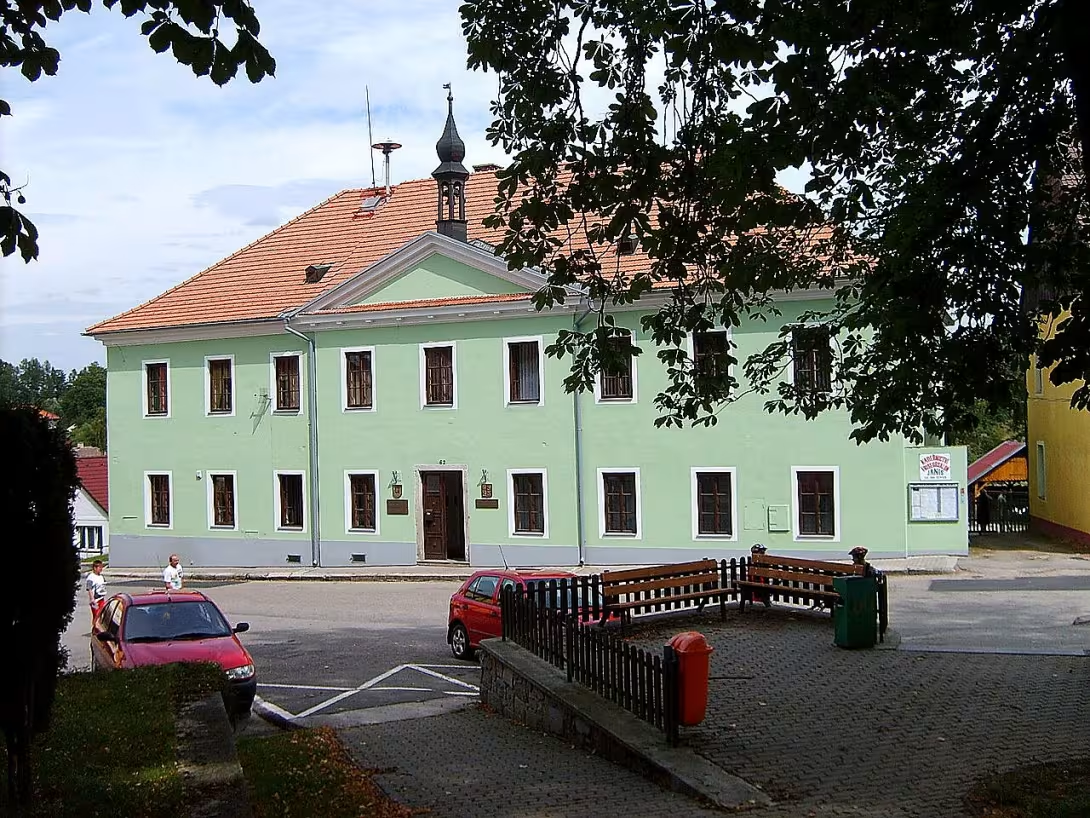
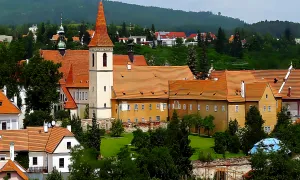
Town Hall in Lower Dvořiště, located on the eastern side of the village in the district of Český Krumlov, is a protected building no. 62. This one-story classic building with an onion turret bears witness to historical architecture and local administrative life. Its importance lies not only in the construction itself, but also in the location near the parish church of St. Gilji.
City Hall history dates back to the 19th century. Originally it was a simple, regularly divided object with five rows of windows on the main front and six on the side facade. In 1850 a significant reconstruction took place which transformed the building into a classical building. This adjustment included not only aesthetic changes, but also the extension of the site to economic buildings, probably built at the same time. In the 20th century there were other building modifications that contributed to the preservation and modernisation of the building.
Architecturally, the town hall is characterized by a classical style, which is evidenced by the regular breakdown of windows and onion turret. The original elements from the 19th century - such as the doors of several rooms on the first floor, the main entrance, arched stables, shed or granary - have remained preserved and still create an historic atmosphere. The building has a traditional tin roof, which gives the building a unique look.
Over the years, the building has become a centre of local administration; Today, the Municipal Office Dolní Dvořiště is based here. This historical whole, which accompanied several generations of citizens and officials, serves not only as an administrative seat but also as a cultural heritage of the municipality.
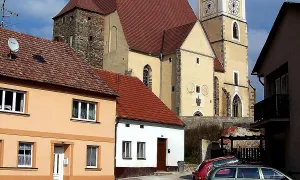
Its location is interesting near the parish church of St. Jilje, which underlines the social importance of the building in the village. In addition, maintaining the original 19th century doors and arched stables gives city hall authenticity and allows visitors to feel connected to the past.
Today, the town hall in Lower Dvořiště serves as a functional administrative centre as well as an attractive place for tourists and historians. The preserved architecture and historical context make it an important cultural monument worth visiting. Exploring this building is an opportunity to learn the rich heritage of the village and its historical importance.
The town hall is therefore not only an administrative centre, but also a living witness to local history. Its maintenance ensures that future generations can admire its beauty and recognize the history of the village. Visiting this monument is a valuable experience for anyone interested in Czech history and architecture.
Historical milestones
- 19th century
- Original existence of a simple regularly broken-down object.
- 1850
- Significant reconstruction of the building into classical style and extension of the complex.
- 20th century
- Other building modifications for maintaining and modernising the building.
Architectural development
The construction was rebuilt in 1850 into a classical style. The area consists of a city hall building and economic buildings built probably at the same time. During the 20th century there were further modifications.
Historical events
The building was rebuilt in 1850. In the 20th century, further construction work was carried out.
Points of interest
- The town hall in Lower Dvořiště is a protected building no. 62. - There is a one-story classic building with an onion turret, located on the east side of the village in the district of Český Krumlov. - Town Hall history dates back to the 19th century; in 1850 a reconstruction took place which turned it into a classical building. - The location of the building is close to St. Jilji's parish church, which underlines its social importance in the village. - The preservation of original doors and arched stables from the 19th century gives the city hall authenticity and allows us to feel connected to the past.
Guide
Show guide text
This text was created by artificial intelligence and has not been editorially reviewed. It may contain inaccuracies.
Welcome to the Lower Court. You are standing at the heart of this picturesque town in Český Krumlov district. There's a building in front of you that's a lot more to the locals than just the administration. He's a living witness to history, a place where the crucial moments of life of the entire community took place. Look around you and absorb the calm atmosphere of this place. On the east side of the village, where you are standing, the town hall is situated. It is a single-storey building, which at first glance looks harmonious and peaceful. Its regular layout of windows and characteristic onion turret create a visual dominance that attracts the view of every visitor. This building, marked with a descriptive number of sixty-two, is now the seat of the municipal office, but its history dates back to the past, when it served as the center of governance and social life. Let's move forward in time and look at the roots of this place. The history of the town hall in Lower Dvořiště dates back to the nineteenth century. Originally, it was a simple object with a regular breakdown which corresponded to the needs of the time. However, the real breakthrough came in 1850. During this period there was a significant reconstruction which turned the building into an elegant classical building. This reconstruction was not only a cosmetic treatment, but a fundamental change in the nature of the building. Part of this reconstruction was the extension of the whole complex, which led to the addition of the complex to other economic buildings. Today you can also see the shed or granary, which shows that there was not only administration, but also a practical economy that served the village. In the course of the twentieth century, there were further modifications aimed at preserving and modernising this valuable object for future generations. Now pay attention to the architectural details surrounding you. Classicism, the style to which the building has been rebuilt, manifests itself primarily in the emphasis on symmetry, simplicity and purity of the line. Notice the regular rhythm of the windows on the facade. This regular breakdown is not random, but is a sign of order and harmony that are typical of this architectural stream. Look up on the roof. There's an onion turret. This element gives the building lightness and a certain romantic mood that contrasts with the strict geometry of the lower part of the building. Onion towers were very popular in Czech architecture and were often found at city halls and parish buildings, where they also performed the function of bell tower or orientation point for citizens. Even though the names of the architects who designed or rebuilt this building have not been preserved, their work is still visible and impressive. The building is protected as a cultural monument, which means that its appearance and essence are carefully guarded to remain preserved for us and for those who come after us. Looking at this city hall, we can imagine how everyday life used to be here. Town Hall has always been a place where questions of public interest have been addressed, where birth, marriage and death have been recorded, where citizens have been meeting for meetings and where disputes have been resolved. Although the particular historical figures that were closely linked to this place are not listed in the available records, it is clear that people who formed the fate of Lower Dvořiště were going through and acted here. Every decision taken here has affected the lives of many families. We can imagine mayors, officials, but also ordinary residents who come here to the board, to the room, to the information. So this building is not only a stone structure, but also a place where the voice of history resonates. It is a place where the chronicle of the village is written, not only in writing, but also in the memory of local people who live and work here today. The interesting thing that can attract your attention is the fact that this object is historically protected under a number of sixty-two. This is not just a dry number, but a symbol of its importance in the local cultural heritage. Did you know that the Classicist reconstruction from 1850 was a relatively late phenomenon for this part of the Czech Republic? While classicism was being promoted in large cities in the first half of the century, it was only a little later in smaller municipalities, often in connection with economic development and the need to modernise administrative buildings. It was in 1850 that there were major changes in the administration, which could have been the impetus for rebuilding the town hall into a more modern and dignified building. This building is not only an aesthetic object, but also a document of administrative changes that took place in the nineteenth century. Today, when you walk around this town hall, you have a unique opportunity to connect with local history. Look at the area from different angles. Notice how economic buildings such as shed or granary are added to the main town hall building. It thus constitutes a coherent whole that reflects the economic reality of the municipality in the past. Today, the municipal office is based here, which means the building is still a living organism. Its gates open and close, people come here to do business, and that gives tradition from generation to generation. Although technology and means of communication have changed, the essence of the town hall as the center of municipal life remains the same. If you want, try to imagine what this building would look like before the reconstruction in 1850. It was probably easier, maybe with a different type of roof and without the characteristic onion turret that makes it so different today. This transformation is proof of how society's needs change and how architecture adapts to these changes. Classicist style brought to Lower Dvořiště a new dimension of elegance and dignity that is reflected in today's perception of this place. Finally, I would like to recommend that you enjoy this view of City Hall as long as possible. Let her feel her calm and dignified atmosphere. Look at the facade details, absorb the sense of history that radiates this place. And if you want, you can come back later and look at the building in another light, like at dusk, when its silhouette may seem even more mysterious. Dolní Dvořiště is a city with rich history and beautiful architecture, and the town hall is one of its most distinctive symbols. I hope this short walk around this monument has brought you new knowledge and joy. I wish you a pleasant continuation of your visit and many beautiful moments in this magical corner of our region. Let us say good-bye here, in this place where history meets the present, and watch out for the beauty that surrounds you.
Tips for visitors
The best time to visit is spring or autumn, when the weather is pleasant for walking outdoors. The building is visible from the outside throughout the year, allowing its observation at different seasons.
For best photos we recommend morning or late afternoon hours. At this time the sun will best illuminate the east side of the village, the classicist facade and the characteristic onion turret.
With it we recommend to take comfortable shoes for a walk after the bath and camera to capture architectural details of the building and surrounding environment.
In the immediate vicinity of the town hall on the village you will find the parish church of St. Jilje, which is an ideal goal to complete short walks in the centre of the village.
For families with children, a short walk around the building is ideal, during which children can observe the interesting shape of the turret and the regular layout of the windows.
Frequently asked questions
Can the monument be visited?
The building is in use (offices, a school, shops and the like). The interior is generally accessible only during operating hours and tours are not usually offered; we have not verified the details. You can see the exterior from the street.
Where is the monument?
Location: Dolní Dvořiště. The map on this page shows the exact spot.
Why is the monument protected?
It is listed in the Central List of Cultural Monuments of the Czech Republic as a cultural monument (register no. 1000152481).
Businesses nearby
Do you run a restaurant, accommodation, shop, museum, rental, wellness or other visitor service near this monument? Show yourself directly to the people heading to it — this is how they will see you in the app and on the web:
Events nearby
Zdroj akcí: otevřená data měst a obcí ČR (Národní katalog otevřených dat) a kalendář akcí Národního památkového ústavu.
Nearby
Nedaleko radnice na návsi stojí farní kostel svatého Jiljí.
Accommodation nearby
Trips and activities nearby
Guided tours, tickets and activities nearby from GetYourGuide
Affiliate link: if you buy from the partner, we may receive a commission. The price for you does not change.
Search tours and activities →Themed route
Thematic cruise route: Dolní Dvořiště
1. City Hall
Type: Historical building
Why it is worth a visit: The main aim is to explore the history and architecture of the town hall in Lower Dvořiště, which is a key element of local cultural heritage. Its construction reflects the time at which it was founded and the municipality developed.
2. Parish Church of St. Gilji
Type: Religious object
Why is it worth a visit: This church is located on a village near the town hall and offers an interesting architecture with a rich history. It is advisable to explore its interior where important artistic elements and reliefs are located.
3. Nav Dolní Dvořiště
Type: Local centre
Why is worth a visit: The naves are the living heart of the village where visitors can look at the daily life and atmosphere of the village. It is also a place to meet locals and get information about other attractions in the area.
4. Ambient street
Type: Historical architecture
Why is it worth a visit: By exploring ancient houses and buildings on the surrounding streets you can discover other historical elements that add to the overall impression of local heritage. These structures often show a characteristic architecture of the area.
5. Garden Town Hall
Type: Green space
Why is it worth a visit: If it is accessible, the town hall garden offers a quiet place to relax and explore. It is an ideal place to relax after exploring historical buildings.
This route will allow you to dive deeply into the history and cultural environment of Lower Dvořiště, focusing on the key rooms of the village.
Seasonal recommendations
Spring: During the spring period, the City Hall in Lower Dvořiště is affected by the presence of flowering trees and bushes, which gives the surrounding area color shine. Sunshine days provide ideal conditions for visiting when local nature wakes up from winter. Due to regular weather, it is a good time in the morning or evening to enjoy warm sunlight without overheating. It is recommended to dress in several layers, which allows easy adjustment according to changing temperatures.
Summer: In the summer, City Hall is dedicated to long sunny days and high temperatures. The atmosphere is full of life, when local nature is growing in intensity. Although the days are long, it is recommended to visit in the morning or evening to avoid the heat and sun in full. Clothes should be light and light, with sun protection.
Autumn: In autumn, the City Hall in Lower Dvořiště receives characteristic colours. Tree leaves turn yellow, orange and red, which gives the surroundings a unique atmosphere. Sunshine days are usually warm, but evenings get cold fast, so it is advisable to have a choice of clothes according to daily and night temperatures. The best time to visit is morning or evening when you can enjoy pleasant temperatures.
Winter: In winter, the City Hall is affected by cold temperatures and shorter days. If there is enough snow, the surroundings become quiet and quiet. Sunshine days are rare, so it is recommended to visit in the morning or in the evening when the temperature is milder. It is important to have a suitable durable suit and protection against cold in order to enjoy visits without discomfort.
Visualizations and artistic views

The visualisations are generated by artificial intelligence and serve as inspiration.
Photos from the area
Real photos taken near the monument


Zdroj a licence jsou uvedeny u každého snímku.
Tips from visitors
No tips yet. Be the first!
Log in and add your tip.
Sources and literature
Photos: Ondřej Koníček / CC BY-SA 3.0 — Wikimedia Commons. The author and licence also appear when you hover over the image.
Faktickým podkladem tohoto textu byl článek na Wikipedii, jehož autory jsou přispěvatelé Wikipedie. Článek je dostupný pod licencí CC BY-SA 4.0.
Location on the map

Příběhy a pověsti
Legendy, pověsti a příběhy spjaté s touto památkou
Fotografie návštěvníků
Zatím žádné fotografie. Buďte první, kdo přidá fotografii z návštěvy!
Log in a přidejte svou fotografii nebo hodnoťte.
Za ověřenou návštěvu v aplikaci získáte víc bodů — poznáme podle GPS, že jste na místě.
Reviews and comments