



Radnice (Nový Bor) Town hall
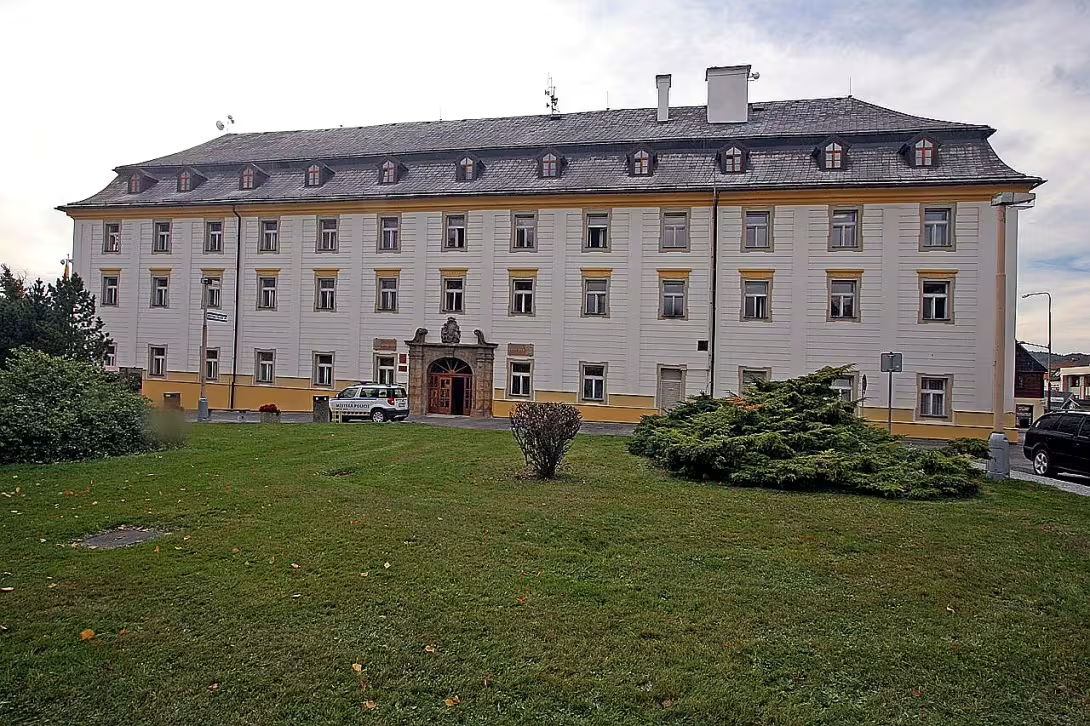
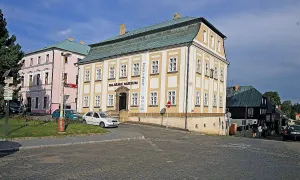
The town hall in Nový Bor is a Baroque building and the main dominant of the Square of Peace in the district of Česká Lípa in the Liberec Region. The building is registered as a cultural monument. Together with the surrounding city houses of glassmakers, they form the urban monument zone announced in 1992.
The building with the number descriptive 1 was originally created as a baroque granary of the Manor Court, which since 1710 belonged to the Colonial estate of Kinsky. The first written mention of it dates back to 1751. In 1757, Empress Marie Terezie granted, at the request of Count Josef Jan Maximilian Kinsky, the former village of Bor, which had only 21 houses, the status of a market subordinate town. Originally stand-alone construction was then integrated into the area of the newly emerging square. In the first years of development the city served partly for housing.
From an architectural point of view, it is a rectangular wall two storey building with a mansard roof. The southeast main facade has 13 window axes, and the windows on the first floor are supplemented by the mantelpiece. The main entrance portal with pilasters and a broken shield is decorated in the upper part of the Rococo Cartouche with city emblem. In the interior there are some rooms on the ground floor arched and the ceremonial hall has a valentine vault. The entrance space behind the portal has a beam ceiling. The left part of the ground corridor is finished with cross vaults and the right part with flat vaults with vaults.
Underground Baroque cellars divided into eight parts in three heights are an important part. Three of these spaces are cut directly in sandstone rock massif. The final room has a circular shape and arched ceiling. Originally, there was an underground mill, which is evidenced by a preserved circular hole in the ceiling designed to pour grain.
The ownership of the building was transferred from Kinski Manor to the city in 1821, when the granary was rebuilt at City Hall. From 1849 to 1850 it underwent further adjustments to serve as the seat of the tax, land and customs office, also the district court. Between 1875 and 1904 the town savings bank was located here and since 1893 the city museum. The city hall function for Nový Bor and the neighbouring Arnultovice building was actually filled only since 1942. From 1949 to 1960, the district and later the municipal national committee were located here. Between 1996 and 1997, the building was substantially modified as a seat of the municipal office.
The building is connected to a tragic event from June 1945. On 2 June 1945 eight German men and women from Nový Bor, Pláp and Janov were shot at the wall of the town hall without prior trial. The execution was carried out by soldiers of the 47th Regiment of the Czechoslovak Army at the order of Lieutenant Colonel Josef Sekáč, despite the opposition of city representatives.
Today, the City Hall building serves as a seat of the City Office and represents a key element of the historical core of the city. Its transformation from the mantle to the administration center reflects the historical development of New Bor. Visitors can see the authentic Baroque architecture in the context of the glass tradition of the region.
Historical milestones
- 1751
- First written mention of the existence of the granary.
- 1821
- Buying a building by the city and rebuilding it at City Hall.
- 1942
- The building began to perform the functions of City Hall for Nový Bor and Arnultovice.
Architectural development
Originally it was a baroque granary, which was rebuilt in 1821 at City Hall. In 1849-1850, the building was redesigned for the needs of the district court and other offices. In the years 1996- 1997 it underwent major modifications as the seat of the municipal office.
Historical events
In 1757, the settlement Bor acquired the status of a market subordinate town. On 2 June 1945 eight German soldiers were shot at the wall of the City Hall by the 47th Regiment of the Czechoslovak Army.
Owners
Since 1710 the Colonial Manor of Kinsky, since 1821 the City of Nový Bor.
Points of interest
The building was originally created as a baroque granary of the court. - Underground baroque cellars are divided into eight parts, three of which are cut directly in sandstone. - There was originally an underground grinder in the last round room, which shows the opening in the ceiling for the crop. - The building served at different times as a seat of the court, savings bank, museum and national committee. In June 1945, eight German men and women were shot at the city hall wall.
Guide
Show guide text
This text was created by artificial intelligence and has not been editorially reviewed. It may contain inaccuracies.
Welcome to New Bor. Right now, you're standing in the Square of Peace, and in front of you is a building that is the real dominance of this whole place. Look at her carefully. It is a town hall, a building that by its presence determines the character of the whole square and is rightly registered as a cultural monument. When you look at her today, you see the city's administrative center, but her history is much more layered than it might seem. This building began not as a seat of power, but as a place for storing grain.
Let's go back together in time deep into the past to make it clear why this building looks just like this. The first written mention of this place dates back to the year seven hundred fifty and one. At that time, it was not the town hall, but the Baroque granary of the court. So imagine that in the areas where phone calls are being made today and official meetings are being held, there was once a grain that was the basis for the survival and wealth of local people. The granary was at that time a key element of the government's economy.
But times have changed, and with them the needs of a growing city. In a thousand and eight hundred twenty one city bought the building. At this very moment, a great transformation began. The granary was converted into an administrative building, which was a crucial step in the development of New Bor. The building thus began to perform the function that we know today, although the road to the full establishment of the town hall lasted longer. This role for Nový Bor and neighbouring Arnultovice definitely began in the year one thousand nine hundred forty-two.
Now pay attention to the architecture itself. When you look at the facade and the overall design of the construction, notice how naturally different periods work together. The building combines the elements of the Baroque, which remained in it from the time of the granary, with later modifications made to the city hall. It's an architectural record of time. The whole building is part of the urban monument zone, which was announced in the year one thousand nine hundred ninety-two to preserve its unique face for future generations.
When we think about the people connected to this building, we can touch names that have left a mark in history. In the context of administration and ownership there appear personalities like Marie Terezie or Josef Jan Maxmilián Kinský. The name Josef Sekáč is also one of those associated with the fate of this place. Even if you don't see their portraits in the building today at every turn, their influence and decisions shaped what you see before you. This town hall was not just an ordinary office, but a place where the fate of thousands of people was decided, where the courts were based and where at some point the city museum found its place.
Now I want to take you to something you can't see at first sight, but what is fascinating. Imagine now you're sinking deep beneath your feet, underground. That's where one of the biggest secrets of this building is hiding. There are baroque cellars under the town hall, which are divided into eight different parts. What is truly remarkable, however, is the fact that three of these parts are not built from bricks, but are cut directly into sandstone. The sandstone is typical of this region and it required enormous effort to create space in it.
But the most interesting thing is hiding in the last circle room underground. If you were there now, I suggest you look up at the ceiling. You'll see an opening. This opening here is not even a mistake in the construction. It was used to sprinkle grain from the upper floors directly into the underground mill, which was originally here. It's a fascinating detail that reminds us of the original function of the building as granary. It is such a silent witness to the time when the rhythm of the city was determined by the grain and mill wheel, not by digital clocks and official stamps.
It's amazing how one building can change its identity. From the granary to the administration building, the courts and the museum to the present town hall. Each of these functions left an invisible mark in the building. If you look at her again, you probably don't just see her as an official building anymore, but as a layered story about people, about work and the development of the entire New Bor.
I hope this short trip to history has helped you better understand the importance of this place. The City Hall in New Bor is more than just an administrative centre, a monument to human effort and adaptability. Now invited to further explore the surroundings of Peace Square. Feel the atmosphere of this place, look at the details of the surrounding houses and be guided by curiosity. Thank you for your attention, and I wish you a pleasant journey along New Bor. Goodbye.
Tips for visitors
The best time to visit is during sunny days when the building as the dominant square excels best. We recommend arriving in the morning when natural light falls on the facade of the former Baroque granary, which will highlight the details of its architecture.
When visiting we recommend comfortable shoes for a walk around the surrounding square.
For photo lovers, the best places are the edges of the Square of Peace, from where the whole building can be seen in context with the surrounding pit. The most interesting pictures come from soft light before sunset.
In the immediate vicinity of the town hall, within short walks, you will definitely visit the Square of Peace. You will find here a number of exhibition townhouses associated with the tradition of glass making, which complement the historical character of the place.
Families with children can enjoy a common walk around the town hall and find interesting details on the facades of the surrounding houses, which helps children to better understand the history of the city.
Frequently asked questions
Can the monument be visited?
Some buildings of this kind are open for guided tours, others serve another purpose or are privately owned. We have not verified whether and when this monument is open – please ask the operator.
What are the opening hours and admission?
We have not verified the opening hours or admission. Current information is published by the operator.
Where is the monument?
Location: Nový Bor. The map on this page shows the exact spot.
Why is the monument protected?
It is listed in the Central List of Cultural Monuments of the Czech Republic as a cultural monument (register no. 1000146289).
Businesses nearby
Do you run a restaurant, accommodation, shop, museum, rental, wellness or other visitor service near this monument? Show yourself directly to the people heading to it — this is how they will see you in the app and on the web:
Events nearby
Zdroj akcí: otevřená data měst a obcí ČR (Národní katalog otevřených dat) a kalendář akcí Národního památkového ústavu.
Nearby
Náměstí Míru s řadou výstavných sklářských měšťanských domů.
Accommodation nearby
Themed route
Here is the design of the thematic route:
1. Square of Peace (urban area) - Walk begins in the center where you can admire a number of exhibition glass townhouses. These buildings are indicative of the wealth of local craftsmen.
2. Town Hall (administrative building) - The main destination of the trip, which represents the centre of the city administration and architecture in Nový Bor. It's the key point of the trip.
Seasonal recommendations
In the spring, the town hall's surroundings awaken to life and the city is flooded with a lush zielon. The soft spring light will highlight the facade details beautifully. We recommend light but laminated clothing and walking in the morning when the air is the cleanest.
In the summer months, the atmosphere of heat and bright sun dominates, which sharply illuminates architectural elements. It is advisable to visit the building in the early morning or late evening to avoid the greatest heat. Don't forget the comfortable shoes and the sun hat.
Autumn brings colorful leaves and melancholy mood to the streets. Low sun creates long shadows and pleasant golden tones that are ideal for observing the appearance of the building. Due to the variable weather, it is reasonable to carry a waterproof coat or a bee.
Zimą works in contrast with freezing air and possible snow, which gives it a cosy character. In advent time, the neighborhood is lit up and full of expectations. Hot clothing, thermal bra and fixed footwear with anti-slip soles are essential for visitors.
Visualizations and artistic views

The visualisations are generated by artificial intelligence and serve as inspiration.
Photos from the area
Real photos taken near the monument


Zdroj a licence jsou uvedeny u každého snímku.
Tips from visitors
No tips yet. Be the first!
Log in and add your tip.
Sources and literature
Photos: Petr1888 / CC BY-SA 3.0 — Wikimedia Commons. The author and licence also appear when you hover over the image.
Faktickým podkladem tohoto textu byl článek na Wikipedii, jehož autory jsou přispěvatelé Wikipedie. Článek je dostupný pod licencí CC BY-SA 4.0.
Location on the map
Příběhy a pověsti
Legendy, pověsti a příběhy spjaté s touto památkou
Fotografie návštěvníků
Zatím žádné fotografie. Buďte první, kdo přidá fotografii z návštěvy!
Log in a přidejte svou fotografii nebo hodnoťte.
Za ověřenou návštěvu v aplikaci získáte víc bodů — poznáme podle GPS, že jste na místě.
Reviews and comments