






Rokitanského 4 House
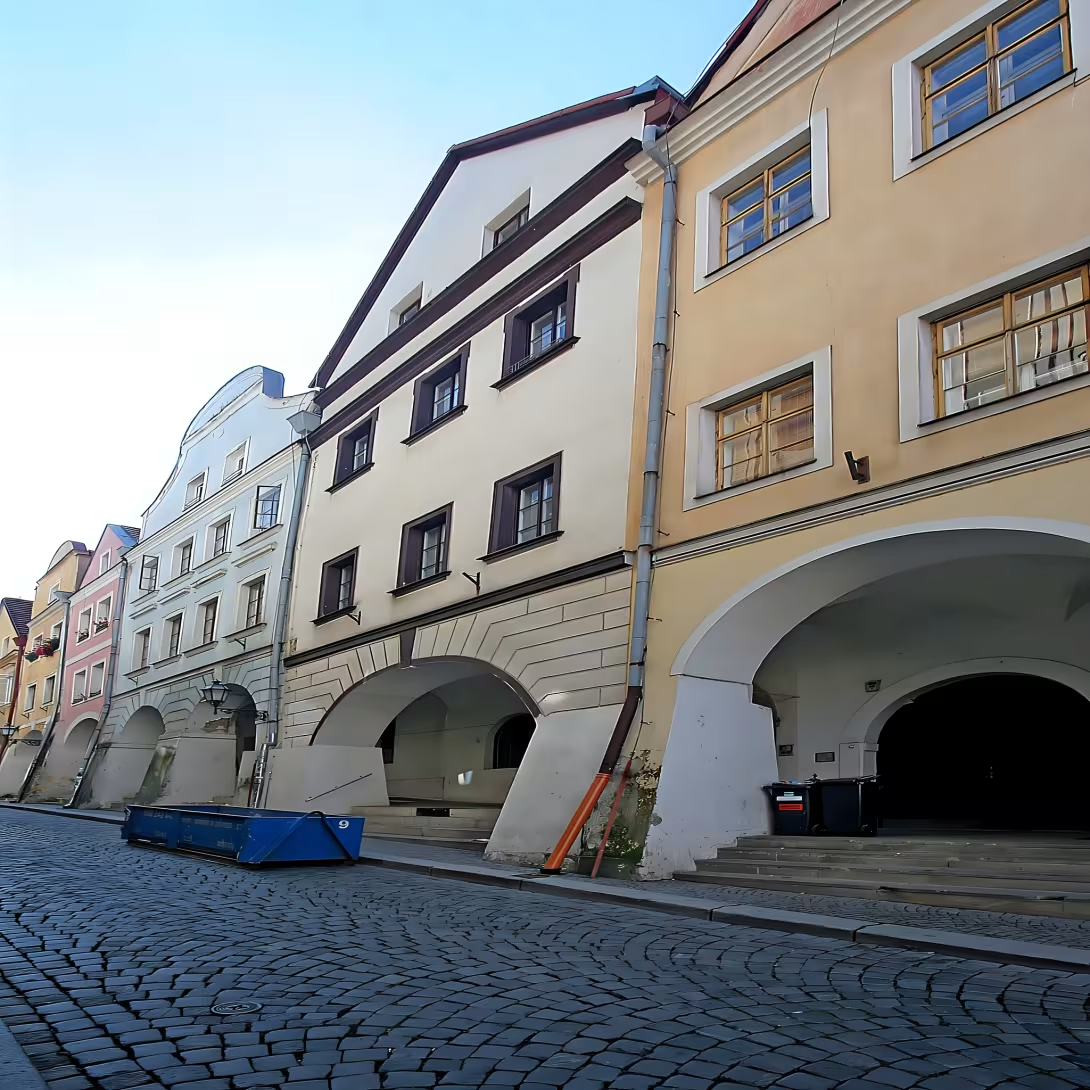
The house in Rokitanský Street in Hradec Králové is originally a Gothic township building that underwent a major Renaissance reconstruction in 1570. The monument is remarkable by its architectural development and by the fact that the strength builder Antonín Kermer was born here.
The oldest history of the building is evidenced by its Gothic roots, which reflected the boom of medieval craftsmanship and trade in Bohemia. In 1570, the construction was significantly rebuilt in the spirit of the Renaissance, which corresponded to the expansion of humanism and modernisation of urban architecture.
The three-storey terraced house is on a narrow parcel and is finished with a saddle roof with shields. The main facade in the parterre consists of an arc arch with concrete supports, while the ground floor is decorated with a rustic imitation of a jeweller. The facade is triple; The windows are equipped with post-date robes and profiled shambles. The original storey Renaissance shield from the 16th century was not preserved, but it was replaced by a triangular shield with two windows in the atice. The original Gothic valences of vaulted cellars were preserved in the interior, and on the ground floor rooms with vaulted vaults and lunettes.
In 1790 she was the owner of Anna Hubrin and in 1806 Anna Koželuho, which may be the same person after the remarriage. The house was subsequently owned by František Lhota in 1826 and by František Stein in 1854. After 1867, it was inherited by Stein's widow and sold to Zutchkova; In 1891, she was the owner of Marie Součková. After 1894 the house was owned by the Höllige family, which operated the bakery here. In the 1930's, Václav Košák ran a bakery and a colonial shop here.
An important event was the birth of Fortress builder Antonín Kermer, son of architect František Kermer, on 26 June 1753. The specific feature of the house was that during the course of its history it always had a very dangerous right.
In 1964, the building was entered in the list of cultural monuments. After the transfer to state ownership in 1966, the reconstruction started due to the impending withdrawal, which was not completed in full for financial reasons. In 1992 the historical appearance of the main entrance was restored and the passage to the neighbouring house No. 72 was sealed. Since 2010, the house has been divided into residential units with several owners, with the burden of carrying it freely in the arch.
This monument represents an authentic section of the urban development of Hradec Králové from goth to the present. It is a valuable testament to the craft tradition and architecture that deserves a personal tour.
Historical milestones
- 1570
- significant renaissance reconstruction of the house
- 1753
- birth of strength builder Antonín Kermer
- 1964
- registration of the property in the list of cultural monuments
- 1992
- restoration of the main entrance to the building in historical form
Architectural development
The original Gothic house was remodeled in 1570. The interior preserved gothic valences vaulted cellars and the ground floor vaults with lunettes. The original Renaissance shield was replaced by a triangular shield with windows in the atice.
Historical events
1753 birth of Antonín Kermer, 1964 entry to the list of cultural monuments, 1966 transition to state ownership and start of reconstruction, 2010 sale of the house by housing units.
Owners
1790 Anna Hubrin, 1806 Anna Koželuhová, 1826 František Lhota, 1854 František Stein, 1867 widow Steinova and subsequently family Souček, after 1894 family Höllige, 1930's Václav Košák.
Points of interest
- The house is originally a Gothic townhouse, which underwent a Renaissance reconstruction in 1570. - Here was born strength builder Antonín Kermer on 26 June 1753. - During his history, he always had a war law. - He was listed as a cultural monument in 1964. Since 2010, the house has been divided into residential units with several owners.
Guide
Show guide text
This text was created by artificial intelligence and has not been editorially reviewed. It may contain inaccuracies.
Welcome to the heart of Hradec Kralove. You're standing in front of one of those houses that makes up the real soul of this historic city. There's a building in front of you at Rokitanski Four. Even though this building is mainly used as a private apartment space today, its walls contain traces of centuries and dissenting prints of different times. Feel this atmosphere, feel the silence of the historic streets surrounding you, and try to look at this building not only as an ordinary house, but as a living witness to history, which has stood firm here for centuries.
To understand what you're seeing, we need to go back deep into the past together. The roots of this house go back to the Gothic era. Imagine a town back then whose face was completely different from today's, but at the very beginning it formed a solid structure from which this house grew. However, a major breakthrough in his life occurred in 1570. That's when the building went through a massive Renaissance reconstruction. This transformation was crucial because it was during this period that the urban architecture began to change, became more representative and brought new shapes and ways of using space. This Renaissance layer added its present character to the house and turned it into an important part of the urban development.
Now pay attention to the architecture itself and the way in which the various epochs intersect. Although we do not know the names of the particular architects who have worked over this construction in the past, their work is evident in the overall influence of this townhouse building. Notice how the house is trying to preserve its historical integrity despite all the changes it had to face. It is important to mention that this building is not just an ordinary house, but is protected as a cultural monument since the year one thousand nine hundred sixty-four. This means that any change to it must be carefully planned in order to preserve its historical value. Pay particular attention to the main entrance to the building. He was subjected in the year of nineteen hundred and two to a thorough reconstruction, in which he was returned precisely to his historical form. This work allowed the house to continue to work as it should look in this historic centre and to keep its appearance consistent with the surrounding building. Now look at the facade and try to imagine how the shadows of the past century reflected in it.
Now let's move from the building itself to the people who defined this place. History is not only about stones and painting details, but above all about the stories of the people who lived, worked and dreamed in these areas. One of the most important inhabitants of this house was a man whose name is one of the important figures in the history of engineering and construction. It was Antonín Kermer. He was born here, in this house, on twenty-six June in the year one thousand seven hundred fifty-three. Kermer was no ordinary citizen; He was a major strength builder. His expertise and abilities, which he built, later appeared in his work on strategic construction works, which was essential for the defence and stability of the former forts. It is fascinating to imagine that it was in these rooms that you see now that the life of a man whose engineering talent later influenced the architecture of military objects began. This house thus serves as a place of birth of a man who has become a symbol of technical skill and expertise.
We have one more interesting thing for you that may surprise you and help you better understand the social position of this place. Do you know that this house was not only a habitable space in the past, but also a strong economic and social position? During his rich history, the house always had a right to war. This is a very important detail in the context of the city at that time. The law of war meant that the owners of this house were authorized to make their own beer. At the time, it was not only a question of making drinks, but above all a symbol of status, wealth and a certain degree of independence within the urban hierarchy. Imagine the busy life that was inextricably linked to this right, and the economic significance that the house had for the whole neighborhood. So this house was not just a quiet home, but a living centre that had its own strength and influence.
This building is such a valuable witness to history that its protection was necessary to preserve the memory of Hradec Kralove's past. Since the year one thousand nine trăm sixty-four has been included in the list of cultural monuments, which confirms its irreplaceable role in our history. It is proof of how important it is to preserve our heritage so that future generations can stand in front of these walls and feel the same wonder that you feel right now.
We hope that this brief insight into the past, which we have shared together, has captured and inspired you. Please continue to walk these historic streets and let yourself be carried away by the beauty and mystery of Hradec Kralove. Every next step can welcome you with a new story, a new monument or a new detail that will reveal the secrets of this city. Thank you for your time and for coming with us on this short journey through time. We'll wait you out at the next historical monument. Goodbye.
Businesses nearby
Do you run a restaurant, accommodation, shop, museum, rental, wellness or other visitor service near this monument? Show yourself directly to the people heading to it — this is how they will see you in the app and on the web:
Nearby
XXXHistorical monuments (335)
- P. Stanislav Vydra (Cordatus Bohemia) 0.0 km
- Josef Liboslav Ziegler 0.1 km
- White Tower 0.1 km + 420734711142 web
- Karel Rokitanski 0.1 km
- Judr. Josef Tausik 0.1 km
- Klara Tausik 0.1 km
- Marian Columns 0.1 km web
- House "The Spuds" 0.2 km
- Former Jesuit Seminar 0.2 km
- Petrof muse 0.2 km
- Jesuit track 0.2 km
- Church of the Assumption P. Marie 0.2 km
- Ophelia 0.2 km Klicperova
- Museum of Eastern Bohemia 0.2 km
- Memorial to fallen legionaries of Prokop the Great's 4th Rifle Regiment. Jan Gayer (1885 - 1918) 0.2 km web
- Museum of Eastern Bohemia in Hradec Králové 0.2 km
- Gallery of Modern Art 0.3 km
- Museum of Czech Pharmacy 0.3 km Grand Square 29 / 39
- Havl dvoorče 0.3 km
- Olga Beran 0.3 km
Restaurant and catering (398)
- Chroast 0.0 km
- Battalion U Draku 0.1 km V Hill 163 + 420 775 944 026 web
- Pizza Luigi 0.1 km web
- Grill Bench 0.1 km
- Brewery Gate 0.1 km V Hill 5 + 420 602 500 848
- Sachi 0.1 km
- Fika. 0.1 km
- U stolu 0.1 km
- Kebab and Burgers 0.1 km
- Pizza Rio Grande 0.1 km
- Murloc Lounge 0.1 km
- Alen Bakery 0.1 km Large square 165 / 2
- Döner Kebab Istanbul 0.1 km
- Cross CaffexZ7ZX 0.1 km V Hill 2 + 420 778 481 797 web
- Psi bouda 0.1 km
- La Caffé 0.1 km V Hill 81 + 420 777 345 531 web
- Kasumi 0.1 km
- X-treme 0.1 km
- Hendrix Caffé 0.1 km Large square 153 / 9 + 420 491 611 402 web
- Cup Bab Korean Bistro 0.1 km Large square 153 / 9 + 420 608 812 259 web
Accommodation (52)
- Hotel Pod Turrets 0.1 km
- Hotel Grand 0.1 km + 420 491 514 999 web
- Hotel District House 0.1 km Palacký 6 + 420 495 054 300 web
- U Czech Crown 0.2 km
- New Adalbertinum 0.2 km Large square 32 / 40
- Hnezdo sásásá 0.3 km + 420608024616 web
- Hotel Stadion 0.3 km web
- Hotel U Queen Elishka 0.4 km Small Square 117 / 10 + 420 495 518 052 web
- Guesthouse Amatka 0.4 km Small square 120 / 13 + 420 606 776 795 web
- Teresian Court 0.5 km + 420495505111 web
- Hotel house Academic 0.9 km + 420 495 511 175 web
- Guesthouse Pupendo 1.2 km
- Guesthouse MAR 1.3 km
- Chernigov 1.3 km
- Kolotyuk 1.5 km + 420 774 716 339 web
- Alessandria 1.7 km
- Guesthouse - Hostel U Mlejna 1.7 km Zoblock 261 / 19
- Hertz 1.9 km Kydlinovská 335 / 46a
- Sasanka 1.9 km web
- Stulík 1.9 km web
▶ Rental and Sport (167)
- Nextbike 0.1 km web
- Nextbike 0.1 km web
- Nextbike 0.2 km web
- Kostka 0.2 km
- Nextbike 0.3 km web
- Nextbike 0.3 km web
- Nextbike 0.3 km web
- Winter Stadion 0.3 km
- Nextbike 0.3 km web
- MOJEKOLO 0.3 km
- Nextbike 0.3 km web
- Sokol 0.4 km
- Cyclospecialities 0.4 km
- Nextbike 0.4 km web
- Hudy Sport 0.5 km
- Nextbike 0.5 km web
- Equestrian equipment 0.5 km
- Nextbike 0.5 km web
- City Spa 0.5 km
- Swimming Pool 0.5 km
© Tourism and Nature (200)
- Town Hall 0.1 km
- Přecholek batarda 0.3 km web
- Žižek sets 0.3 km
- Corridor 0.5 km web
- Kavcí sláče 0.5 km
- Jirask sets 0.5 km
- Přecholek batarda 0.5 km web
- remains of the pontoon bridge 0.5 km web
- XZ1Reinforced pavements 0.6 km web
- _ 0.7 km web
- Sets architect Lisky 0.7 km
- Square Václav Havla 0.7 km
- ŠIMKOV Sady 0.8 km
- Sets architect Lisky 0.8 km
- Kubišt sets 0.8 km
- Vošek sets 0.8 km
- Vila Václav and Luisa carpentry 0.9 km web
- Park Glass 1.0 km
- Borders of the strength 1.0 km web
- Bidl park 1.1 km
Accommodation nearby
Themed route
Route: Walk around Rokitanského 4 in Hradec Kralove
This short thematic route focuses exclusively on the main objective and its immediate surroundings, since no other specific places to supplement are listed in the given base. The aim is a detailed examination of the site and its premises.
Rokitanského 4 Type: Main objective / Memory Why is it worth a visit: This is a key point of the whole cruise route, which offers a unique view of local architecture and history. Visitors can enjoy the specific atmosphere of this place and get detailed information about its importance within the village Hradec Králové.
Tanks and input area Type: Part of the main objective Why is it worth a visit: The immediate surrounding of the building often hides attractions that are invisible from the street. The courtyard tour allows you to better understand the spatial relations and aesthetic elements that complement the main object.
Internal exposure or interior space Type: Part of the main objective Why is it worth a visit: If the object is accessible from the outside, there is an opportunity to look inside and discover details that enrich the overall experience. The interior can reveal other layers of history and artistic elements associated with this location.
Park or green area near the building Type: Part of the main objective Why is worth a visit: Green spaces around the sights provide a quiet place to relax and reflect. They also offer an ideal background for photography and allow you to enjoy the natural elements right in the centre of interest of the route.
Ambient walkways and pedestrian zones Type: Part of the main objective Why is it worth a visit: Walking along the surrounding sidewalks allows you to gain a wider perspective on the location. It allows you to notice tiny details in the surroundings that could escape attention on a quick pass.
This route is designed to fully explore all aspects of the main destination and its immediate surroundings without leaving the site. Emphasis is placed on detailed observations and experiences from a place that is the only listed point in the background.
Seasonal recommendations
Spring - In the spring days, the town green blossoms around the monument and the sun rays gently highlight the historical details of the stone facade. The morning hours before 60 are the quietest because the locals don't like to go for walks yet. We recommend a light jacket and comfortable shoes because weather variability can bring a cooler breeze. Weekends are slow to visit, but on working days you can expect smaller crowds.
Summer - In the summer months the sun illuminates the stone wall into golden tones and the surrounding trees provide a pleasant shade. In the main summer season the traffic increases, therefore it is advisable to arrive early in the morning, preferably around eight o'clock when it is still cold and the crowd is smaller. We recommend sunglasses, a hat and light clothes, but also a bottle of water because temperatures can be high. The number of tourists and waiting times may increase in the afternoon.
Autumn - Autumn light brings warm orange and red shades to the sights that highlight the texture of old bricks. Leaf falling from surrounding trees creates a romantic atmosphere that is ideal for photography. In this period the crowds are milder, but rainy days appear more frequently; so pack a waterproof jacket and tight shoes. The best time is noon to afternoon, when the sun stands below and the lighting is softer.
Winter - The winter season surrounds the memory of quiet snow and cool, clean air, which underlines the historic atmosphere. Opening hours may be shortened, so it is reasonable to check the current operating hours before visiting. Dress warm - laminated clothing, hat, gloves and tight shoes with anti-slip sole, as the pavement can be slippery. The best time is the morning when the light is bright and the crowds are the smallest.
Visualizations and artistic views

The visualisations are generated by artificial intelligence and serve as inspiration.
Photos from the area
Real photos taken near the monument

Zdroj a licence jsou uvedeny u každého snímku.
Tips from visitors
No tips yet. Be the first!
Log in and add your tip.
Sources and literature
Fotografie: Petr1888 / CC BY-SA 3.0, rozlišení zvýšeno umělou inteligencí — Wikimedia Commons. The author and licence also appear when you hover over the image.
Faktickým podkladem tohoto textu byl článek na Wikipedii, jehož autory jsou přispěvatelé Wikipedie. Článek je dostupný pod licencí CC BY-SA 4.0.
Location on the map
More monuments – Hradec Králové
Show all in the municipality
Příběhy a pověsti
Legendy, pověsti a příběhy spjaté s touto památkou
Fotografie návštěvníků
Zatím žádné fotografie. Buďte první, kdo přidá fotografii z návštěvy!
Přihlaste se a přidejte svou fotografii nebo hodnoťte.
Za ověřenou návštěvu v aplikaci získáte víc bodů — poznáme podle GPS, že jste na místě.
Reviews and comments